How to Prepare for the LSESU Essay Competition: Self-Study vs Coaching, the Rubric & a 16-Week Roadmap (2026)
There are two honest ways to prepare for the LSESU Economics Society Essay Competition: self-study and coaching. Both can produce a strong entry — the difference is whether you want structure and feedback on your argument, or prefer to write it alone. This guide does not start by selling a course. It breaks the competition down to its real demands — the five set questions, the 100-point rubric, and the 1,500-word argument — and shows what good preparation looks like even if you self-study.
First, know what you are preparing for
A competition essay is not a school essay. It is judged by a published rubric, and that is why the preparation is specific:
| Demand 1 · The five set questions | You answer one of five questions, each tied to an LSE academic’s field. Choosing well, and reading around it, is half the work. |
| Demand 2 · The 100-point rubric | Originality (25), relevance, clarity, structure, referencing and argument depth. You are scored on how you argue, with Harvard referencing and an AI-screening threshold. |
| Demand 3 · 1,500 words, one argument | A tight word limit means a single, defensible thesis — no room to wander. The open-ended argument is the hardest part to self-assess. |
Reading economics and building a marked-rubric argument are different skills. Settling whether your gap is the idea or the argument’s structure is the single most useful thing to do before choosing self-study or coaching.
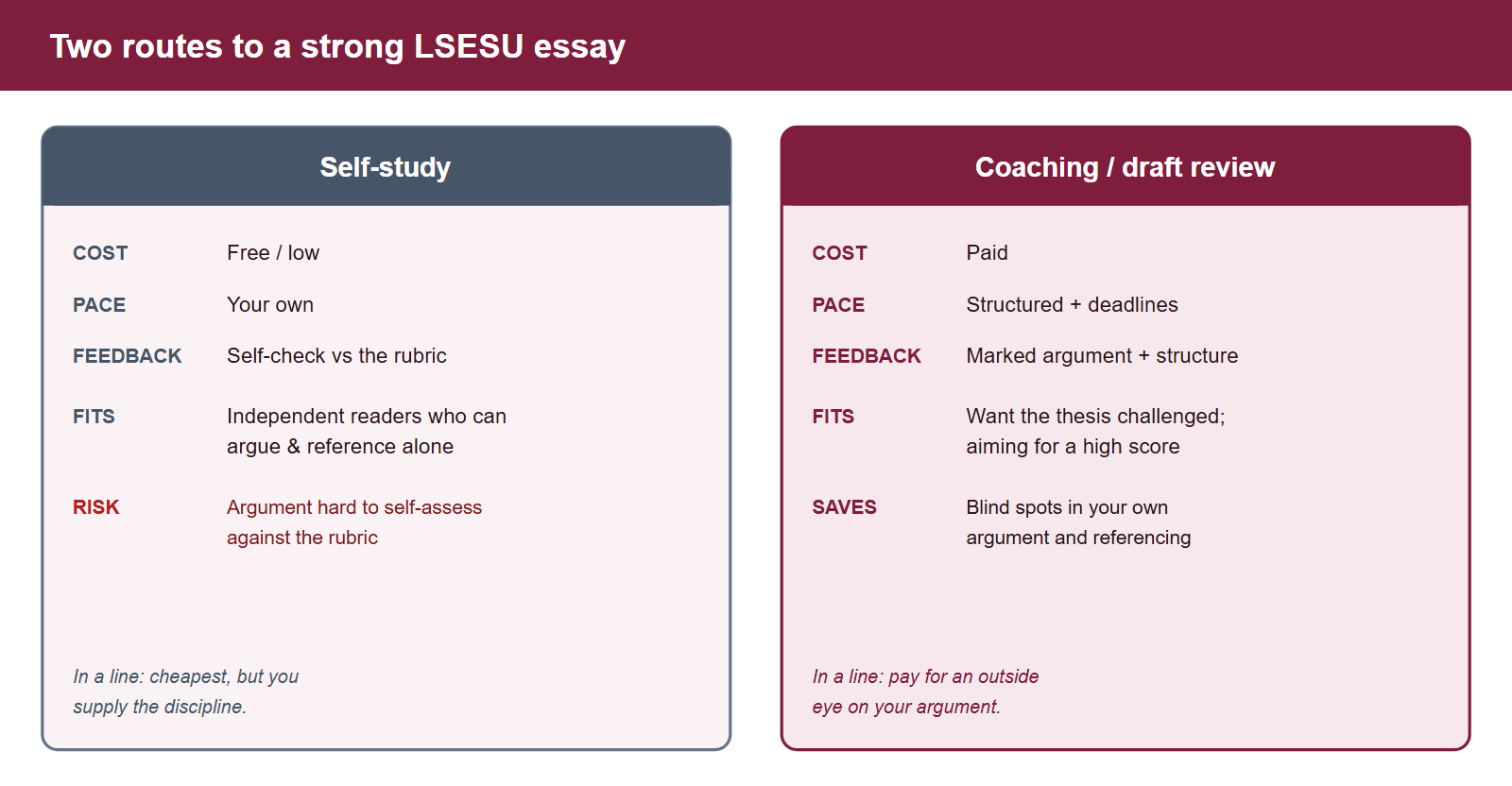
Self-study vs coaching: how to choose
An honest test: if you read economics widely, can build a clear thesis, and reference properly, self-study is genuinely viable — a strong independent writer can score well. If your gap is seeing your own argument’s weaknesses — the thing every writer is blind to — then an outside eye is what moves the needle. A structural draft review is often the highest-leverage help: not writing it for you, but showing where the argument sags against the rubric. Students aiming for a top score usually gain most from this single round of expert feedback.
The four-phase roadmap below works for both routes: self-studiers follow it; coached students use it to check a program covers each phase.
A four-phase roadmap (~16 weeks)
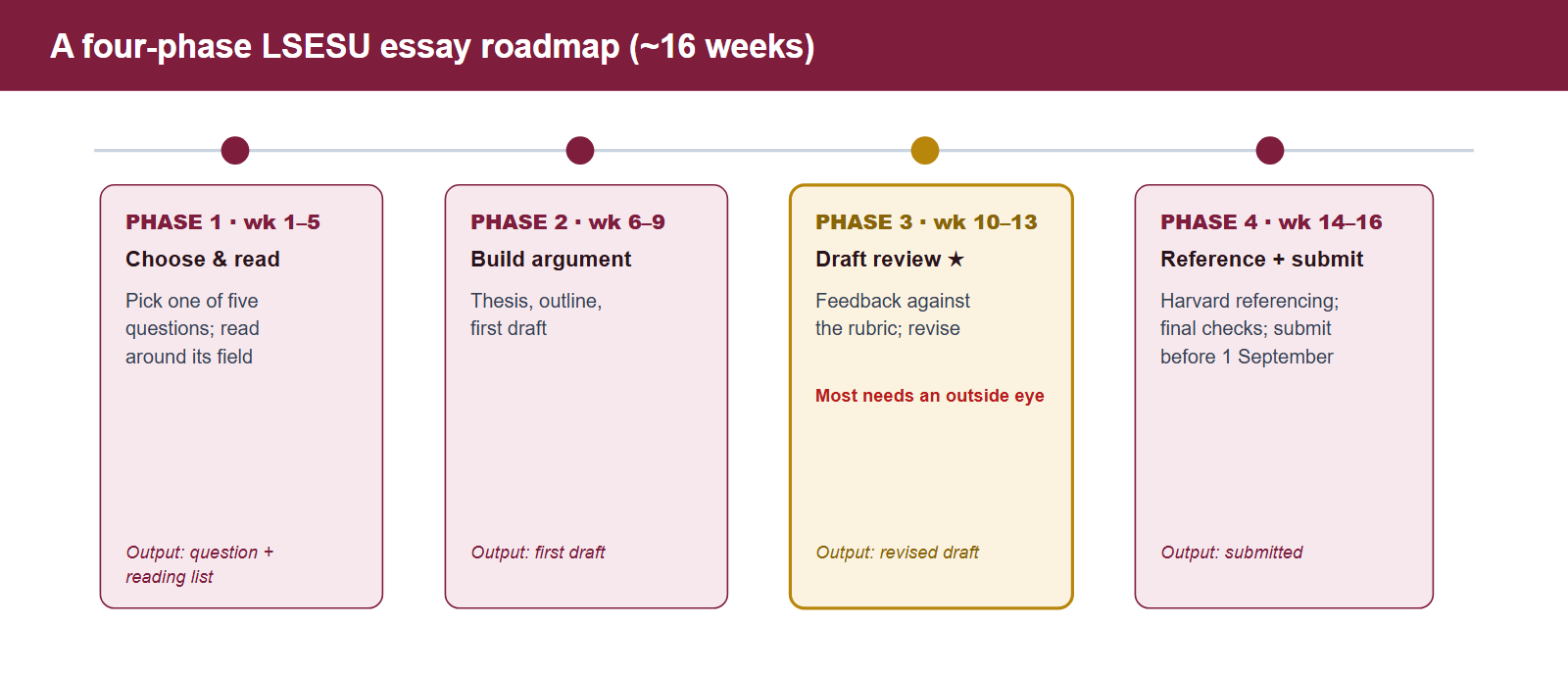
Phase 1 (Choose & read) picks one of the five questions and reads around the relevant LSE field. Phase 2 (Build argument) turns reading into a thesis, outline and first draft. Phase 3 (Draft review) is the divider — feedback against the 100-point rubric, the one thing a writer cannot do for themselves. Phase 4 (Reference + submit) finishes Harvard referencing and submits before the 1 September deadline.

A note on the rubric and AI screening
Two rubric realities shape good preparation. First, originality scores most (25 of 100), so a fresh angle on a question beats a competent but predictable answer. Second, entries are screened for AI-generated content. The right response is not to “avoid detection” by trickery — it is to do genuine, human work: your own reading, your own argument, your own voice. A draft review helps precisely because it strengthens your writing rather than replacing it.
What good LSESU prep looks like (a checklist you can use either way)
| ✅ 1 · Rubric-specific | Does it prepare you against the actual 100-point rubric, not generic “essay tips”? |
| ✅ 2 · Real draft feedback | Is your argument actually read and challenged — the thing self-study can’t give you? |
| ✅ 3 · Question & deadline clear | Does it help you choose among the five questions and plan to the 1 September deadline? |
| ✅ 4 · Honest track record | Does it state plainly which competitions its results come from — not blur them together? |
| ✅ 5 · No guarantees | Honest coaching never promises a win — results depend on the writer; it promises process. |
About our support (disclosure + honest track record)
To be transparent: this site is an independent guide to the LSESU Essay Competition, operated independently by Hanlin International Education, and we offer essay support including a structural draft review — so this section is a disclosure of commercial interest. We are careful about results:
Our essay-competition coaching is proven by an extensive award record in the John Locke Institute essay competitions — the same argument-building, research and academic-writing skills the LSESU essay rewards. To be clear: those are John Locke results, not LSESU results. We never relabel one competition’s record as another’s. We also provide our own structural draft review — a real, current service. (Ask us for specifics on our John Locke record.)
The honest version: the essay-coaching capability is real and transferable — building and defending an argument is the same craft across competitions — and every result is attributed to the competition it came from.
Is an LSESU result worth it for applications?
For students aiming at economics, PPE and related programs — especially Oxbridge and the LSE itself — yes, as evidence of genuine academic writing and economic thinking, not as a trophy. A strong entry shows you can build a referenced argument at a high standard, exactly what a personal statement needs to demonstrate. It does not guarantee admission, and you should treat it as one credible signal among many. The deeper value is upstream: the essay you build is often the seed of a strong personal statement, whether or not you place.
Frequently asked questions
Do I need coaching to do well in the LSESU essay?
Not always. A strong independent reader and writer can score well alone. The highest-leverage help is usually a single structural draft review, which shows where your argument is weak against the rubric — the one thing you cannot see yourself.
How long should I prepare, and what is the deadline?
About 3–4 months (roughly 16 weeks) before the 1 September deadline, following the four-phase roadmap: choose and read, build the argument, draft review, then reference and submit. Confirm the current year’s deadline on the official channels.
Do I need to have studied economics?
No prior economics course is required; the essay is judged on the quality of the argument. What helps is reading widely around your chosen question.
Do your results include LSESU wins?
Our published track record is in the John Locke Institute essay competitions — clearly attributed as such, not LSESU. We also offer our own structural draft review. We never relabel another competition’s results as LSESU.
Can coaching guarantee a win?
No. Any “guaranteed win” claim is a red flag. Results depend on the writer; honest support only commits to the process — rubric-specific guidance, real draft feedback and a clear deadline plan.
Filed underPreparation · Rubric
This site is an independent English-language guide to the LSESU Economics Society Essay Competition, operated independently by Hanlin International Education (翰林国际教育) for China-based international-school students. It is not the official competition website and is not affiliated with the LSESU Economics Society, the LSE Students’ Union, or the London School of Economics. This article describes our own essay support, so it is a disclosure of commercial interest. Our published track record is in the John Locke Institute essay competitions — attributed as such, not relabeled as LSESU results. Official rules are set by the competition and change yearly, so always confirm current details on the official site lsesuesec.org. Confirmed errors are corrected within 7 working days.