The 1,500-Word Budget: How to Allocate Words in Your LSESU Essay (2026)
The LSESU Economics Society Essay Competition limits you to a maximum of 1,500 words, excluding references. That ceiling is the single biggest design constraint on your essay: it is not enough room to do everything, so the entrants who place are the ones who decide in advance where each word earns its keep. This guide gives you a concrete section-by-section word budget and shows where students quietly waste a third of their allowance.
Why the word limit is the real exam
Per the official rules on lsesuesec.org, the 1,500-word cap excludes references but includes everything else — introduction, argument, evidence, counterargument, and conclusion. References are counted separately, so citing well does not cost you body words. Within that ceiling you are answering one of five questions set by LSE academics, in 12pt Times New Roman, 1.5 line spacing, with Harvard referencing recommended.
The hard truth: 1,500 words is roughly three pages. A judge can finish it in minutes. There is no room to “warm up,” restate the question at length, or summarise textbook background. Every word spent on setup is a word not spent on the analysis the rubric actually rewards — and our breakdown of the 100-point rubric shows that argument and critical engagement carry the heaviest weighting.
A working word budget
Here is an allocation that keeps your reasoning at the centre. Treat it as a starting frame, not a rule — a more empirical question may push more words into evidence, a more theoretical one into the argument body.
| Section | Target words | Share | Job it must do |
|---|---|---|---|
| Introduction & thesis | 150–180 | ~11% | State your specific claim in the first 3–4 sentences |
| Framework / mechanism | 250–300 | ~18% | The economic logic your argument runs on |
| Argument body (2–3 moves) | 600–700 | ~45% | Your case, built step by step with evidence |
| Counterargument & response | 180–220 | ~13% | The strongest objection, then why your claim survives |
| Conclusion | 100–120 | ~8% | Sharpen the claim; no new ground |
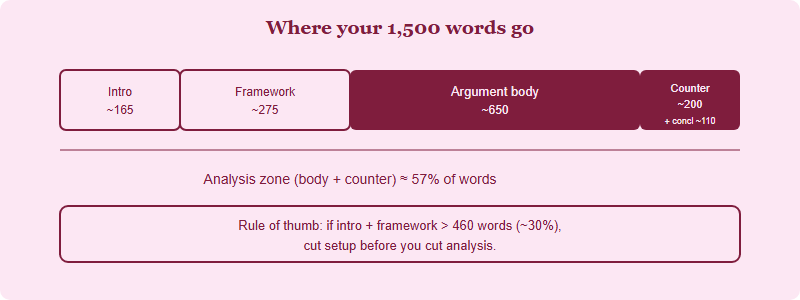
The first 165 words decide your fate
Under this budget your introduction is about 150–180 words — three to four sentences. That is enough to do exactly one thing well: state a specific, arguable thesis. It is not enough to restate the question, define common terms, or set “context.” A strong opening to an economics essay names the mechanism you will argue about and commits to a position.
- Weak open (wastes ~120 words): “Taxation is one of the most debated topics in modern economics. For centuries, governments have used taxes to…” — generic, scores nothing.
- Strong open (earns its 165 words): a sentence that states the claim, a sentence that names the mechanism, a sentence that previews the two moves you will make. The reader knows your argument before paragraph two.
If you find your introduction needs 300 words to “set up” the question, that is a signal the thesis is not yet sharp — not a signal you need more words. Sharpen the claim and the setup collapses.

Where the words actually leak
From reviewing essay-competition drafts, the same four leaks recur. Each one quietly drains 50–150 words from the analysis zone without the writer noticing.
| Leak | Typical cost | Fix |
|---|---|---|
| Restating the question | 40–80 words | Answer it instead; assume the reader knows it |
| Textbook definitions | 60–120 words | Use terms correctly; define only the non-obvious |
| Signposting filler (“In this essay I will…”) | 30–60 words | Let structure show itself through topic sentences |
| Conclusion that re-explains | 80–150 words | Cap at ~110 words; sharpen, don't summarise |
A three-pass method to land exactly on budget
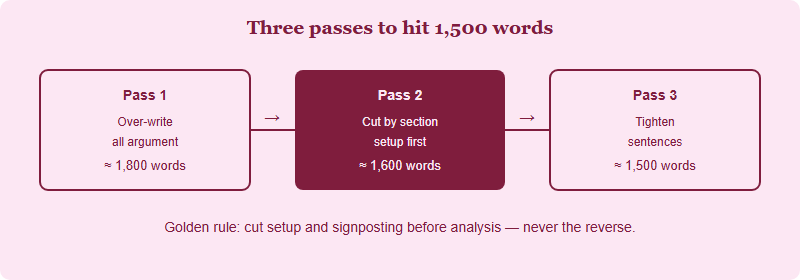
Hitting 1,500 words with the right distribution is a process, not a single draft. Use three passes, each with a different job.
- Pass 1 — over-write the argument (aim ~1,800). Get every analytical move on the page. Ignore the limit. You cannot trim what you have not written.
- Pass 2 — cut to the budget by section. Count words per section against the table above. Cut from setup and conclusion first; defend the analysis zone. This is where over-long introductions die.
- Pass 3 — tighten sentences (recover the last 100). Replace “due to the fact that” with “because,” cut adjectives that add no economics, merge redundant sentences. This pass alone routinely saves 80–120 words.
One discipline matters most: cut analysis last, never first. When the count is over by 200 words, the instinct is to delete the hardest paragraph — the one with the most reasoning — because it is the most effortful to keep coherent. That is exactly backwards. Delete a definition, a piece of signposting, a softening clause. Protect the thinking.
Before you submit: a budget checklist
Run these checks once your draft is on budget. If you want the full picture of the questions and scoring first, see the 2026 prompts and rubric, and if you are new to the competition, start with what the LSESU Essay Competition is.
- Body word count is at or below 1,500 excluding references — confirm what counts on the official site.
- The analysis zone (body + counterargument) is roughly 55–60% of your words.
- Your thesis appears in the first 165 words, not on page two.
- Formatting matches the brief: 12pt Times New Roman, 1.5 spacing, page numbers, file named FORENAME SURNAME + Question X.
- No registration is needed; submit directly at lsesueconsoc.org/competitions/ before 1 September 2026, 23:59 (GMT+1).
FAQ
Does the 1,500-word limit include references?
No. Per lsesuesec.org the maximum is 1,500 words excluding references, so citations do not cost you body words. Confirm edge cases on the official site.
How long should the introduction be?
About 150–180 words — three or four sentences that state a specific thesis. If it needs more, your claim is not yet sharp enough.
What share of words should the argument get?
The argument body plus counterargument should be roughly 55–60% of the total. Setup creeping past 30% means analysis is being squeezed.
What should I cut first when over the limit?
Cut restated questions, textbook definitions, and signposting filler before any analytical paragraph. Protect the reasoning that the rubric rewards.
Published by the editorial desk of this site, operated independently by Hanlin International Education (翰林国际教育) for China-based international-school students. This site is not the official competition website and is not affiliated with the LSESU Economics Society or the London School of Economics. Official rules are set by the competition and change yearly, so always confirm current details on the official site lsesuesec.org. Confirmed errors are corrected within 7 working days.