Question 1 deep-dive: Pissarides on workers, monitoring, and the home office
The 2026 Question 1 prompt is set by Sir Christopher Pissarides, 2010 Nobel laureate in Economics and LSE Regius Professor. It asks how firms should balance the case for remote work with the case for the office — and the answer turns on a principal-agent problem most candidates do not initially recognise.
The prompt: workers like to work from home, but they hate monitoring devices. How should firms balance the incentive case for remote work with the supervision case for the office? On a first read, the question looks like a survey of remote-work preferences. On a second read — the read the rubric rewards — it is a principal-agent problem with a productivity-signal trade-off, and the candidate who frames it that way already has a sharper essay than the candidate who does not.
Why the prompt-setter matters
Sir Christopher Pissarides shared the 2010 Nobel Memorial Prize in Economic Sciences (with Peter Diamond and Dale Mortensen) for analysis of markets with search frictions — work that explains why unemployment, job vacancies, and wage bargaining behave the way they do in real labour markets, rather than the way frictionless textbook models predict. The same analytical tradition shapes how the Question 1 reader will look at remote-work and monitoring. Search-and-matching frictions, hidden information, and incentive design are the working vocabulary; pure preference surveys are not.
What the rubric will reward
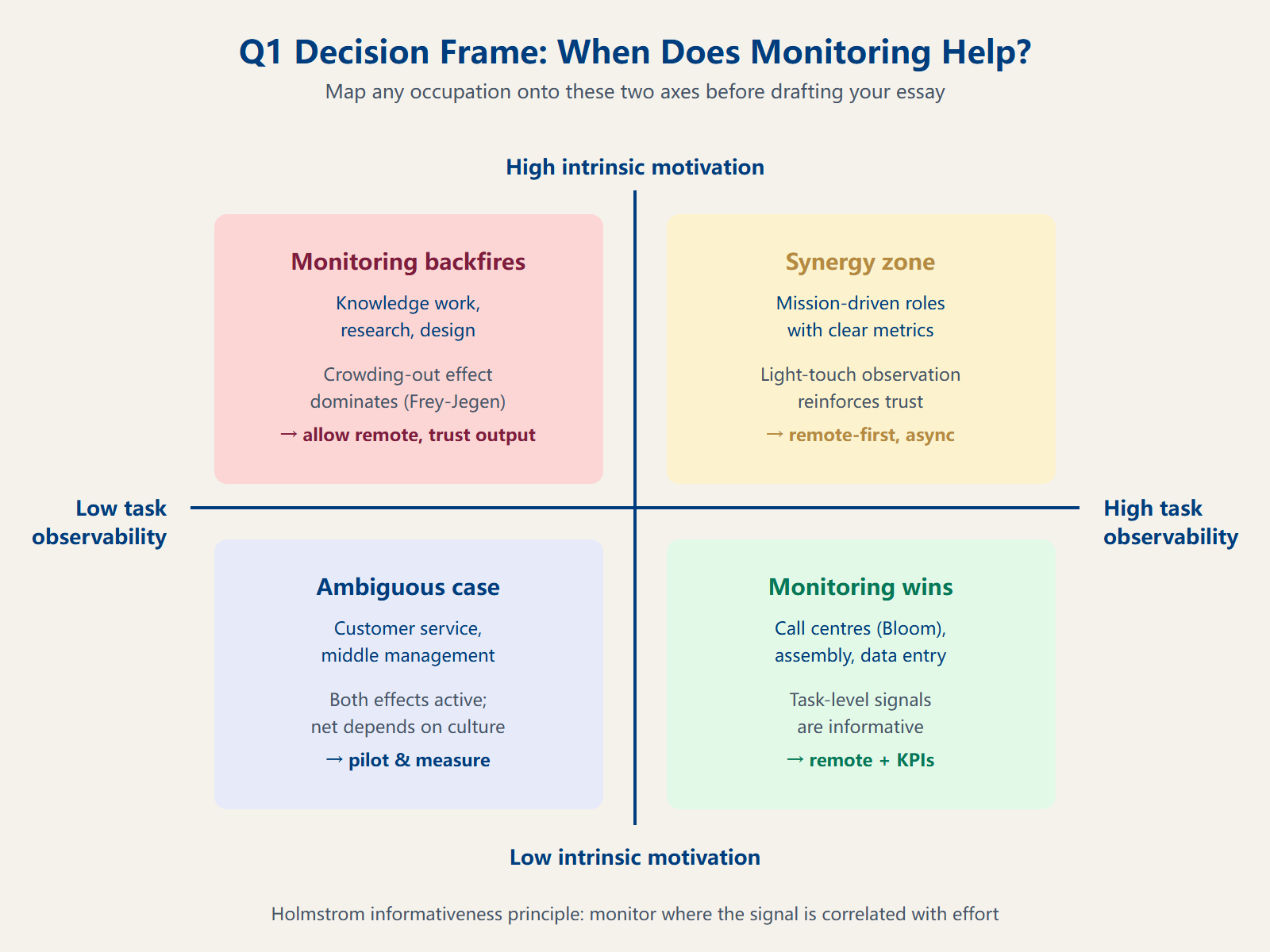
A strong essay on Q1 does three things. It identifies the principal-agent structure of the problem — the firm cannot directly observe a remote worker effort, and monitoring devices are a costly second-best substitute for direct observation. It cites empirical evidence on monitoring effects on intrinsic motivation, not just survey data on what workers prefer. And it acknowledges the counter-argument: in some occupations and at some intensity levels, monitoring genuinely increases output without crowding out intrinsic motivation, and the firm task is to identify where that line sits.
On a first read, the question looks like a survey of remote-work preferences. On a second read — the read the rubric rewards — it is a principal-agent problem with a productivity-signal trade-off.— Editorial committee
Reading list
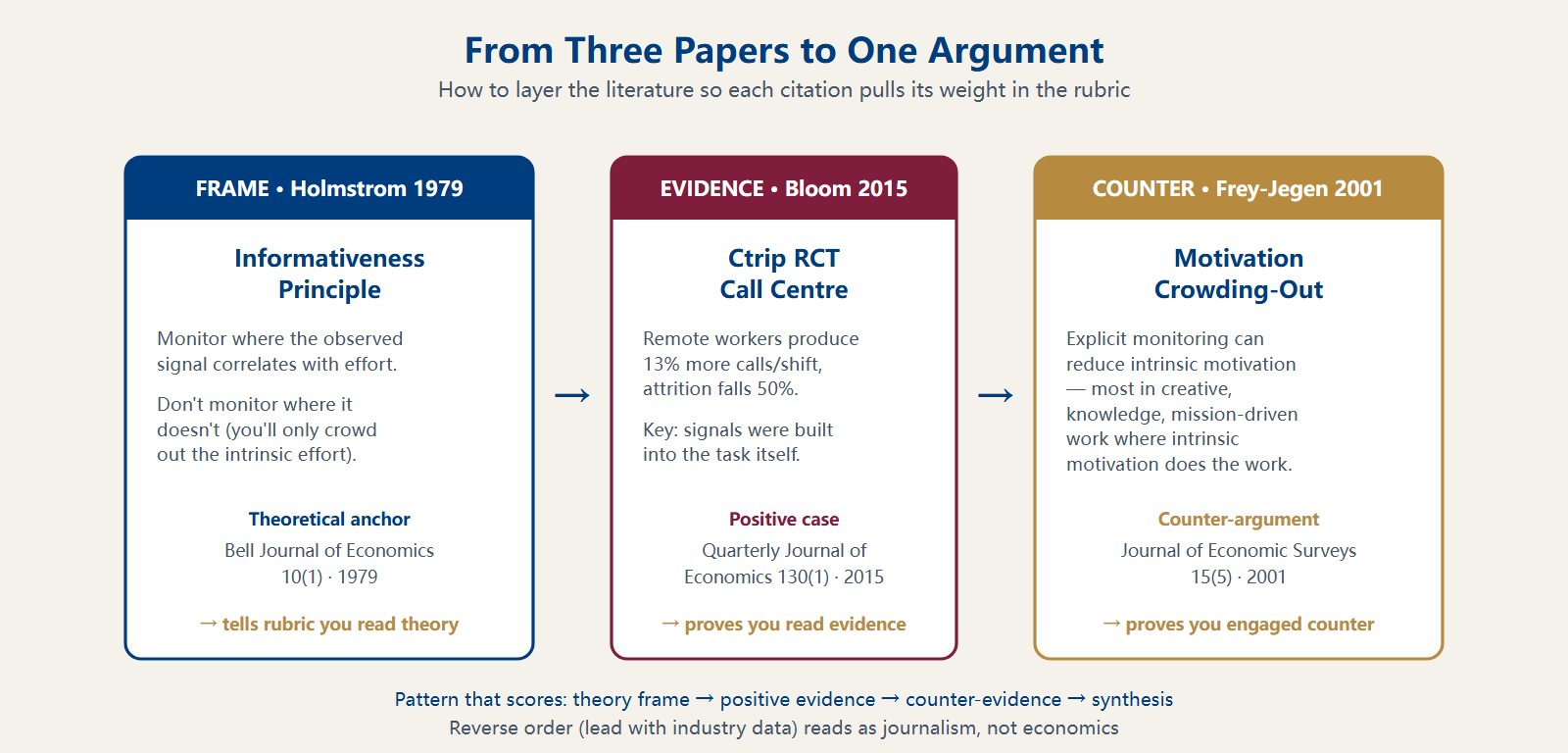
Three classes of evidence work well on Q1. First, the post-2020 empirical literature on remote-work productivity — Nicholas Bloom work on the Stanford Marketplace experiment and his subsequent papers are the canonical citations. Second, Microsoft Workplace Insights and the equivalent industry studies, which give granular data on actual behaviour rather than self-reported preference. Third, the older principal-agent theoretical literature — Bengt Holmstrom informativeness principle, for example — which the prompt-setter will recognise as serious framing.
Common framing trap: writing the essay as a personal preference question (I prefer working from home because…). The rubric awards 25 points for argument and originality and only 5 for relevance to the prompt — but a personal-preference essay loses on argument, evidence, critical analysis, and economic theory simultaneously. Frame it as an institutional design question, and every rubric criterion has room to score.

Sample structure: how to organise 1500 words on Q1
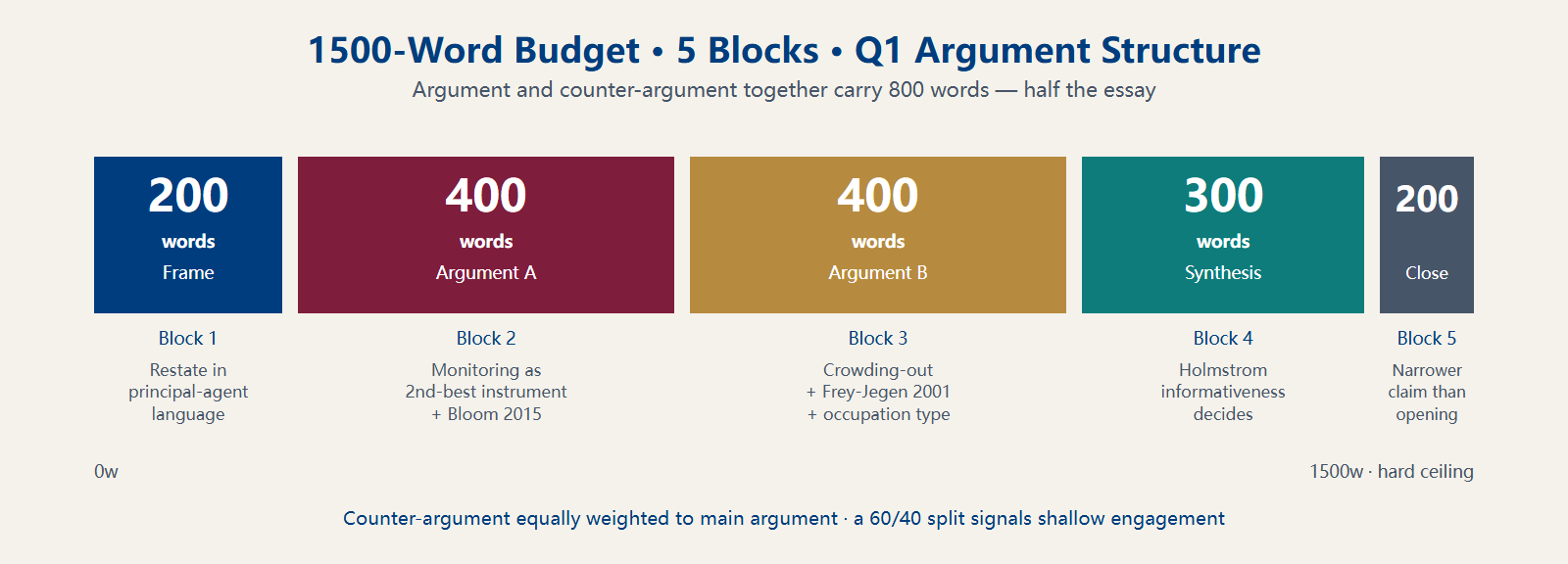
A useful working budget for the 1500-word ceiling is roughly five blocks. The opening 200 words restate the problem in principal-agent language and signal the analytical frame the rest of the essay will live in. The next 400 words develop the first substantive argument — typically the case for monitoring as a costly second-best instrument, with at least one piece of empirical evidence. The middle 400 words develop the counter-argument — the case that monitoring crowds out intrinsic motivation, with a different piece of evidence and a clear acknowledgment that the conclusion depends on occupation type and intensity. The next 300 words attempt synthesis — under which conditions does each side win, and what would a firm actually do at the margin. The closing 200 words restate the institutional design implication and leave the reader with a sharper, narrower claim than they had at the start.
| Block | Words | Purpose |
|---|---|---|
| 1 · Frame | ~200 | Restate as principal-agent; signal Pissarides search-and-matching tradition |
| 2 · Argument A | ~400 | Monitoring as second-best with Bloom (2015) Ctrip evidence |
| 3 · Argument B | ~400 | Crowding-out, intrinsic motivation, occupation-dependence |
| 4 · Synthesis | ~300 | Margin conditions; Holmstrom informativeness as the discriminator |
| 5 · Close | ~200 | Institutional design claim, narrower than the opening |
Two arguments worth anchoring
The first anchor argument is Bloom and colleagues 2015 Ctrip working-from-home experiment, published in the Quarterly Journal of Economics. In a randomised setting with a Chinese call centre, remote workers produced 13 percent more calls per shift than office controls; attrition fell by 50 percent. The result is the canonical positive evidence on remote-work productivity, but it is also a case where monitoring was technologically built into the task — call volumes, hold times, and satisfaction scores were directly observable. The lesson the rubric rewards is not “remote work is better”; it is “remote work plus task-level observability is better than office work without task-level observability, in a call-centre setting.” That qualification — what economists call an informativeness boundary — is what separates a 70-point essay from an 85-point essay on Q1.
The second anchor argument runs in the opposite direction. The motivation crowding-out literature, including Bruno Frey and Reto Jegen 2001 survey of the empirical evidence, finds that explicit monitoring devices can reduce intrinsic motivation in tasks where intrinsic motivation was doing most of the work — most clearly in knowledge work, creative work, and roles where the agent identifies with the principal goals. The candidate who can name this counter-finding, and identify exactly which occupational categories make it bind, is writing a serious essay. The candidate who treats it as a yes-or-no question is not.
Common mistakes that cost points
Four recurring weaknesses appear in essays that score in the lower bands. First, treating the question as a personal-preference survey — already flagged in the section above, but worth repeating because the AI-detection layer catches almost every essay that reads as opinion writing. Second, citing only post-2020 popular-press articles (Bloomberg, FT, Atlantic) without anchoring to academic primary sources; the rubric awards points for engagement with economic theory, not journalism. Third, writing as if the productivity question and the monitoring question were the same question — Pissarides explicitly poses them as a tension to be balanced, and an essay that elides the tension loses the argument-and-originality block entirely. Fourth, treating “the firm” as a unitary actor; in reality, different functions inside the same firm face different informativeness conditions, and the strongest essays recognise this directly.
How Q1 differs from Q2 through Q5
The five Q1 to Q5 prompts each year are set by different LSE Economics Department professors, and they pull from different sub-fields — macroeconomics, microeconomics, political economy, behavioural economics, development economics, depending on the year. Q1 in 2026 is a labour-economics-meets-organisational-economics question, which sits closest to Pissarides own search-and-matching tradition. Q2 through Q5 in any given year typically include at least one macroeconomic question, one development or political-economy question, and one microeconomic or behavioural question. The rubric is the same across all five — 25 points for originality, 25 for argument, lower weights for relevance, clarity, structure, and referencing — but the literatures candidates need to draw from differ. We publish deep-dive analyses for each of the five questions as they are released; the index is updated through the writing-cycle window.
- Bloom, N. et al. (2015) Does Working from Home Work? Evidence from a Chinese Experiment, Quarterly Journal of Economics 130(1)
- Microsoft Workplace Insights — published research on remote-work productivity patterns
- Holmstrom, B. (1979) Moral Hazard and Observability, Bell Journal of Economics 10(1) — the informativeness principle
- Christopher Pissarides at nobelprize.org — biographical and academic background
The 2026 LSESU Economics Society Essay Competition is open to high-school students worldwide — free, with no registration required. The five essay questions are public, and the deadline is 1 September 2026. See how to enter, or open the Contact page and scan the QR to reach the support team. All contact is via QR scan only.
Frequently asked questions about Q1
Do I have to take a side, or can I argue both perspectives are valid?
A strong synthesis essay can argue that both sides are valid under different conditions — for example, monitoring helps in task-observable settings and harms in knowledge-work settings — provided the candidate states the condition explicitly. What the rubric does not reward is “both sides have a point” without the candidate stating which conditions decide the outcome. Synthesis essays scoring at the top end always identify the discriminator.
Can I cite Microsoft Workplace Insights or Slack-style data?
Yes, and these citations strengthen an essay when they are paired with academic primary sources. The pattern that scores well is: theoretical frame from Holmstrom or Bloom, empirical pattern from the academic literature, granular industry data from a Microsoft or Slack study, in that order. The reverse order — leading with industry data and then reaching for theory — reads as journalism, not economics, and the readers know the difference.
How much of the 1500 words should be the literature review versus my own argument?
Roughly 30 to 40 percent literature, 60 to 70 percent the candidate own analysis. Essays that read like literature reviews — long summaries of Bloom 2015, then Pissarides search frictions, then back to Bloom — lose on the originality block, which alone carries 25 points. The literature should be the scaffold, not the subject. Every citation should be in service of an argument the candidate is making.
Can I submit a draft for feedback before the 1 September deadline?
The competition does not provide individual feedback before submission. Separately, and independently of the competition, you can request a structural review from our editorial desk up to 14 days before the deadline; we comment on framing and citation strategy, not line edits. Use the contact page to start the review request.
Filed underBehavioral Economics · LSE Faculty · Microeconomics · Pissarides · Question 1 · Question Deep-Dive
Published by the editorial desk of this site, operated independently by Hanlin International Education (翰林国际教育) for China-based international-school students. This site is not the official competition website and is not affiliated with the LSESU Economics Society or the London School of Economics. Official rules are set by the competition and change yearly, so always confirm current details on the official site lsesuesec.org. Confirmed errors are corrected within 7 working days.