The Sen Club at LSE: three Nobel laureates the Society has hosted
The LSESU Economics Society flagship seminar series — the Sen Club, named in honour of Amartya Sen — has hosted Nobel laureates including Sen himself, Eric Maskin, and Oliver Hart. Each is connected to the analytical traditions that shape what the Essay Competition rubric rewards.
The Sen Club is one of the few student-run seminars in the UK where Nobel-tier economists speak alongside doctoral candidates and undergraduates as conversational equals. The format is small, the questions are technical, and the discussion never strays into ceremony. For prospective candidates of the Essay Competition, the value of the Sen Club is indirect but real — the same academics who attend or supervise these sessions are the ones whose research shapes how a serious economics essay actually argues a point.
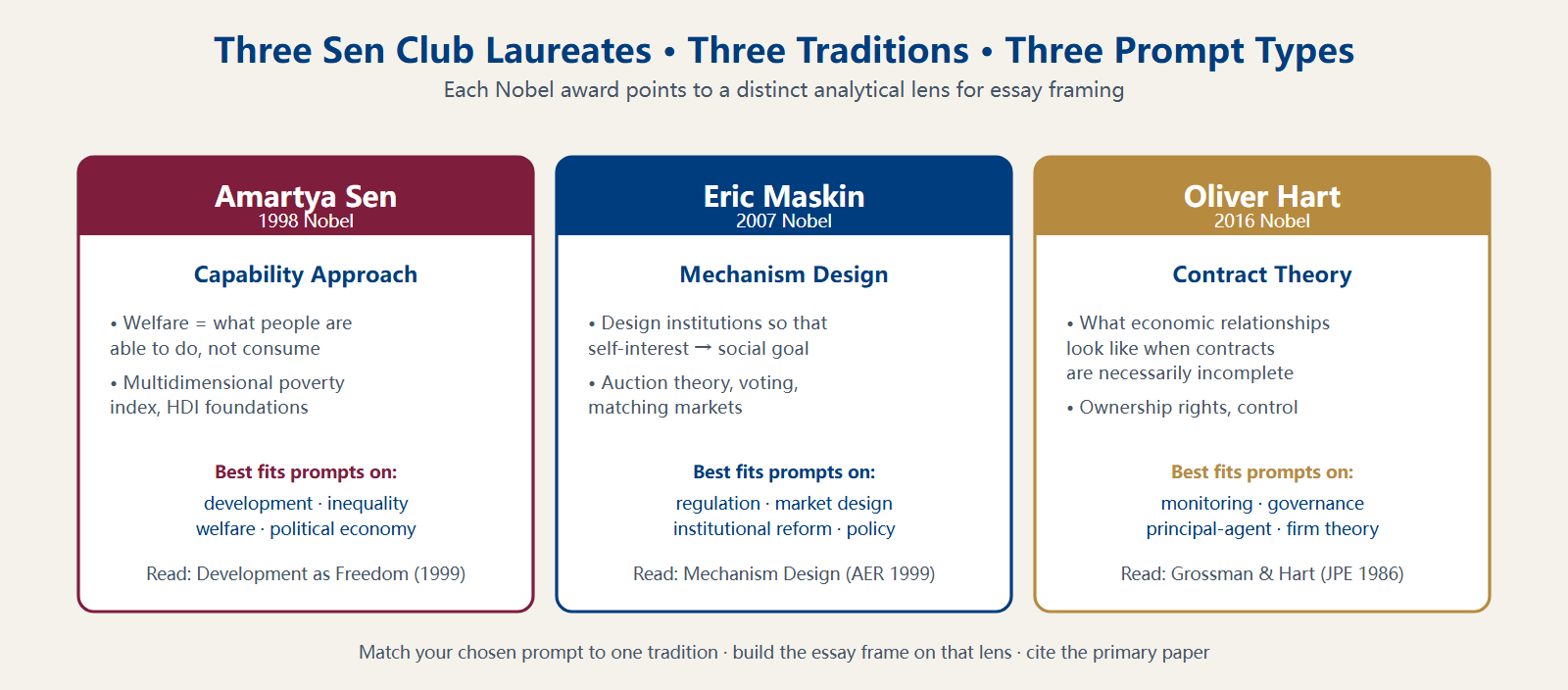
Amartya Sen · Nobel Memorial Prize 1998
Sen received the 1998 Nobel Prize for his contributions to welfare economics and social choice theory. The Sen Club takes its name from his enduring influence on economic ethics and capability theory — the framework that asks not just whether a person has resources, but whether they have the capability to use those resources to lead a life they have reason to value. For candidates on Question 4 (taxing the top 1%) or Question 5 (green technology and wealth distribution), Sen framework is among the most cited theoretical anchors for any normative argument.
Welfare economics is not a sub-discipline. It is the discipline answer to what economics is ultimately for.— Amartya Sen, paraphrased
Eric Maskin · Nobel Memorial Prize 2007
Maskin shared the 2007 Nobel Prize (with Leonid Hurwicz and Roger Myerson) for laying the foundations of mechanism design theory — the framework that underlies modern auctions, matching markets, and incentive contracts. For Essay Competition candidates working on Question 1 (remote work and monitoring), Maskin mechanism-design vocabulary is directly applicable: the firm problem is to design a contract that elicits effort from a worker whose effort cannot be directly observed.
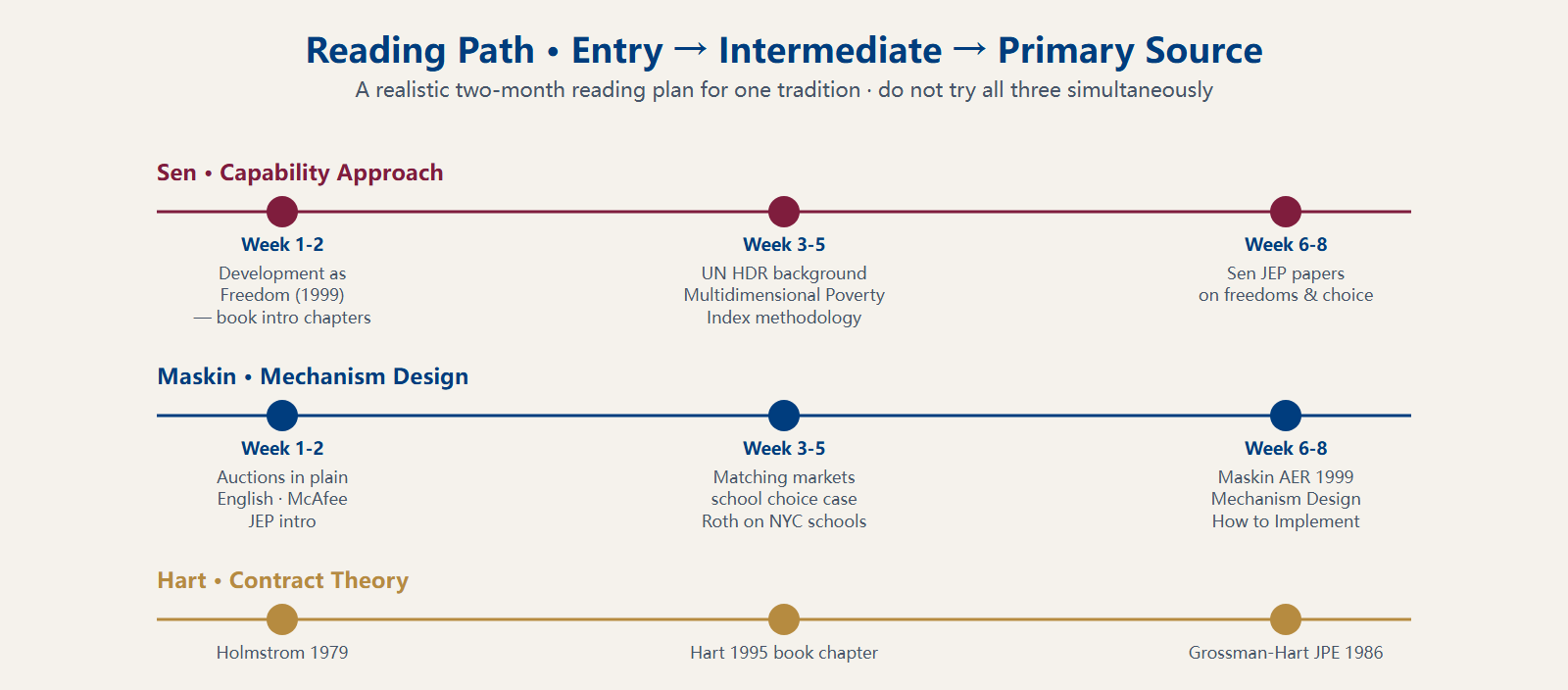
Oliver Hart · Nobel Memorial Prize 2016
Hart shared the 2016 Nobel Prize (with Bengt Holmstrom) for work on contract theory — exploring how incomplete contracts shape firm boundaries, corporate governance, and the structure of modern organisations. His work is the theoretical bridge between standard microeconomics and the institutional economics that explains why firms exist at all. Candidates on Question 1 or Question 3 (AI and labour displacement) can draw on Hart framework when discussing how the structure of firms is likely to change under different assumptions about contractibility.
How Sen Club connects to the Essay Competition
There is no direct connection — Sen Club speakers do not set Essay Competition prompts as a rule, and the 2026 prompts are set by current LSE Department of Economics faculty rather than visiting Nobel laureates. The connection is intellectual rather than institutional. The Sen Club shows what the Society values in an economic argument; the Essay Competition rewards the same values when the candidate puts them on the page. Reading the published work of Sen, Maskin, or Hart — at undergraduate-level summary if not full-paper depth — is among the most efficient ways for a candidate to internalise the analytical voice the rubric rewards.
- Amartya Sen at nobelprize.org
- Eric Maskin at nobelprize.org
- Oliver Hart at nobelprize.org
- About the LSESU Economics Society — Sen Club history and Society background
The 2026 LSESU Economics Society Essay Competition is open to high-school students worldwide — free, with no registration required. The five essay questions are public, and the deadline is 1 September 2026. See how to enter, or open the Contact page and scan the QR to reach the support team. All contact is via QR scan only.

Why these three: complementary research traditions
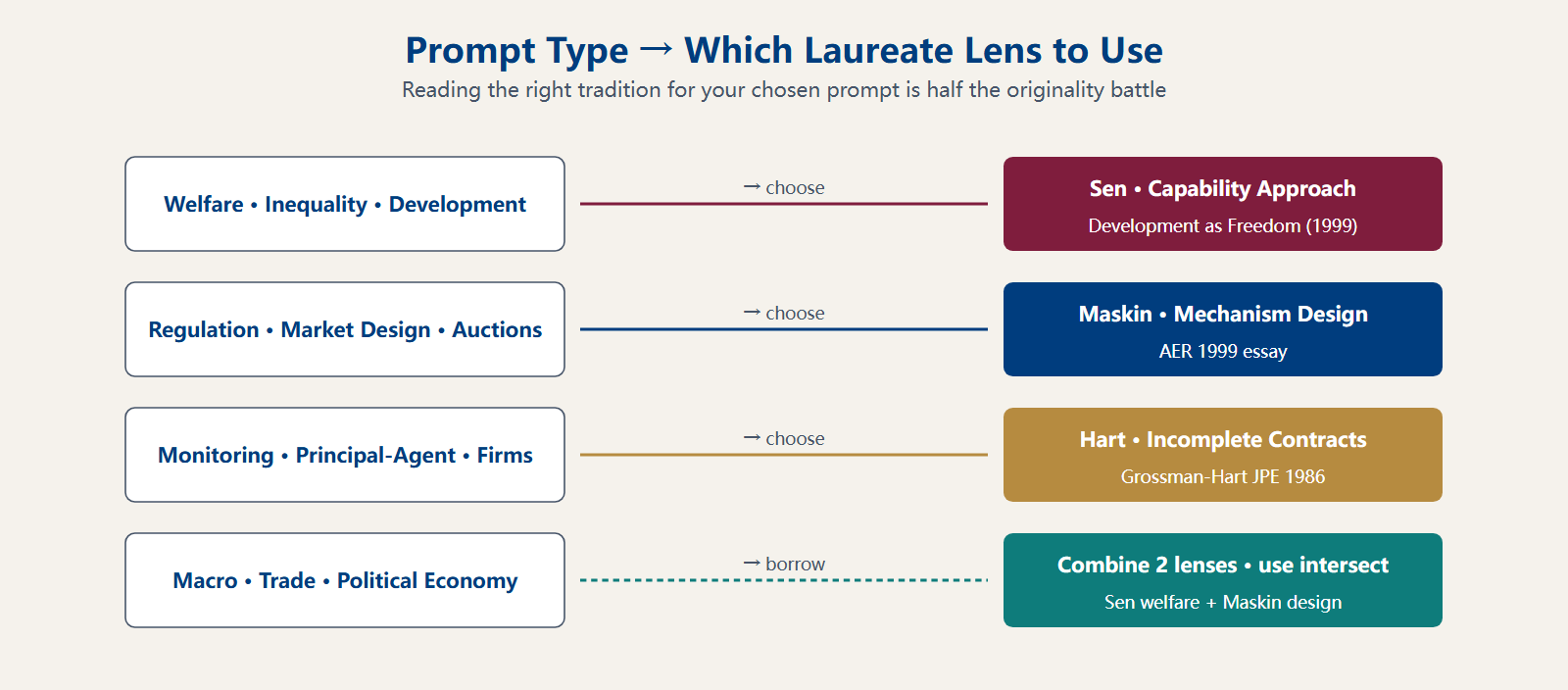
Amartya Sen, Eric Maskin, and Oliver Hart are not a random selection of Nobel laureates the Society could persuade to visit. Each represents a distinct research tradition that maps onto a different axis of how candidates might approach the Essay Competition prompts. Sen capability approach reframes welfare economics around what people are able to do rather than what they consume, and underpins the modern development-economics literature on freedoms, capabilities, and the multidimensional poverty index. Maskin mechanism-design work, which shared the 2007 Nobel, asks how institutions can be designed so that self-interested actors produce socially desirable outcomes — directly relevant to prompts that ask about regulation, market design, or institutional reform. Hart 2016 Nobel for contract theory addresses what economic relationships look like when contracts are necessarily incomplete, which is the unspoken background of almost every monitoring, principal-agent, or institutional-economics prompt the Department has set.
A reading list inspired by the Sen Club
Candidates who want to internalise the analytical traditions these three laureates represent have a manageable reading list. Sen Development as Freedom (1999) is the accessible book-length statement of the capability approach. For Maskin, his 1999 essay Mechanism Design: How to Implement Social Goals in the American Economic Review is the introductory paper. For Hart, the 1986 paper with Sanford Grossman The Costs and Benefits of Ownership in the Journal of Political Economy is the foundational reference. Each reading is dense for a high-school candidate but tractable in two or three careful passes, and each connects directly to the kind of prompt the Department sets. Reading even one carefully before drafting an essay materially changes how a candidate frames their own argument.
What candidates can learn from each laureate approach
From Sen, candidates can learn to broaden the welfare criterion their essay implicitly uses. Most pre-university economics essays measure welfare by GDP, consumption, or some equivalent monetary aggregate; Sen tradition opens space for capability-based measures, which can transform an essay on development, inequality, or political economy. From Maskin, candidates can learn to ask the institutional-design question: rather than describing how an outcome happened, ask how an institution could be designed to produce the outcome reliably. This question reframes any essay that touches regulation, taxation, or public policy. From Hart, candidates can learn to take incompleteness of contracts seriously: most real-world economic problems are not about choosing between fully specified contracts but about deciding what to do when the contract cannot anticipate every contingency. The framing applies to corporate governance, labour markets, international trade agreements, and the principal-agent prompts the Department regularly sets.
From the Sen Club to the Essay Competition: institutional bridges
The Sen Club seminar series and the Essay Competition share more than the Society as their host. Both express the same institutional position: that serious economics is a discipline of careful argument from theoretical foundations, applied to empirical evidence, with explicit recognition of where the argument can fail. The seminar series brings working economists to undergraduate and postgraduate audiences; the Essay Competition reaches outward to the pre-university community using the same standard of careful argument. Candidates who watch publicly available recordings of recent Sen Club seminars — many are accessible via the Society YouTube channel and the LSE Public Lectures archive — develop an ear for what serious economics writing sounds like, which is the most valuable preparation the open-access materials can provide.
Frequently asked questions
Is reading the canonical paper from each laureate realistic for a Year 12 or Year 13 student?
Yes, with realistic expectations about effort. Each paper requires two to three careful passes, ideally with a glossary of unfamiliar terms compiled on the first pass. Year 12 and Year 13 students at A-Level economics or IB Higher-Level economics have the background to follow the argument in two passes; younger students benefit from a guided reading group or teacher feedback.
Do I need to cite these laureates in my Essay Competition entry to score well?
No — there is no required-citation list. The point of reading these papers is to internalise their analytical framing, which then shapes any essay the candidate writes, regardless of whether the citations appear by name. That said, when a citation fits the argument the candidate is making, the rubric rewards engagement with serious primary economic literature over engagement with secondary journalism.
Are the Sen Club seminars open to non-LSE students or only to enrolled members?
Most seminars are open to LSE students and registered guests; some are open-public. Recordings of past seminars are typically posted to the Society YouTube channel within four to six weeks of the live event. For pre-university candidates, the archive is usually the most accessible entry point, and is sufficient preparation for picking up the tradition each laureate represents.
Have other Nobel laureates spoken at LSE recently, beyond the Sen Club series?
Yes — LSE hosts a large number of Nobel laureates each year across the Department of Economics, the Institute of Public Affairs, and the wider School. The Sen Club is the Society own flagship seminar series and is distinguished by being student-organised; the broader School also runs the LSE Public Lectures programme, which is the easiest archive for pre-university candidates to explore for general background.
Filed underBehavioral Economics · Development Economics · Foundation · LSE Faculty · Microeconomics
Published by the editorial desk of this site, operated independently by Hanlin International Education (翰林国际教育) for China-based international-school students. This site is not the official competition website and is not affiliated with the LSESU Economics Society or the London School of Economics. Official rules are set by the competition and change yearly, so always confirm current details on the official site lsesuesec.org. Confirmed errors are corrected within 7 working days.