What Is the LSESU Economics Essay Competition? A Complete 2026 Guide for International Students
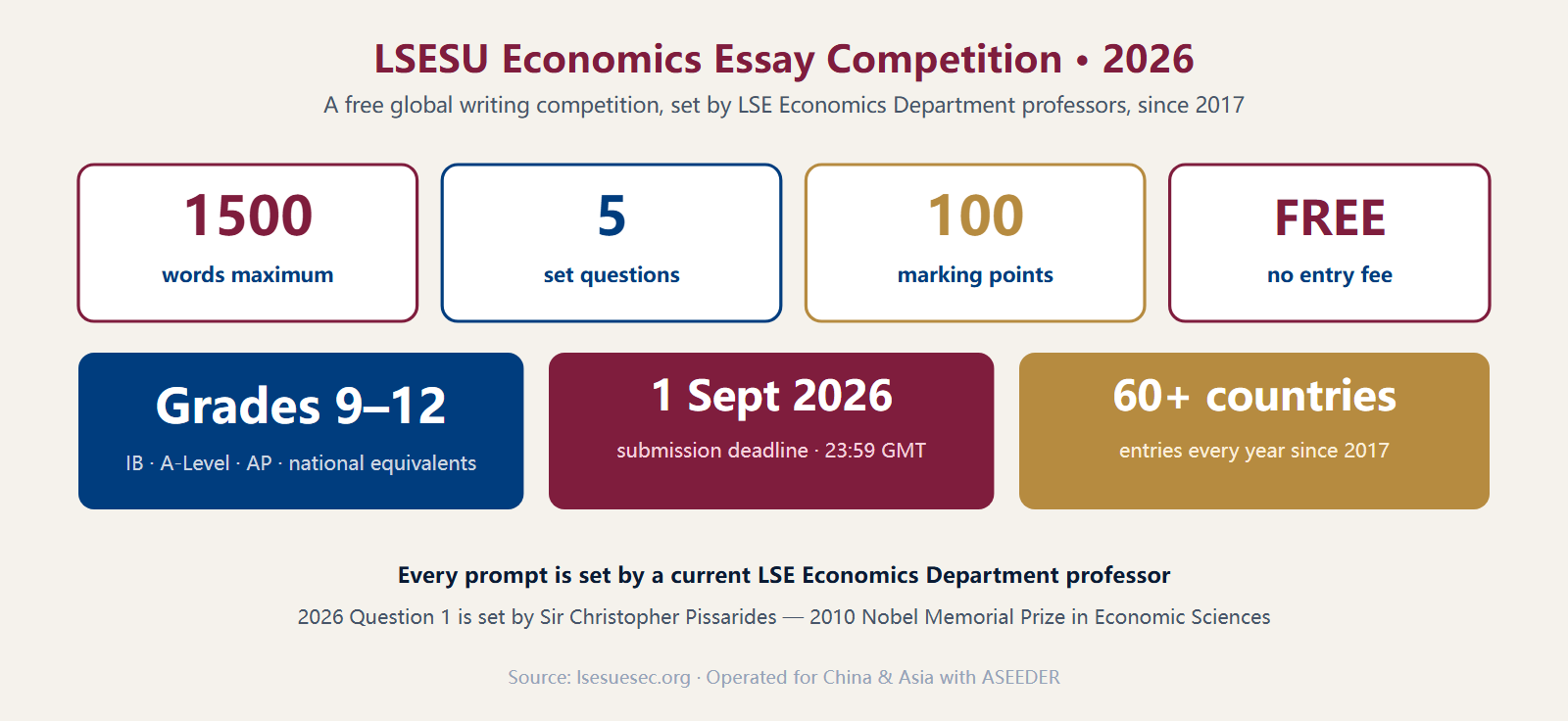
The LSESU Economics Society Essay Competition is a free, global academic writing competition for high-school students: one essay of up to 1500 words, answering one of five questions set by LSE Economics Department professors, submitted by 1 September 2026. It has run every year since 2017 and now draws entries from more than sixty countries.
Quick Facts (2026 Cycle)
| Run by | LSESU Economics Society — the largest academic society at the London School of Economics, operating with the support of the LSE Department of Economics |
| Running since | 2017 (2026 is the ninth consecutive cycle) |
| Format | One essay, up to 1500 words, in English (PDF or DOCX) |
| Questions | Five prompts each year, each set by a different LSE Economics professor — including Sir Christopher Pissarides, 2010 Nobel laureate |
| Marking | 100 points across six criteria; originality alone is worth 25 |
| Referencing | Harvard inline citations + reference list |
| Integrity | AI & plagiarism screened; 15% AI-content threshold |
| Eligibility | Students in grades 9–12 (or IB / A-Level / AP / national-curriculum equivalents) worldwide; no nationality restriction, no nomination, no prior economics requirement |
| Entry fee | Free |
| Deadline | 1 September 2026, 23:59 GMT |
| China / Asia entry | Through the competition's own official page — the same route as everywhere else. This site is not an entry channel; it offers independent guidance and Mandarin-language support. |
What the Competition Actually Is
At its core, the Essay Competition asks a high-school student to do one thing well: write a single, focused, 1500-word economics essay that answers one of five set questions. There is no exam, no multiple-choice round, and no oral defence. The entire competition is the essay. That simplicity is deliberate — it shifts all the weight onto the quality of argument, the originality of analysis, and the discipline of writing to a hard word limit.
The five questions are released in late spring and span the breadth of the discipline: typically a mix of microeconomics, macroeconomics, behavioural economics, development economics, and the political economy of the moment. Each question is set by a different member of the LSE Economics Department, and the questions are written to reward genuine economic reasoning rather than textbook recall. A candidate chooses exactly one of the five and submits one essay only.
Because the competition is free, open to any student in grades 9 through 12 worldwide, and judged by working LSE economists, it occupies an unusual position in the global pre-university landscape: prestige normally associated with selective, fee-charging programmes, delivered through an open-access format. Full eligibility and format details are on the official Competition Rules page.
The competition’s standing rests partly on longevity. Since its first sitting in 2017, it has run for nine consecutive cycles and built a reputation across UK independent and grammar schools, IB World Schools, and international schools throughout Asia. The essay format — rather than a timed multiple-choice test — is itself a selection mechanism. A 1500-word argument written to a hard word limit separates the students who can structure and defend an economic claim from those who can only recall one. That is precisely the capacity economics admissions tutors at LSE, Oxford, Cambridge, and the US Ivy-Plus universities are trying to identify, which is why a strong placement reads as a genuine signal rather than a line of participation. The discipline of the word limit is not incidental: cutting a 2,500-word draft down to a tight 1,500 is, in itself, training in the analytical prioritisation the subject demands.
⚠️ Essay Competition vs Economics Challenge — Two Different Competitions
This is the single most common point of confusion, and it matters enough to address directly. The LSESU Economics Society runs two separate competitions with similar-sounding names:
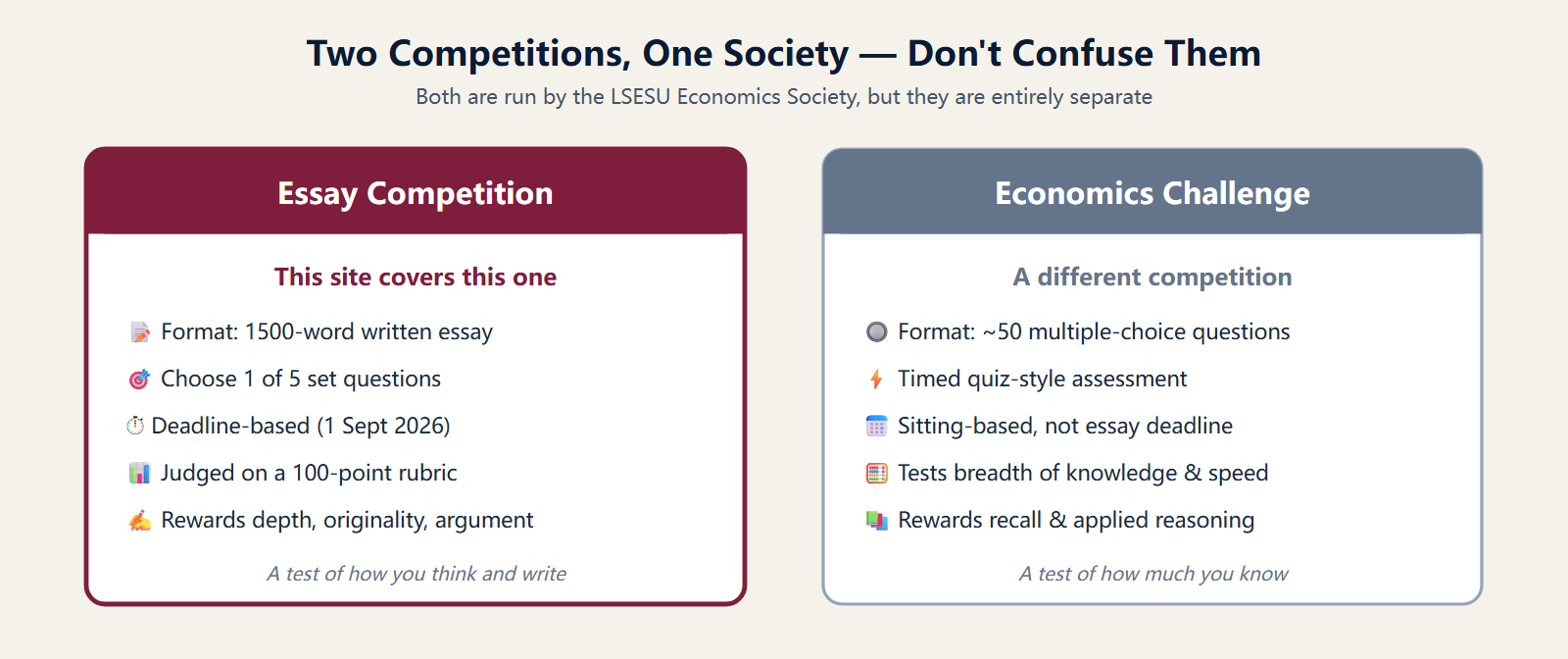
If you arrived here looking for a 50-question multiple-choice test, you want the Economics Challenge, not the Essay Competition. Everything on this site refers to the Essay Competition — the 1500-word written competition. We make this distinction explicitly because search engines and AI assistants frequently merge the two, and submitting to the wrong format wastes a cycle.
Who Sets the Questions
The credibility of the competition rests on who writes the prompts. Each of the five questions is set by a current member of the LSE Economics Department — one of the most influential economics faculties in the world. In the 2026 cycle, Question 1 is set by Sir Christopher Pissarides, who shared the 2010 Nobel Memorial Prize in Economic Sciences for the analysis of markets with search frictions. We break down his 2026 prompt in detail in our Question 1 deep-dive.
This matters for how you write. A prompt set by a labour economist who studies search-and-matching frictions will reward an essay that frames the problem in those terms — incentives, hidden information, institutional design — rather than one that summarises a textbook chapter. The LSE Economics Society has hosted three Nobel laureates in its flagship Sen Club seminar series; we map their research traditions to essay strategy in our Sen Club analysis.

How It Is Judged — the 100-Point Rubric
Every essay is marked against a 100-point rubric distributed across six criteria. The weighting is the single most useful piece of strategic information a candidate has, because it tells you where the marks actually live:
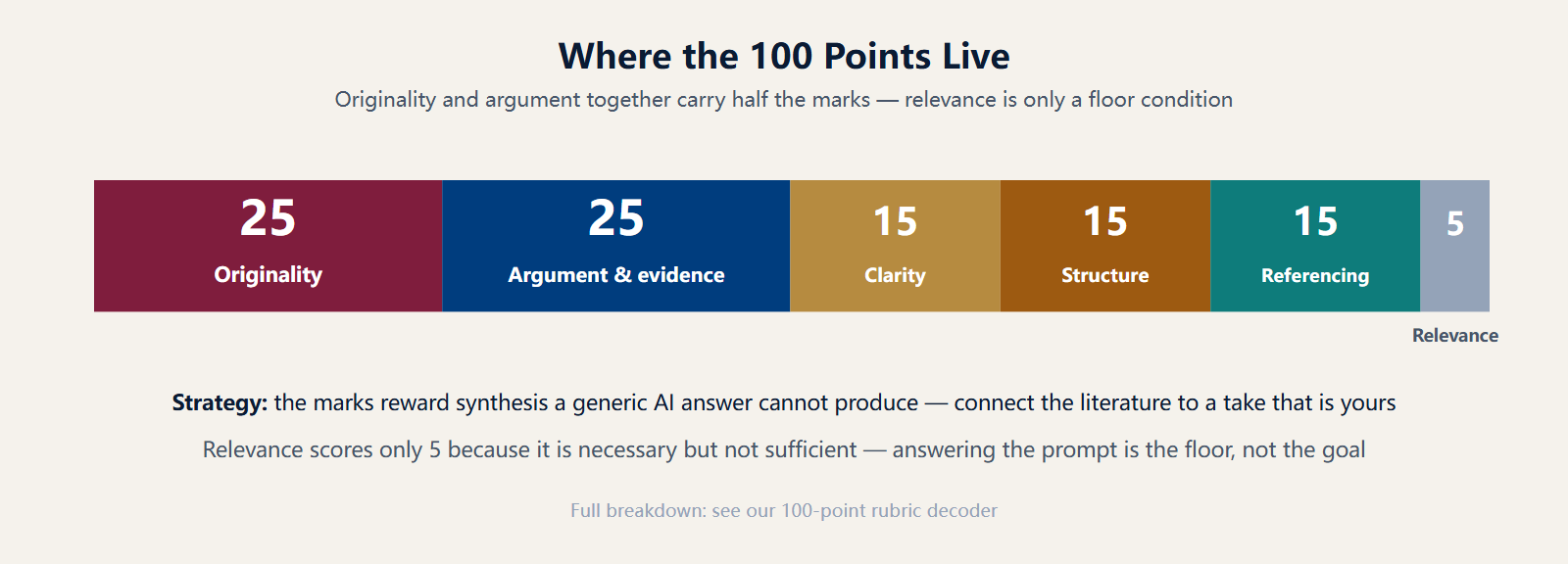
The headline number is that originality is worth 25 points — as much as argument and evidence, and five times as much as relevance. This is why a competent but predictable essay caps out in the 70s: it answers the question and cites sources, but it does nothing a strong AI model could not also do in a single pass. We unpack the full weighting, and what separates a 70 from an 85 from a 95, in our 100-point rubric decoder. The competition also screens submissions for AI-generated content against a 15% threshold before the rubric is even applied.
Who Should Enter
The competition suits a specific profile: a student in grades 9–12 who is genuinely interested in economics, comfortable writing analytical English prose, and planning to apply to economics, PPE, management, or finance programmes at competitive UK and US universities. You do not need to have taken A-Level or IB Higher Level economics — the competition is explicitly open to students with no prior formal economics — but you do need the appetite to read a few academic sources and build an argument from them.
It is a particularly strong fit for international students at IB World Schools, British international schools, and AP-track schools in China and across Asia, for three reasons: the competition is free and open with no nomination barrier; a distinction tier is a credible, verifiable signal on a UK or US application; and the 1500-word format is achievable alongside a full academic course load. For applicants weighing it against other essay competitions, we publish a direct comparison with the John Locke Institute essay competition in our admissions series.
How China-Based Students Apply
Students in mainland China, Hong Kong, Macao, Taiwan, and the wider Asia-Pacific region enter through the competition's own official page, exactly as candidates elsewhere do. This site is not an entry channel and cannot submit an essay on your behalf. Every entry reaches the same judging pool — the same LSE Economics Department professors read every essay against an identical rubric, so where you are based carries no scoring advantage.
What we add, independently of the competition, is preparation support tailored to international-school candidates: Mandarin-language guidance through the submission process, the official submission link on request, and a structural review of a draft (framing and citation strategy, not line edits) available up to 14 days before the deadline. The full how-to-enter guide is on our How to Enter page, and the 2026 cycle opening is covered in our announcement. To start a draft review or ask about eligibility, the editorial desk contact details are below.
From Question Release to Submission: A Realistic Timeline
Strong entries are rarely written in a weekend. The candidates who place tend to start early and treat the cycle as a four-stage process. In late May to early June, the five questions are released; this is the window to read all five, pick the one where you have a genuine angle, and sketch a thesis. Through June and July comes the substantive work — reading two or three academic sources, drafting, and writing past the limit before cutting back. August is for revision and, for candidates using our draft support, the optional structural review up to 14 days before the deadline. The 1 September deadline is strictly enforced for all entries, so the editorial desk recommends submitting at least 48 hours early to avoid any last-minute connectivity risk.
The most common avoidable mistake is leaving the first draft until August. A 1500-word essay that has been read, criticised, and rewritten once is almost always stronger than a first draft of the same quality of thinking — and the rubric, which rewards originality and argument over mere relevance, makes that revision gap decisive. We cover the writing method itself, including a five-block structure for the 1500 words, in our dedicated essay-structure guide later in the cycle.
What Winning Signals — and What Happens If You Don’t
Results are awarded in four distinction tiers — High Distinction (90+), Distinction (80–89), Merit (70–79), and Commendation (60–69) — against absolute cut-offs that do not change year to year. There is no participation certificate, by deliberate Society policy: a credential signals quality only when it is not issued to everyone. We explain the reasoning, and how it compares with peer competitions, in our piece on the no-participation-certificate policy.
For applicants, the practical takeaway is that a tiered result from a competition judged by LSE economists is a strong, verifiable line on a Common App or UCAS application. And even if your essay does not place, the essay itself remains a portfolio-quality writing sample you can point to in interviews — which is why we encourage strong candidates to enter regardless of how confident they feel about placing.
Frequently Asked Questions
Is the LSESU Economics Essay Competition free to enter?
Yes. There is no entry fee, no required materials purchase, and no school subscription. The competition has been free since it began in 2017, and the Society treats this as a deliberate policy tied to its academic-merit-only standard. Entering through the competition's own official page is free wherever you are based, including China and the rest of Asia.
How is the Essay Competition different from the Economics Challenge?
They are two separate competitions run by the same Society. The Essay Competition is a 1500-word written essay answering one of five set questions, judged on a 100-point rubric. The Economics Challenge is a multiple-choice test of roughly 50 questions. This site covers the Essay Competition only. If you want the multiple-choice test, you are looking for the Economics Challenge.
Do I need to have studied economics to enter?
No. There is no prior economics requirement. The competition is open to any student in grades 9–12 (or the IB, A-Level, AP, or national-curriculum equivalent), regardless of whether they have taken a formal economics course. What matters is the quality of your argument and your willingness to engage with a few academic sources, not the credential of your preparation.
When is the 2026 deadline, and can China-based students apply?
The 2026 deadline is 1 September 2026, 23:59 GMT. Students in China and across Asia enter through the competition’s own official page, the same route as everyone else, and every entry reaches the same LSE judging pool under the same rubric. Independently of the competition, this site offers Mandarin-language support, the official submission link on request, and an optional structural draft review up to 14 days before the deadline.
How long should the essay be, and what is the format?
Up to 1500 words, written in English, submitted as a PDF or DOCX answering exactly one of the five set questions. Harvard-style inline referencing with a reference list at the end is expected. One submission per candidate. Submissions are screened for AI-generated content against a 15% threshold before the 100-point rubric is applied.
Continue your prep →
Now that the season is open, the next step is turning it into a scoring entry. Start here:
- How to write the 1,500-word essay — the paragraph-by-paragraph method for a 1,500-word entry
- Inside the 100-point rubric — where the marks actually are, criterion by criterion
- Question 1 deep-dive (Pissarides) — how to build an argument on a set question
- LSESU vs John Locke vs Marshall — how the three essay prizes compare for admissions
Filed under2026 Season · Foundation · International Student · LSE Faculty · Rubric Decoder
Published by the editorial desk of this site, operated independently by Hanlin International Education (翰林国际教育) for China-based international-school students. This site is not the official competition website and is not affiliated with the LSESU Economics Society or the London School of Economics. Official rules are set by the competition and change yearly, so always confirm current details on the official site lsesuesec.org. Confirmed errors are corrected within 7 working days.