LSESU Essay Distributional Effects: Explaining Who Gains, Who Loses and Why
Why Distributional Effects Trip Up Most First Drafts
When an LSESU essay question asks who gains, who loses, and why, the instinctive move is to list stakeholders and label them “winners” or “losers.” That produces a flat answer. The rubric rewards mechanism—showing how a policy or shock changes relative prices, bargaining power, or risk exposure, and tracing whose welfare moves as a result.
This article works through two hypothetical cases. The first shows a clean chain of reasoning that holds up. The second shows the same topic approached through a common shortcut, and why that shortcut collapses under scrutiny. A diagnostic table at the end helps you test your own draft before submission.
These are original teaching illustrations, not official past-paper questions or marking criteria.
Worked Example 1: A Subsidy on Electric-Vehicle Batteries
Suppose a government introduces a production subsidy for domestic EV-battery manufacturers. The question asks who gains, who loses, and why.
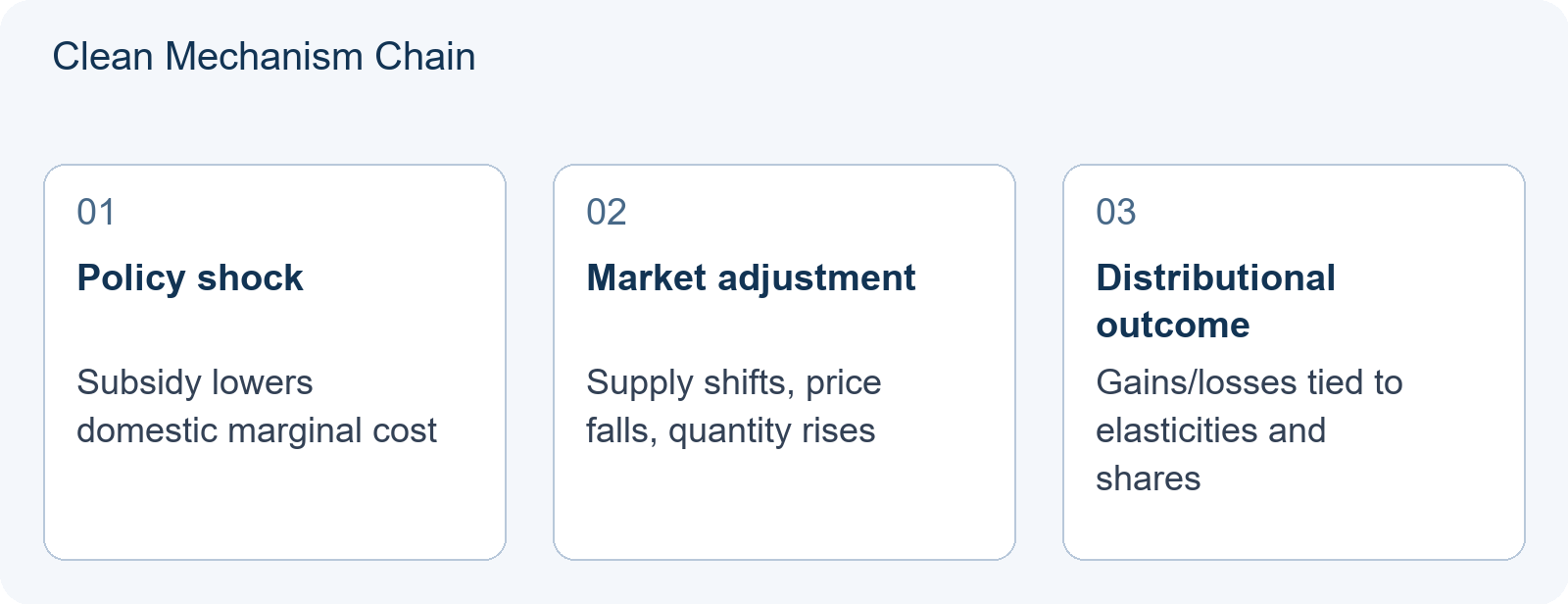
Step 1: Map the direct price effect
Domestic producers receive a per-unit subsidy. Their marginal cost falls at every quantity, so profit-maximising output rises and the supply curve shifts right. In the short run, with foreign competitors still facing old costs, domestic firms gain market share and producer surplus.
Step 2: Trace the distributional shift
Consumers see lower prices if domestic and foreign goods are close substitutes. The gain is larger when demand is elastic—buyers who would have stayed out of the market at the pre-subsidy price now enter. Domestic workers in battery plants may gain if output expansion raises labour demand, but this depends on whether the subsidy is tied to capital-intensive or labour-intensive production.
Step 3: Identify the less visible losers
Foreign producers lose market share and may retaliate with their own subsidies, triggering a race-to-the-bottom dynamic. Taxpayers fund the subsidy; if the government finances it through debt, future taxpayers bear the cost. Domestic industries that compete with batteries for skilled labour may face higher wages—a general-equilibrium loss often skipped in partial analysis.
This answer works because each “gain” or “loss” is tied to a specific market mechanism, not asserted from a stakeholder list.
Worked Example 2: The Same Topic, Approached Through a Shortcut
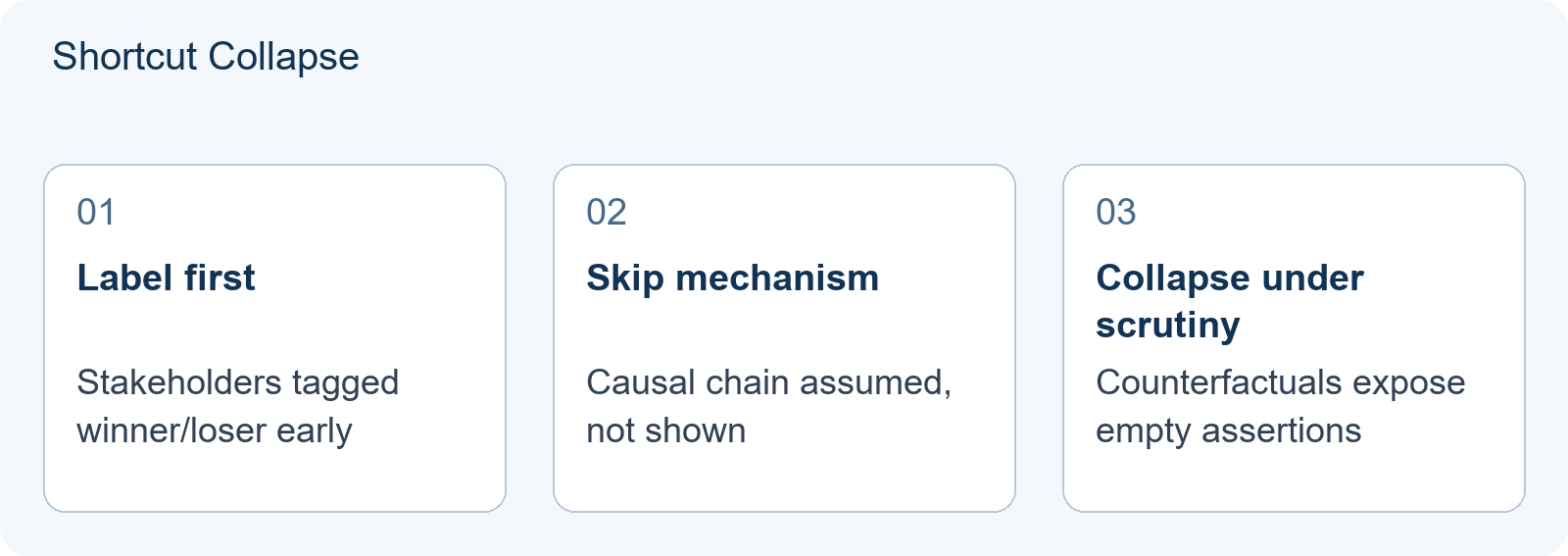
Now imagine a student reasons as follows: “The environment gains because EVs reduce emissions; domestic firms gain because of the subsidy; foreign firms lose because they are crowded out; taxpayers lose because they pay for it.”
Each clause sounds plausible, but the logic is fragile:
- “The environment gains” skips the lifecycle analysis. If the subsidy draws resources from cleaner public-transit investments, or if battery production is carbon-intensive, the net environmental effect is ambiguous.
- “Domestic firms gain” ignores heterogeneity. A subsidy tied to output rewards large incumbents with spare capacity; small entrants with high fixed costs may still exit.
- “Foreign firms lose” assumes static market share. Some foreign producers may relocate production to capture the subsidy, turning losers into gainers.
- “Taxpayers lose” treats the fiscal cost as pure deadweight loss. If the subsidy generates positive externalities in learning-by-doing, future taxpayers may recoup the cost through cheaper technology.
The shortcut fails because it labels stakeholders before establishing the causal chain. While the official rubric does not publish a specific penalty code for this, high-scoring essays typically avoid such assertions in favor of explicit mechanisms.

Diagnostic: Is Your Draft Making the Shortcut Mistake?
| Red-flag phrase | What to replace it with |
|---|---|
| “X gains because the policy helps X” | “X gains because the policy lowers X’s relative cost of…” |
| “Y loses due to reduced competitiveness” | “Y loses because the policy raises Y’s marginal cost relative to…” |
| “Consumers benefit from lower prices” | “Consumer surplus rises if the price elasticity of demand exceeds…” |
| “The government loses revenue” | “The fiscal cost is offset if the marginal excess burden is less than…” |
| “Society is better off” | “Social welfare rises if the sum of corrected consumer and producer surplus…” |
If your draft contains more than one red-flag phrase per paragraph, the argument is probably running on labels, not mechanisms.
A Targeted Practice Sequence
To move from assertion to mechanism:
- Pick one policy from the current LSESU question set.
- Draw the supply-and-demand diagram (or the game-theory tree, or the principal-agent structure) before writing any prose.
- For each stakeholder you plan to name, write one sentence that starts with “The mechanism through which [stakeholder] is affected is…”
- Check whether any two mechanisms conflict. If they do, state the conflict explicitly and argue which effect dominates under what condition.
- Conclude with a comparative-statics summary: “Compared to the pre-policy equilibrium, the distribution of [welfare measure] shifts from [group A] to [group B] because…”
Repeat this sequence with a second question from a different topic area—say, monetary policy or labour-market regulation—to build transferable pattern recognition. The goal is not to memorise stakeholder lists but to internalise the habit of asking “through what price, cost, or risk channel?” before ever writing “gains” or “loses.”
What to Read Next
For a focused preparation plan if you are in Grade 11, see LSESU Essay Competition Preparation: A Focused Plan for Grade 11 Students. If you are deciding between the LSESU essay and the Marshall Society essay, the LSESU Essay Competition vs Marshall Society Essay: A Decision Framework for 2026 offers a side-by-side comparison. For guidance on what happens after you submit, refer to LSESU Essay Competition Results: What Happens After You Submit and How to Use the Wait.
The Skill You Should Demonstrate
After working through these examples, you should be able to: identify a policy or shock; trace at least two transmission channels; name a hidden or delayed distributional effect; and explain why the net direction of welfare change is uncertain without further empirical or theoretical specification. That is the standard the originality criterion on the rubric rewards.
This is an independent guide operated by Hanlin International Education. It is not affiliated with, endorsed by, or authorised by the LSESU Economics Society, the LSE Students’ Union, or the London School of Economics. For official rules, dates and announcements, always refer to the official competition website: www.lsesuesec.org
Frequently Asked Questions
Does the LSESU rubric actually penalise stakeholder lists without mechanisms?
The public rubric awards up to 25 points for originality, the highest single weighting. Independent teaching experience suggests that answers which label groups without tracing the market or institutional mechanism that changes their welfare score lower on the reasoning dimensions than answers that embed each stakeholder inside a causal chain.
Can I use real-world data in my distributional analysis?
You may cite published empirical estimates if they are sourced and brief. The 1500-word limit means one or two well-chosen statistics are more useful than a data appendix. Always connect the number back to the mechanism you are arguing.
How do I check whether my draft is making the shortcut mistake?
Apply the diagnostic table in this article. If more than one paragraph contains a phrase like ‘X gains because the policy helps X,’ rewrite those sentences to begin with the specific price, cost, or risk channel through which the policy operates.