LSESU Essay Assumption Stress Test: How to Check a Conclusion Before You Commit
The LSESU Essay Assumption Stress Test is a four-move check for a policy conclusion: identify the assumptions that could flip the sign or the ranking, set a defensible low, central and high case, compare the scenarios, then rewrite the conclusion as a condition plus a net judgement. Use it on your own draft and verify current competition rules on the official page; the 2026 deadline of 1 September has passed.
The rubric gives 15 marks to critical analysis, including engagement with trade-offs, limitations and alternative explanations, and 20 marks to correct and effective application of economic theories. The aim is not to sound cautious. It is to make a judgement that survives scrutiny inside 1,500 words.
Why a stress test is not just an elasticity check
A LSESU Essay Elasticity Check: Test Your Policy Conclusion asks a narrow question: if one number changes, does the sign of the conclusion change? That is useful, but it can leave a false impression of robustness. A policy may survive a change in one parameter and fail when take-up, cost and behavioural response move together. A conclusion can also fail in a second way: the sign stays positive, but the ranking of two options reverses. If option A remains worthwhile while option B becomes clearly better, a sign test misses the decision problem.
The stress test is therefore a small robustness audit. It varies the assumptions that are jointly decision-relevant and records where the recommendation changes. It differs from LSESU Essay Policy Trade-Offs: Comparing Two Options Under the Same Assumptions. In a trade-off comparison, the assumptions are held fixed while the options change. Here the assumptions themselves are the object of study. The output is not a forecast; it is a bounded claim about what must be true for the recommendation to hold.
Build an assumption ledger before you write the conclusion
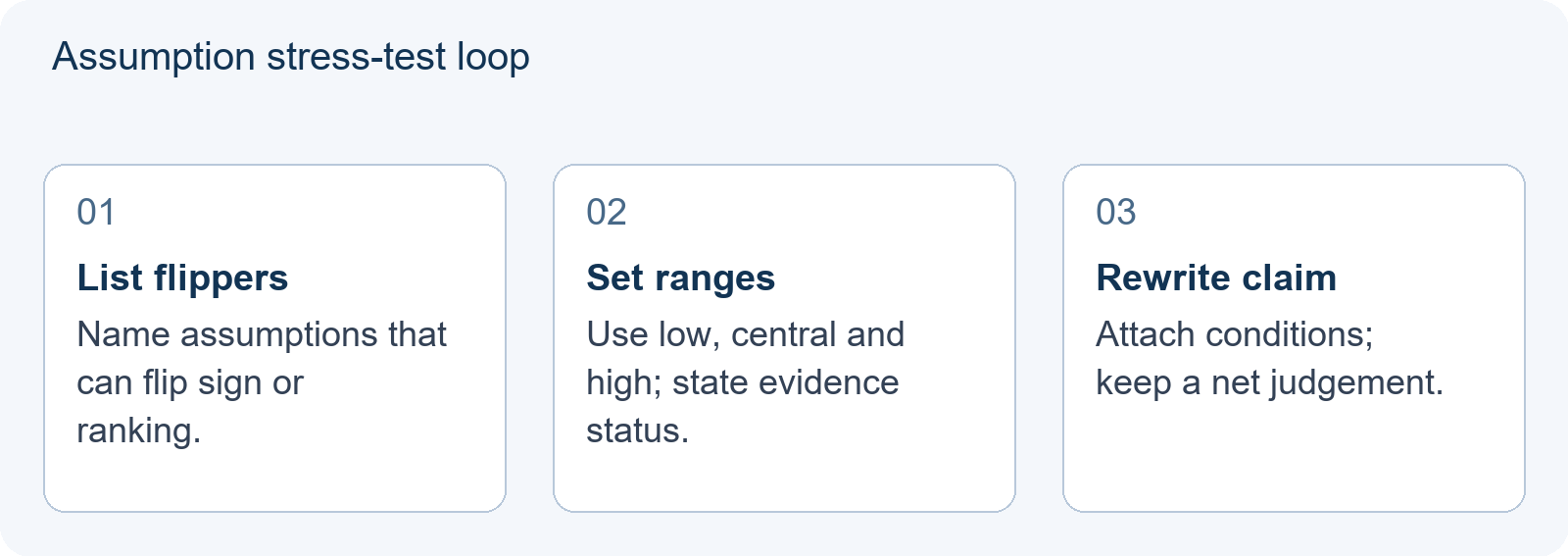
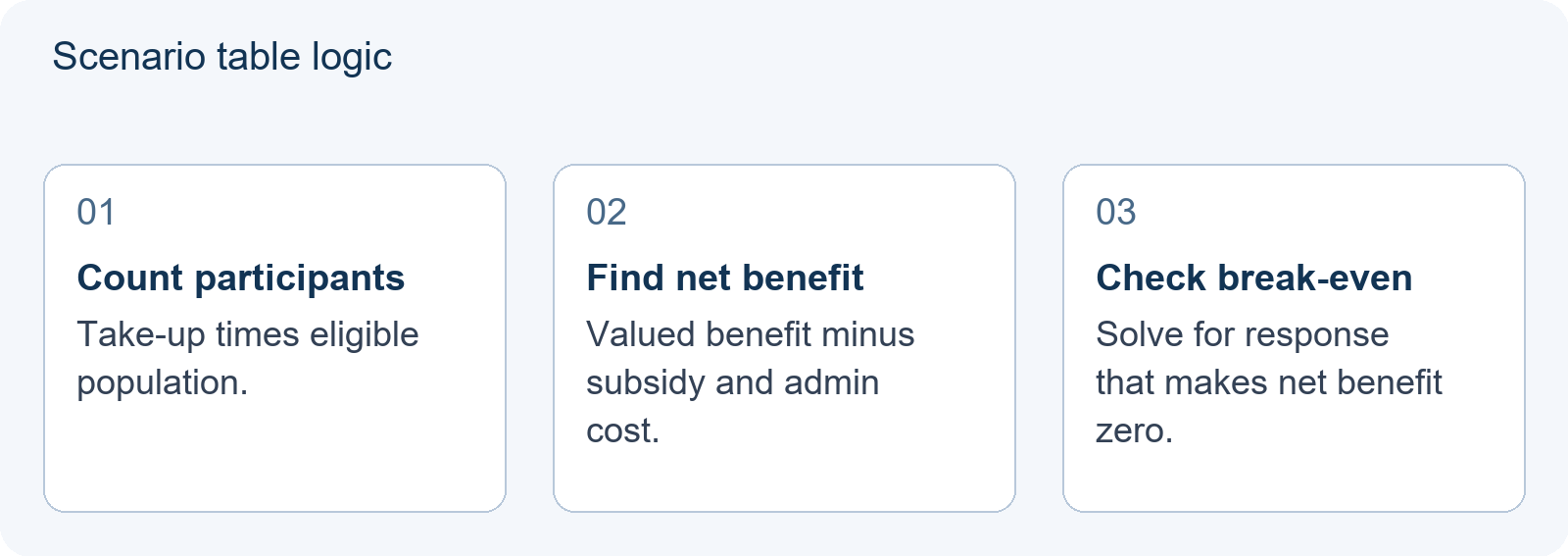
Use five columns: assumption, direction, plausible range, evidence status, flip threshold. The direction matters because it tells you whether the assumption supports or undermines your claim. The plausible range should be defensible from a source, a simple calculation or an explicitly labelled author assumption. The flip threshold is the value at which your net benefit becomes zero or the ranking of options reverses. For example, if a programme costs £128m and each additional employed parent is valued at £25,000, the break-even number of additional employed parents is 5,120. If 40,000 parents participate, the required employment response is 12.8%. That single threshold is more informative than a vague statement that take-up matters.
Do not list every assumption in the model. A 1,500-word essay cannot audit ten uncertainties with equal care. Select the ones that can change the sign or the ranking: take-up, behavioural response, unit cost, shadow price, time horizon or the value of a non-market outcome. Leave the rest fixed and say so. The ledger is a decision aid, not a confession of uncertainty.
Choose low, central and high cases without false precision
Three cases are enough for a short essay because the purpose is to test the logical boundary, not to simulate every possible world. The central case should be the one you can defend with the best available evidence. The low and high cases should be plausible bounds, not dramatic worst-case and best-case stories. A low case is not a strawman; it should be a world a reasonable reader could accept. A high case is not a wish; it should be a favourable but defensible scenario.
Use round numbers and state the evidence status. If the range is your own assumption, write ‘illustrative range’ and do not present it as an empirical finding. Avoid decimals that imply measurement you do not have; ‘about 40%’ is usually more honest than ‘41.7%’. The reader should be able to see why each case is included and what it does to the conclusion. Three cases also fit the word budget; a ten-row Monte Carlo table would not.
A worked teaching illustration: childcare subsidy stress test
The following is an original teaching illustration, not a real policy evaluation or evidence about any actual childcare programme. Suppose a hypothetical city considers a subsidy of £3,000 per participating family for 100,000 eligible families. Fixed administration costs £8m a year. The city values each additional employed parent at £25,000 a year in tax, output and other social benefits. Two assumptions are uncertain: take-up among eligible families and the employment response among participating parents. The table varies both together.
| Case | Take-up | Participants | Employment response | Additional employed parents | Annual net benefit |
|---|---|---|---|---|---|
| Low | 20% | 20,000 | 8% | 1,600 | -£28m |
| Central | 40% | 40,000 | 15% | 6,000 | +£22m |
| High | 60% | 60,000 | 20% | 12,000 | +£112m |
In the low case, 20,000 families participate and 8% of them, or 1,600 parents, move into work. The subsidy costs £60m, administration adds £8m, and the valued benefit is £40m, so the net benefit is -£28m. In the central case, 40,000 participate and 15% respond: 6,000 additional employed parents, £150m benefit, £128m cost, net +£22m. In the high case, 60,000 participate and 20% respond: 12,000 additional employed parents, £300m benefit, £188m cost, net +£112m.
The conclusion flips between the low and central cases. The central case breaks even at 5,120 additional employed parents, or a 12.8% response among 40,000 participants. The low case breaks even at 2,720 additional employed parents, or 13.6% of 20,000 participants; its assumed 8% response is below that. A responsible conclusion is therefore conditional, not a claim that the subsidy works in general.
If one assumption dominates, say so. Here take-up and employment response are multiplicative: a low take-up reduces both the cost and the number of people who can respond. The table shows the joint effect, not a claim that one variable alone decides the outcome. That distinction matters when you write the conclusion.

When the central case fails, change the claim before changing the numbers
If the central case produces a negative net benefit, do not rescue the essay by inventing a favourable high case. First narrow the claim: the subsidy may be justified on child-development grounds even if it is not cost-effective on employment grounds, but that requires a separate benefit category and evidence. Second, change the instrument: a smaller pilot, a tapered subsidy or a different target group may reduce cost or improve take-up, but each change needs its own mechanism. Third, argue for phased implementation with evaluation triggers. All three moves are analytical, not rhetorical. The worst response is to keep the same conclusion and quietly strengthen an assumption.
A stress test is not sensitivity theatre. Adding a table does not help unless the table changes what you say. If every scenario supports the same unconditional recommendation, either your range is too narrow or the recommendation was never really at risk. If the central case fails, the honest move is to rewrite the claim, not to bury the failure in a footnote.
Write a bounded conclusion in three sentences
A useful template is: ‘On the assumptions tested, X is justified when [condition]. It fails when [condition]. My net judgement is [recommendation], subject to [qualification].’ For the teaching illustration: ‘On the assumptions tested, the £3,000 subsidy is justified on employment grounds when take-up reaches about 40% and at least 13% of participating parents move into work. If take-up is 20% and response is 8%, the policy costs £68m and returns £40m in valued employment benefits. My judgement is therefore to support a pilot with evaluation triggers, not a permanent universal rollout.’ This is not weaker than an unqualified recommendation; it is more informative because the reader knows exactly what must be true.
The bounded conclusion should still make a judgement. Do not end with ‘it depends’ and leave the reader there. State the condition, state the failure point, then state what you would do. That final sentence is where the critical analysis becomes a recommendation rather than a list of caveats.
Map the move to the rubric and the word budget
The official essay page published by the LSESU Economics Society, ‘LSESU Economics Society Essay Competition – LSESU Economics Society Economics Challenge’ (page), lists 15 marks for critical analysis, including engagement with trade-offs, limitations and alternative explanations, and 20 marks for correct and effective application of economic theories. The stress test addresses that critical-analysis focus because it confronts limitations rather than hiding them. It supports the theory-application criterion when you explain the mechanism behind each assumption, not just insert numbers. The same page states that the essay is a maximum of 1,500 words excluding references and that Harvard referencing style is recommended. Keep the whole stress-test move to about 180-220 words: one sentence on the ledger, a compact table or three-sentence scenario, and a bounded conclusion. A self-scoring clinic can help you check whether the move is visible in the draft.
Do not treat the word ‘limitation’ as a substitute for showing how the limitation changes the argument. The rubric focus is engagement with trade-offs, limitations and alternative explanations; the stress test makes that engagement concrete by naming a threshold and a condition. Check the official page before relying on any remembered rule, especially for a later cycle.
Prepare a focused review request
If you ask a teacher or reviewer for help, do not send only the draft and ask whether it is good. Send four things: your one-sentence recommendation, the assumption ledger, the scenario table and one specific question, such as ‘Does my conclusion overclaim if take-up is 20%?’ This makes the review about the logic rather than line editing. A LSESU Essay Feedback: A Reviewer Brief That Produces Comments You Can Use can turn comments into a checklist. The aim is not to collect reassurance; it is to find the assumption that would change your mind before a reader does.
Frequently Asked Questions
How many assumptions should I stress-test in an LSESU essay?
A practical target is two or three. Choose the assumptions that can change the sign of your conclusion or reverse the ranking of two options. A longer list may fit a report, but it will crowd out the explanation and conclusion in a 1,500-word essay.
Do I need exact probabilities for each scenario?
No. Use defensible low, central and high values, label uncertain values as illustrative, and avoid false precision. The purpose is to test whether your judgement survives plausible changes, not to forecast the future.
Does a bounded conclusion make my essay sound weaker?
It can sound stronger because it tells the reader exactly when your recommendation holds and when it fails. The key is to keep a clear net judgement after stating the condition, rather than ending with an unresolved ‘it depends’.