The 2026 LSESU Economics Essay Competition Is Open: How to Enter
The 2026 cycle of the LSESU Economics Society Essay Competition is open and free to enter — with no registration of any kind. Five prompts, set by serving LSE Economics Department professors, are published openly, so you can read them and start today. The submission deadline is 1 September 2026.
After nine consecutive seasons, the Essay Competition continues to follow the format that has defined it since 2017 — one essay per candidate, up to 1500 words in English, judged blind against a published rubric. The 2026 cycle keeps every structural element of the competition unchanged: free entry, no nationality restriction, no school nomination process, and no participation certificate.
What is new for 2026
Two refinements come into the 2026 cycle. First, the integrity-screening pipeline now runs an AI-generation check on every submission in addition to the existing plagiarism check; both run automatically on receipt and any borderline result is reviewed manually before a disqualification is confirmed. Second, the Cambridge eligibility associated with the High Distinction tier is now formalised in writing in the awardee email rather than left implicit on the certificate.
Neither change affects how a candidate prepares or writes. The rubric — 25 points for argument and originality, 20 for economic theory, 15 each for evidence and critical analysis, 10 each for structure and citation, 5 for relevance to the prompt — is stable across seasons.
Five prompts, five professors
Each year the LSE Economics Department sets five prompts across the disciplinary range — labour economics, monetary policy, macro and inequality, public finance, and an applied topic of the year. The 2026 prompts cover work and monitoring devices, a Bank of England energy-policy brief, AI and labour inequality, taxing the top 1%, and the distributional effects of climate-friendly technology. Question 1 is set by Sir Christopher Pissarides, the 2010 Nobel laureate in Economics and LSE Regius Professor.
The same disciplinary rigour the Society applies internally is what we make available to high-school students through the Essay Competition.— LSESU Economics Society
When to start
As early as possible. The five questions are public, so you can start reading and drafting straight away; when your essay is ready, message us on WeChat for the submission link. Students who start by mid-June give themselves a comfortable ten-week writing window; students who start in late August are working against the clock. The deadline is 1 September 2026 at 23:59 GMT+1 — no extensions, no exceptions.
Schools intending to send a cohort of five or more students can arrange cohort submission via WeChat — there is no registration and no spreadsheet to file. Entering is free for the students and the school; results-day reports are issued to the coordinator in aggregate, with individual scores remaining confidential to each student.
- lsesuesec.org — official Essay Competition announcement and 2026 prompt release
- Competition rules — full format spec and 100-point rubric
- How to enter — free, no registration
The 2026 LSESU Economics Society Essay Competition is open and free, with no registration. The five questions are already public, so you can start today, and the deadline is 1 September 2026. See how to enter, or open the Contact page and scan the QR to reach us on WeChat. All contact is via QR scan only.

What is being set this year
The 2026 cycle releases five prompts in late May, each set by a different LSE Economics Department professor. Question 1 this year is set by Sir Christopher Pissarides, the 2010 Nobel laureate for search-and-matching market analysis, and it asks how firms should balance remote-work preferences against monitoring costs. Questions 2 through 5 in any given cycle typically cover macroeconomics, development economics, microeconomic theory, and political economy or behavioural economics; the editorial desk publishes a deep-dive for each prompt within seven days of release. Candidates choose exactly one of the five prompts, write up to 1500 words, and submit by 1 September.
Eligibility, in plain language
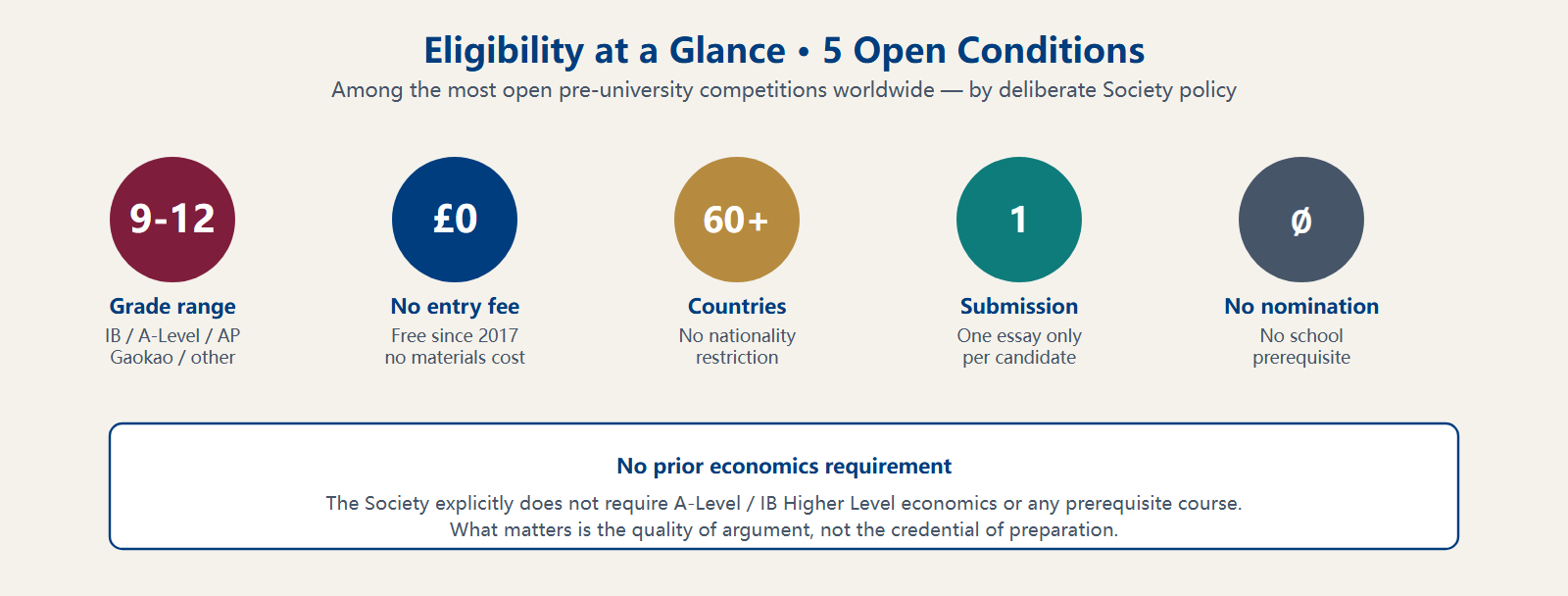
The competition is open to students in grades 9 through 12 of any school system worldwide — IB, A-Level, AP, the Chinese gaokao or international curricula, and any equivalent national programme. There is no nationality restriction, no school nomination process, no prior economics requirement, and no entry fee. One submission per candidate is the only structural constraint. The combination of being free, open, and judged by working LSE Economics Department professors is unusual in the global pre-university competition landscape, and explains why entries arrive from more than sixty countries each year.
How China-based candidates apply
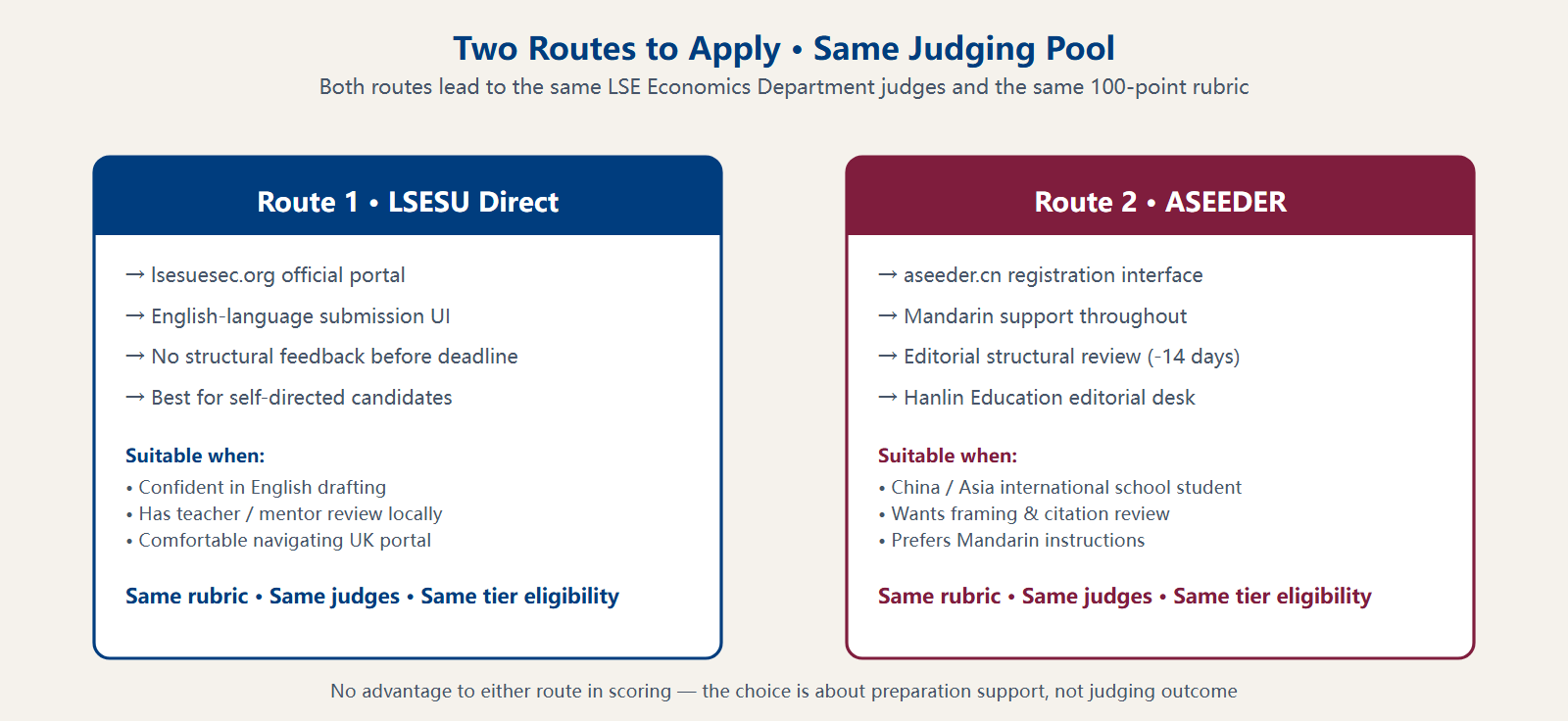
Candidates from mainland China, Hong Kong, Macao, Taiwan, and the wider Asia-Pacific region enter the same way as everyone else: through the competition’s own official page at lsesuesec.org. There is one entry channel and the Society runs it — this site is not an entry channel and cannot submit on your behalf. What we offer, independently, is preparation support for students working from China: structural feedback on a draft up to 14 days before deadline, Mandarin-language guidance through the submission process, and we can send you the current submission link if the official page is hard to reach. This site is operated by Hanlin International Education (翰林国际教育) and is not affiliated with the LSESU Economics Society or LSE. Using our support or not has no bearing on judging: the same LSE Economics Department professors read every essay against the same rubric, and eligibility for all distinction tiers is unaffected.
Timeline at a glance
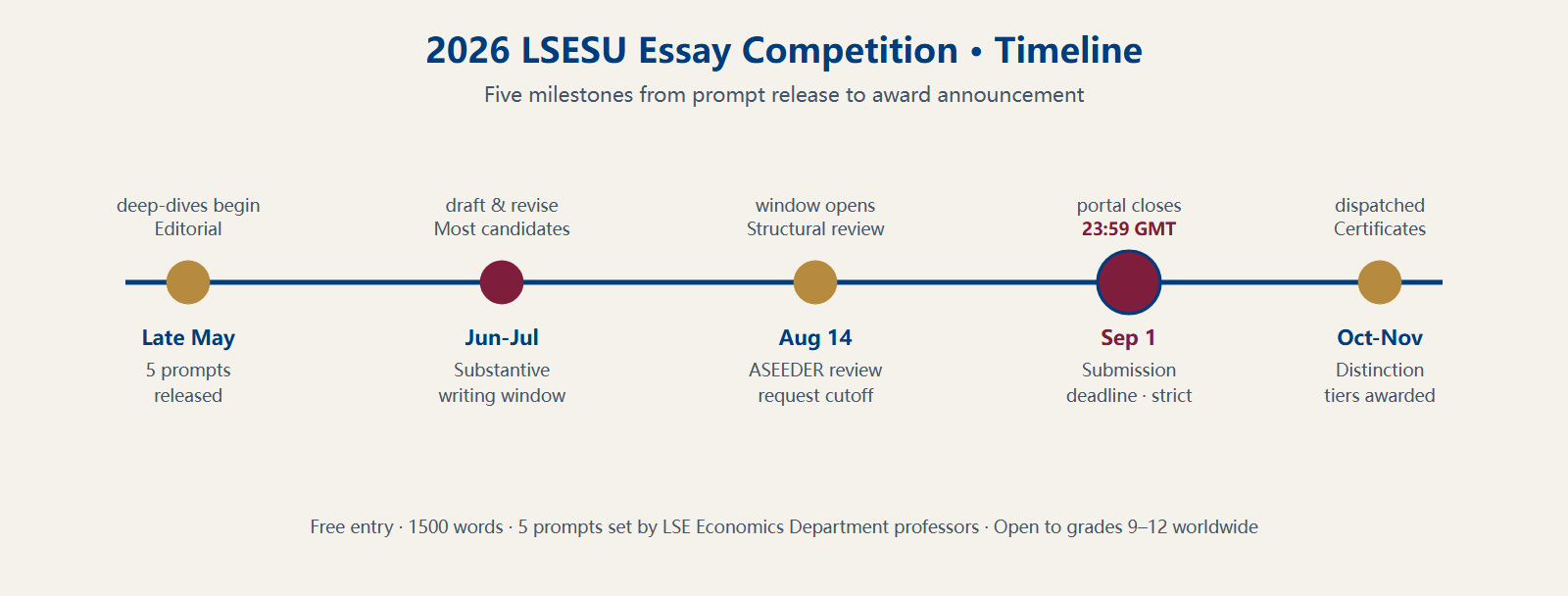
The 2026 cycle runs on a familiar rhythm. Late May to early June, the five prompts are released and the editorial deep-dives appear on this site. June and July are the substantive writing window — most successful candidates start drafting in early June and revise through July. August is the structural-review window for candidates who ask our editorial desk for feedback. The 1 September deadline is strict and is enforced for all entries; late submissions are rejected automatically rather than reviewed for late acceptance. Distinction tier results are published in October or November, and certificates dispatched in late autumn.
Frequently asked questions
Is the 2026 Essay Competition really free to enter, with no hidden costs?
Yes. There is no entry fee, no required materials purchase, and no school subscription. The competition has been free since 2017 and the Society has been explicit that this is a deliberate policy choice tied to the academic-merit-only judging standard.
If I am applying from a Chinese international school, is there a different route I should use?
No. There is a single entry route — the competition’s own official page — and every essay is read by the same LSE Economics Department judging pool against the same rubric. What this site adds is optional preparation support, provided independently by Hanlin International Education: structural feedback up to 14 days before deadline and Mandarin-language help with the submission process. Taking it or leaving it does not affect eligibility for any of the four distinction tiers.
Can I submit more than one essay if I have ideas for several prompts?
No. The competition is strictly one essay per candidate, on exactly one of the five prompts. Multiple submissions from the same candidate are detected during screening and the first submission is the only one judged; subsequent entries are discarded.
What happens if I am cutting it close to the deadline on 1 September?
Submissions are accepted from mid-August until 23:59 on 1 September 2026 — message us on WeChat for the link. Historical late-arrival rates on deadline day are very low, but our editorial desk recommends submitting at least 48 hours before deadline. Late submissions due to candidate-side connectivity issues are not accepted as an appeal ground.
Continue your prep →
Now that the season is open, the next step is turning it into a scoring entry. Start here:
- How to write the 1,500-word essay — the paragraph-by-paragraph method for a 1,500-word entry
- Inside the 100-point rubric — where the marks actually are, criterion by criterion
- Question 1 deep-dive (Pissarides) — how to build an argument on a set question
- LSESU vs John Locke vs Marshall — how the three essay prizes compare for admissions
Filed under2026 Season · China Pathway · Foundation · Submission Deadline
Published by the editorial desk of this site, operated independently by Hanlin International Education (翰林国际教育) for China-based international-school students. This site is not the official competition website and is not affiliated with the LSESU Economics Society or the London School of Economics. Official rules are set by the competition and change yearly, so always confirm current details on the official site lsesuesec.org. Confirmed errors are corrected within 7 working days.