Referencing and Academic Integrity in the LSESU Essay (2026)
For the LSESU Economics Society Essay Competition 2026, reference every borrowed fact, figure and idea in a consistent style (Harvard is recommended), keep your full reference list outside the 1,500-word limit, and write the analysis yourself. Citations carry 10 of the 100 rubric points, and every essay is AI-screened and plagiarism-checked on receipt — a breach means immediate disqualification, with no appeal. The safest path is real human reasoning, not detector-gaming. Always confirm current rules on the official LSESU Economics Society pages.
Why referencing is a scoring criterion, not an afterthought
It is tempting to treat the reference list as clerical work you bolt on at 11pm before the deadline. The published rubric says otherwise. “Citations & Sources” is one of seven weighted criteria, worth 10 of 100 points — the same weight as “Structure & Clarity,” and double the 5 points given to “Topic Relevance.” Referencing is not where you win the competition, but it is an easy place to leak marks that a stronger candidate will not.
More importantly, citations are the plumbing that makes your other criteria believable. “Evidence & Examples” (15 points) only counts if the reader can trust where your numbers came from. “Argument & Originality” (25 points) reads as credible only when your claims are anchored to real sources rather than asserted. A judge skimming an unreferenced statistic has two options: take it on faith, or discount it. Good referencing removes that doubt. (For the full breakdown of why each criterion is weighted the way it is, see our companion piece inside the 100-point rubric; this article is about the mechanics — how to actually do it.)
One practical rule that students miss every year: your reference list and in-text citations sit outside the 1,500-word count. The official guidance states the limit excludes titles, subtitles and references. So citing properly costs you nothing in word budget — there is no excuse to drop a source to “save words.” Confirm the exact wording on the official LSESU Economics Society pages, because formatting rules are restated each cycle.
Harvard referencing: the format the competition recommends
The competition recommends Harvard referencing, and our reading of the official guidance is that any single consistent style is accepted — the cardinal sin is mixing styles. We recommend Harvard simply because it is the one the organisers name, it is the house style of most UK economics departments, and it is forgiving for the data-heavy, report-style sources economics essays lean on (central-bank releases, OECD tables, working papers).
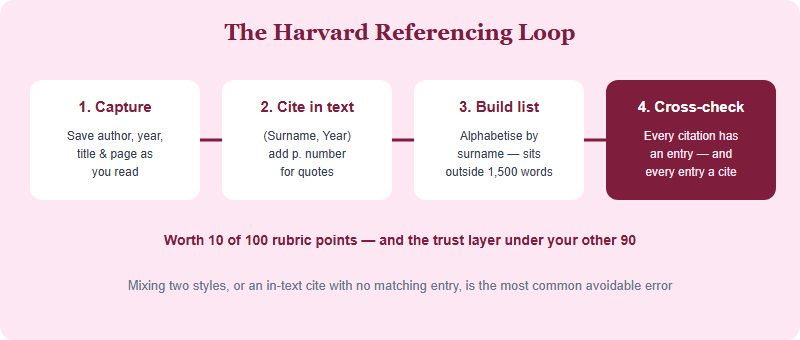
Harvard is an author–date system. In the body of the essay you give the author’s surname and year in brackets; at the end you give the full details in an alphabetised reference list. Get these two halves to agree and you have done 90% of the job.
| Source type | In-text citation | Reference-list entry (Harvard pattern) |
|---|---|---|
| Journal article | (Pissarides, 2000) | Pissarides, C. (2000) Equilibrium Unemployment Theory. 2nd edn. Cambridge, MA: MIT Press. |
| Direct quotation | (Krugman, 2009, p.45) | Author, Initial. (Year) Title. Place: Publisher. (page number required for quotes) |
| Institutional report | (IMF, 2025) | International Monetary Fund (2025) World Economic Outlook. Washington, DC: IMF. |
| Web page / dataset | (Bank of England, 2025) | Bank of England (2025) Monetary Policy Report. Available at: URL (Accessed: day month year). |
| Two authors | (Acemoglu and Robinson, 2012) | Acemoglu, D. and Robinson, J. (2012) Why Nations Fail. London: Profile Books. |
| Three or more | (Banerjee et al., 2015) | List all authors, or first author + “et al.” — be consistent with whichever you choose. |
Four habits separate a clean reference section from a messy one:
- Cite where the idea appears, not just at the end. If a paragraph leans on one paper, the bracket belongs in that paragraph — not parked in a bibliography the judge has to cross-check.
- Add a page number for any direct quotation — e.g. (Author, Year, p.12). Quoting without a page reference is the single most common Harvard error.
- Alphabetise the reference list by surname, and make sure every in-text citation has a matching entry and vice versa. Orphan citations look careless.
- Date your web sources. Central-bank pages and statistics get revised, so include an “Accessed:” date for anything online.

What the AI rules actually say in 2026
This is the part students most often get wrong by skimming. The official guidance is blunt: “Plagiarism and AI-generated content are strictly forbidden and adequate referencing is vital.” The Organising Committee runs AI-detection and plagiarism checks on every submission before judging even begins, and an essay found in breach “will be disqualified from the judging process immediately.” There is no extension and no appeal route described — one global deadline of 1 September 2026, 23:59 GMT+1, applied uniformly.
“AI-generated content” does not mean “you may never open an AI tool.” It means the text and viewpoints you submit must be your own. LSE’s own published guidance for its essay competitions draws the line cleanly, and it is the clearest map we have of the spirit the markers apply:
| Likely acceptable (a tool, not a writer) | Forbidden (the tool becomes the author) |
|---|---|
| Grammar and spell-checking text you wrote | Submitting any text produced by a generative-AI system |
| Searching for relevant literature to read yourself | Quoting or relying on AI output as a source |
| Clarifying a term or concept so you can then research it | Using AI to alter or improve the content of your argument |
| Sketching a rough outline you then write and rethink alone | Generating paragraphs and lightly paraphrasing them |
Two principles fall straight out of that table. First, generative AI is not an academic source — LSE states explicitly that AI output “cannot be quoted or relied upon” and is “not considered an academic or peer-reviewed source.” So you can never cite ChatGPT to support a claim; trace the claim to a real paper or dataset instead. Second, the boundary is about content versus mechanics: polishing your own sentences is help; outsourcing the thinking is misconduct. These are our reading of the published rules — the competition sets its own policy and it can change, so confirm the current wording on the official LSESU Economics Society pages before you submit.
Build real reasoning — don't try to game the detector
Every year students ask the wrong question: “How do I get my AI-written essay past the detector?” The right question is “How do I make the essay so obviously, traceably mine that detection is a non-event?” Detector-gaming is a losing strategy on three counts: detectors are imperfect and produce false positives that can flag genuine writing, paraphrasing tools leave statistical fingerprints, and even a clean detector pass does not buy you the analytical depth that the 25-point “Argument & Originality” criterion actually rewards. You cannot fake your way to an original thesis.
The honest method is also the higher-scoring one. Here is the workflow we coach students through — it produces both authentic prose and a clean integrity record:
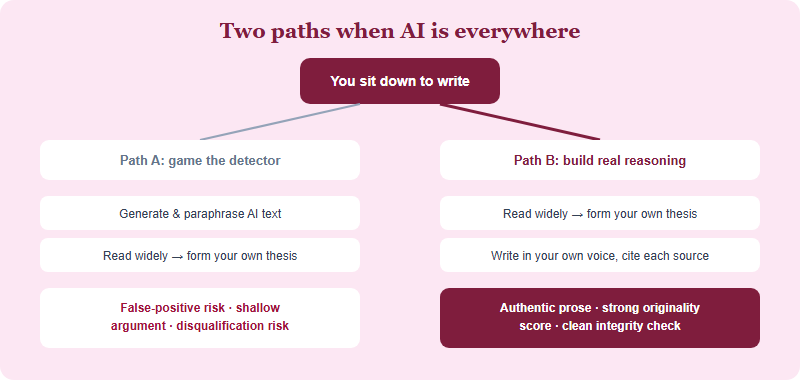
Concretely, do this:
- Read three to five real sources before you draft a word. Mix a textbook chapter, a working paper and a current dataset. Your own thesis emerges from the friction between sources — that friction is where “originality” lives.
- Draft from notes, not from a screen of AI output. If the sentences started in your head, they will sound like you, and they will pass any detector because they are genuinely human.
- Keep a working source log as you go. Every time you use a number or an idea, paste the citation into a running list. This becomes your reference section and guarantees nothing goes uncredited — the fastest route to a clean plagiarism check.
- Quote sparingly, paraphrase honestly, cite both. Paraphrasing without a citation is still plagiarism. The test is simple: if the idea is not yours, it needs a bracket.
- Read your draft aloud. Passages that do not sound like your own voice are exactly the passages markers — and detectors — flag. Rewrite them in your words.
If you are still mapping out how the whole competition works, start with what the LSESU Essay Competition is, then read the 2026 prompts and rubric so your reading and your referencing are aimed at the question from day one.
A first-party note from a desk that coaches essay writers
Hanlin International Education operates this site independently — we are not a partner of, and are not authorised by, the LSESU Economics Society or LSE — and our editorial desk reviews a large volume of student drafts each cycle. The single most common integrity slip we see is not deliberate cheating — it is the uncited paraphrase: a student reads a source, restates it in their own words, and assumes that because the wording changed, no citation is needed. It still needs one. The borrowed thing is the idea, not just the sentence.
A note on track record, stated honestly so you can weigh it: our essay-coaching results to date are in competitions such as the John Locke Institute essay prizes, not the LSESU competition itself, and we never relabel one as the other. What transfers is the discipline — building an original argument from real sources and referencing it cleanly — which is exactly what this rubric rewards. We make no guarantee of any prize or admissions outcome; no reputable coach can, and the rules and judging are set entirely by the competition. Our role is to help you submit work that is unmistakably your own.
Frequently asked questions
Do references count toward the 1,500-word limit?
No. The limit excludes titles, subtitles and references, so cite generously — it costs you no word budget. Confirm on the official site.
Which referencing style should I use?
Harvard is recommended. A single consistent style is what matters most — never mix two styles in one essay.
Can I use AI to help at all?
Grammar/spell-checks and literature searches are generally fine; submitting AI-generated text or citing AI as a source is forbidden and triggers disqualification.
What happens if my essay fails the AI or plagiarism check?
It is disqualified before judging, with no appeal route described. Every submission is screened on receipt, so write genuinely original work.
Published by the editorial desk of this site, operated independently by Hanlin International Education (翰林国际教育) for China-based international-school students. This site is not the official competition website and is not affiliated with the LSESU Economics Society or the London School of Economics. Official rules are set by the competition and change yearly, so always confirm current details on the official site lsesuesec.org. Confirmed errors are corrected within 7 working days.
Filed underAcademic Integrity · Harvard Style · Referencing