Common LSESU Essay Mistakes That Lose Marks (2026)
The most common LSESU Essay Competition mistakes that lose marks in 2026 are: going off-topic, exceeding the 1500-word limit (references excluded), thin or non-Harvard citations, having no counterargument, and writing descriptively instead of analytically. Each maps to a specific slice of the official 100-point rubric — and most are fixable in a single editing pass before you submit directly to the official portal. There is no registration step; you simply choose one of the five public prompts and upload.
Why mistakes matter more than brilliance here
The LSESU Economics Society Essay Competition is marked against a published 100-point rubric calibrated by serving LSE faculty across a pool of thousands of essays from sixty-plus countries. That structure rewards the essay that loses the fewest marks, not the one with the cleverest single idea. A strong argument that runs 1,750 words, cites a blog instead of a journal, and never tests a counterpoint can quietly bleed 20–30 marks across four categories — while a disciplined 1,480-word essay that does the basics cleanly stays in contention.
So the highest-leverage move for most applicants is not “write something genius.” It is “stop donating marks.” This guide walks the five mistakes our editors see most often when reviewing drafts from China-based international-school students, maps each to the exact rubric line it damages, and gives you a concrete fix you can apply today. For the rubric itself, see our breakdown of the 100-point rubric and the current 2026 prompts and grading; if you are new to the competition, start with what the LSESU Essay Competition is.
| Rubric criterion | Marks | The mistake that costs you here |
|---|---|---|
| Argument & Originality | 25 | No clear thesis; no counterargument; descriptive not analytical |
| Application of Economic Theories | 20 | Naming a model but never using it to drive the argument |
| Evidence & Examples | 15 | Assertions with no data; examples that do not test the claim |
| Critical Analysis | 15 | Listing both sides without weighing them; no “so what” |
| Structure & Clarity | 10 | Over the word limit; rambling intro; no signposting |
| Citations & Sources | 10 | Weak sources; inconsistent or missing Harvard referencing |
| Topic Relevance | 5 | Answering a question the prompt did not ask (off-topic) |
Mistake 1 · Off-topic — answering the question you wish they asked
This is the cheapest way to lose marks and the easiest to avoid. Each year five questions are set by professors in the LSE Department of Economics, and you respond to one of them. Topic Relevance is its own scored line (5 marks), but off-topic drift does collateral damage: an essay that wanders off the prompt also weakens its Argument score, because the thesis no longer answers anything the judges are looking for.
The classic version is loading a pre-written favourite. A student who has read widely on, say, carbon taxes will sometimes bend an AI-and-employment prompt toward carbon taxes because that is where they feel strong. Judges notice instantly. The fix is mechanical:
- Copy the exact prompt to the top of your draft and keep it there while you write. Delete it only at the end.
- Underline the command verb — “evaluate,” “to what extent,” “discuss.” An “evaluate” prompt that gets a description back has already capped its own marks.
- Write your thesis as a direct answer to that verb in one sentence before you write anything else. If you cannot, you do not yet understand the question.
- Re-read the prompt after every section and ask: did this paragraph move the prompt’s question forward, or my own?
Do not invent or paraphrase a specific 2026 prompt from memory — the wording matters, and the five questions are public on the official site. Read them there and quote the one you choose precisely.
Mistake 2 · Over the 1500-word limit
The cap is 1500 words, excluding references. This is not a soft target. An essay that overruns signals weak editing before a judge has read a single argument, and it directly threatens the Structure & Clarity line (10 marks). Worse, applicants who pad to hit some imagined “longer is better” standard almost always dilute their best paragraph — the one that would have earned Argument marks — by surrounding it with filler.
Treat 1500 as a budget you spend, not a ceiling you graze. A workable allocation for a single-question economics essay:
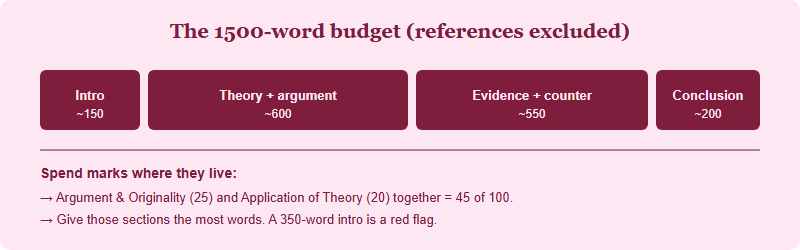
Practical editing tactics that recover words without losing substance: cut adverbs and hedges (“very,” “arguably,” “it could be said that”), replace a sentence of throat-clearing with the claim itself, and delete any sentence that restates the previous one. If you are 200 words over, the fix is almost never one big cut — it is fifty small ones. Format conventions (12pt Times New Roman, 1.5 spacing, page numbers, and the file name “FORENAME SURNAME + QUESTION X”) are on the official site; confirm them there before you export.

Mistake 3 · Weak or inconsistent citations
Citations & Sources is worth 10 marks, and high-quality sources cited consistently in Harvard style is exactly what that line rewards. Two failure modes are common. The first is thin sourcing: a 1,500-word economics essay leaning on one news article and a Wikipedia page reads as under-researched, no matter how fluent the prose. The second is inconsistency: mixing Harvard with footnotes, or citing in-text but never building a reference list.
There is also a hard line you must not cross. Plagiarism and AI-generated content are strictly forbidden, and adequate referencing is described as vital; essays in breach are immediately disqualified. “Avoiding AI detection” is the wrong goal — the right goal is doing genuine, human, well-attributed research. If a sentence is not yours, cite the person it belongs to.
| Weak sourcing (loses marks) | Strong sourcing (earns the 10) |
|---|---|
| One news article doing all the work | A mix of academic and authoritative sources, used where each is strongest |
| Wikipedia cited as the evidence | Wikipedia only as a doorway to its cited primary sources |
| In-text citations with no reference list | Consistent Harvard in-text + a complete reference list |
| A statistic with no source at all | Every number traceable to a named, datable source |
| Mixing Harvard, footnotes, and bare URLs | One referencing system, applied everywhere |
A quick self-test before you submit: open your reference list and ask whether a sceptical reader could find each source and verify the claim it supports. If a “fact” has no home, either source it or cut it.
Mistake 4 · No counterargument
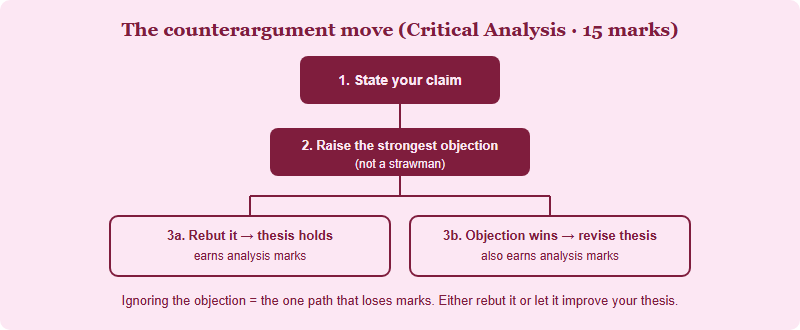
This is the mistake that separates a competent essay from a competitive one. Critical Analysis is worth 15 marks, and it is precisely where one-sided essays stall. A piece that argues a position hard but never engages the strongest objection to it cannot score well on analysis, because analysis is the act of weighing one claim against another.
Note the trap on the other side: simply listing “on one hand / on the other hand” without ever resolving the tension is also weak. Judges reward the essay that raises a genuine counterpoint and then answers it, showing why the writer’s position survives the challenge. That single move feeds three rubric lines at once — Critical Analysis (15), Argument & Originality (25), and Application of Economic Theories (20), because the best rebuttals are usually theoretical.
Mistake 5 · Descriptive, not analytical
This is the most common ceiling on otherwise capable essays, and it directly limits the biggest block on the rubric: Argument & Originality at 25 marks. A descriptive essay explains a topic — what a carbon tax is, how automation works, why inflation happens. An analytical essay argues a position about it and uses economic theory to defend that position. Judges set questions with command verbs (“evaluate,” “to what extent”) precisely to demand the second kind.
The tell is the “so what” test. After each paragraph, ask: did I just inform the reader, or did I advance a claim? Description has its place — you may need a sentence to define a term — but if three paragraphs in a row only inform, your Argument and Critical Analysis scores are both being capped. Application of Economic Theories (20 marks) is the bridge: naming a model is description; using the model to predict, weigh a trade-off, or settle a dispute is analysis.
- Description: “A carbon tax raises the cost of emitting carbon.”
- Analysis: “Because demand for energy is price-inelastic in the short run, a carbon tax shifts the burden onto consumers before it changes firm behaviour — which is why its distributional effect, not its efficiency, is the real political constraint.”
The second sentence names a concept (price elasticity), applies it, and reaches a contestable conclusion. That is what earns marks across the top three rubric lines simultaneously.
A first-party note on fixing these in practice
Our editorial desk, operated independently by Hanlin International Education, reviews essay drafts for exactly these five patterns. The single most valuable thing a coach does is not “make the writing better” in the abstract — it is the rubric-mapped diff: pointing at the paragraph that informs instead of argues, the claim with no source, the objection you never raised. We make no guarantees about results, and we do not write essays for students (the competition forbids it and disqualifies for it). For honest signal on what disciplined essay coaching can do, our teams have a strong record in comparable analytical-essay competitions such as the John Locke Institute essay prize — track record we report as John Locke wins, never relabelled as LSESU outcomes. The reusable skill is the same: argue, don’t describe; weigh, don’t list; source everything.
Frequently asked questions
Do I need to register before writing my LSESU essay?
No. There is no registration step. You choose one of the five public prompts, write your essay, and submit directly to the official portal at lsesueconsoc.org/competitions/.
What is the single biggest mark-loser?
Writing descriptively instead of analytically — it caps Argument & Originality, the rubric’s largest block at 25 marks. Always argue a position and defend it with theory.
Does the 1500-word limit include references?
No. The 1500-word maximum excludes references, so there is no word-count reason to under-cite. Confirm current format rules on the official site before you export.
What happens if I miss the deadline or use AI?
The deadline is 1 Sep 2026 at 23:59 (GMT+1) and late entries are not accepted; AI-generated content and plagiarism lead to immediate disqualification.
Published by the editorial desk of this site, operated independently by Hanlin International Education (翰林国际教育) for China-based international-school students. This site is not the official competition website and is not affiliated with the LSESU Economics Society or the London School of Economics. Official rules are set by the competition and change yearly, so always confirm current details on the official site lsesuesec.org. Confirmed errors are corrected within 7 working days.