LSESU Economics Challenge 2027: A 16-Week Plan for the 9 January Paper, for Students Coming from the Essay
The LSESU Economics Challenge is not the Essay Competition this site covers. It is a separate competition run by the same Society: one 90-minute paper of 50 multiple-choice questions on 9 January 2027, sat on 8 January in some regions because of time differences. Unlike the essay, it needs registration, which closes on 27 December 2026. If you wrote an essay this summer, some of that work carries over. Most of the test skill does not.
What is confirmed, and by whom
Two sources describe the 2027 paper, and they deserve different weight. The Society's own Challenge page states the core rules. Our organising channel's September materials, prepared for students in China, add the start time, the award bands and the team structure, none of which the official page publishes. The table keeps the two apart.
| Item | Detail | Source |
|---|---|---|
| Date | Saturday 9 January 2027; the official page notes that time differences put the paper on 8 January in some areas | Official page |
| Time | 09:30 to 11:00 | Channel materials; confirm the start time in your own time zone |
| Registration | Closes 27 December 2026 | Official page |
| Format | Individual; 50 multiple-choice questions; 90 minutes; in English | Official page |
| Where you sit it | Online or on campus; the channel describes the in-person option as a paper sitting | Official page; channel materials |
| Who can enter | Grades 9 to 12 | Official page |
| Content | Microeconomics, macroeconomics and TMUA-aligned theoretical and applied mathematics, designed as 50% high-school curriculum and 50% LSE first-year economics | Official page |
| Question setting | “set and academically reviewed by an LSE economics professor”; Dr Judith Shapiro, a Senior Lecturer in Practice in LSE's Department of Economics, is listed as Supporting Professor | Official page |
| Individual awards | Super gold for the top 5% of entrants, then gold, silver, bronze and merit for the top 15%, 30%, 45% and 60% | Channel materials |
| Certificates | Not stated on the official page | Confirm what certificates are issued when you register |
| Team awards | Team awards are offered, and a school needs five or more entrants to be considered for the school team award; the team tiers are not stated on the official page, so confirm them when you register | Channel materials |
| Test centre | Hanlin is an authorised exam centre | Channel materials |
| Fee, marking rule, results date | Not stated on the official page | Confirm when you register |
One line in that table is worth pausing on if you know the essay. The Essay Competition's official page says only winning students receive certificates and participation certificates are not available. The Challenge page says nothing about certificates at all, so do not assume the essay's rule carries across. Two competitions run by one Society can differ on points like this, and each should be described only from its own published rules.
What your essay summer gave you, and what it did not
An essay rewards depth on one question built over weeks. The Challenge samples breadth at speed: 90 minutes for 50 questions is 108 seconds each. Some of your essay work transfers, so know exactly which part before you plan.
How much transfers depends on the question you answered. If you wrote on monetary policy after an energy price shock, you have already thought hard about inflation, interest rates and imported costs. If you wrote on home working and monitoring, you have worked with incentives inside firms. The AI, top 1% tax and green technology questions all took you into labour markets, taxation and distribution. The 2026 questions and published criteria are a quick reminder of which of these you actually covered.
| Essay habit | On the Challenge | What to add |
|---|---|---|
| Reading one question in depth | Helps with a handful of items at most | A topic checklist across microeconomics, macroeconomics, statistics and mathematics |
| Weighing a counter-argument | A multiple-choice item has one keyed answer, not a stronger and a weaker case | Elimination: strike the options that cannot be true, not the ones that merely seem less convincing |
| Checking every figure and source | The same care prevents arithmetic slips | The same care, delivered at an average of 108 seconds per item |
| Explaining a model in prose | You know what the model says | Computing with it: profit, labour demand, multipliers and index numbers |
| Drafting over weeks | No direct transfer | Timed sets from the midpoint of the plan onwards |
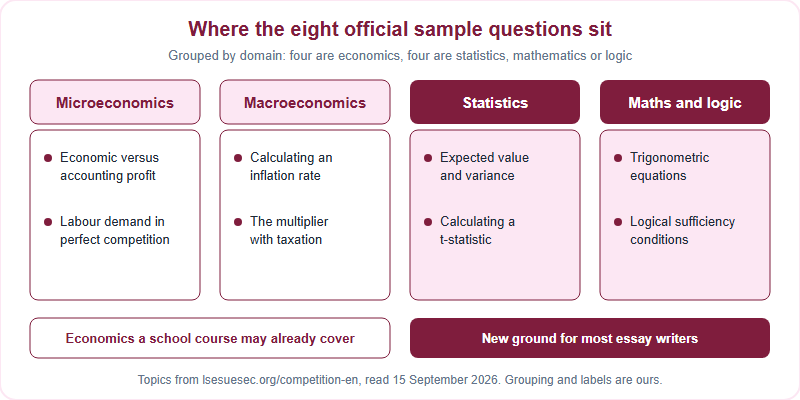
That split is the one to plan around. The official page describes the mathematics as TMUA-aligned. The Test of Mathematics for University Admission is an admissions test some UK universities use for mathematics and economics courses, and its reasoning questions include the if-and-only-if logic seen in the sample list. You need not have sat it, but you do need expected value, variance and what a t-statistic measures, none of which an IB or A-Level economics course teaches on its own.

The 108-second problem: pacing and guessing
Not every question costs the same, so treat 108 seconds as an average rather than a clock on each item. A two-pass method suits this format: answer anything you can settle quickly and mark the rest, then spend the banked time on the marked items, keeping the last few minutes to check that every answer you meant to give is recorded.
| Item type | Official sample topic | Working target |
|---|---|---|
| Concept check | Economic versus accounting profit | 45 to 60 seconds |
| One-step calculation | An inflation rate | 60 to 90 seconds |
| A model with a twist | The multiplier with taxation | 90 to 150 seconds |
| Statistics | Expected value and variance; a t-statistic | 90 to 150 seconds |
| Mathematics or logic | Trigonometric equations; sufficiency conditions | Up to 150 seconds, then park it and move on |
Guessing is where the marking rule decides everything, and the official page does not state it. The only version we have seen is the 2025 paper's instruction sheet as reproduced in our channel's materials. It appears to show 2 points for each correct answer on a paper scored out of 100, no points for unanswered questions, and a deduction for wrong answers, but the reproduction is partly illegible and it is a previous year's sheet, so treat the whole rule, including whether any deduction applies at all, as unconfirmed until you have the 2027 instructions in front of you.
If the rule turns out to be plus 2 for a correct answer and minus 1 for a wrong one, the arithmetic is simple. A guess among four remaining options is worth minus 0.25 marks on average, among three it is worth exactly nothing, and between two it is worth plus 0.5. That holds however many options the question started with, so the working rule is to guess when you are down to two, treat three as break-even and skip it when time is short, and otherwise leave the answer blank. If it turns out there is no deduction at all, never leave a blank.
A 16-week plan to 9 January
The plan starts on Monday 21 September. It front-loads diagnosis, builds the school-level half before the university-level half, and reserves four weeks for timed practice, because speed is the one skill an essay summer did not build.
| Weeks | Dates | Focus | Output by the end |
|---|---|---|---|
| 1 to 2 | 21 Sep to 4 Oct | Work the eight official sample questions untimed; list every topic you could not do; start an error log by domain | A ranked list of gaps |
| 3 to 6 | 5 Oct to 1 Nov | The school-level half: costs and profit, market structures, labour demand, elasticity; national income, multipliers with taxation, price indices, monetary and fiscal policy | One page of definitions and formulas per domain |
| 7 to 10 | 2 Nov to 29 Nov | The first-year bridge: probability, expected value and variance, sampling and the t-statistic; an algebra and trigonometry refresh; necessary and sufficient conditions | A 20-question mixed set each week, first untimed, then timed |
| 11 to 14 | 30 Nov to 27 Dec | Timed mixed practice at the 108-second average; two full 50-question rehearsals; registration completed well before 27 December | Two rehearsal scores and a shrinking error log |
| 15 to 16 | 28 Dec to 9 Jan | Taper: the error log only, short timed sets every other day, and the logistics of an online or campus sitting | A settled routine for the day itself |
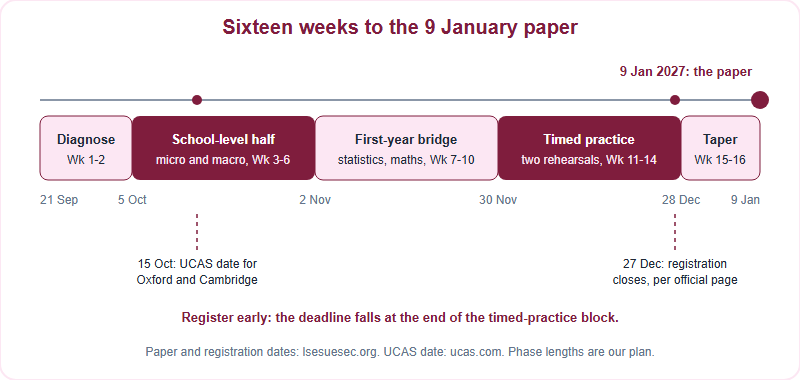
For practice volume, use the preparation material the official page says the Society provides, the multiple-choice practice attached to your economics course, and your mathematics course for the statistics and trigonometry. In Year 13, protect the week around 15 October, the UCAS date for Oxford, Cambridge and most medicine courses, and let weeks 3 to 6 run long rather than squeezing them.
Who should sit it, and how a school should plan a cohort
A Year 12 student who wrote the essay is the strongest fit. A January result does not replace the essay; it sits beside it. An admissions reader who later sees an argued essay, a timed quantitative result and predicted grades that match both is looking at three documents that corroborate one another, and that agreement is what makes a profile credible. No single result guarantees an outcome, but a quantitative result that confirms what the essay suggested reads more convincingly than either would alone.
A Year 13 student applying this cycle should be realistic about timing. The paper falls four days before UCAS's 13 January 2027 date for most courses, and no results date is published, so do not plan to cite it in that application. Sit it for the skill, and consider starting at week 7 if your autumn already carries applications and admissions tests.
A Grade 9 or 10 student is eligible, but half the paper is designed at first-year university level. Treat an early sitting as a benchmark for the next attempt rather than a verdict, and do not read a band as a measure of material you have not yet been taught.
A department sending a cohort should do the arithmetic early. Per the channel's materials, a school needs at least five entrants to be considered for the school team award, and below five no school team score is calculated; everyone still sits the paper individually. Decide by the end of November who sits, whether each student sits online or on campus, and who confirms the start time in the school's time zone. In many school calendars 27 December falls inside the winter break, so a cohort's working deadline is the last week of term. If students are also weighing next summer's essay, our overview of the Essay Competition explains how that separate competition works.
Frequently asked questions
Is the LSESU Economics Challenge the same as the Essay Competition?
No. It is a separate 50-question multiple-choice paper on 9 January 2027, with registration by 27 December. The essay needs no registration.
How long is the paper and how many questions are there?
The official page lists 50 multiple-choice questions in 90 minutes, in English, sat individually online or on campus.
What mathematics should I expect on the paper?
The official page describes TMUA-aligned maths. Its sample topics include expected value, variance, a t-statistic, trigonometry and logic.
Can Grade 9 or 10 students sit the Challenge?
Yes. The official page lists Grades 9 to 12. Half the content is designed at first-year level, so treat an early sitting as a benchmark.
Published by the LSESU Essay Competition editorial desk, operated by Hanlin Education for China-based international-school students. Official rules are set by the competition and change yearly — confirm current details on lsesuesec.org. Errors are corrected within 7 working days.