LSESU Essay Competition Results: What Happens After You Submit and How to Use the Wait
Submitting your 1,500-word essay to the LSESU Economics Society Essay Competition marks a significant milestone. The competition, set annually by LSE professors and free to enter for students in grades 9–12 worldwide, closes on 1 September. But once your file is uploaded, a quieter period begins—one that raises practical questions: When will results come? How are winners notified? And what should you do with your essay and your time while waiting?
What We Know About Results Timing
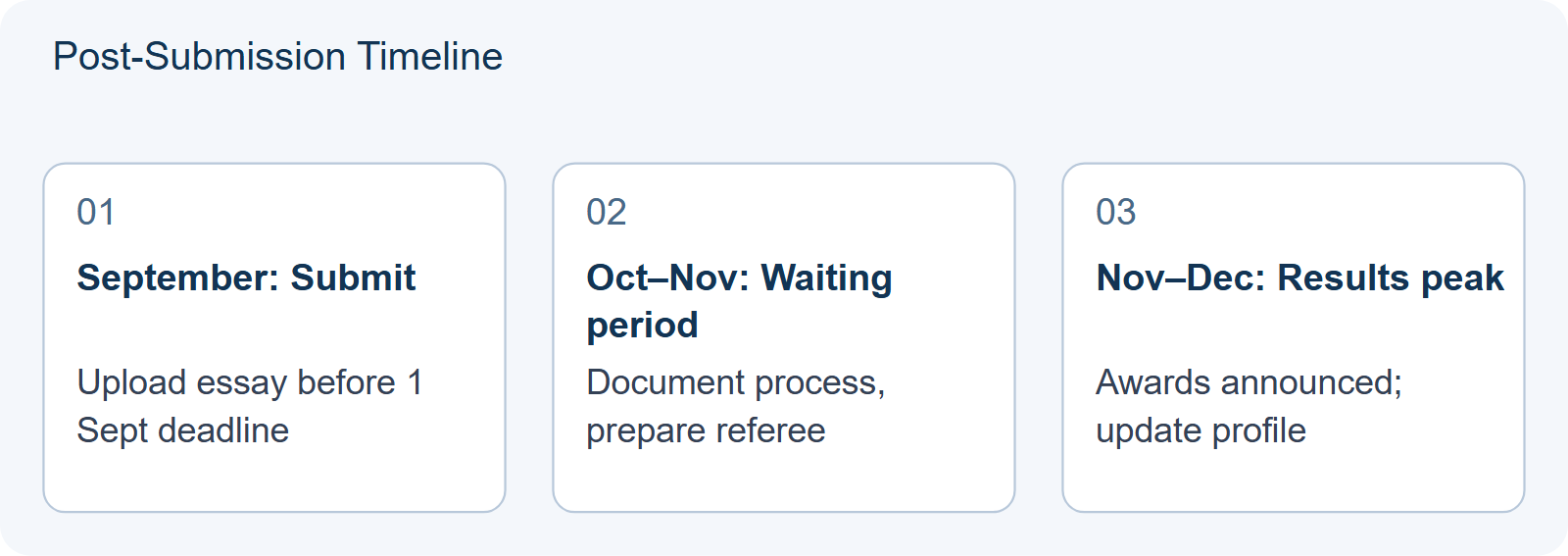
The source facts confirm that the competition’s seasonal peak 2 runs from November through December, covering both award announcements and admission outcomes. However, the exact date and method of the results announcement have not been confirmed by the available source. This means prospective families and students should not rely on any specific calendar date circulating informally.
What this practically means: plan your university application timeline assuming you may not hear back before mid-to-late November, and do not build conditional steps—such as delaying UCAS reference updates—around an unconfirmed results date.
The Four Award Tiers Explained
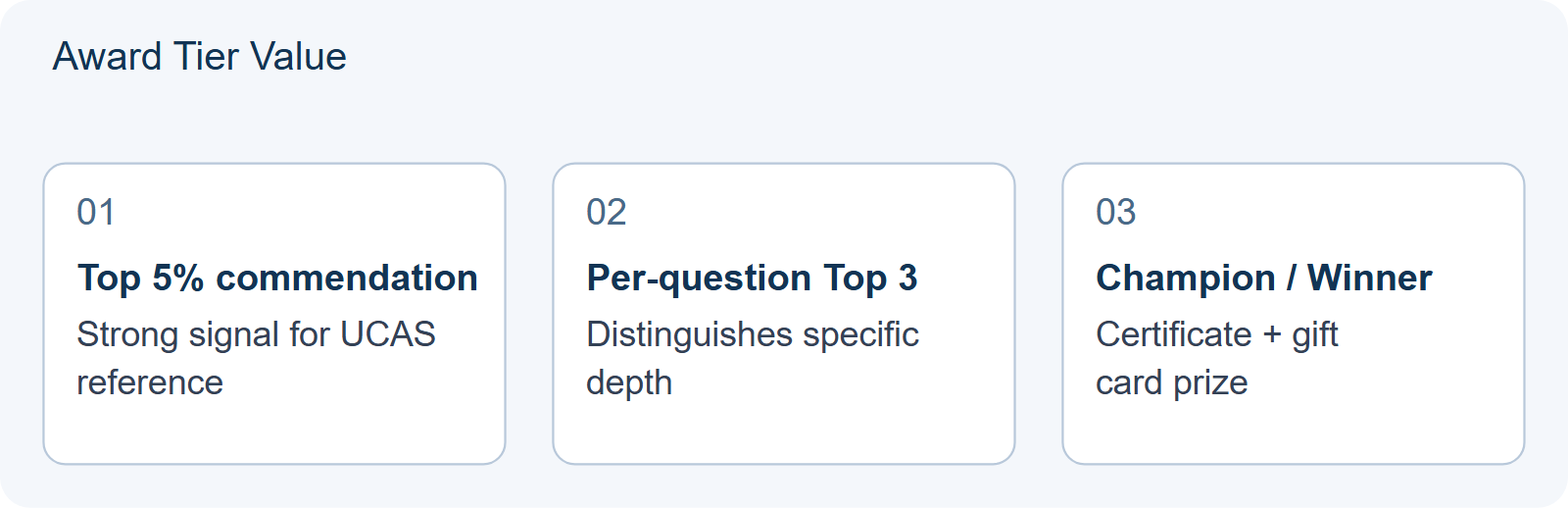
The LSESU Essay Competition operates a four-tier award structure:
| Award Tier | Recognition | Reward |
|---|---|---|
| Top 5% commendation | High commendation | None |
| Per-question Top 3 | Placed in top 3 for that question | None |
| Per-question champion | Best essay per question | £50 Amazon gift card |
| Overall winner | Best essay across all five questions | £100 Amazon gift card |
Importantly, only winners receive certificates; no participation certificates are issued. This is a meaningful distinction for students building an academic portfolio—an award here signals genuine distinction rather than mere completion.
If You Receive an Award: Updating Your Academic Profile
An award from this competition, particularly at the per-question champion or overall winner level, represents external validation of your economic reasoning and writing ability from one of the world’s leading economics departments. Here is how to capture that value:
- UCAS reference: Ask your referee to mention the award specifically, noting the tier and the competitive context (global entry, LSE professor-set questions). The per-question champion level, in particular, demonstrates subject-specific depth.
- Resume or activities list: List the award with the year, the question topic if relevant, and the tier. Avoid vague phrasing like “participated in” when you can state “awarded per-question champion, LSESU Essay Competition.”
- Interview preparation: Be ready to discuss your essay’s argument, what you would revise with hindsight, and how the research process shaped your understanding of the topic. Admissions tutors at economics-intensive courses may probe the substance behind the credential.

If You Do Not Receive an Award: Your Essay Still Holds Value
The absence of an award does not diminish the work invested. A 1,500-word essay responding to a question set by an LSE professor, researched and written to competition standard, is a reusable asset:
- Other competitions: Essays on overlapping themes can be adapted for submission to other economics essay competitions, provided each competition’s rules permit previously written work and the essay is appropriately revised for the new prompt.
- Extended essay or coursework: IB Extended Essay candidates, in particular, may find their competition research forms a foundation for their formal assessment, with appropriate academic supervision and citation adjustments.
- University application supplementary material: Some universities accept additional written work. A polished, self-critical version of your competition essay—ideally with a brief reflective note on what you would now change—can demonstrate intellectual maturity.
For guidance on how competition experience translates into application strength regardless of outcome, see how to position your LSESU essay in a UCAS reference.
Three Productive Moves Between September and November
Regardless of eventual outcome, the October-November period offers strategic opportunities:
1. Document Your Process While Details Are Fresh
Write a brief log of your research sources, the dead-ends you encountered, and how your argument evolved. This reflective record becomes invaluable if you are interviewed about your work or if you later adapt the essay for another purpose. Memory fades; contemporaneous notes preserve nuance.
2. Prepare Your Referee Before November Deadlines
Many UK university reference deadlines fall in November. If you hope your referee will mention your competition entry, provide them with a concise summary now: the question you answered, your core argument in one sentence, and why it matters to your academic trajectory. This is especially important given that results may not arrive before reference submission.
A suggested approach: email your referee with a subject line like “LSESU Essay Competition entry—details for reference if helpful,” attaching your essay and a half-page summary. This respects their time while ensuring accuracy.
3. Deepen the Topic Independently
The competition questions are designed by active LSE researchers and typically touch on live debates in economics. Use the waiting period to read one or two papers cited in your essay’s bibliography more thoroughly, or follow the question’s theme through recent LSE research publications or working papers. This builds genuine expertise that will show in interviews or follow-up applications, independent of competition results.
Preparing Your Resource Request or Consultation
If you are considering professional guidance on how to leverage your competition experience—whether for UCAS positioning, essay refinement for other competitions, or interview preparation—preparing the following will make any consultation more productive:
- A copy of your submitted essay and the question you answered
- A brief note on your research process and main sources
- Your current university application timeline and target courses
- Specific questions about what you hope to clarify or improve
This preparation ensures that discussion focuses on your specific situation rather than generic advice.
What to Expect and When
To summarise the confirmed facts: the award structure is four-tiered, with tangible prizes at the champion and overall winner levels. Results fall within the November-December seasonal peak, but no exact announcement date is confirmed. Only winners receive certificates. Students should treat the competition as one component of a broader academic portfolio, prepare documentation while the work is fresh, and avoid planning critical application milestones around unconfirmed dates. The essay you have written, and the thinking it represents, retains value independent of any external validation.
For a closer look at how the competition’s rubric evaluates originality and argumentation—the criteria that determine those award tiers—see our breakdown of the LSESU Essay Competition scoring criteria.
Frequently Asked Questions
When exactly are LSESU essay competition results announced?
The available source confirms that results fall within a November-December seasonal peak, but does not specify an exact date or notification method. Students should not rely on unconfirmed dates and should plan their application timelines accordingly.
Do all participants receive certificates?
No. According to the source facts from the LSESU site, only winners receive certificates; no participation certificates are issued for this competition.
Can I use my LSESU essay for other competitions if I don't win?
Potentially, yes. Your researched essay can be adapted for other competitions if their rules permit previously written work and you revise it appropriately for the new prompt. It may also serve as coursework foundation or supplementary application material.