You've Submitted Your LSESU Essay. What It's Worth Between September and December
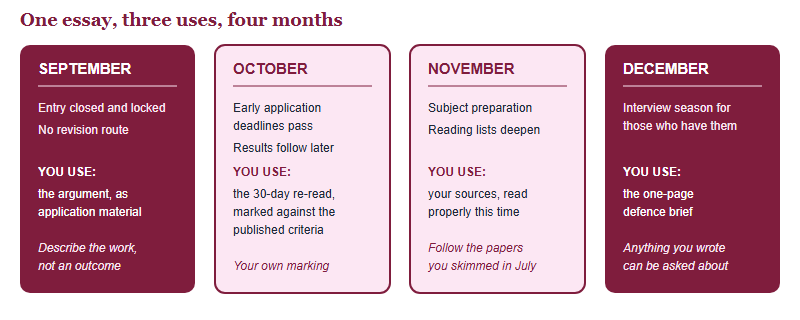
Your entry is locked and the result is not in your hands. What is still in your hands is the essay itself — an argument you built, a reading list you actually finished, and evidence you can recall under questioning. Between September and December that asset gets used three times, and only one of those uses depends on winning anything.
The timing mismatch nobody warns you about
Entries close on 1 September 2026, and results follow later — confirm the current schedule on the official site. Application deadlines do not wait for that. Depending on where you are applying, you may be writing about your summer in a personal statement, a supplement or a school reference before anyone has told you how your essay was received.
Students handle this badly in two opposite directions. Some leave the essay out entirely, on the grounds that there is nothing to report yet — which throws away the strongest piece of independent academic work many of them did all year. Others reach for language that implies an outcome they do not have. Both are avoidable once you separate two different things: what you did, which is finished and fully claimable today, and what you were awarded, which is not yours to mention until it exists.
It also helps to be clear about what entering does and does not confer. The published awards are certificates for High Distinction and for the per-question podium, with £50 for a Prompt Winner and £100 each for the Overall Winner and the LSE Offer Holder Winner (confirm current figures on the official site). The Society does not issue participation certificates, by deliberate policy. So entry alone produces no document, and the value of having entered has to come from somewhere else — which, conveniently, is the part that survives regardless of the result.
Honest claim language before the result exists
The rule is simple and it protects you: describe the work, in the past tense, with enough specificity that it could not have been invented. Never describe a status you have not been given.
| Situation | Accurate and usable | Do not write |
|---|---|---|
| Submitted, no result yet | “I wrote a 1,500-word economics essay for the 2026 LSESU Economics Society Essay Competition arguing that…” | “Shortlisted”, “selected”, “recognised by LSE”, or anything implying an outcome |
| Entered, no award announced | “I entered…” followed immediately by what the essay argued and what you read to write it | “Participant award” or “certificate of participation” — the Society does not issue one |
| High Distinction | The award name exactly as published, with the year | “Won a prize” when the award is a distinction band rather than a per-question win |
| Prompt Podium or Prompt Winner | The award name, plus the topic of the question you answered | “Best essay in the competition” when the award was on one question |
| Overall Winner | The award name and the year. No embellishment needed | Anything about admission outcomes following from it |
Notice what the accurate column does. It spends its words on the argument rather than on the competition's prestige, which is also better writing: a reader learns something about how you think from “I argued that monitoring costs, not preferences, explain the persistence of hybrid work” and nothing at all from “I entered a prestigious LSE competition”. If you need to remind yourself what your question was actually asking before you paraphrase it, our guide to the 2026 prompts and published criteria has the framing for each one.

Everything you write becomes interview material
This is the part students underestimate. If you mention the essay anywhere in an application, an interviewer is entitled to open with it, and they will not be testing whether you won. They will be testing whether the argument is yours: what mechanism drives it, what evidence supports it, what the strongest objection is, and whether you can think when pushed rather than recite.
That is a good position to be in if you prepare, and an uncomfortable one if three months have passed and you can no longer remember which paper your central figure came from. So build the defence brief now, in the week after submitting, while everything is still loaded in memory. One page, five boxes, handwritten if you like.
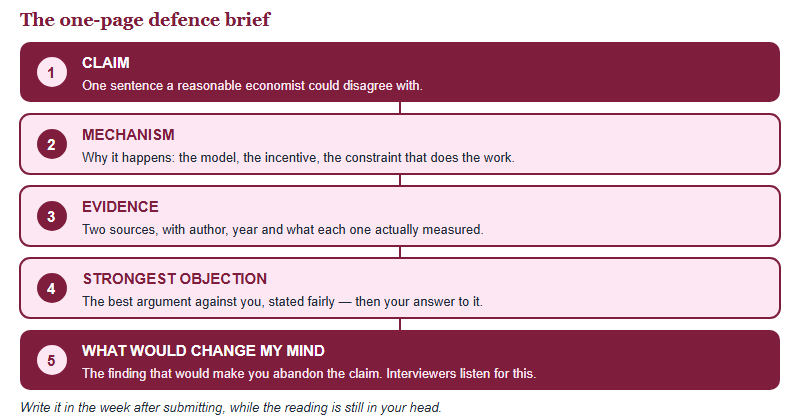
Two practical notes on box five. First, if you genuinely cannot name a finding that would change your mind, your claim is probably unfalsifiable as written, and tightening it is a useful exercise in itself. Second, saying it out loud in an interview is not a weakness. Being able to specify the conditions under which you would be wrong is exactly the habit the critical analysis criterion was rewarding when your essay was marked.
The thirty-day re-read
Some time in October, when the essay has gone cold, open it and mark it yourself against the published criteria: argument and originality out of 25, application of economic theories out of 20, evidence and examples out of 15, critical analysis out of 15, structure and clarity out of 10, citations and sources out of 10, topic relevance out of 5. Write a number in each and one sentence of justification.
Do this before any result arrives, because the point is calibration rather than consolation. You are finding out whether your own judgement of your work matches what the criteria reward — and that skill transfers to every piece of assessed writing you produce afterwards. Students who do this typically discover the same two things: the argument was thinner than it felt in August, and the evidence was stronger than they gave themselves credit for. Both are useful to know before an interview. Our guide to writing the 1,500-word essay is a reasonable checklist to mark against if you want a structured version of the exercise.
Where the essay can and cannot go next
The 1,500 words themselves have a limited afterlife, and it is worth being precise about it.
- Do not assume you can re-enter it elsewhere. Competitions publish their own conditions on originality, prior publication and simultaneous submission, and they differ. Read the current rules of any other competition on its own official site before you send it anything, and never rely on a summary — including a summary of ours.
- Do extend it into school work where your school permits. The natural continuation is a longer research piece: the question you compressed into 1,500 words usually has a fuller version that fits an extended essay, an internal assessment or a research project. Check your school's own rules on reusing your own work first.
- Do turn the reading list into real reading. Most competition essays are written on papers half-read under time pressure. Autumn is when you can go back and read them properly, and that is what makes a December conversation about your essay go well.
- Do offer to present it. A fifteen-minute talk to a school economics society forces exactly the compression and defence that an interview will ask for, in a room where the cost of stumbling is nil.
- Do not keep editing the submitted file. It is locked, there is no revision route, and re-reading it for flaws produces anxiety rather than marks.
If you are supporting a younger sibling or a classmate who is thinking about next year's cycle, the most useful thing you can hand them is not your essay — it is your notes on what took longest. Our overview of what the LSESU Essay Competition is is the right starting point for them; your account of where the eight weeks actually went is the part they cannot get anywhere else.
Frequently asked questions
Can I mention the competition before results are announced?
Yes, if you describe what you wrote and argued in the past tense. Do not imply a shortlisting, award or recognition you have not received.
Do entrants get a participation certificate?
No. The Society does not issue participation certificates by policy, so entering alone produces no document to cite.
Will I be asked about my essay at interview?
If you mention it in an application, assume yes. Prepare a one-page brief covering claim, mechanism, evidence, objection and disconfirming finding.
Can I submit the same essay to another competition afterwards?
Only if that competition's own published rules allow it. Conditions on originality and simultaneous entry differ, so read them directly.
Published by the editorial desk of this site, operated independently by Hanlin International Education (翰林国际教育) for China-based international-school students. This site is not the official competition website and is not affiliated with the LSESU Economics Society or the London School of Economics. Official rules are set by the competition and change yearly, so always confirm current details on the official site lsesuesec.org. Confirmed errors are corrected within 7 working days.