LSESU Essay Competition Preparation: A Focused Plan for Grade 11 Students
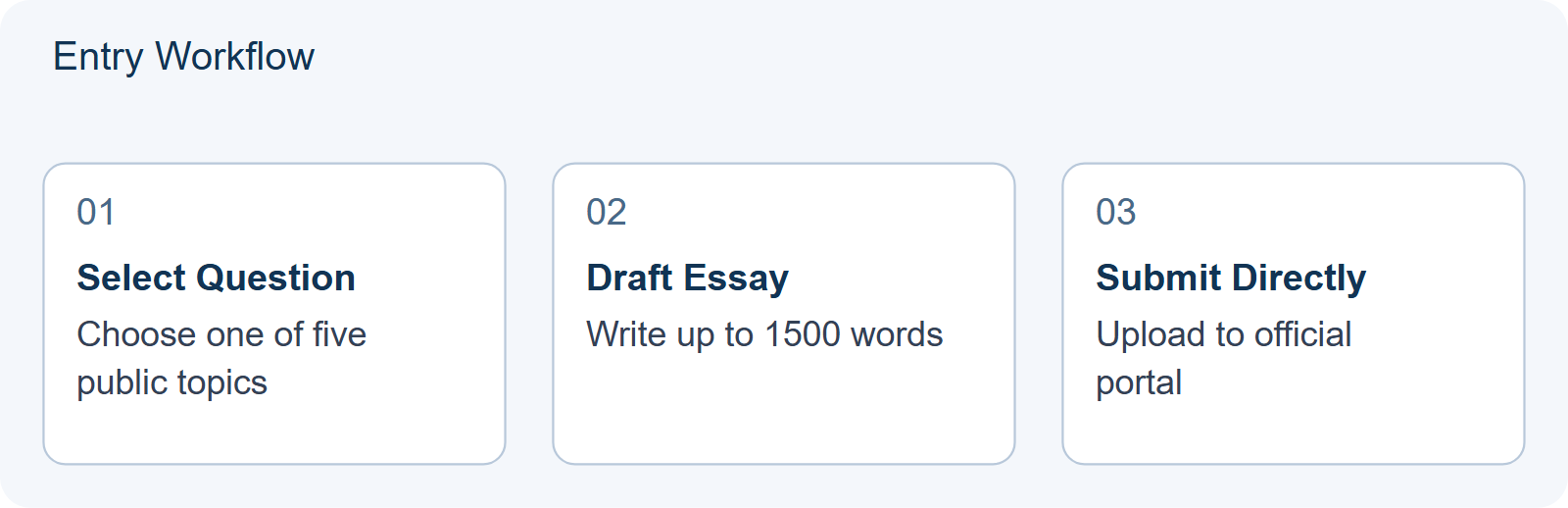
For Grade 11 students, the LSESU essay competition preparation journey begins with understanding the unique entry mechanism. Unlike many academic contests, the LSESU Economics Society Essay Competition does not require registration. The five essay questions are public, and you submit your final paper directly to the official portal. This article outlines a focused plan to help you navigate this process effectively.
Understanding the Entry Process
The most critical aspect of LSESU essay competition preparation is recognizing that there is no preliminary sign-up step. You do not need to create an account or receive a candidate ID to begin. Once you have selected one of the five available questions, you can start drafting immediately. The deadline for the 2026 season is September 1, 2026, at 23:59 GMT+1. Ensure your file naming convention follows the official requirement: “FORENAME SURNAME (uppercase) + Question X”.
Selecting Your Question
Choosing the right question is half the battle. The five questions are set by current LSE Economics Department professors. For Grade 11 students, it is advisable to pick a topic where you can demonstrate both economic theory and real-world application. Avoid questions that require specialized knowledge beyond your curriculum unless you are prepared to conduct extensive independent research. Our team provides question-type audits to help you verify if your chosen angle actually answers what was asked.

Structuring Your Argument
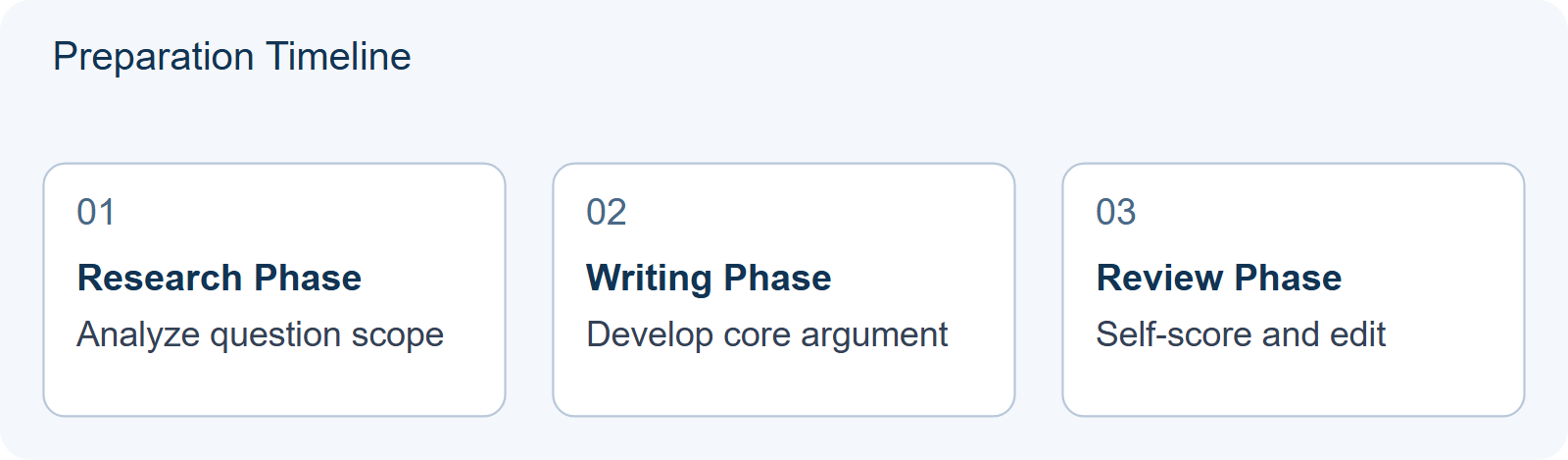
A strong essay needs a clear thesis, logical progression, and evidence-based conclusions. Many students struggle with transitioning from exam-style answers to essay-style arguments. We recommend reviewing our guide on unlearning exam templates, which highlights why IB and A-Level habits might cost marks in this competition. Focus on originality, which carries significant weight in the rubric.
Editing and Final Submission
Once drafted, rigorous editing is essential. Use our seven-criterion self-scoring clinic to evaluate your work before submission. Remember, submissions cannot be modified after upload. Therefore, perform a final check on formatting (12pt Times New Roman, 1.5 line spacing) and word count (maximum 1,500 words). If you miss the deadline, consider the value of your unsubmitted work for future applications, as discussed in our post-mortem analysis.
Illustrative Decision: Balancing Breadth and Depth in Question Selection
To apply the advice on selecting a question effectively, consider this hypothetical scenario involving two Grade 11 students, Alex and Jamie, who are preparing for the LSESU essay competition. Both have strong academic records but different strengths. Alex excels at memorizing standard economic models and applying them to textbook examples. Jamie is more interested in current events and enjoys reading news articles about global markets, though their theoretical foundation is slightly less rigid than Alex’s.
The competition offers five public questions. One question asks students to evaluate the impact of interest rate changes on consumer behavior. Another asks students to analyze the long-term economic consequences of a specific recent trade policy shift. Alex initially gravitates toward the interest rate question because it aligns perfectly with their curriculum. They can quickly outline supply and demand curves and cite standard theories. However, they realize that hundreds of other students will likely choose this safe option, resulting in a generic argument that lacks originality—a key rubric criterion mentioned in the article.
Jamie, conversely, feels intimidated by the trade policy question because it requires synthesizing information from various sources beyond the classroom. Yet, Jamie recognizes that this topic allows for a unique perspective based on their independent reading. Instead of relying solely on established models, Jamie plans to integrate real-world data and contrasting viewpoints found in recent economic journals. This approach directly addresses the article’s warning against “exam-style answers” and leverages the opportunity to demonstrate genuine engagement with the subject matter.
The decision point here is not just about difficulty, but about strategic positioning. If Alex chooses the interest rate question, they must work harder to find a novel angle, perhaps focusing on behavioral economics nuances rather than classical theory. If Jamie chooses the trade policy question, they must ensure their research is rigorous enough to support their claims without becoming disjointed. The critical factor changing the decision is the weight placed on originality versus safety. For Grade 11 students, where curriculum knowledge is often uniform across competitors, differentiation comes from how you apply that knowledge, not just what you know.
A reusable self-check for any student facing this dilemma involves asking three specific questions before finalizing their choice. First, does my chosen topic allow me to present an argument that is distinct from the most obvious interpretation? Second, do I have access to sufficient evidence or reasoning to support a nuanced view, or am I relying entirely on memorized definitions? Third, if I were a judge reading ten essays on this topic, would mine stand out due to its structure and insight, or would it blend in with the rest?
| Consideration | Safe Choice (Curriculum-Aligned) | Riskier Choice (Research-Intensive) |
|---|---|---|
| Originality Potential | Lower; requires extra effort to differentiate | Higher; natural room for unique insights |
| Preparation Time | Faster drafting; slower refinement | Slower drafting; faster structural flow |
| Key Risk | Being perceived as generic | Lacking theoretical rigor |
Frequently Asked Questions
Do I need to register for the LSESU Essay Competition?
No, there is no registration required. Questions are public, and you submit directly to the official portal.
Can I change my essay after submitting?
No, submissions cannot be modified or replaced after uploading to the portal.
What is the word limit for the essay?
The maximum word count is 1,500 words, excluding references and appendices.