Mark Your Own LSESU Essay: A Seven-Criterion Self-Scoring Clinic (2026)
Your entry is locked, the result is still weeks away, and the reasoning behind every paragraph is fresher today than it will ever be again. That makes this the best week of the year to mark your own essay against the published rubric — seven criteria, 100 marks, four bands. Done honestly, a self-score teaches you more than a result does, because it names the paragraph that lost the mark.
Why you mark it now, not when the result arrives
A result is a band. It arrives without a reason attached, and by the time it lands you will have forgotten why you cut the third case study, why the counterargument section shrank to four lines, and which claim you left unsourced because you ran out of words. The information you need to improve is in your head this week and nowhere else.
There is also a safety feature in the timing. The competition does not accept revised or replaced entries once an essay has been submitted, so nothing you discover today can tempt you into fiddling with a locked file. That removes the anxiety from the exercise entirely. You are not repairing anything. You are building the checklist you will use before you write, rather than after.
The third reason is the one that compounds. Calibration — the ability to predict a piece of your own writing within one band — is a transferable skill. A student who can look at a draft in July and say “this is a fifty-eight, and the missing marks are in critical analysis” has a fundamentally different next season from one who can only say “I think it’s quite good.” The first student knows where to spend August. If you are new to the competition, the overview of what the LSESU Essay Competition actually is is the right starting point before this exercise.
The seven criteria, and where the marks actually sit
The 2026 criteria distribute 100 marks across seven headings. Most students can recite the biggest one and have only a vague sense of the rest, which is exactly how essays lose marks in places nobody was looking. Here is the full set, with the question that decides each mark and the failure mode we see most often in drafts we read.
| Criterion | Marks | The question that decides the mark | The failure mode we see most |
|---|---|---|---|
| Argument & originality | 25 | Does a reader who already knows the textbook learn something from this essay? | An accurate, fluent summary of the consensus — correct, and worth far less than it feels |
| Application of theory | 20 | Is the model doing work, or decorating the page? | A framework named in paragraph two that never reappears in the conclusion |
| Evidence & example | 15 | Could a sceptical reader check every number you used? | One striking statistic, no source, no comparison point, no date |
| Critical analysis & evaluation | 15 | Does the strongest objection appear, in its strongest form? | A weak objection raised so that it can be knocked over politely |
| Structure & clarity | 10 | Can a reader state your thesis in one sentence after the first 150 words? | An introduction that previews topics instead of stating a claim |
| Citations & sources | 10 | Is one referencing style applied consistently from first page to last? | Three styles in one document, and a bare link where a reference belongs |
| Relevance to topic | 5 | Are you answering the clause the question actually contains? | Answering the topic rather than the question — the most expensive cheap mistake |
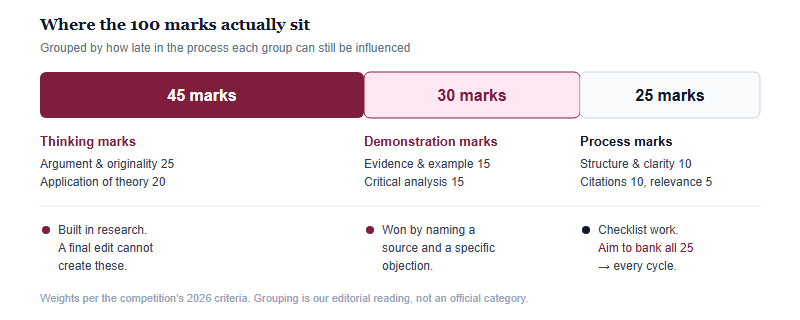
Group those seven and the shape of the paper changes. Forty-five marks sit in criteria that reward thinking done before you wrote a word. Thirty marks reward specific, nameable moves on the page. Twenty-five marks — a quarter of the total — are process marks that a disciplined student can very nearly bank in full, and which get thrown away every year by essays whose economics was perfectly good.
How to score yourself without flattering the draft
Self-marking fails in one predictable way: you mark your intentions instead of your text. You know what the third paragraph was supposed to do, so you read the intention into the sentence and award the mark. Five rules stop that.
- Name the sentence. For every mark you award, point at the line that earns it. If you cannot quote it, the mark is not on the page — it is in your memory of writing it.
- Score the PDF you actually submitted, opened as a PDF, not the working document you kept tidying afterwards. Those two files diverge more than students expect.
- Work upwards from the smallest criterion. Start with relevance (5), finish with argument and originality (25). By the time you reach the hardest judgement you will have spent thirty minutes gathering evidence about your own essay, and the verdict gets noticeably harsher.
- Mark it cold. Twenty-four hours minimum since you last touched it; a week is better. Read it once straight through without a pen before scoring anything.
- Write the reason in five words. “Objection is a straw man.” “Model never returns.” A number with no reason attached is useless a month later.
One boundary worth stating plainly: your self-score is not a prediction of your result. You cannot see how the paper is moderated internally, and you certainly cannot see the field you are being read alongside. The output you want from this exercise is the list of reasons, not the number at the bottom.

Reading the four bands honestly
The published grade scale gives four bands with plain-language descriptors. Read them as a description of what a reader experiences, not as a ladder of effort — a great deal of effort can be spent inside one band without ever crossing out of it.
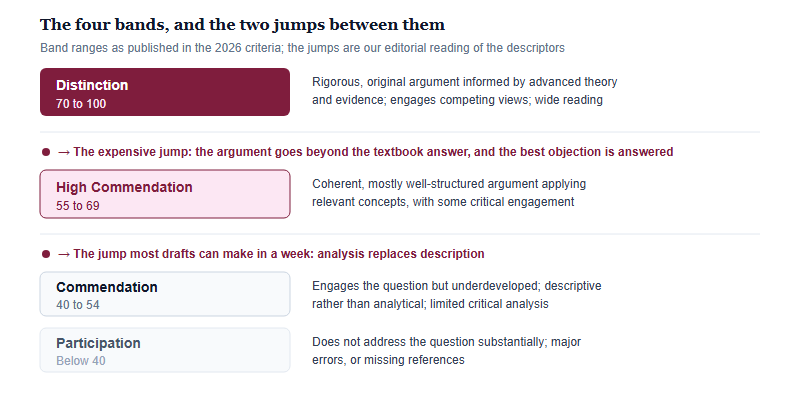
Now the arithmetic, and please read this as an illustration of how the weights interact rather than as any claim about how a real paper is marked. Suppose a disciplined student banks the process marks in full: structure 10, citations 10, relevance 5. Add a competent but unsurprising theory section at 12 out of 20, a clear consensus argument at 12 out of 25, decent evidence at 9 out of 15, and a thin objection section at 8 out of 15. That totals 66 — a solid High Commendation, produced by an essay with nothing visibly wrong with it.
Crossing 70 from there needs four marks, and notice where they cannot come from. Relevance is already maxed at 5. Structure and citations are already maxed at 20. The only places left are the three criteria that require you to have thought harder: the argument, the theory, and the treatment of objections. This is the whole reason the process marks matter so much — not because they win anything, but because a student who has already banked them has all their remaining headroom in the criteria that actually reward reading and reasoning. A student who threw away six process marks on inconsistent citations spends that headroom clawing back ground.
The worksheet: seven rows, thirty minutes
Make one page with three columns and seven rows — one per criterion. Column one: your mark, in whole numbers. Column two: the sentence, quoted, that earns it. Column three: the specific change that would have earned more, written as an instruction rather than a wish.
| Criterion (mark) | The sentence that earns it | The instruction for next time |
|---|---|---|
| Argument & originality (12/25) | “Firms should therefore offer flexibility while monitoring outputs rather than hours.” | Name the one mechanism the textbook version misses, and build the essay on that instead of the recommendation |
| Application of theory (13/20) | “This is a classic principal–agent problem.” | Return to the model in the conclusion; a framework introduced once and abandoned earns a fraction of its weight |
| Evidence & example (9/15) | “Studies show hybrid workers are more productive.” | Replace every “studies show” with one named study, its population, its year and its limitation |
| Critical analysis (7/15) | “Some argue monitoring is necessary, but employees dislike it.” | State the objection in the form its strongest advocate would use, then answer that version |
| Structure & clarity (9/10) | Thesis stated in sentence three of the introduction | Keep it; check the conclusion answers the same question the thesis promised |
| Citations & sources (7/10) | Reference list present, two entries incomplete | One style, applied to the last entry as carefully as the first — ten marks for a mechanical task |
| Relevance to topic (4/5) | Answers “what should the firm do” but drifts into policy in section three | Re-read the question clause by clause before the final edit and delete anything answering a different one |
When the seven rows are filled, compress column three into three rules for next time. Not twelve rules — three, because you will actually remember three. In the drafts our editorial desk reads, those three rules are very often the same family: name your mechanism, name your source, and steelman the objection. If you want to see how those rules translate into the shape of a finished piece, our guide to building the 1,500 words works through the structure paragraph by paragraph.
What a self-score is worth after this week
Three uses, in descending order of value. The first is next season: your three rules become a pre-writing checklist rather than a post-mortem, which is the only version of this that changes an outcome. The second is conversation. If you are interviewed on your own writing at any point this year, the student who has already identified their essay’s weakest joint is in a much stronger position than the one defending it for the first time under questioning.
The third is your application file, and it is worth being precise about how this works. An admissions reader does not take a competition entry on its own; they read it against your transcript, your subject choices and what you write about yourself, and the file becomes believable when those things corroborate each other. An essay you can discuss in detail — including its limitations — is what makes the entry read as real intellectual work rather than a line on a list. Nothing here guarantees any outcome, and no honest adviser will tell you a single competition does. What a rubric-literate self-assessment gives you is the ability to talk about your own economics accurately, which is a quality that survives contact with an interviewer.
Frequently asked questions
Can I change my essay after the self-score turns up a problem?
No. The competition does not accept revised or replaced entries after submission, so a self-score is learning, not repair.
Will my self-score match the official result?
Probably not exactly. You cannot see moderation or the strength of the field, so treat the reasons as the output, not the number.
Which criterion should I work on first for next year?
Argument and originality, at 25 marks. It is the criterion a late edit cannot rescue, so it has to be built during research.
Where are the criteria published?
In the competition's own candidate materials. Our 2026 prompts-and-rubric page reproduces them; confirm current rules on lsesuesec.org.
Published by the LSESU Essay Competition editorial desk, operated by Hanlin Education for China-based international-school students. Official rules are set by the competition and change yearly — confirm current details on lsesuesec.org. Errors are corrected within 7 working days.