LSESU Essay Model Selection: A One-Model Decision Tree for the 2026 Prompts
Short answer: choose one economic model per LSESU essay, choose it with a three-gate test, and then use it as the essay’s spine. The competition’s own rubric awards 20 of 100 marks for “Application of Economic Theories”, judged on whether relevant models, frameworks or concepts are used correctly and effectively. One model applied to the mechanism the prompt actually describes, with its assumptions stated and its limits tested, is the most reliable way to earn those marks inside a maximum of 1,500 words excluding references.
The 2026 LSESU Economics Society Essay Competition closed on 1 September 2026 at 23:59 GMT+1, and the competition’s own page lists results as tentatively announced in October 2026. The five 2026 prompts are therefore a training set now rather than a live brief. That makes this the right moment to work on LSESU essay model selection: the decision of which single framework to build an answer on. The method below is designed to transfer unchanged to whatever set of prompts is published next.
One boundary matters before we start. Everything described here as an official rule comes from the competition’s own published page for the 2026 edition. Everything described as a coaching judgment is our editorial reasoning about how to write well under those rules; it is not an official instruction, and the rubric does not require any particular model.
Why the 2026 prompts are still the right practice set
Most students preparing for a future cycle have no genuine prior-year material except past prompts. The five 2026 questions are unusually useful for model-selection practice because each one points at a different part of the discipline: labour incentives, monetary policy, technical change, taxation, and the distribution of gains from a new technology. A student who can run the three-gate test on all five prompts has effectively rehearsed five different selection decisions before a single word of the next cycle is written.
The efficient way to use them is as a selection drill rather than five full essays. For each prompt, spend twenty minutes writing only the diagnostic paragraph described later in this article: state the model, state the mechanism, state the limitation. If you want a fuller training method for turning old prompts into deliberate practice, we have written separately about LSESU Essay Past Prompts as Practice: A Training Method. The point of the drill is that model selection is a decision you can rehearse in isolation, and it is the decision that most often goes wrong.
What the rubric actually pays for
The published 2026 rubric distributes 100 marks across seven criteria. Reading it as a list of “things to include” hides the real structure: the two largest criteria together account for 45 marks, and both are about the quality of your reasoning rather than the volume of your reading.
| Criterion | Marks | What the marker is assessing |
|---|---|---|
| Argument and Originality | 25 | Is the argument well articulated, logically consistent and innovative? Does it go beyond textbook answers? |
| Application of Economic Theories | 20 | Are relevant models, frameworks or concepts used correctly and effectively to support the argument? |
| Evidence and Examples | 15 | Are claims supported by empirical studies, historical examples, case studies or credible data? |
| Critical Analysis | 15 | Engagement with opposing views, trade-offs, limitations and alternative explanations. |
| Structure and Clarity | 10 | Logical flow, effective introduction and conclusion, precise language. |
| Citations and Sources | 10 | High-quality sources, cited correctly and consistently. |
| Topic Relevance | 5 | Does the essay stay on topic and directly answer the question asked? |
Notice what this structure implies about breadth. Forty-five marks sit with argument quality, critical analysis and relevance, all of which depend on the coherence of a single line of reasoning. Twenty marks reward correct and effective use of theory. Nothing in the rubric rewards the number of models named. The following is our coaching judgment rather than an official rule, but it follows directly from the arithmetic: a 1,500-word budget spent on three or four frameworks leaves roughly 350 to 500 words per framework, which is usually enough to name a model and restate its textbook conclusion, and not enough to apply it, test it, and argue against it.
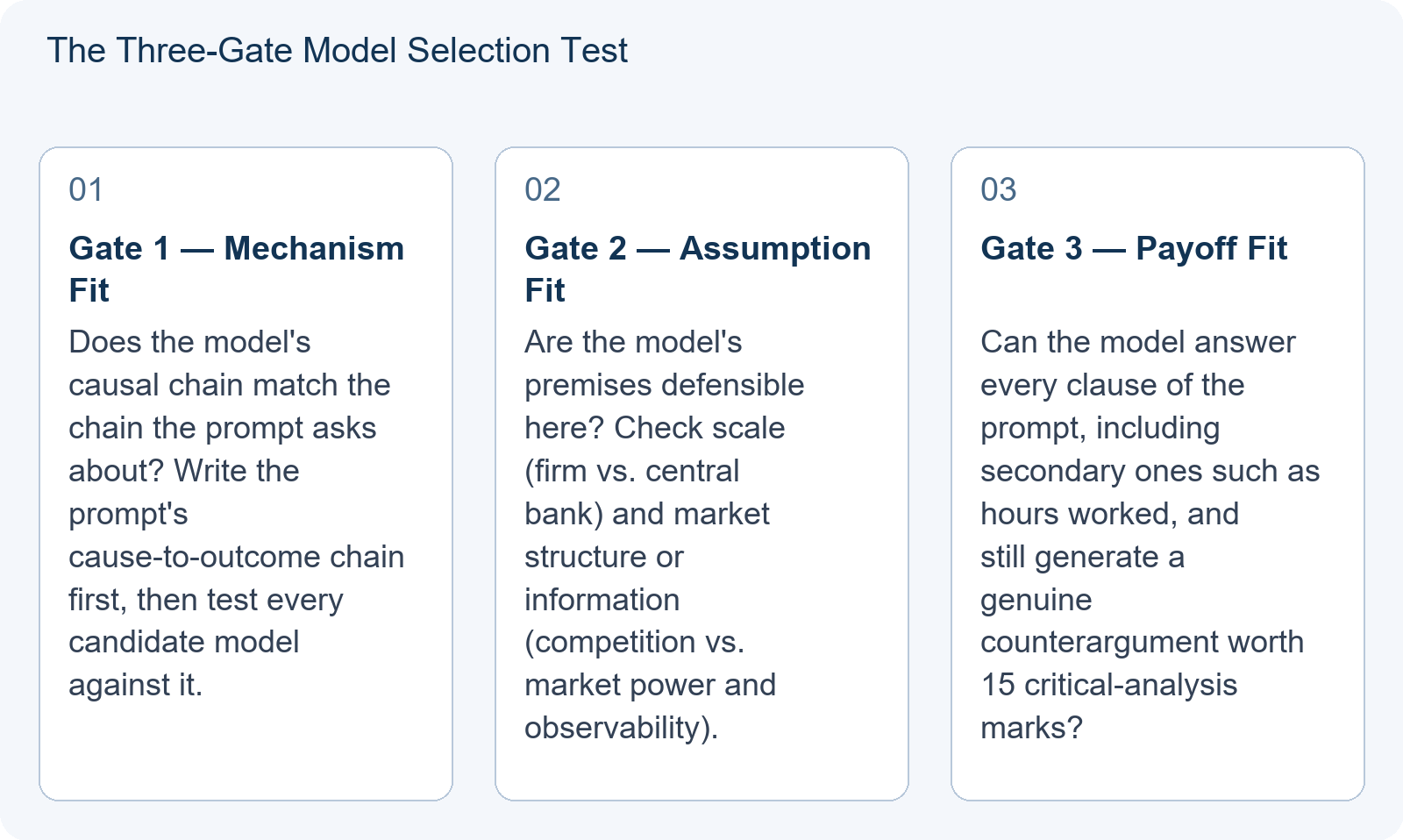
The three-gate selection test
Run every candidate model through three gates in order. A model that fails any gate is rejected, no matter how impressive it sounds. The gates are deliberately sequential: mechanism fit is cheap to check and eliminates most wrong answers immediately; payoff fit is the gate students most often skip.
Gate 1: Mechanism fit
Does the model’s causal chain match the causal chain the prompt asks about? Prompts rarely ask “what happens to a market”. They ask about a specific channel: monitoring and effort, an imported cost shock passing into consumer prices, automation changing the demand for particular tasks, a tax changing behaviour at the top of the distribution, a new technology changing who owns productive assets. If the model’s mechanism is a different channel, you will end up writing about a question nobody asked.
A useful habit is to write the prompt’s mechanism as an arrow chain before choosing anything: cause to intermediate variable to outcome. If you want a fuller treatment of that step, see our guide to LSESU Essay Mechanism Chain: Link Policy to Outcome. The chain you write becomes the test that every candidate model must pass.
Gate 2: Assumption fit
Are the model’s core premises defensible in the setting the prompt describes? Two checks do most of the work. First, scale: a single firm choosing a monitoring technology and a central bank setting a policy rate operate at different levels, and mixing them produces an essay that answers neither. Second, market structure and information: a perfectly competitive benchmark may misrepresent a prompt that is explicitly about market power, bargaining, or what one party can observe about another.
Gate 3: Payoff fit
Can this model produce the exact answer the prompt demands, including its secondary clauses? This gate has two parts. The first is completeness: if the prompt asks about pay and hours, a model that only generates a prediction about employment will force you to bolt on a second framework. The second is contestability: a model that delivers a single unambiguous conclusion with no live debate gives you nothing to attack, and Critical Analysis is worth 15 marks. The best choice is often the model that generates a clear answer and an equally clear reason to doubt it.
Prompt-by-prompt decision table
The table below applies the three gates to the five 2026 prompts. These are suggested starting points for practice, not official requirements and not the only defensible choices. For the 2026 edition, entrants could submit only one response to one of the five questions.
| Prompt | Model family that passes the gates | What to avoid, and why |
|---|---|---|
| Q1: Technology and worker wellbeing — workers value one home day a week but dislike monitoring; what should the firm do to motivate workers while still getting value during working hours? | Principal–agent framework with effort, monitoring cost and non-monetary benefits. The prompt is a hidden-action problem with a costly monitoring technology, so the model must contain effort choice and the firm’s instrument set. | A labour supply-and-demand diagram alone. It can show a wage and a quantity of hours, but it has no place to put effort, monitoring or the value workers place on the home day, which is the entire question. |
| Q2: Energy and economics — a brief for a central bank after a sharp rise in UK energy prices, given the UK is a net importer and the mandate is 2% inflation. | A cost-push shock inside an aggregate demand–aggregate supply framework, combined with a central bank reaction function. The shock’s imported origin is what generates the policy trade-off between inflation and output. | A long-run growth model. Growth theory cannot represent a short-run inflation mandate or a policy reaction function, so it answers a different question. |
| Q3: AI and employment — suppose AI reduces the number of people needed for a large fraction of jobs; what measures should limit inequality in pay and, ideally, also in hours worked? | Task-based framework, in which jobs are bundles of tasks and technology substitutes for some while complementing others. It separates the pay channel from the hours channel, which the prompt explicitly distinguishes. | A single aggregate labour-market diagram. It can produce an unemployment prediction but cannot distinguish pay dispersion from hours reduction, so it fails Gate 3. |
| Q4: Taxation and fairness — is it possible and desirable to raise taxation on the top 1%? | Optimal income taxation built around a behavioural response to tax rates, commonly modelled as the elasticity of taxable income. The Laffer curve then appears as a derived special case rather than an assumption. | Presenting the Laffer curve as settled empirical fact. Whether revenue rises or falls is exactly what the prompt asks you to assess, so treating the answer as a premise removes the argument. |
| Q5: Green technology — how will the development and adoption of climate-friendly technologies affect inequality and the distribution of wealth? | Directed technical change, combined with an asset-ownership channel. The first explains why the technology develops in a particular direction; the second is what connects it to wealth distribution. | An efficiency-only cost–benefit calculation. It can report net gains but is silent on who receives them, and the prompt asks only about distribution. |
Worked teaching illustration: Q3, AI and inequality
Teaching illustration: the following is a worked example written for this article to demonstrate the selection test. It is not a past competition answer, not an official model answer, and not a summary of any published winning essay.
The Q3 prompt asks a question with two clauses and one conditional. It supposes that AI reduces the number of people needed to perform a large fraction of jobs, and it asks what measures should limit inequality in pay, and ideally in hours worked. Because the prompt already stipulates the mechanism in broad terms, the selection question is narrower than it first appears: you need a framework that can hold pay and hours separately.
Run Gate 1. The prompt’s chain is technological capability, applied to work, changing the demand for particular kinds of labour, which changes pay and hours. A task-based framework matches this chain directly. It treats a job as a bundle of tasks. Automation substitutes for tasks that are routine and codifiable, reducing demand for workers who specialise in them. It complements workers whose tasks it makes more valuable, raising their marginal product. The framework’s output is a distributional prediction rather than a single employment number, which is what the prompt needs.
Run Gate 2. The core assumption is that tasks can be meaningfully separated and that substitution is partial rather than total. That is defensible for the prompt as written, which says AI reduces the number of people needed for a large fraction of jobs, not for all of them. If you wanted to argue that most jobs are bundles with strong complementarities throughout, you would be arguing against the premise, which is a different essay.
Run Gate 3. The framework generates separate predictions for pay and hours, so it can handle both clauses of the prompt instead of bolting on a second model. It also generates a genuine limitation, which is what gives you something to attack.
Now apply it. On the pay side, the framework distinguishes workers whose tasks are substituted from those whose tasks are complemented, so pay dispersion widens between the two groups rather than simply falling overall. A policy candidate such as progressive taxation of the gains concentrates on the pay channel: it compresses after-tax dispersion but does not create hours. Wage insurance or targeted transfers similarly affect the pay channel for displaced workers, and again do not create hours. On the hours side, instruments such as a shorter standard working week or subsidised short-time working act on the hours channel directly, at a cost that has to be named. A universal basic income is best analysed as acting on the pay channel through transfers, not as an hours policy, and treating it as one is a category error the model will reveal.
The framework’s honest limit is that it explains the demand for tasks, not the ownership of capital. The wealth-distribution half of a broader question about AI, or the wealth element in Q5, needs an explicit additional layer connecting productivity gains to asset ownership. Naming that boundary is worth more than quietly widening the claim, because it shows the marker exactly what your model does and does not cover.
One further point earns marks rather than costing them: because these policy candidates act on different channels, comparing two of them is a trade-off question, and trade-offs need the same assumptions held fixed on both sides. We have written separately about LSESU Essay Policy Trade-Offs: Comparing Two Options Under the Same Assumptions, which is the natural next step once a single model has been chosen.

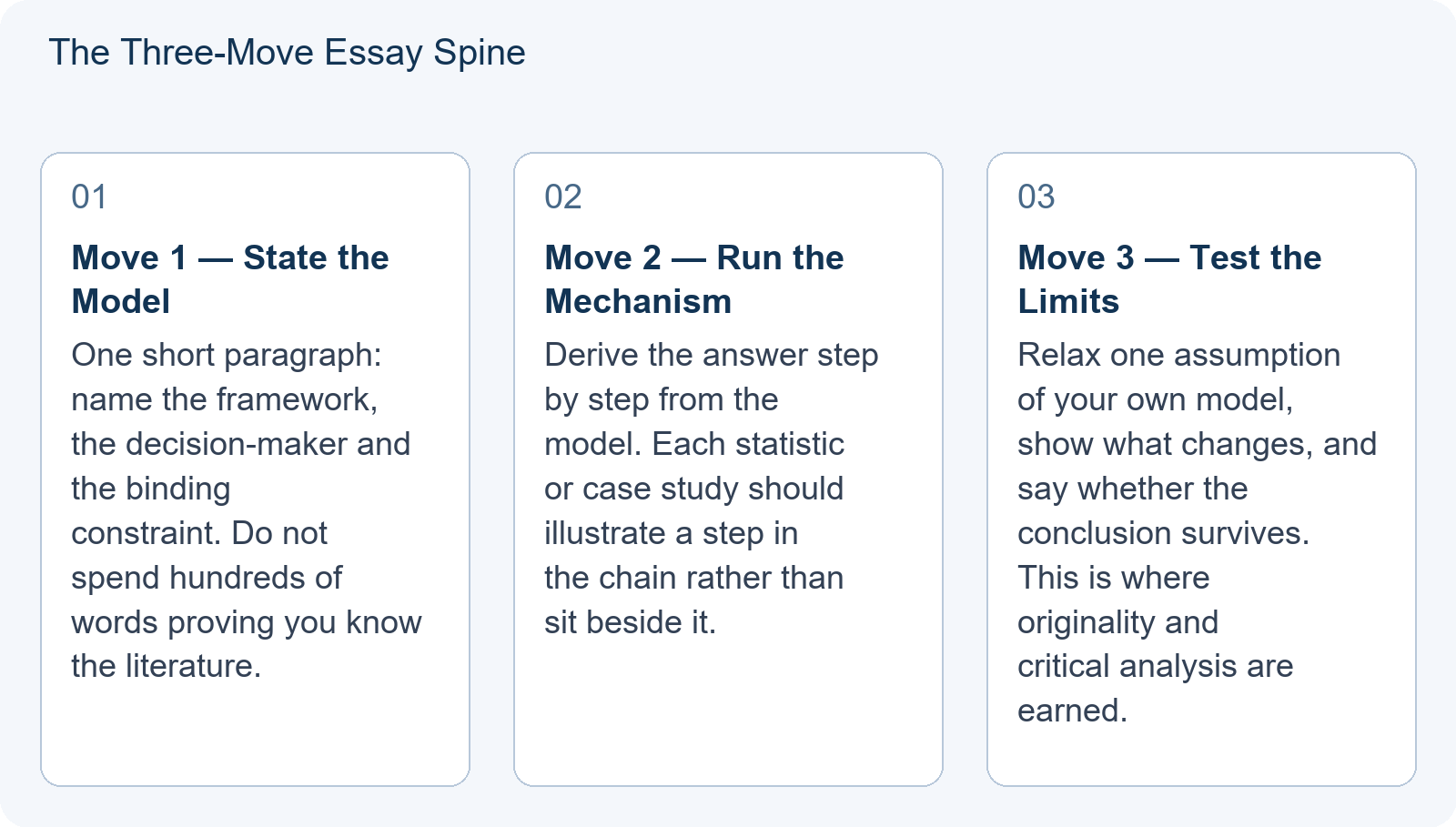
The three-move essay spine
Once the model is chosen, the essay has three jobs, in this order. Each maps to roughly a third of the body.
- State the model. One short paragraph. Name the framework, name the decision-maker, name the instrument or constraint that matters, and stop. Do not spend 400 words proving you know the literature.
- Run the mechanism. Derive the answer from the model rather than asserting it. Each step should follow from the previous one, and each piece of evidence you introduce should illustrate a step in that chain rather than sit beside it.
- Test the limits. Attack your own conclusion through the model’s assumptions: relax one, show what changes, and say whether the policy conclusion survives. This is where Critical Analysis and Originality are earned, and it is the section most drafts leave out.
Stating assumptions without weakening the argument
Assumptions are not confessions. Treat them as the boundaries of your analysis and state them once, early, in the same paragraph where you introduce the model. The failure mode is not admitting assumptions; it is scattering caveats through the essay so that every conclusion arrives pre-undermined. A useful discipline is to state each assumption positively, in terms of what it lets you analyse, and then return to one or two of them in the limits section. That way the assumption serves the argument in the body and becomes a source of critical engagement at the end, instead of a running apology.
The diagnostic paragraph test
Before writing the essay, write one paragraph containing three sentences: the model’s core mechanism, how that mechanism applies to the specific scenario in the prompt, and one limitation. If you cannot write it, the model is either too broad or not yet understood. If the paragraph describing the model itself runs to three paragraphs, you have left little room for evidence and critique inside 1,500 words, and you should narrow the scope. This test takes ten minutes and prevents the most expensive mistake in the process, which is discovering in the final edit that the model does not actually answer the prompt.
Common pitfalls
Three errors recur most often when students practise model selection on these prompts. The first is scale mismatch: a firm-level framework deployed on a central bank question, or a macroeconomic framework deployed on a question about one employer’s monitoring policy. The second is complexity as a substitute for clarity: choosing a framework whose machinery cannot be explained within the word limit, so the essay describes the model instead of using it. The third is ignoring the secondary clause: prompts that include a phrase such as “and, ideally, also in hours worked” are telling you what the model must be able to produce. A model that cannot reach the second clause will force a weak final section.
Next step
If you are working through the five 2026 prompts as practice, the highest-return exercise is not a full essay but a set of five diagnostic paragraphs, one per prompt, each naming a different model family and its weakest assumption. That gives you five rehearsed selection decisions before the next prompt set appears. For the official 2026 rules, dates and announcements, always refer to the official competition website, www.lsesuesec.org.
This site is an independent information resource operated by Hanlin International Education, and has no affiliation with, endorsement by, or authorisation from the LSESU Economics Society, the LSE Students’ Union, or the London School of Economics. If you would like your model choice stress-tested before you draft, the editorial desk is reachable on WeChat through the contact link in the footer.
General event background is available at Event background.
Frequently Asked Questions
Can I use more than one economic model in my LSESU essay?
Nothing in the published rubric forbids it, and the rubric rewards models used correctly and effectively. The constraint is the 1,500-word limit and the 20 marks available for theory application: a second framework means a second set of assumptions to justify and less room for critical analysis. Add a second layer only when the prompt’s own wording requires it, as with the capital-ownership gap in the Q3 illustration in this article.
What if my chosen model has unrealistic assumptions?
Choose a model whose assumptions are defensible for the specific prompt, then discuss the ones that are least secure. The rubric’s Critical Analysis criterion rewards engagement with limitations and alternative explanations. An assumption you have identified and tested strengthens the essay; an assumption you have not noticed is the vulnerability.
How do I know whether my model fits the prompt?
Use the diagnostic paragraph test: write one paragraph with three sentences covering the model’s core mechanism, how it applies to the specific scenario in the prompt, and one limitation. If you cannot link the mechanism to the specific outcome the prompt names in two sentences, the model fails the first gate and should be replaced rather than rescued.