LSESU Essay Mechanism Chain: Link Policy to Outcome
Students often struggle with the LSESU Essay Mechanism Chain because they state a policy conclusion without showing the causal path. A reader can test your argument only if you explicitly link the instrument to the behavioural response and then to the aggregate outcome. This article provides a compact four-link template that fits within the competition’s 1,500-word cap and helps you identify where your own reasoning might be asserted rather than evidenced.
Why a Policy Conclusion Needs a Mechanism
The LSESU Economics Society Essay Competition uses a 100-point rubric in which originality is the highest-weighted criterion at 25 marks. The essay is capped at 1,500 words and answers one of five public questions set by LSE professors. No prior registration is required, and the five questions are public, so they can be used as practice material. These structural constraints mean that every sentence must carry analytical weight. There is no room for lengthy preamble or repetitive restatement of the question. Instead, the space must be used to build a logical bridge between the policy tool proposed and the societal result claimed.
A statement like “a carbon tax reduces emissions” is a direction, not an argument. It lacks the middle steps that explain how the policy changes incentives, how agents respond to those changes, and how individual responses aggregate into a societal outcome. Without this mechanism, your essay remains descriptive rather than analytical. The missing middle is the mechanism, and an unexplained mechanism is one of the most common reasons an essay reads as descriptive rather than analytical. Markers look for evidence that you understand the transmission channels of policy, not just the intended destination.
The mechanism chain does not replace your thesis. It supports it. Your thesis says what you will argue; the chain shows why the conclusion follows. In a short essay, this distinction matters because every paragraph needs to do analytical work. A reader who can trace your causal links is more likely to accept your conclusion, even if they disagree with your policy preference. By making the implicit explicit, you invite critique on the strength of the links rather than the validity of the premise. This is a safer position for a student writer, as it demonstrates intellectual honesty and rigorous thinking.
The Four-Link Chain Template
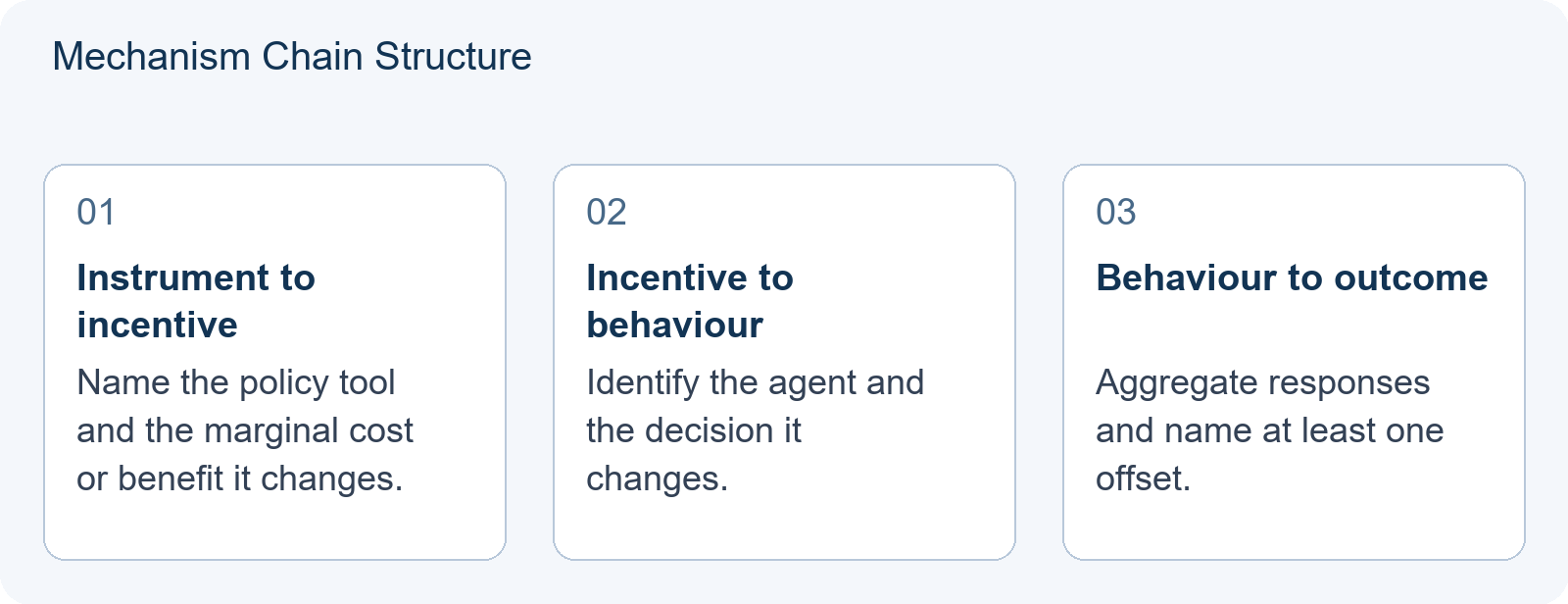
To build a robust argument, structure your analysis around four distinct links. Each link must have a verb, a decision-maker, and a possible offset. This framework ensures you are not just listing facts but connecting them causally. Let us break down each link in detail to understand its function in the broader argument.
- Link 1: The Instrument. What specific policy tool is introduced? For example, a tax, subsidy, regulation, mandate, or public investment programme. This link must be precise. Vague terms like “government intervention” are insufficient. You must name the specific lever being pulled. Is it a price-based instrument like a tax? Or a quantity-based instrument like a quota? The nature of the instrument determines the subsequent incentive structure.
- Link 2: Price or Incentive Change. How does the instrument alter marginal costs or benefits for key agents? This is where the policy starts to change the decision environment. If a tax is imposed, the private cost of production rises. If a subsidy is given, the private benefit increases. This link connects the legal or administrative action to the economic calculus faced by individuals and firms. It is the translation layer between politics and economics.
- Link 3: Behavioural Response. How do firms, households, or governments adjust their decisions in response to the new incentives? This link must name the agent and the choice. Do firms switch technologies? Do consumers reduce consumption? Do workers move sectors? This is often the most contested part of an argument because it relies on assumptions about rationality, information availability, and elasticity. You must specify who acts and what they do differently.
- Link 4: Aggregate Outcome. What is the net effect on the target variable, such as emissions, employment, growth, or inequality, once you consider likely offsets? Individual actions sum up to market outcomes, but these outcomes may be dampened or amplified by general equilibrium effects. This link requires you to look beyond the immediate reaction to the final societal impact, considering interactions between different markets and agents.
This chain forces you to specify who acts and why. If you cannot name the decision-maker in Link 3, your argument is likely assuming rational behaviour without justification. If you cannot name at least one offset in Link 4, your conclusion may be too clean to be credible. Real-world economics is messy, and acknowledging complexity strengthens your case rather than weakening it.
Teaching Illustration: The Carbon Tax Example
Note: This is a hypothetical teaching illustration, not an official LSESU prompt or scoring guide.
Consider a student arguing that a carbon tax reduces emissions. Applying the four-link chain allows us to see how a simple assertion becomes a complex argument:
- Instrument: The government imposes a per-tonne tax on CO2 emissions. This is a direct price signal applied to polluters.
- Incentive: The marginal cost of producing energy from fossil fuels rises relative to renewables. Firms now face a higher cost curve for dirty energy compared to clean energy.
- Behaviour: Firms substitute towards cleaner inputs; households reduce energy consumption because higher prices make some uses less attractive. This assumes that both producers and consumers are responsive to price signals.
- Outcome: Domestic emissions fall. However, if firms relocate production to countries without the tax, leakage may offset part of the fall in global emissions. This introduces the concept of carbon leakage, where domestic policy fails to achieve global environmental goals due to cross-border arbitrage.
The strength of this argument lies in Link 4’s nuance. By acknowledging leakage, you demonstrate that your conclusion depends on behavioural responses that may not be uniform across firms and households. That is more persuasive than simply asserting that the tax works. It shows you understand the limits of unilateral policy in a globalized economy.
A useful classroom habit is to write each link as a sentence with an active verb. “The tax raises marginal cost.” “Firms substitute towards cleaner inputs.” “Households reduce energy use.” “Leakage offsets part of the emissions fall.” Once the causal verbs are visible, you can decide which link deserves the most space in your essay. Typically, Link 3 and Link 4 require the most elaboration because they involve the most uncertainty and debate.
Finding the Weakest Link
Most essays fail because one link is assumed rather than evidenced. For instance, if you argue that AI regulation protects jobs, you might skip Link 3 entirely. You assume firms will retain workers instead of automating, but you have not shown why the regulatory burden makes retention cheaper than automation. If Link 3 is missing, the conclusion is asserted rather than demonstrated. The gap between the incentive and the behaviour is where many arguments collapse.
To fix this, ask: “What specific decision does the agent make, and what alternative did they reject?” If you cannot answer, your mechanism is broken. For a firm deciding whether to automate, the alternative might be hiring more workers, retraining existing staff, or relocating production. For a household deciding whether to insulate a home, the alternative might be paying higher energy bills. Naming the rejected alternative makes the behavioural response testable. It forces you to consider opportunity costs and trade-offs, which are central to economic reasoning.
This is also where the essay can connect to other reasoning skills. The LSESU Essay Causal Inference: Why Correlation Is Only the Start of an Argument guide explains why a correlation between policy and outcome is not enough. The mechanism chain supplies the missing causal story. Similarly, the LSESU Essay Time Horizons: Separate an Immediate Effect From a Long-Run Adjustment guide is useful when Link 4 differs between the short run and the long run. A policy may reduce emissions immediately but encourage innovation later, or protect jobs temporarily while changing hiring incentives permanently. Distinguishing these timeframes prevents overgeneralization.

Compressing the Chain into Two Sentences
With a strict 1,500-word limit, you cannot afford verbose explanations. The goal is to compress the four links into two tight sentences without losing logical integrity. Instead of writing four separate paragraphs, combine Links 1 and 2 into a premise sentence, and Links 3 and 4 into a consequence sentence. This technique saves word count while maintaining analytical depth.
Weak: “The government taxed carbon. This made fuel expensive. People bought less fuel. Emissions went down.” This is choppy and lacks nuance.
Strong: “By raising the marginal cost of fossil fuels through taxation, the policy encourages producers and consumers to substitute towards cleaner alternatives, thereby reducing domestic emissions, though cross-border leakage may offset part of the fall.” This single sentence captures the instrument, the incentive, the behaviour, and the outcome with its caveat.
This compression maintains the causal verbs (“raises,” “encourages,” “reducing,” “offset”) while saving space for deeper analysis of the offsets. If you need to discuss distributional effects, you can add a third sentence that identifies who bears the higher cost and who captures the benefit. The key is that every sentence advances the causal chain rather than restating the thesis. Efficiency is not just about brevity; it is about density of meaning.
Generating Counterarguments via the Chain
A well-built mechanism chain naturally generates counterarguments. Attack each link individually. Is Link 2 valid? Does the tax actually raise marginal costs if subsidies exist elsewhere? Is Link 3 realistic? Do households really substitute, or do they absorb the cost because demand is inelastic? Is Link 4 complete? Are there second-order effects such as inflation, reduced competitiveness, or administrative burden?
For example, in the carbon tax case, a strong counterargument targets Link 3: “If demand for energy is inelastic, households will not reduce consumption much; they will pay more, which may cause welfare loss without achieving the environmental goal.” This shows you understand the behavioural assumptions behind the policy. Another counterargument targets Link 4: “If firms relocate production rather than reduce emissions, domestic emissions fall but global emissions may not.” Both counterarguments are specific because they attack a named link. Generic objections like “this policy is bad” are weak; targeted objections based on mechanism failure are strong.
This approach mirrors the strategy outlined in The Rigour Audit: Six Economic Reasoning Errors That Quietly Cost Marks in the LSESU Essay (2026), where identifying hidden assumptions is key to rigour. A mechanism chain makes those assumptions visible, so you can choose which ones to defend and which ones to concede. By pre-emptively addressing weaknesses in your own chain, you demonstrate critical engagement, which is highly valued in the rubric.
Checklist for Your Mechanism
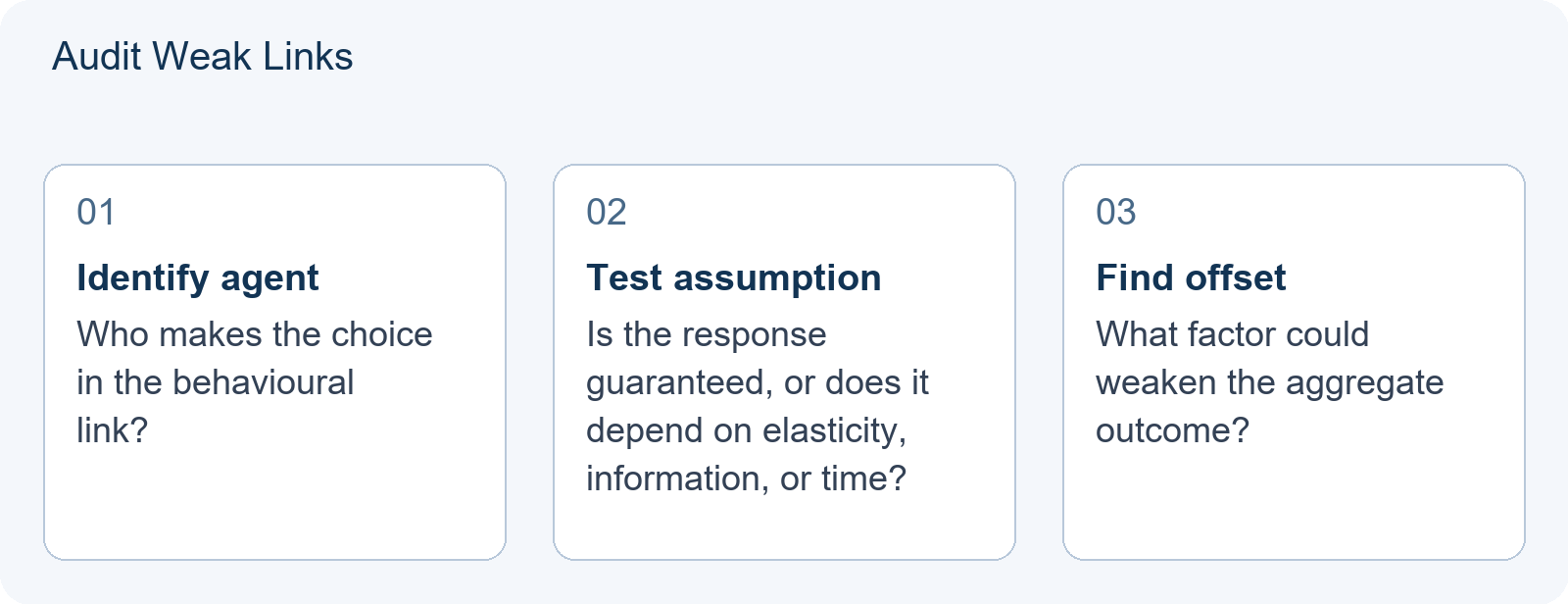
Before submitting, audit your main argument against these three criteria. This checklist serves as a final quality control step to ensure your logic holds up under scrutiny.
- Verb Check: Does every link contain an active verb describing a change, such as “raises,” “substitutes,” or “offsets”? Passive voice or nominalizations can obscure agency. Ensure that someone is doing something.
- Agent Check: Is the decision-maker explicit in Link 3, such as a firm, household, worker, or regulator? If the agent is vague, the mechanism is incomplete. Specify who is reacting to the incentive.
- Offset Check: Have you identified at least one factor that could weaken Link 4, such as leakage, inelasticity, administrative cost, or a time lag? Acknowledging limitations adds credibility. It shows you are not trying to sell a perfect solution but analyzing a real-world scenario.
If any check fails, revise. A clear mechanism chain demonstrates that you can connect policy to behaviour and behaviour to outcomes. That is a transferable skill for any economics essay question, not only for one policy area. Whether you are discussing monetary policy, labor markets, or international trade, the same four-link structure applies.
A Short Practice Exercise
Take one of the public LSESU questions you are using as practice material. Write a one-sentence answer, then fill in the four links without looking at your notes. If you cannot fill Link 3 with a named decision-maker and a rejected alternative, you have found the part of your argument that needs more evidence. If you can fill all four links, compress them into two sentences and use the remaining space to discuss one offset and one distributional effect.
The goal is not to memorise a template. The goal is to make your causal reasoning explicit enough that a reader can test it. That is what turns a policy assertion into an economic argument. Practice this exercise repeatedly until the chain becomes second nature. Over time, you will find that constructing these chains becomes faster and more intuitive, allowing you to spend more time on the nuanced discussion of offsets and distributional impacts.
Frequently Asked Questions
Does the LSESU essay require a specific word count for the mechanism?
No, the full essay is capped at 1,500 words. The mechanism should be concise, often compressed into two or three sentences, so it does not crowd out the rest of the answer.
Can I use real data in my mechanism chain?
Yes. If you use a statistic, make it support a specific link, especially the behavioural response. A statistic alone does not prove causation, but it can test whether the proposed mechanism is plausible.
Is the carbon tax example an official prompt?
No. It is a teaching illustration. The competition’s public questions are set by LSE professors and are the only official prompts.