How to Write the 1,500-Word LSESU Economics Essay: Structure and Method (2026)
To write the 1,500-word LSESU Economics Society essay, commit to one defensible argument, apply one or two standard economic models precisely, support each claim with specific evidence, and edit every paragraph against the 100-point rubric. The word limit excludes references, so the discipline is not coverage but depth: a narrow, well-defended thesis beats a broad survey every time.
Start from the rubric, not the question
Most strong essays are reverse-engineered from how they are scored. The LSESU rubric distributes 100 marks across seven dimensions, and the weighting tells you exactly where to spend your 1,500 words. “Argument & Originality” (25) and “Economic Theory Application” (20) together carry 45 marks — nearly half — yet many first drafts spend most of their length restating background. Before writing a word, decide which model you will use and what your one-sentence claim is. If you cannot state the claim in a single sentence, you do not yet have an argument; you have a topic.
For the full criterion-by-criterion logic, see our companion piece on what each band of the 100-point rubric actually rewards. For the official 2026 questions and the published rubric, read the 2026 candidate guide. If you are still deciding whether to enter at all, start with our overview of what the LSESU Essay Competition is.
| Criterion | Marks | What the marker is checking |
|---|---|---|
| Argument & Originality | 25 | Is there one clear, non-obvious thesis the essay actually defends? |
| Economic Theory Application | 20 | Are standard models applied correctly and relevantly (not just named)? |
| Evidence & Examples | 15 | Are claims backed by specific, sourced data or cases? |
| Critical Analysis | 15 | Does the essay weigh trade-offs and engage the strongest counter-argument? |
| Structure & Clarity | 10 | Can a reader follow the logic without re-reading? |
| Citations & Sources | 10 | Is referencing consistent (Harvard recommended) and complete? |
| Topic Relevance | 5 | Does the essay answer the chosen question directly? |
A word budget for 1,500 words
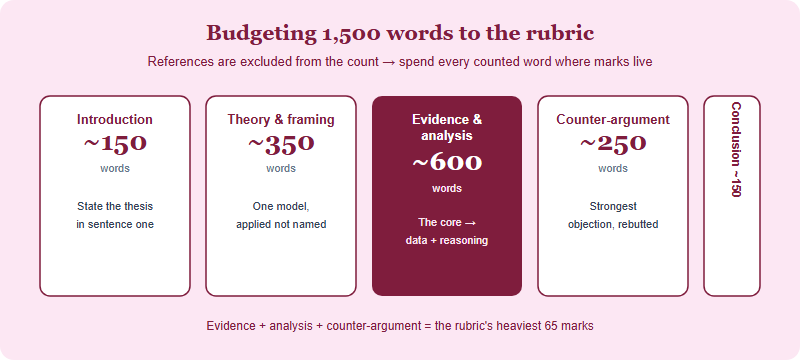
The single most useful habit we have seen in students who finish strong is treating the 1,500 words as a fixed budget and allocating it deliberately. References do not count toward the limit, but everything else does — so a 250-word “history of the debate” introduction is 17% of your essay spent on marks you will mostly not earn. The allocation below is not an official rule; it is an editorial guideline we use in draft review, derived from the rubric weights so that the heaviest-scoring sections get the most room. Treat it as a starting frame, then adjust to your argument.
Frame one argument and defend it
“Argument & Originality” is the single heaviest criterion at 25 marks, and it is where Chinese international-school students most often leave marks on the table — strong on knowledge, cautious on taking a position. Originality here does not mean inventing new economics; it means a defensible, non-obvious claim that a well-read sixth-former would not reach by default. The test is simple: if the opposite of your thesis is absurd, your thesis is too weak to score. Aim for a claim a reasonable economist could disagree with, then spend the essay closing that disagreement.
Build the thesis in three moves. First, name the specific mechanism you are arguing about (an incentive, an externality, an elasticity). Second, state your directional claim about it (“X raises Y because…”). Third, attach a condition that shows judgement (“…under conditions A, but the effect reverses under B”). That conditional clause is what separates a 70-band argument from an 85-band one, because it signals you understand the limits of your own claim — which is also half of the 15-mark “Critical Analysis” score.

Use theory and evidence with intent
Theory (20 marks) is rewarded for correct, relevant application — not for the number of models you can name. One model used precisely beats four mentioned in passing. Introduce the model, state its key assumption, apply it to the specific case in the question, and then say what it predicts. If you find yourself defining a concept the way a textbook glossary would, cut it: definitions earn almost nothing, application earns the marks.
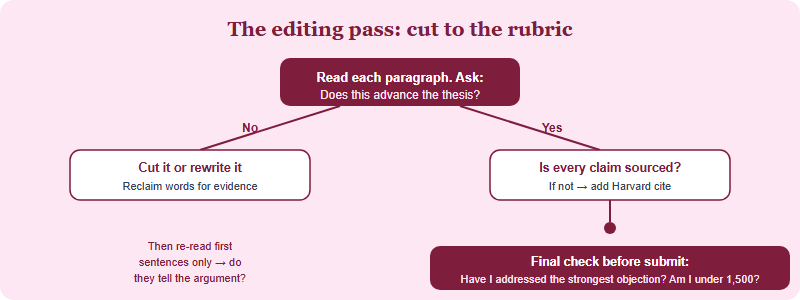
Evidence (15 marks) rewards specificity. A figure with a source and a date (“UK CPI, ONS, 2024”) earns; an unsourced generality (“inflation has risen sharply”) does not. Because references sit outside the word count, there is no excuse for an unsupported empirical claim — cite it in Harvard style and move on. The pattern that scores is claim → specific evidence → one sentence of interpretation. Two or three of these tight evidence cycles, each tied back to your thesis, will outperform a paragraph of impressive-sounding but unsourced assertion.
| Dimension | Raises the score | Wastes words |
|---|---|---|
| Argument | One conditional thesis, defended throughout | “This essay will discuss several factors…” |
| Theory | One model applied to the exact case | Listing four models without using any |
| Evidence | Sourced figure + interpretation | “Studies show…” with no source |
| Critical analysis | Steelman a counter-view, then rebut it | A one-line “however” dismissal |
| Structure | Topic sentence opens every paragraph | A 250-word historical preamble |
Structure so a tired marker can follow you
Structure & Clarity is 10 marks, but it is also the multiplier on every other score: a brilliant argument a marker cannot follow does not get its 25. The reliable shape is intro → theory → two or three evidence-led body paragraphs → one genuine counter-argument → conclusion. Open every body paragraph with a topic sentence that advances the thesis, so a reader skimming only first sentences still gets your whole argument. End the essay by answering “so what” — restating the claim with the one condition that makes it credible, not by summarising what you just said.
Edit to the rules — and write it yourself
The format rules are not graded artistry, but breaching them is an avoidable cost. Per the official guidance, submit up to 1,500 words (excluding references) in English by 1 September 2026 (23:59, GMT+1), choosing exactly one of the five questions. Format in Times New Roman 12pt, 1.5 line spacing, with page numbers, and reference consistently — Harvard style is recommended. Name your file as instructed (forename surname in uppercase + the question number). The competition is open to all secondary students, with prizes reported in the £50–£100 range plus certificates; always confirm current figures and the file-naming format on the official site, as details change yearly.
One rule is non-negotiable: AI-generated content and plagiarism are strictly forbidden, and submissions are screened, with breaches disqualified. Write the essay yourself. If you use any external tool only to check grammar, the words, argument, and evidence must remain genuinely your own — a screened essay that reads as machine-written is a wasted year. For honest, transparent help with the *method* — not ghost-writing — our China desk offers structured draft feedback; our own competition track record in this format comes from John Locke essay-prize coaching, which we attribute honestly and do not relabel as LSESU results.
Frequently asked questions
Do references count toward the 1,500-word limit?
No. The limit is 1,500 words excluding references, so cite every claim in Harvard style without spending body words on it.
How many economic models should I use?
Usually one or two, applied precisely. Theory is 20 marks for correct application, not for the number of models named.
What scores the most marks?
Argument & Originality (25) and Theory Application (20). Spend your strongest words on a clear, defended thesis and one well-applied model.
Can I use AI to help write the essay?
No. AI-generated content is strictly forbidden and submissions are screened; breaches are disqualified. Write it yourself.
Published by the editorial desk of this site, operated independently by Hanlin International Education (翰林国际教育) for China-based international-school students. This site is not the official competition website and is not affiliated with the LSESU Economics Society or the London School of Economics. Official rules are set by the competition and change yearly, so always confirm current details on the official site lsesuesec.org. Confirmed errors are corrected within 7 working days.
Filed underEssay Method · Word Limit · Writing Structure