How to Score 25/25 on Originality in the LSESU Essay (2026)
To score 25/25 on Argument & originality in the LSESU Economics Society Essay Competition, you need one defensible, non-obvious thesis that goes beyond textbook framing and is carried by your own reasoning, not the length of your literature review. It is the largest of seven rubric bands (25 of 100 marks). The five prompts are public, there is no registration, and you submit one essay of 1,500 words directly to the official portal by 1 September 2026, 23:59 GMT+1.
Why originality is 25% of your mark — and what it actually rewards
Across the official 100-point rubric, Argument & originality carries 25 marks — the single biggest band, ahead of Application of theory (20), Evidence & example (15) and Critical analysis & evaluation (15). If you have read our breakdown of the 100-point rubric, you already know the headline: the band that most often separates a Top-3 essay from a merely strong one is the originality of the central argument, not how many papers you cite.
There is a common misreading worth killing now. “Originality” here does not mean inventing a brand-new economic theory or saying something no economist has ever said. The questions are set by current LSE Economics faculty, and they are deliberately open. What the markers reward is your own synthesis: a clear thesis with logical progression that moves past the standard answer, an example you genuinely worked through, and a precise reason why your reading of the question beats the obvious one. Novelty of argument and angle — not novelty of fact — is the target.
A useful mental model: imagine a tired marker reading their fortieth essay on the same prompt. Thirty-nine of them reach the textbook conclusion by the textbook route. Yours earns the originality marks the moment it makes that marker stop and think, “I hadn’t framed it that way.” That reaction is engineered, not lucky — and the rest of this guide is the engineering. For the wider context of the competition, see our explainer on what the LSESU Essay Competition is.
The originality scale: where most essays sit, and where the marks are
Originality is a spectrum, not a switch. The table below maps the levels we see most often when reviewing drafts, what each typically scores within the 25-mark band, and the move that lifts an essay to the next rung. Use it to locate your current draft honestly before you try to climb.
| Originality level | What it looks like | Rough band (of 25) | The move up |
|---|---|---|---|
| Restated prompt | Essay answers the question in the obvious direction; conclusion is predictable from paragraph one. | ~8–12 | Find a tension the obvious answer ignores. |
| Textbook-plus | Correct theory applied cleanly, but the framing is the one a strong A-level/IB student would reach by default. | ~12–16 | Add an own worked example that complicates the clean story. |
| Genuine angle | A specific, defensible thesis that picks a side and names why the alternative reading is weaker. | ~16–21 | Surface the analytical discriminator — the one variable that decides it. |
| Original synthesis | Connects literature, a real worked case, and a sharp discriminator into an argument the marker has not seen on this prompt. | ~21–25 | Hold it: don't dilute with a broad, generic literature sweep. |
Notice the ceiling problem in the first two rows. A “textbook-plus” essay can be flawless on theory and still cap out around two-thirds of the originality marks, because nothing in it could only have been written by you. The jump that matters is from “correct” to “yours.”
A four-step method to build a 25/25 thesis
Originality is hard to fake and harder to bolt on at the editing stage, so build it in from the start. This is the sequence we walk students through during draft reviews. It works on any of the five prompts because it is about how you reason, not what the prompt says — we are giving you methodology only, never the wording of a specific 2026 question.
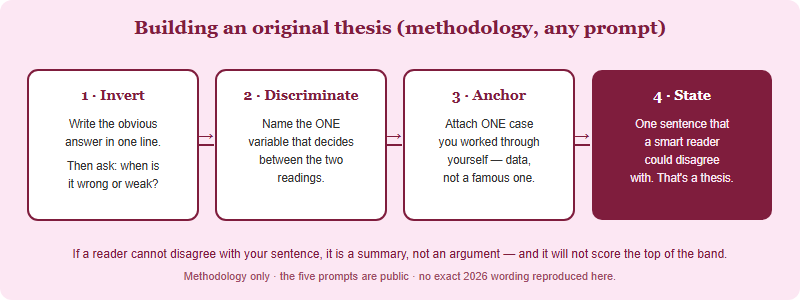
Step 1 — Invert the obvious answer. Write the textbook response to your chosen prompt in a single sentence. Now interrogate it: under what conditions does it fail, mislead, or only half-explain the data? The gap between the obvious answer and reality is where original arguments live. Markers can smell an essay that simply agreed with the prompt and decorated the agreement.
Step 2 — Find the analytical discriminator. Most essays lose originality marks by staying general — “it depends on many factors.” Strong essays name the one factor that actually tips the verdict: an elasticity, a time horizon, an institutional condition, a measurement choice. Identifying that discriminator is itself an act of original thinking, and it gives your essay a spine the marker can follow.
Step 3 — Anchor it to an example you worked through. Originality marks reward connecting theory to “a real-world example the candidate worked through themselves.” A famous case everyone cites (the 2008 crisis, the textbook minimum-wage study) adds little originality precisely because everyone cites it. A smaller, specific case you analysed — a particular country-year, a dataset you actually opened, a policy you traced — signals that the synthesis is yours.
Step 4 — State a falsifiable thesis. Compress steps 1–3 into one sentence a smart, informed reader could reasonably dispute. If nobody could disagree with your thesis, it is a description, and descriptions sit in the lower half of the band. A thesis that takes a side, names its discriminator, and could be wrong is what the top of the 25-mark band looks like.

Where originality marks leak away — and how to plug each leak
In draft reviews, the same handful of failure modes drain the originality band over and over. They are all fixable before submission. The diagram below shows the four most common leaks and the plug for each.
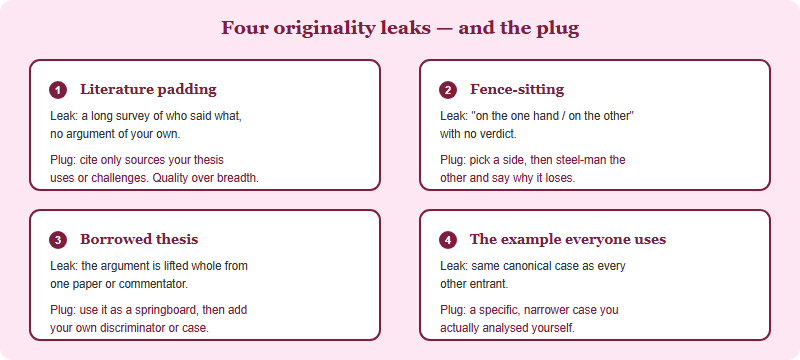
The throughline across all four leaks is the same: originality is what only you could have written. Padding, fence-sitting, borrowing, and recycling all make your essay interchangeable with the next one in the pile — and interchangeable essays do not reach the top of a 25-mark band. Within the strict 1,500-word limit (excluding titles, subtitles and references), every sentence that does not advance your argument is a sentence stolen from the marks that do.
How originality interacts with the other six bands
Originality is worth 25 marks, but it does not float free of the other 75. A genuinely original thesis quietly pulls up your other bands, because the same move that earns originality also gives the essay something to apply theory to (20), something to evidence (15), and something to evaluate critically (15). That is why we tell students to settle the thesis first and write outward from it — the rubric is more correlated than it looks. For the full prompt-by-prompt and rubric picture, our guide to the 2026 prompts and rubric lays out all seven bands and the prize structure.
A first-party note from reviewing competitive economics essays — including students we have coached toward wins in comparable open essay competitions such as the John Locke Global Essay Prize (track record attributed honestly to those competitions, not relabelled as LSESU results): the essays that converted were almost never the ones with the longest reading lists. They were the ones where, by paragraph two, you could already feel a specific mind taking a specific position. That “felt” originality is the engineering this guide describes, done early.
Before you submit: the originality checklist
Run your final draft against these checks. They map directly to the 25-mark band and to the leaks above.
- One-sentence test: Can you state your thesis in one sentence a smart reader could dispute? If not, you have a summary.
- Inversion test: Does your essay engage the strongest version of the opposing answer — and beat it?
- Discriminator test: Is there one named variable that decides your verdict, stated explicitly?
- Ownership test: Is at least one example or piece of analysis something you worked through, not borrowed wholesale?
- Process check (official): One essay, your choice of one of the five public prompts, 1,500 words, in English; no registration step; submit to the official portal by 1 September 2026, 23:59 GMT+1 — late entries are not accepted. Confirm the current submission link and any rule on the official site.
Originality cannot be sprinkled on at the end. But built in from step one — invert, discriminate, anchor, state — it becomes the most reliable 25 marks on the entire rubric, and the part of your essay that no other entrant can copy.
FAQ
How many marks is originality worth in the LSESU essay?
Argument & originality is worth 25 of 100 marks — the single largest band, ahead of application of theory (20) and evidence (15). Confirm current criteria on the official site.
Do I have to register before I can see the prompts?
No. There is no registration step and the five prompts are public. You choose one prompt and submit your essay directly to the official portal — verify the current submission link on the official site.
Does originality mean inventing a new economic theory?
No. It means your own synthesis — a defensible, non-obvious thesis with your own reasoning and example — not novel facts. Markers reward the originality of the argument, not the size of the reading list.
What is the deadline and word limit for 2026?
1,500 words (excluding titles, subtitles and references), submitted by 1 September 2026, 23:59 GMT+1. Late entries are not accepted; always confirm on the official site.
Published by the editorial desk of this site, operated independently by Hanlin International Education (翰林国际教育) for China-based international-school students. This site is not the official competition website and is not affiliated with the LSESU Economics Society or the London School of Economics. Official rules are set by the competition and change yearly, so always confirm current details on the official site lsesuesec.org. Confirmed errors are corrected within 7 working days.