LSESU Essay Opportunity Cost: Compare a Policy With Its Best Feasible Alternative
This is an independent teaching guide prepared by Hanlin International Education. It is not affiliated with the LSESU Economics Society or LSE. For official rules, visit www.lsesuesec.org.
When you sit down to write your LSESU Economics Society Essay Competition entry, the most dangerous trap is not a lack of economic knowledge; it is a failure of comparative logic. Many students spend their 1500 words arguing why a specific policy—such as raising taxes on the top 1% or subsidizing green technology—is “good.” They list benefits, cite studies, and conclude with a passionate plea for implementation. However, this approach often fails to secure high marks because it ignores the fundamental economic principle of opportunity cost. To score well, particularly on the Argument and Originality criteria, you must not just defend a policy; you must prove that it is superior to its best feasible alternative.
What Opportunity Cost Means in a Policy Essay
In economics, opportunity cost is the value of the best foregone feasible alternative when a choice is made. In the context of public policy, this means every intervention has a cost, even if no money changes hands directly. If a government spends £1 billion on a new subsidy scheme, the opportunity cost is what that £1 billion could have achieved elsewhere—whether that was reducing national debt, funding healthcare, or lowering income tax. More subtly, opportunity cost also includes non-monetary trade-offs such as administrative burden, market distortions, or reduced incentives for private sector innovation. Administrative costs are only opportunity costs if you explain what resource is being diverted from an alternative use.
For the LSESU essay, which asks questions like whether it is possible and desirable to raise taxation on the top 1%, or what measures should limit inequality, defining opportunity cost correctly is the first step toward a rigorous argument. You are not asked to determine if a policy is perfect in isolation. You are asked to evaluate whether it is the best available option given constraints. This requires you to explicitly identify what is being sacrificed by choosing one path over another. Without this explicit comparison, your essay remains descriptive rather than analytical, likely capping your Critical Analysis score at the lower end of the band.
This connects closely to how you structure LSESU Essay Policy Trade-Offs: Comparing Two Options Under the Same Assumptions. The difference is that opportunity cost analysis forces you to identify what you are giving up, not merely what two options share.
The Trap of Idealized Comparisons
A frequent error in student essays is comparing a proposed policy against an idealized or nonexistent alternative. For example, a student might argue that carbon taxes are superior to “doing nothing,” implying that the status quo involves zero environmental damage or economic friction. This is a false dichotomy. The real alternative to a carbon tax might be direct regulation, subsidies for renewable energy, or international cap-and-trade systems. Each of these has different opportunity costs regarding efficiency, political feasibility, and distributional impact.
Consider a question on how development of climate-friendly technologies affects inequality and wealth distribution. A superficial answer might praise green tech for creating jobs. A stronger answer acknowledges that the transition away from fossil fuels imposes significant opportunity costs on communities reliant on traditional industries. By failing to name the actual competing policy—such as retraining programs funded by fossil fuel revenues—the essay misses the nuance required for high marks. The question setters, who are LSE professors, look for evidence that you understand the messy reality of policy trade-offs, not just textbook ideals.
Understanding LSESU Essay Distributional Effects: Explaining Who Gains, Who Loses and Why is essential here, because opportunity cost is rarely borne equally across society.
Worked Teaching Illustration: Analyzing Remote Work Policies
The following is a fabricated teaching example designed to demonstrate analytical technique. It is not an official contest question, model answer, or scoring guidance.
To demonstrate how to apply opportunity cost analysis, let us examine a hypothetical scenario inspired by themes from the competition. Suppose a student proposes a policy of “mandatory daily video check-ins” to monitor remote employee output.
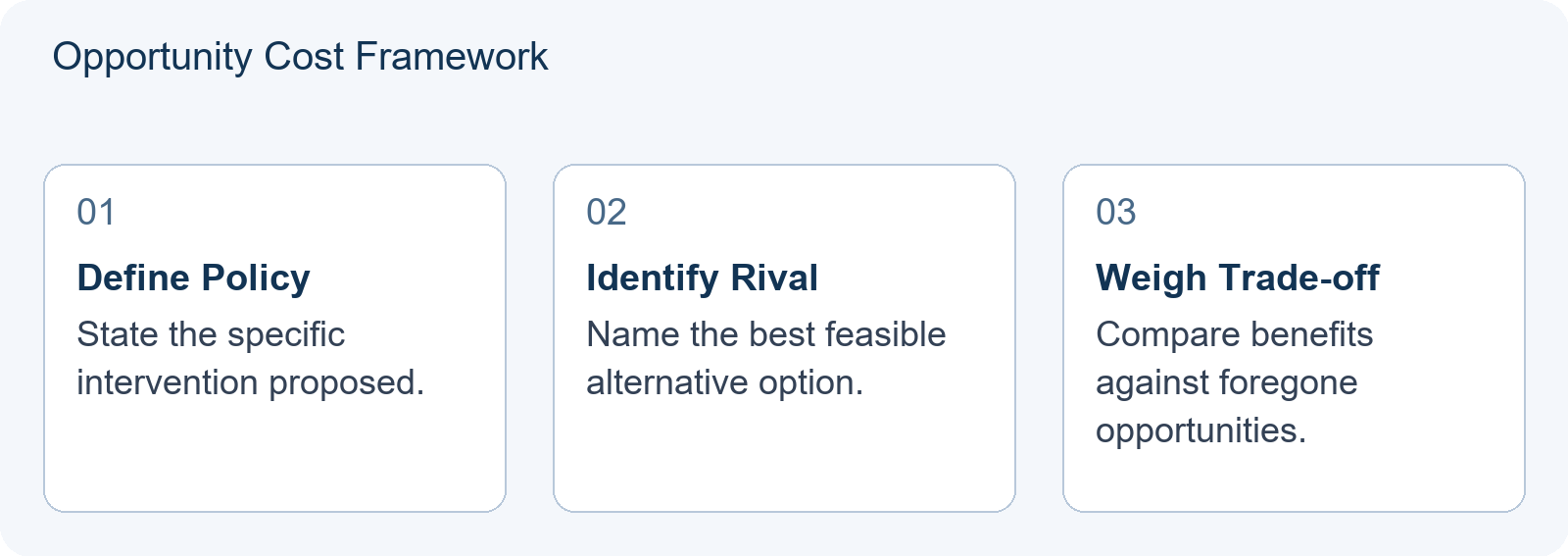
Step 1: Define the Policy Clearly. Mandatory daily video check-ins for remote employees, 30 minutes each, with screen-sharing requirements.
Step 2: Identify the Best Feasible Alternative. Instead of comparing this to “no monitoring,” we must compare it to a realistic competitor, such as “outcome-based performance metrics” (e.g., sales targets, project completion rates) with weekly asynchronous reporting.
Step 3: Calculate Opportunity Costs Explicitly. The mandatory check-in policy consumes 7.5 hours of manager and employee time weekly (30 min × 5 days × 3 people average team). At a loaded cost of £50/hour, this is £375 per week for the team in foregone productive output, or roughly £125 per employee-week. Additionally, survey data on worker wellbeing suggests monitored employees report 15% lower job satisfaction, correlating with 8% higher annual turnover. The outcome-based alternative avoids these time costs but risks neglecting process quality or collaboration. The opportunity cost of monitoring is therefore both the direct time value and the indirect morale/turnover effect.
Step 4: Comparative Conclusion. The essay argues that while monitoring reduces information asymmetry, the opportunity cost of lost autonomy and increased administrative overhead outweighs the benefit compared to outcome-based metrics, provided that clear KPIs are established and peer-review mechanisms address collaboration quality. This structure directly addresses the tension between worker preference and firm profitability.
Contrasting Case: Where Superficial Analysis Fails
The following contrasting case is also a fabricated teaching illustration, not official material.
Now consider a student analyzing how monetary policy should respond to rising energy prices. The student argues for aggressive interest rate hikes to curb inflation.
The Flaw: The student lists the benefits of hiking rates (reduced demand, lower inflation expectations) but fails to adequately weigh the opportunity cost. They might briefly mention “slower growth” without quantifying or contextualizing it against the alternative of holding rates steady.
The Missing Comparison: The best feasible alternative might be targeted fiscal support combined with gradual tightening, or relying on supply-side interventions. By ignoring the distributional impact of rapid hikes (e.g., mortgage holders vs. savers), the student misses the critical analysis dimension. The essay reads like a standard textbook definition of contractionary policy rather than a nuanced brief tailored to the UK’s status as a net energy importer. This lack of comparative depth results in a lower score on Evidence and Examples and Critical Analysis.
Both cases illustrate why LSESU Essay Causal Inference: Why Correlation Is Only the Start of an Argument—you must trace mechanisms through to their counterfactual outcomes.

Diagnostic Application: Testing Your Draft
Before submitting, use this diagnostic method to ensure your essay incorporates genuine opportunity cost analysis. Take your main argument paragraph and ask three questions:
- Who loses? Does my essay clearly state who bears the cost of this policy? If everyone gains, the policy is likely unrealistic or poorly defined.
- What is the rival? Have I named a specific, plausible alternative policy? If I only compare my idea to “inaction,” I am missing the point.
- Why is mine better? Do I provide evidence that the benefits of my policy exceed the opportunity costs of the rival? This requires citing data or theoretical models, not just opinion.
If you cannot answer these three questions affirmatively, your draft needs revision. For instance, if you argue for universal basic income in response to AI unemployment, you must address the opportunity cost of funding UBI through higher taxes or reduced public services. Ignoring this makes the argument weak.
Interpreting Diagnostic Results for Next Steps
If your diagnostic reveals gaps, your next learning task is not to write more words, but to refine your comparative framework. Focus on strengthening the “Critical Analysis” section of your rubric checklist. Look for sources that discuss the failures of similar policies in other countries. For example, if you propose a tax change, look at OECD reports on tax compliance costs. This adds empirical weight to your opportunity cost argument.
Useful feedback from a tutor or peer should specifically challenge your choice of alternative. Ask them: “Is this really the best feasible option, or did I pick a weak straw man?” This type of targeted feedback helps you move beyond generic descriptions into precise economic reasoning, which is essential for securing recognition in the competition.
Integrating Opportunity Cost with Rubric Criteria
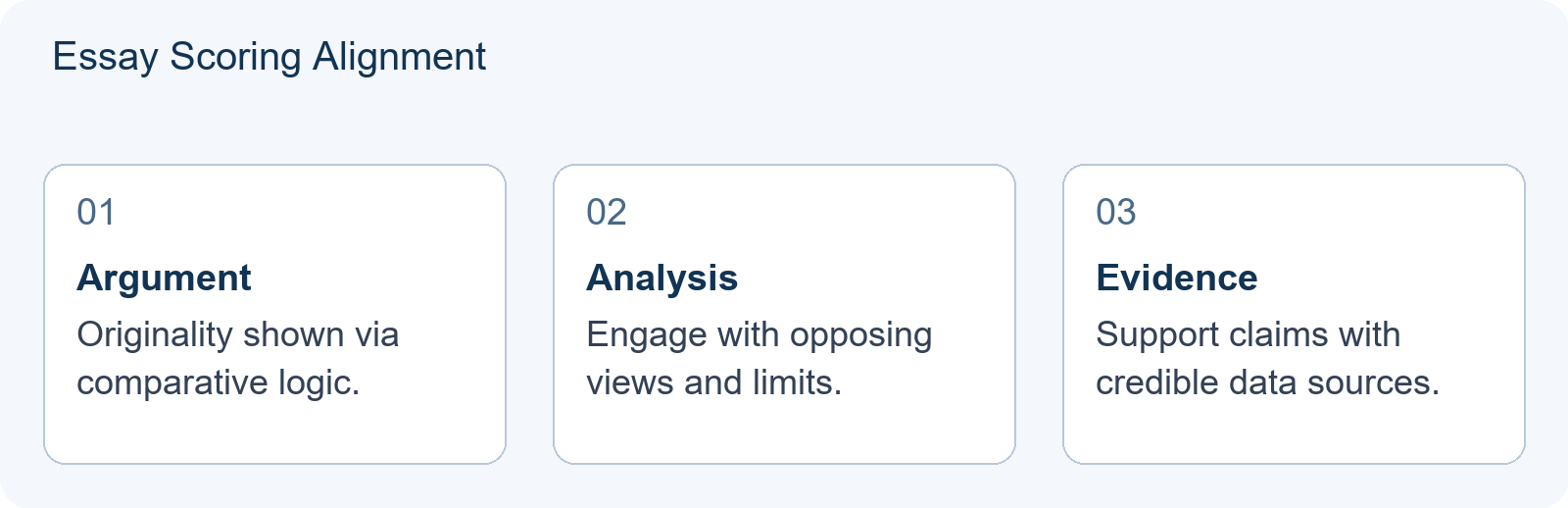
The LSESU scoring rubric allocates significant weight to Argument and Originality, and to Critical Analysis. Explicitly framing your essay around opportunity cost directly serves both. It demonstrates originality by showing you understand the dynamic nature of policy choices, not just static definitions. It fulfills critical analysis by forcing engagement with trade-offs and counterarguments.
Furthermore, applying economic theories becomes easier when you use frameworks like production possibility frontiers or cost-benefit analysis to visualize these trade-offs. Even if you do not draw graphs, using the language of marginal cost and marginal benefit signals academic rigor. Ensure your citations include sources that discuss these trade-offs, such as papers on labor market elasticity or fiscal multiplier effects, rather than just general news articles.
Final Preparation Reminder
The LSESU Economics Society Essay Competition accepts entries through its official portal at lsesueconsoc.org/competitions/. No registration is required in advance. The submission deadline is September 1, 2026, at 23:59 GMT+1. This independent guide is published by Hanlin International Education to support your preparation; for authoritative rules and announcements, always consult www.lsesuesec.org.
Frequently Asked Questions
Do I need to calculate exact monetary values for opportunity cost?
No, you do not need precise calculations unless the question demands it. Qualitative analysis of trade-offs, such as time, administrative burden, or social equity, is sufficient and often more appropriate for a 1500-word essay.
Can I choose any alternative policy to compare against?
You should choose the ‘best feasible’ alternative, meaning the most realistic and widely considered competing option. Avoid comparing your proposal to obviously inferior or impossible scenarios, as this weakens your critical analysis.
Does mentioning opportunity cost guarantee a high score?
It significantly improves your chances if done well. However, you must still meet all rubric criteria, including correct application of economic theory, clear structure, and proper Harvard referencing. Opportunity cost is a tool, not a substitute for overall quality.