LSESU Essay Elasticity Check: Test Your Policy Conclusion
Many entries in the LSESU Economics Society Essay Competition make policy claims that sound decisive: a tax will cut consumption, a subsidy will help buyers, a price cap will protect consumers. These assertions often rest on implicit assumptions about how people react to price changes. The claim may be true under one set of behavioural assumptions and false under another. The LSESU Essay Elasticity Diagnostic is a short test you can run on your own draft. It asks whether your policy conclusion survives a change in responsiveness. This is an independent teaching guide, not official scoring guidance.
Why ‘It Depends on Elasticity’ Is Not Yet an Argument
Mentioning elasticity is not the same as using it. A strong policy paragraph names the affected margin and the direction of the effect. If you argue that a tax on sugary drinks will reduce obesity, you need to show that demand responds enough to the higher price. If demand is very inelastic, the tax may raise revenue while barely changing consumption. The policy conclusion changes even though the tax itself has not changed.
The competition’s published rules cap the essay at 1,500 words and use a 100-point rubric, with originality as the highest-weighted criterion at 25 marks. That word limit makes it impractical to derive every formula from first principles. It does not excuse you from testing whether your conclusion is robust. The diagnostic below lets you do that in a few sentences. By explicitly stating your assumption about responsiveness, you demonstrate critical engagement—a key component of high-scoring essays—rather than simply describing a mechanism.
Diagnostic 1: Which Side of the Market Is More Responsive?
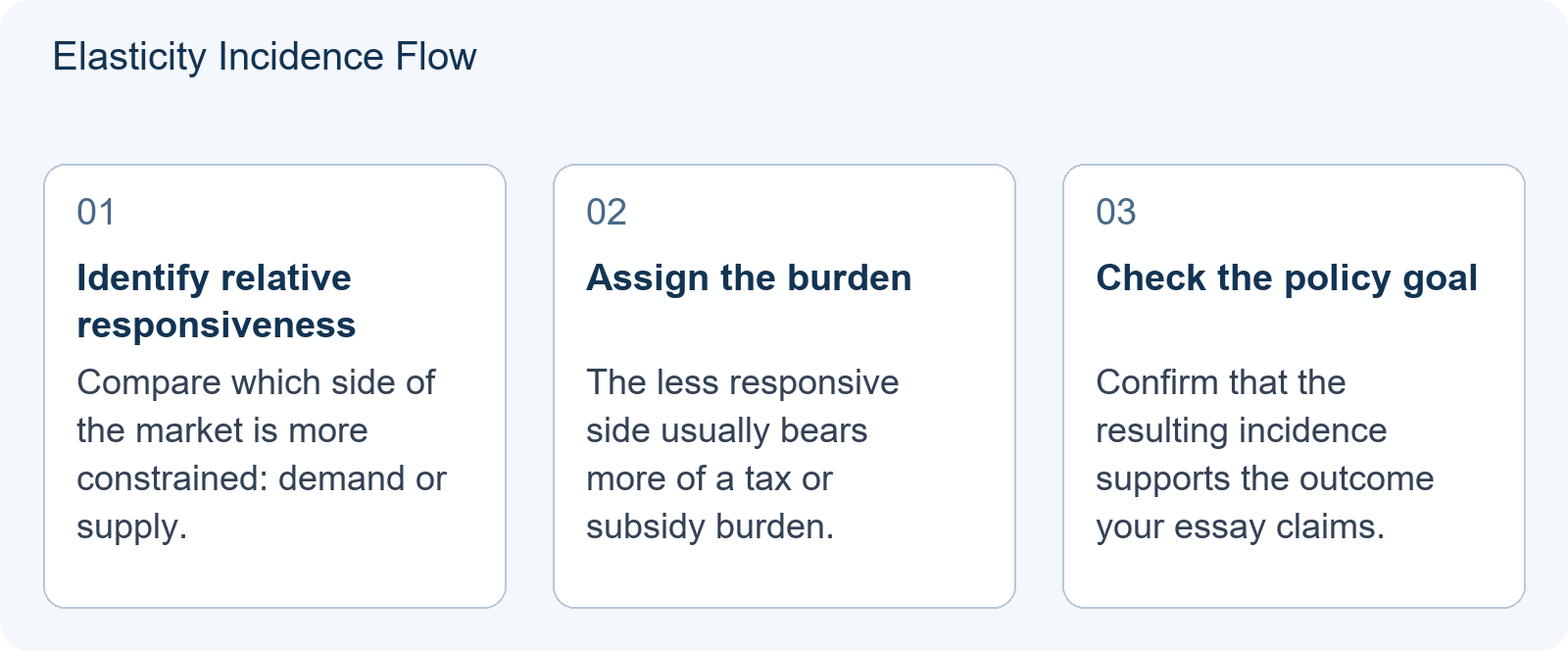
Start by comparing the price elasticity of demand and the price elasticity of supply. The less responsive side of the market usually bears more of a tax burden. If demand is more elastic than supply, consumers can switch away or reduce purchases easily, so producers absorb more of the tax through lower margins. If supply is more elastic than demand, producers can adjust output or exit the market quickly, so consumers bear more of the cost through higher prices.
In a diagram, the steeper curve is the less responsive one. But do not confuse steepness in the standard quantity-price diagram with elasticity itself. Elasticity changes along a linear curve. The diagnostic only requires a relative comparison: which side is more constrained in your specific scenario? Is the constraint consumer preference, availability of substitutes, production capacity, or time to adjust? For example, if you are discussing a tax on luxury cars, demand might be highly elastic because consumers can delay purchase or buy used models. Supply, however, might be inelastic in the short run because manufacturers cannot instantly retool factories. In this case, producers would bear most of the burden.
Diagnostic 2: Does the Policy Aim to Change Quantity, Raise Revenue, or Change Incidence?
Different policy goals depend on elasticity in different ways. If the goal is to raise revenue, inelastic demand helps because consumption remains high after the price rise. If the goal is to reduce a negative externality, elastic demand helps because consumption falls more. If the goal is to protect consumers, the incidence matters: a price cap may help some buyers but create shortages if supply is not responsive.
Many essays fail because the stated goal and the assumed elasticity point in opposite directions. For example, an essay might argue for a carbon tax to cut emissions but then assume that demand for fuel is highly inelastic. The tax may still raise revenue, but it will not cut emissions much. The diagnostic forces you to align the assumption with the outcome you are defending. You must ask: what is the primary objective of this policy? If it is behavioral change, you need elasticity. If it is revenue generation, you need inelasticity. Confusing these objectives leads to weak arguments.
Teaching Illustration 1: A £2 Tax With Symmetric Slopes
Teaching illustration, not an LSESU prompt. Suppose demand is Qd = 100 − 10P and supply is Qs = 20 + 10P. Before the tax, set Qd = Qs: 100 − 10P = 20 + 10P, so 80 = 20P and P = £4. Quantity is Q = 100 − 10(4) = 60.
Now impose a £2 per-unit tax. Let the consumer price be Pc and the producer price be Pp, with Pc = Pp + 2. Demand becomes Qd = 100 − 10(Pp + 2) = 80 − 10Pp. Supply remains Qs = 20 + 10Pp. Setting them equal: 80 − 10Pp = 20 + 10Pp, so 60 = 20Pp and Pp = £3. Then Pc = £5 and Q = 20 + 10(3) = 50.
Consumers pay £5 instead of £4, so they bear £1 of the £2 tax. Producers receive £3 instead of £4, so they also bear £1. The burden is split equally because the demand and supply slopes have the same magnitude in this example. This is a clean baseline, but it is only a baseline. A policy conclusion built on equal sharing is fragile if the real market is asymmetric. Use this symmetry to highlight what happens when asymmetry exists.

Teaching Illustration 2: When Demand Becomes More Elastic
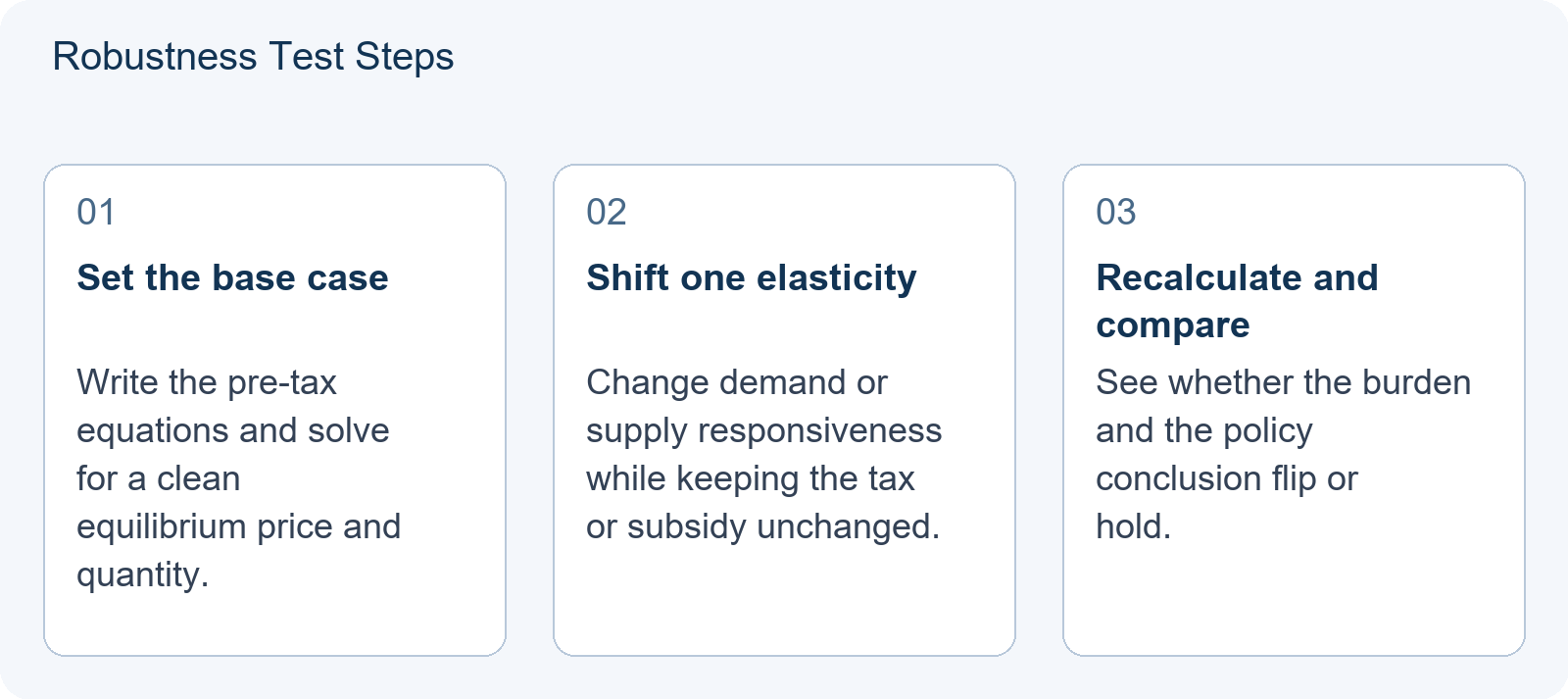
Teaching illustration, not an LSESU prompt. Keep the same supply curve Qs = 20 + 10P and the same £2 tax, but make demand more responsive: Qd = 180 − 30P. Before the tax, 180 − 30P = 20 + 10P, so 160 = 40P and P = £4. Quantity is Q = 180 − 30(4) = 60. The pre-tax equilibrium is deliberately the same as before, which makes the comparison easy to read.
After the £2 tax, demand is Qd = 180 − 30(Pp + 2) = 120 − 30Pp. Set this equal to supply: 120 − 30Pp = 20 + 10Pp, so 100 = 40Pp and Pp = £2.50. Then Pc = £4.50 and Q = 20 + 10(2.50) = 45.
Now compare the incidence. Consumers pay £4.50 instead of £4, so they bear only £0.50 of the £2 tax. Producers receive £2.50 instead of £4, so they bear £1.50. The more elastic demand side bears less of the burden, and the less elastic supply side bears more. This is the robustness test: the same tax produces a different distribution once one elasticity changes. Notice also that the quantity reduction is larger (from 60 to 45) compared to the symmetric case (from 60 to 50), meaning the behavioral impact is stronger.
How to Write the Conclusion Flip in 1,500 Words
You do not need a long derivation. Compress the diagnostic into three sentences. First, state the parameter: ‘Assuming demand is relatively elastic compared with supply…’ Second, identify the bearer: ‘…producers absorb most of the tax through lower margins.’ Third, link to the recommendation: ‘…so the policy mainly affects firm profitability rather than consumer behaviour, which weakens the case for using the tax to change household consumption.’
That structure shows the reader that your conclusion is conditional, not vague. It also respects the competition’s 1,500-word cap. The published format baseline is 12pt Times New Roman, 1.5 line spacing, and Harvard-style citation, so keep any numerical illustration compact and readable. Avoid lengthy algebraic steps in the main text; place them in footnotes or appendices if necessary, but focus on the logical implication.
Common Error: Using Elasticity as a Label, Not a Test
A frequent mistake is to label a good as essential and therefore inelastic without checking the context. Essential goods can have elastic demand if close substitutes exist. Brand-specific coffee may be elastic even though coffee overall is inelastic. Another error is ignoring time horizons. Short-run demand may be inelastic, but long-run demand often becomes more elastic as consumers change habits or technologies. If your essay discusses a long-term policy, do not rely on short-run elasticity without saying so.
A third error is forgetting the tax wedge. The consumer price and producer price are not the same once a tax is imposed. If you compare only the old price with the new consumer price, you will overstate the consumer burden and understate the producer burden. Always write down Pc = Pp + tax before solving. This simple step prevents arithmetic errors that undermine your credibility.
Pre-Submission Checklist: Parameter, Direction, Magnitude, Implication
Before you finish a policy paragraph, run this four-point checklist. 1) Parameter: have you stated the elasticity assumption clearly? 2) Direction: does the incidence flow logically from that assumption? 3) Magnitude: is the quantity or price change large enough to matter for your argument? 4) Implication: does your final recommendation still follow if the elasticity assumption changes?
If any step is missing, the argument is incomplete. This checklist turns a static description of a policy into a dynamic test of its likely effects. It also helps you avoid the trap of asserting a conclusion that only works under one unstated set of behavioural assumptions. By verifying these four points, you ensure that your essay demonstrates rigorous economic reasoning, which is valued in the LSESU rubric.
For the static winners-and-losers question, see LSESU Essay Distributional Effects: Explaining Who Gains, Who Loses and Why. When comparing two policies under the same assumptions, see LSESU Essay Policy Trade-Offs: Comparing Two Options Under the Same Assumptions. For separating immediate and long-run adjustment, see LSESU Essay Time Horizons: Separate an Immediate Effect From a Long-Run Adjustment.
Frequently Asked Questions
Do I need to show full algebraic derivations in my LSESU essay?
You do not need to reproduce a textbook derivation to make the point. The essay is capped at 1,500 words, so a compact numerical illustration is usually more useful. If you use one, label it as a teaching-style example, state the equations, and check the arithmetic.
What if I do not know the exact elasticity values for my topic?
Use a clearly stated assumption based on economic theory, then test the opposite case. For example, if you assume demand is inelastic, show what changes if demand becomes elastic. The diagnostic is about robustness, not about claiming precise estimates you do not have.
Does the LSESU rubric specifically reward elasticity analysis?
The published rubric weights originality most heavily at 25 marks out of 100. Use elasticity analysis to strengthen the logic of your answer, but do not treat it as a phrase that automatically earns marks. Check the official rubric for the full criteria.