LSESU Essay Feedback: A Reviewer Brief That Produces Comments You Can Use
Quick answer: a reviewer needs a brief, not a draft
The short answer: LSESU essay feedback becomes usable when the reviewer is given a brief, not just a draft. If you send an essay with “please read this and tell me what you think”, a reader with no brief may default to line-editing, because that is the only task the request defines: commas, phrasing, a sentence they would have written differently. A reviewer brief replaces that default with three things — the exact question you are answering, the rubric priorities, and the two or three decisions you actually want tested. Everything below hangs on that sentence.
One timing fact frames the rest. The 2026 cycle closed on 1 September 2026 at 23:59 GMT+1, and submitted entries cannot be modified or replaced. So this is not a rescue plan for an essay already sent. It is written for a student assembling a draft for a later cycle, and for anyone who wants a feedback routine reusable on school essays. This page is an independent guide operated by Hanlin International Education; it is not the competition’s official website, has no affiliation with the LSESU Economics Society, the LSE Students’ Union or LSE, and is not an entry channel.
Why “make it more analytical” keeps happening
Vague comments can be a scope problem rather than a lazy reviewer. A reader with no brief has to invent the task, and may invent it in one of three modes. Some proofread: they fix what is objectively fixable and stop, because correctness is the only standard they can apply without knowing your intentions. Some apply taste: they shorten what feels long and soften what feels assertive, producing comments like “tighten this” that carry no information about the argument. A reviewer may do the harder thing and test your reasoning, but only if you ask, and only if they can see what the reasoning is meant to accomplish.
A second effect is worth naming. A cold reader may comment hardest on the last paragraph, where attention is freshest, and on the first, where an impression forms. The middle — where the mechanism may sit — can be skimmed. A brief that names the sections you want examined counteracts both tendencies, and a brief that asks three questions rather than one produces three passes over the draft instead of one.
The package you send with the draft
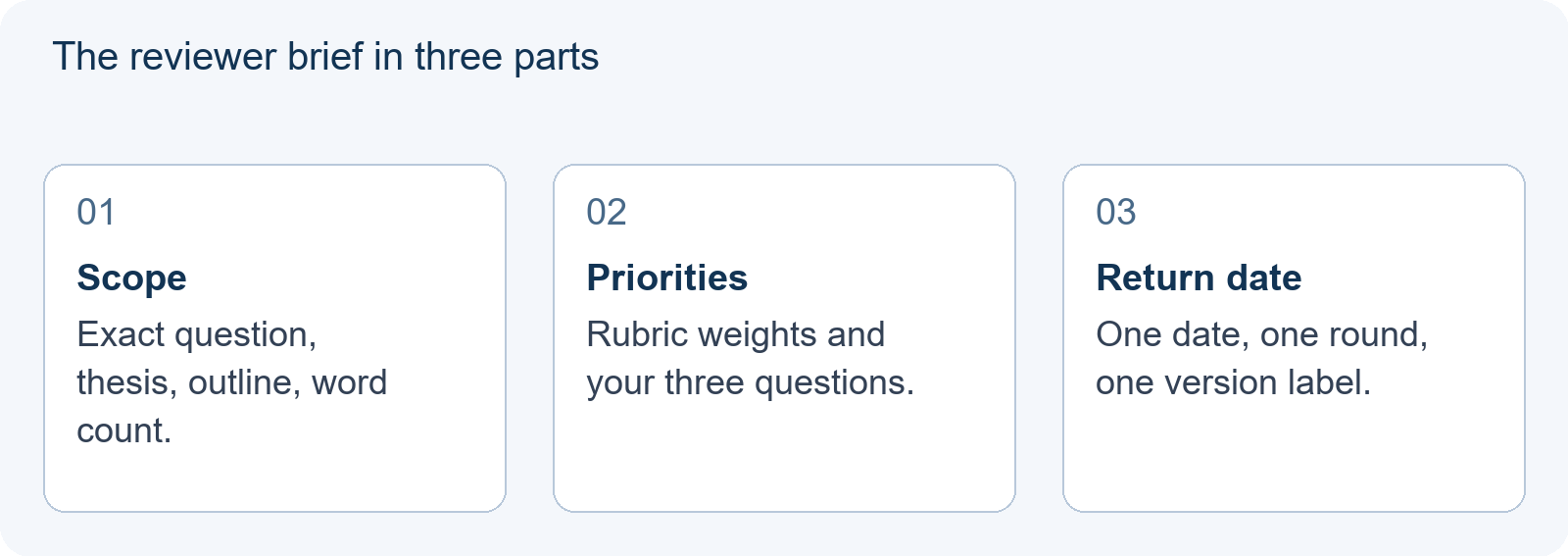
Send everything at once, in one message, in this order. A reviewer who has to ask for the question may spend less attention on the draft itself.
| Item | Why it matters | Example line |
|---|---|---|
| Exact question text | Prevents comments on an essay you were not asked to write | Attach the prompt verbatim; do not paraphrase it |
| Thesis in one sentence | Lets a reader test whether the draft does what you claim | “My argument is X because Y, not Z” |
| Outline with word counts | Shows where the mechanism sits and what space it has | Intro 150 · mechanism 500 · counter 550 · close 300 |
| Rubric weights | Redirects attention to what is actually scored | Originality 25 (highest) · other criteria as listed in the official rubric |
| Three questions | Converts one vague read into three targeted reads | “Is the mechanism in section 2 visible to a cold reader?” |
| Version label and return date | Prevents feedback on a superseded file | “Draft v3 — comments by Thursday” |
The rubric is a 100-point scale in which originality carries 25 marks and is the highest-weighted criterion, as recorded in the LSESU site project note maintained by Hanlin International Education (updated August 2026); check the official rubric for the remaining criteria and their weights. That confirmed weight can guide where a reviewer spends a marginal hour. Our editorial judgment, offered as judgment rather than rule: relevance is close to binary — an essay that drifts from the question risks losing marks that are cheap to protect. Ask a reviewer to flag that first, because it is a quick check.
A copyable reviewer brief
Five short blocks, under 200 words total, so the reviewer actually reads it before starting.
- Scope. “Read draft v3 against the attached question. Comment; do not edit my prose.”
- Priorities. “Spend most of your time on originality (25, the highest-weighted criterion), then on the criteria the official rubric lists. Relevance is close to binary — tell me if any section fails to answer the question.”
- Questions. Three numbered questions, each about one section, not about the essay as a whole.
- Prohibitions. “Do not rewrite my sentences, do not add arguments I have not made, and do not supply citations for me to paste. Point at the problem; I will write the fix.”
- Return. “Margin comments by [date], plus two lines at the top: the strongest part and the weakest part.”
The prohibitions are not etiquette. A reviewer forced to describe a problem instead of solving it must first name it, which is the comment you can act on. If you are unsure whether a section answers the question, run the question-type audit before sending the brief — The Question-Type Audit: Does Your LSESU Essay Actually Answer What Was Asked? (2026) — because a reviewer cannot diagnose a mismatch you have not noticed.

The comment triage table
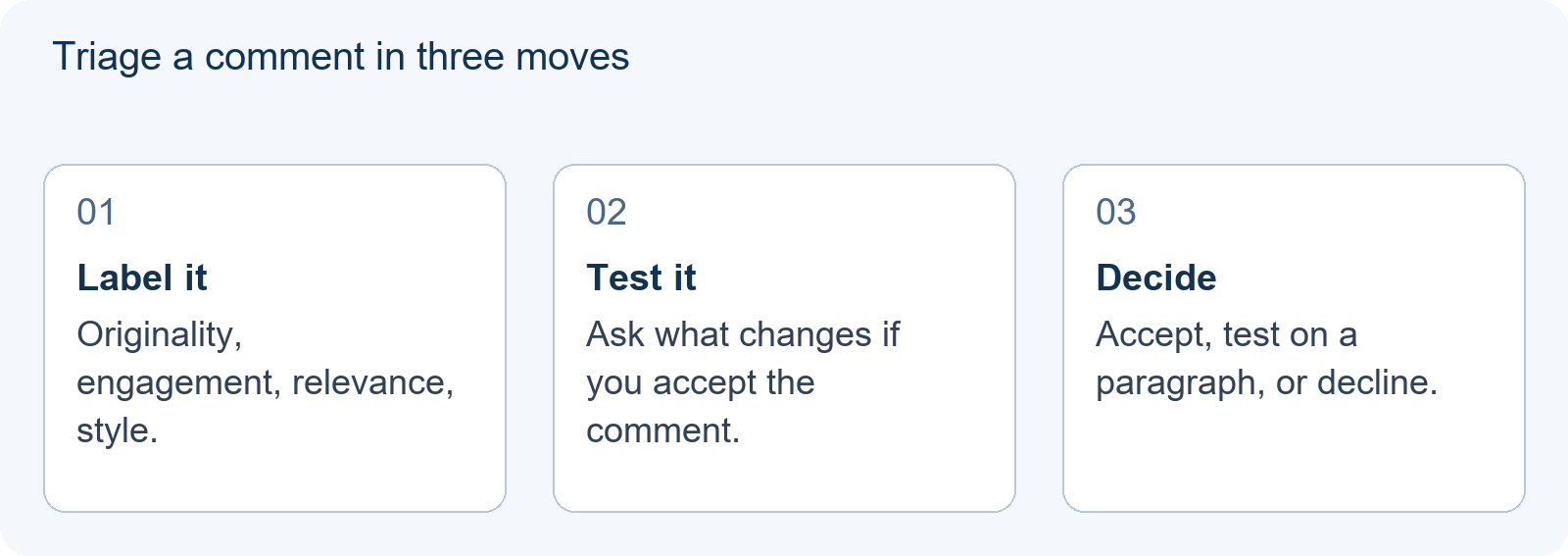
Label every comment before acting on it. The temptation is to start with the ones you can finish quickly, which is exactly backwards: style edits feel productive and change nothing that is scored.
| Label | Diagnostic question | Usual action |
|---|---|---|
| Originality | Does this ask whether the angle is mine? | Accept; answer in your own framing |
| Critical engagement | Does this name a missing step in the reasoning? | Accept; write the missing link yourself |
| Relevance | Does this point at text that does not answer the question? | Accept; delete or repurpose it |
| Evidence | Does this question whether a figure supports the claim? | Test the source, then keep, qualify or cut |
| Style | Would I change this only because someone prefers it? | Defer to the last round, or decline |
Evidence comments deserve their own pass because they are easy to accept lazily. When a reader questions a number, the numbers audit routine is the check to run rather than a reflexive deletion — The Numbers Audit: Verifying Every Figure and Citation Before You Submit (2026).
Worked illustration: three comments on one paragraph
Teaching illustration. The prompt, paragraph and reviewer comments below are invented for this article. They are not an official question, an official rubric interpretation, scoring guidance or a model answer.
Suppose a student is writing on whether a government should prefer a carbon tax to direct regulation, and the draft paragraph reads: “A carbon tax is the more efficient instrument because it raises revenue and reduces emissions at the same time. Firms respond to the price signal and the government can recycle the revenue. This is why economists generally prefer taxes to regulation.” Three reviewers return comments.
Comment 1: “You claim efficiency but never say which margin you mean. Revenue is a fiscal effect; abatement is an environmental one. The paragraph asserts both and demonstrates neither.” Label: critical engagement. It names a missing mechanism step inside the student’s own argument. Action: accept. The repair is the student’s to write — one or two sentences separating the revenue effect from the abatement effect and saying which one the “efficiency” claim rests on.
Comment 2: “This paragraph is too long. Cut it to two sentences; the revenue-recycling sentence can go.” Label: style, dressed as structure. Diagnostic question: what disappears if I cut? Here, compressing to two sentences drops the revenue-recycling clause, which is the only place the paragraph touches distribution. Action: test on a paragraph, then partly decline. Tighten the prose; keep the clause.
Comment 3: “Add a paragraph arguing that carbon taxes are regressive and rebut it with revenue recycling.” Label: a different essay the reviewer would like to read. Diagnostic question: is that objection already handled elsewhere, and is this my argument to make? Action: decline the instruction, keep the observation. The reviewer has usefully shown that a cold reader expects the objection early; whether to answer it, and in what words, remains the author’s decision.
The pattern matters more than the example: one comment names a gap, one names a preference and one proposes a different essay, and all three arrive in the same confident tone. Tone is not a signal of what to do.
Where the integrity line sits
This is this guide’s editorial judgment about safe practice, not a quotation of a competition rule. A reviewer may question, point at evidence, name a gap and say a sentence is unclear. A reviewer should not write or rewrite your prose, hand you a paragraph to insert, or submit anything on your behalf. The line is not bureaucratic. A comment you have to convert into your own words forces you to understand it; a sentence handed to you can be pasted without understanding, and pasted sentences can collapse when someone asks you about them.
Two practical consequences. If a reviewer says “you need a source here”, ask what kind of source would settle it, then find and read that source yourself — a citation supplied ready to paste is worth less than the search that taught you what the number measures. And because submitted entries cannot be modified or replaced, the review has to finish before submission; there is no correction window. That makes the return date in your brief a real constraint rather than a courtesy, and it means the final review must be one you act on rather than one you merely receive.
Two rounds, then stop
Plan for two rounds. Round one should be structural: does the thesis hold, is the mechanism complete, does every section answer the question, and does the draft fit the 1,500-word limit without the argument being amputated. Round two is narrow and line-level: the specific weaknesses round one exposed. After that, additional comments can conflict rather than improve the essay, because two competent readers can weigh the same paragraph differently on length and emphasis rather than substance.
When comments conflict, resolve them against the rubric weights, not seniority or volume. If one reader wants the historical example shortened and another wants it expanded, ask which version does more for originality and critical engagement, decide, and record the reason in one line. Then freeze the argument and move to the final edit; the change freeze routine is the companion discipline for that stage — The Change Freeze: Which Late Edits to Your LSESU Essay Are Worth the Risk (2026). A late structural idea accepted under time pressure can be riskier than a settled one.
When a coach is the right second reader
Three situations justify going outside your school. The comments you already hold contradict each other on substance and you cannot adjudicate; your thesis is unclear to two readers who are genuinely trying to be fair; or a reader identifies a structural gap you agree exists but cannot repair inside the word limit. In each case the problem sits beyond proofreading, and another round with the same reader may not move it.
Prepare for that conversation the way you prepared the reviewer brief, plus two extras: the comment sets you already have, and your triage decisions with reasons. Someone competent can then work on the argument instead of re-reading from zero. If you are asking about preparation support, name which of the three situations you are in and attach the brief — that is the difference between a generic answer and a useful one. Contact routes sit in the site footer.
General event background is available at Event background.
Frequently Asked Questions
Who should read my LSESU essay draft, and what should I send them?
A teacher, parent, tutor or strong peer can all read it, provided you send a brief rather than a bare file. The brief should include the exact question, your thesis in one sentence, a short outline with word counts, the rubric weights, three specific questions about named sections, and a return date. Ask the reviewer to comment rather than rewrite, and to avoid supplying arguments or citations for you to paste. Because submitted entries cannot be modified or replaced, the reading has to be completed before submission.
How many rounds of feedback should I get on one draft?
Two. The first round should be structural: whether the thesis holds, whether the mechanism is complete, and whether every section answers the question within the 1,500-word limit. The second should be narrow and line-level, targeting only the weaknesses the first round exposed. After that, additional comments can conflict rather than improve the essay, because readers can disagree about emphasis rather than substance. When comments conflict, resolve them against the rubric weights and then freeze the argument.
Can a reviewer suggest new arguments or new sources for my essay?
A reviewer can point at a gap and say what kind of evidence would settle a question, and that is useful. What a reviewer should not do is hand you a paragraph to insert or a citation ready to paste. Reading and citing a source yourself is what lets you defend the claim in conversation, and pasted material can fall apart under questioning. Treat a suggested new argument as an observation about what a reader expects, then decide in your own framing whether it belongs in your essay.