LSESU Essay Without School Economics: A Minimal Theory Map for Self-Taught Entrants
Quick answer. A student with no school economics course can prepare for the LSESU essay, but should not try to teach an entire syllabus. The supplied record for the 2026 round describes the competition as open to grades 9–12 across 60+ countries, free to enter and requiring no prior registration; school economics is not listed as a condition. The last verified essay format was limited to 1,500 words in English and answered one of five questions set by LSE economics professors; the 100-point rubric gave 25 marks to originality, the highest single allocation in the supplied record. The 2026 submission window has closed. For a later round, check the official competition site at lsesuesec.org before relying on any competition detail. The practical target remains narrow: learn enough theory to explain one mechanism, test one limitation and show one distributional consequence. The reader question here is how to approach the LSESU essay without school economics as a formal subject.
What the supplied facts do and do not require
The first useful distinction is between eligibility and readiness. For the 2026 record, the supplied facts answer the eligibility question: the competition is described as reaching grades 9–12 in 60+ countries, free to enter and requiring no prior registration. A school economics course is absent from that list. That absence is not a promise that an untrained student will score well. It means the entry gate is not a course-completion certificate. Readiness is a separate question about whether you can build an argument.
The last verified format uses a 1,500-word limit, which is short enough that a survey of microeconomics will crowd out the question. Five questions set by LSE economics professors mean you choose one; you are not expected to answer all five. The rubric’s 25-mark originality allocation, the highest single allocation in the supplied record, reinforces the point. A self-taught entrant should spend more time learning to use a few concepts than learning to name many. The independent guide site is not an entry channel; entries go directly to the official submission portal without prior registration. That procedural fact removes a common false step: there is no registration sequence to complete before you can begin thinking about the question.
What the essay actually rewards
An essay is not an exam answer. The rubric’s 25-mark originality allocation suggests one question you should ask of every draft: is there a clear angle that a thoughtful reader would recognise as yours rather than as a textbook summary? A second question follows from the essay’s argumentative purpose: does the essay test its own claim rather than merely qualify it? In this guide, originality means a well-chosen mechanism, a non-obvious comparison or a precise application of a concept to the prompt. It does not require inventing a new economic theory.
Critical engagement means the reader can see what would count against your argument. If your conclusion would survive the deletion of every theoretical paragraph, the theory is decoration. If your counterargument is a single sentence beginning with however, it is probably a disclaimer rather than a test. The command-words guide, LSESU Essay Command Words: What Each 2026 Prompt Asks You to Produce, is useful here because it pushes you to identify what the question asks you to produce: a judgement, a comparison, an explanation or a recommendation.
A minimal micro toolkit
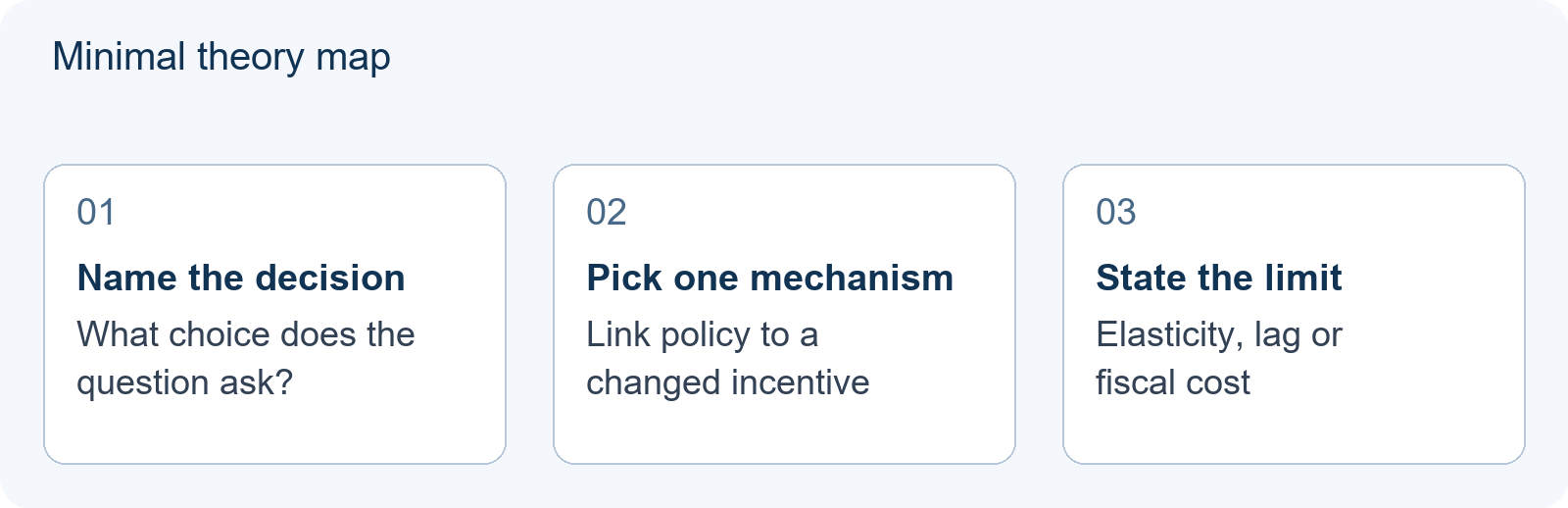
A compact starting set for policy questions is opportunity cost, incentives, elasticity, market failure and incidence. You need to be able to define each in one sentence and apply each to one policy. You do not need to memorise every diagram. The table below uses teaching categories, not official question labels.
| Question family | Essential concepts | Risk to manage |
|---|---|---|
| Should policy X be adopted? | Opportunity cost, marginal benefit and cost, feasibility | Listing pros and cons without a comparator |
| Who gains and who loses? | Incidence, elasticity, distribution | Assuming the statutory payer bears the cost |
| Why is the market outcome bad? | Externality, public goods, information | Assuming a market failure proves a policy works |
| Which instrument is better? | Incentives, administrative cost, incidence | Comparing options under different assumptions |
| What happens over time? | Transmission, lags, expectations | Mixing short-run and long-run effects |
For the first row, the key discipline is comparison with the best feasible alternative, not with an imaginary perfect market. The counterfactual belongs in the first paragraph rather than the conclusion. For the second row, elasticity decides how a tax or subsidy is shared. The elasticity check, LSESU Essay Elasticity Check: Test Your Policy Conclusion, is a useful diagnostic because a policy claim about sharing needs relative elasticities before it can be assessed.
A minimal macro and institutional toolkit
You do not need a full macro model to write a good essay. A compact set of ideas is policy transmission, time lags, credibility and distribution. Transmission asks how a policy instrument changes incentives and then behaviour. Time lags ask whether the effect arrives before or after the political or economic problem changes. Credibility asks whether households and firms believe the policy will be maintained. Distribution asks who bears the cost and who receives the benefit.
These ideas are especially useful when a question asks about long-run effects. A time-horizons discipline separates an immediate effect from a long-run adjustment: a short-run price change and a long-run adjustment can point in different directions. A distributional discipline asks who gains, who loses and why, rather than treating an aggregate gain as if everyone gains.

A four-week self-study sequence
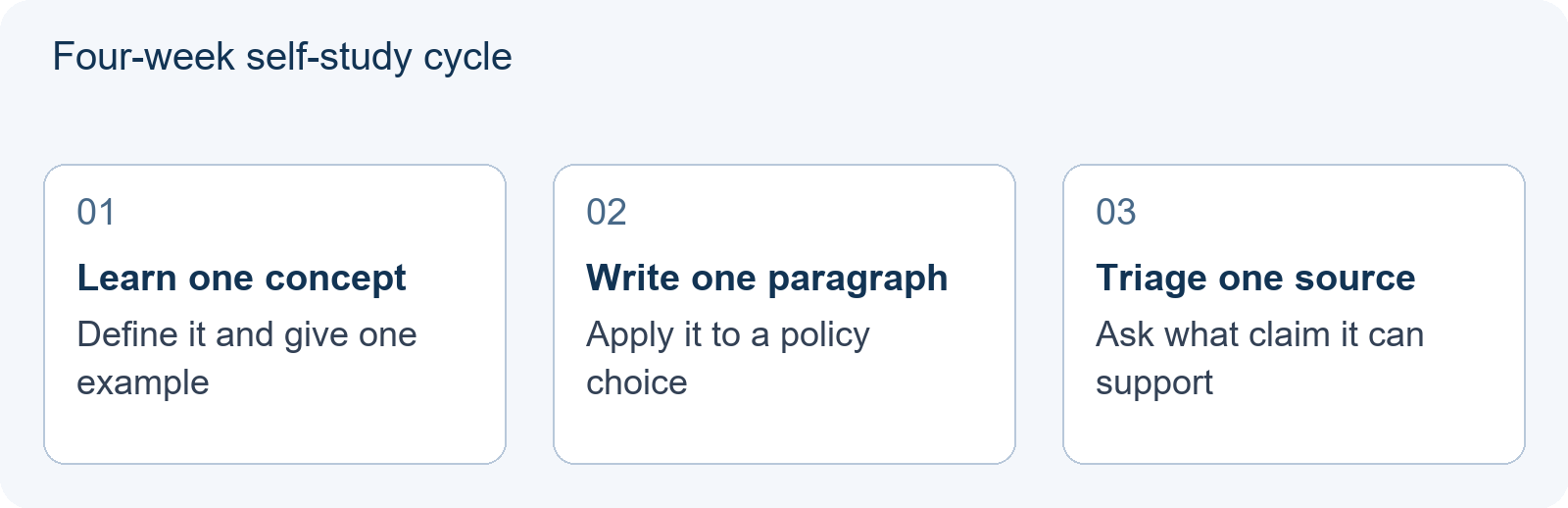
Treat four weeks as a cycle, not a syllabus. Each week has three tasks: learn one concept, write one paragraph applying it, and triage one source by asking what claim it can actually support.
- Week 1: opportunity cost and incidence. Write a paragraph comparing a policy with its best feasible alternative. Then rewrite the same paragraph identifying who bears the cost.
- Week 2: elasticity and market failure. Choose one model for one question and write a paragraph that uses it to explain a mechanism. Do not collect models.
- Week 3: transmission and time lags. Write a paragraph that separates the immediate effect from the adjustment. State one reason the lag might be long or short.
- Week 4: integration and counterargument. Rewrite your best paragraph with one limitation and one comparator. Then test whether the conclusion still follows.
The sequence is deliberately small. The aim is precise application, not a long list of names.
Worked teaching illustration: one subsidy paragraph, before and after
Teaching illustration, not an official prompt or model answer. Consider a government that wants to increase heat-pump installation and is considering a per-unit subsidy to installers in a competitive market.
Before: A government should subsidise heat pumps because the subsidy lowers the price of heat pumps. Lower prices increase purchases, so more households install heat pumps and carbon emissions fall. This shows the policy is efficient and should be adopted.
After: A per-unit subsidy to heat-pump installers shifts supply downward, so the consumer price falls and the quantity installed rises. The size of the consumer price fall depends on the relative elasticities of supply and demand. If installer capacity is inelastic in the short run, much of the subsidy is captured as higher installer receipts rather than passed through to households. The carbon effect also depends on additionality: households that would have installed anyway still generate subsidy payments to installers, raising the fiscal cost per additional installation. A complete case therefore compares the subsidy with a narrower alternative, such as an upfront grant targeted at low-income households, and states which elasticity and take-up assumptions drive the conclusion.
The revision adds one mechanism: the subsidy shifts supply, but incidence depends on relative elasticities. It adds one limitation: some households would have installed anyway, so the fiscal cost per additional installation may be high. It also names a comparator, which is what turns a description into an argument. For a fuller treatment of the chain from policy to outcome, see LSESU Essay Mechanism Chain: Link Policy to Outcome.
Over-theorising diagnostic
Five signs suggest that theory has become a textbook dump rather than an argument:
- You define a concept but never use it in a sentence about the question.
- You include a diagram you cannot explain in plain English.
- You list three models but compare none of them.
- Your counterargument is a disclaimer rather than a test of your claim.
- Your conclusion would survive if you deleted every theoretical paragraph.
Cut each passage that fails one of these tests. Replace it with a sentence that states the mechanism, the assumption and the consequence. That keeps the paragraph focused on the question.
When to seek a teacher or coach
Seek help when you cannot explain your mechanism in plain English, cannot state the strongest objection to your claim, or cannot decide which of two policies your assumptions favour. Bring a one-page theory map, one paragraph you have already revised, and two specific questions. A useful question is not “Is this good?” but “Which assumption is doing most of the work in this conclusion?” That kind of preparation makes feedback more precise and keeps the essay yours.
Source basis and scope
The factual baseline here is the IMA site-operations record titled LSESU site: LSESU site (translated title; record updated 27 August 2026). It is the source for the competition facts used above: grades 9–12, 60+ countries, free entry, no prior registration, a 1,500-word English essay answering one of five questions set by LSE economics professors, a 100-point rubric with 25 marks for originality as the highest single allocation, and direct submission to the official portal. It also records that the independent guide site is not an entry channel and gives a 2026 deadline of 1 September 2026, 23:59 GMT+1. The 2026 submission window has therefore closed; for a later round, check the official competition site at lsesuesec.org. This independent guide is operated by Hanlin International Education and is not affiliated with the LSESU Economics Society, the LSE Students’ Union, or LSE.
General event background is available at Event background.
Frequently Asked Questions
Can I enter the LSESU essay without school economics?
The supplied record describes the competition as open to grades 9–12 across 60+ countries, free to enter, with no prior registration, and it does not list a school economics course as a condition. The 2026 submission window has closed; for a later round, check the current official rules and judge whether you can build and test an argument.
How much economic theory do I actually need?
Enough to explain one mechanism, one limitation and one distributional consequence in plain English. In practice that means opportunity cost, incentives, elasticity, market failure, incidence, and a basic sense of policy transmission and time lags. A broad textbook survey is not required.
Is this official guidance for the competition?
No. This is an independent teaching perspective from Hanlin International Education, not the competition’s official guidance. The organiser’s current rules and submission instructions are authoritative.