Inside the 100-point rubric: why originality scores 25 and relevance scores 5
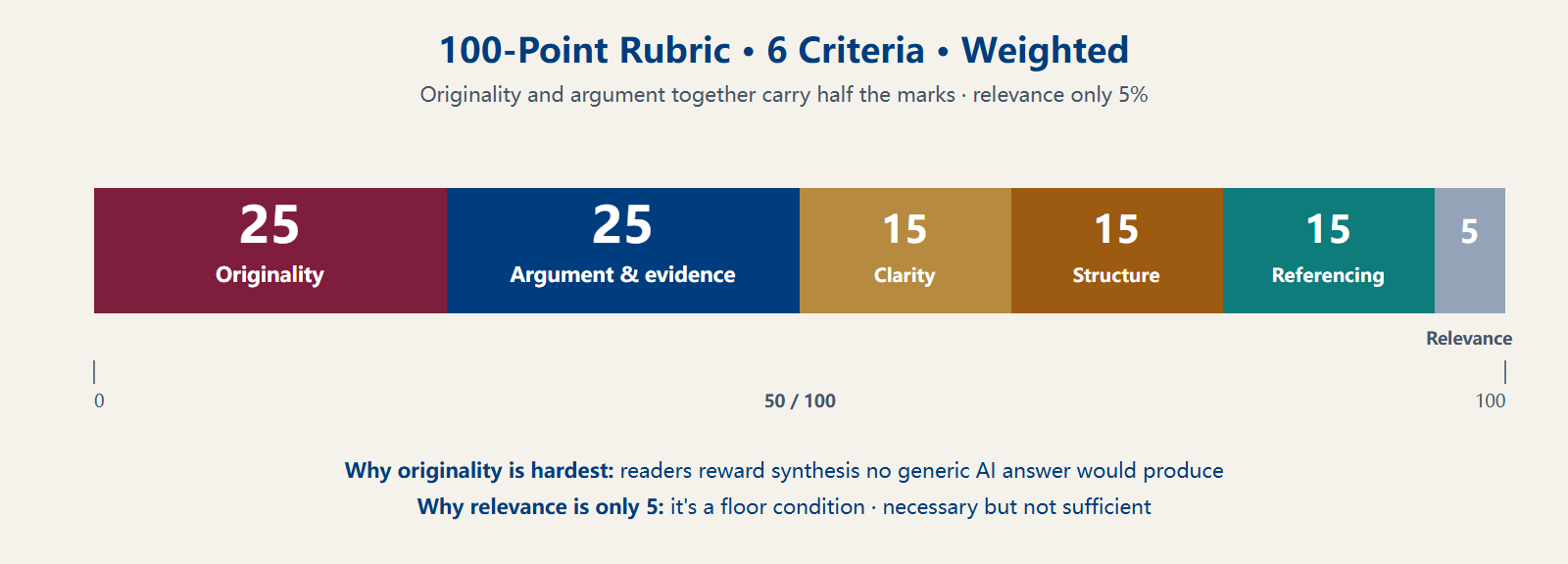
The Essay Competition rubric distributes 100 points across six criteria — argument and originality at 25 points, economic theory at 20, evidence and critical analysis at 15 each, structure and citation at 10 each, and relevance to the prompt at 5. The weighting is not accidental. It tells you exactly what the judging panel is looking for.
A frequent question from first-time candidates is why relevance to the prompt scores only 5 points when answering the right question seems like the basic test of a good essay. The answer is that relevance is binary, not graded — an essay either responds to the chosen prompt or it does not. The 5 points are there as a sanity check, not as a graded criterion the candidate can optimise against. An off-prompt essay loses all 5 points and cannot place, regardless of how well it scores on the other five criteria.
Why argument and originality is weighted heaviest
The 25-point weighting on argument and originality reflects what the prompt-setters actually want to read. They have set five questions across the disciplinary range; they have read more competently-written but generically-argued essays on those questions than they care to count. What they look for is a candidate who has a clear thesis, defends it with a logical progression, and offers a position that goes beyond the textbook framing of the prompt. The textbook framing is the floor, not the ceiling.
What separates a Top 3 essay from a Gold essay is almost always the originality of the central argument, not the breadth of the literature review.— Editorial committee
Economic theory at 20: correct, not necessarily new
The 20-point weighting on economic theory does not reward originality in the way the first criterion does. It rewards correct and apt application of standard economic models, frameworks, and concepts. A candidate who confidently uses an aggregate-demand-aggregate-supply framework to answer Question 2, or who invokes the optimal-taxation literature on Question 4, scores well — provided the application is correct. Misapplied theory loses points faster than missing theory.
Evidence and critical analysis at 15 each
The 30 combined points on evidence and critical analysis are the criteria that most often separate Top 3 essays from Question Winner essays. Evidence — 15 points — covers the citation of empirical studies, historical episodes, and credible data sources to support the argument. Critical analysis — 15 points — covers the discussion of counter-arguments and the acknowledgment of trade-offs. Strong essays defeat the strongest counter-argument they can imagine; weak essays ignore it.
Structure and citation at 10 each
Structure is about whether the reader can follow the argument; citation is about whether the reader can trust the evidence. Both are necessary conditions for a high-tier essay, neither is sufficient. The rubric reflects this by making each worth 10 points — enough to matter, not enough to compensate for a thin argument. A perfectly-structured essay with no original argument can score 10 on structure and 5 on argument; an unstructured essay with a sharp argument can score 5 on structure and 20 on argument. The latter places higher.

How to use the rubric in your drafting
Print the rubric out before you start writing. After every redraft, ask yourself which criterion you have just scored higher on. If two redrafts in a row improve nothing in any of the six criteria, you are wasting time — the next redraft needs to target a specific criterion, not just polish the prose. The candidates who place highest are the ones who can name the criterion their final draft scored highest on.
- Competition rules — full 100-point rubric breakdown
- Preparation resources — Harvard referencing primer and writing timeline
The 2026 LSESU Economics Society Essay Competition is open to high-school students worldwide — it is free and requires no registration. The five essay questions are public, and the deadline is 1 September 2026. See how to enter, or open the Contact page and scan the QR to reach the support team. All contact is via QR scan only.
Why originality (25) is the hardest 25 points in the rubric
Originality is the single largest block in the rubric — equal to argument-and-evidence and double either of the next two heaviest criteria. It is also the criterion candidates most often misread. Originality is not novelty of thesis (most prompts have a small number of defensible answers, and rewarding pure novelty would reward outlier guesses). Originality is the candidate own synthesis: did the essay assemble its evidence, frame its argument, and structure its concession in a way that a Chat-style generic response would not produce. Readers can identify generic answers on a single careful pass — and the AI-detection layer flags the most obvious cases automatically. The essays that earn the top of the 25-point band do something a generic answer cannot: they connect the literature to a real-world example the candidate worked through themselves, or they identify a discriminator that decides between two competing arguments at a granular level.
Why relevance (5) is weighted so low
The relevance block, at 5 points, can feel mismatched to its importance — surely answering the actual question matters more than 5 percent of the mark. The weighting reflects how the Department reads the criteria: relevance is necessary but not sufficient, and any essay that fails the relevance test cannot reach the upper bands on the other five criteria. Relevance is, in effect, a floor condition. The 5 points exist to penalise minor drift (answering an adjacent question rather than the prompt) without making relevance the dominant axis of marking. Candidates who treat relevance as a sliding scale and try to maximise it lose the originality marks they could have earned by taking the prompt in a slightly less obvious direction.
What a 95 looks like vs an 85 vs a 70
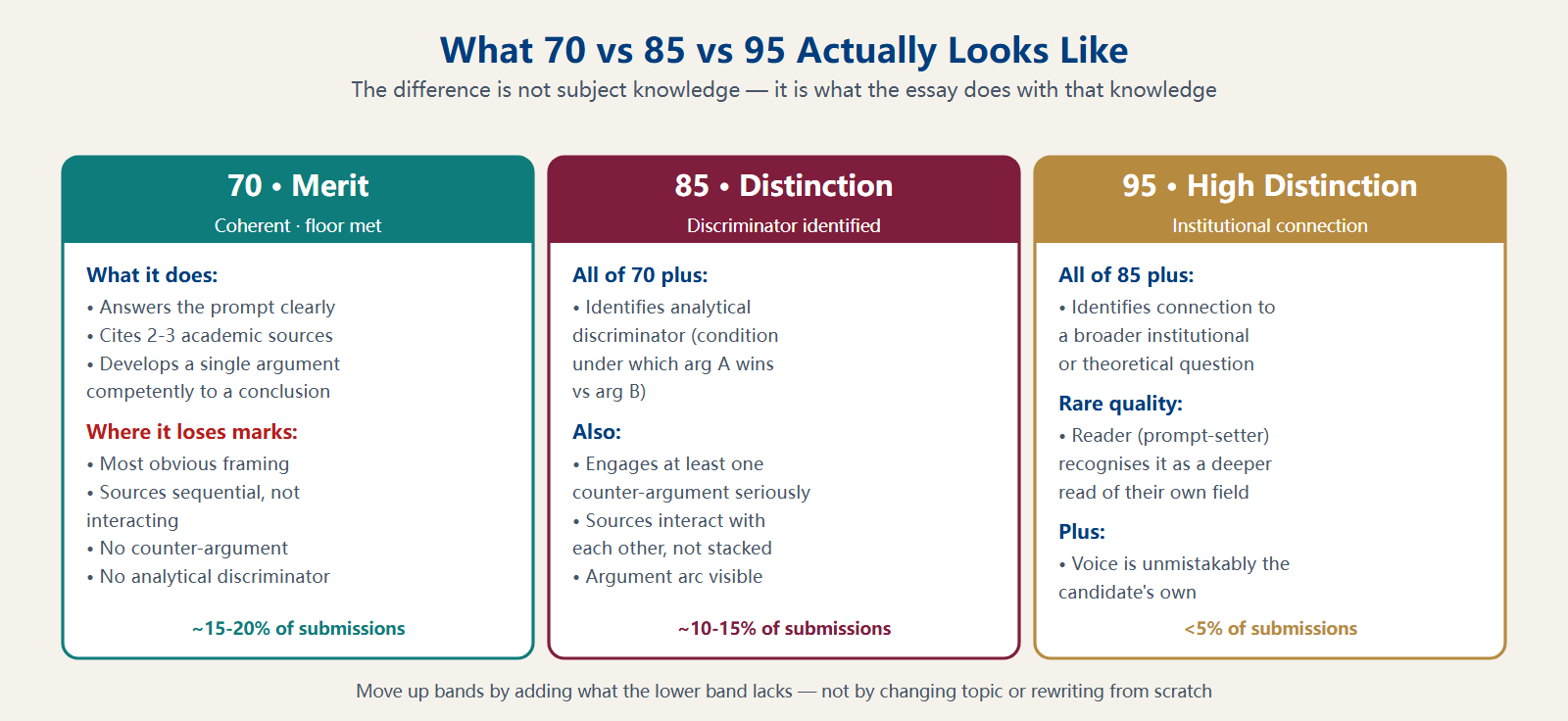
A 70-point essay answers the prompt clearly, cites two or three academic sources, and develops a single argument competently. It loses originality marks by following the most obvious framing and synthesis marks by treating its sources as sequential rather than interacting. An 85-point essay does everything the 70-point essay does, plus identifies an analytical discriminator (the condition under which one argument wins and the other loses) and engages at least one counter-argument seriously. A 95-point essay does both of those, and in addition identifies a connection between the prompt and a broader institutional or theoretical question that the prompt-setter recognises as a deeper read of their own field. The 95-point band is narrow and rare; in most cycles, fewer than two percent of essays land there.
How AI detection interacts with the rubric
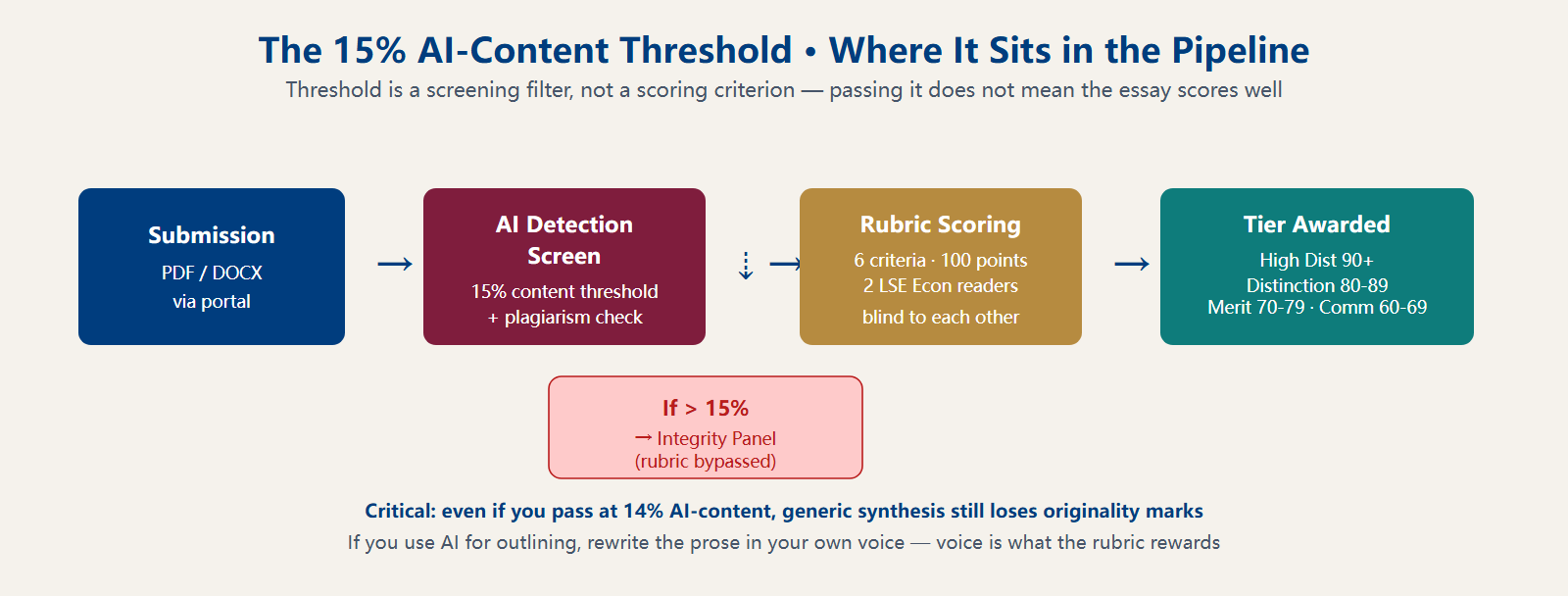
The 15 percent AI-content threshold is applied at the screening stage, before the rubric is scored. Essays exceeding the threshold are referred to the integrity panel rather than judged. The threshold is not, however, an originality measure — an essay can score 14 percent AI-content (under the threshold) and still earn very few originality marks if its synthesis is generic. The reverse is also true: a candidate writing entirely from scratch can fail the threshold if their prose style happens to match the patterns the detector flags. Candidates who use AI tools for outlining or note-taking should rewrite the prose in their own voice; the rubric rewards the candidate own analytical voice, regardless of the tools used in preparation.
Frequently asked questions
If originality is the largest block, can I sacrifice clarity and structure to take a more original angle?
No. The rubric is multiplicative in effect, not additive — an essay that scores at the top of originality but the bottom of clarity will not reach the upper distinction tiers, because readers struggle to follow the original argument. Top essays score high on all six criteria simultaneously; originality is the differentiator only after the floor conditions are met.
How does the panel actually agree on originality scoring across different readers?
Each essay is read by at least two LSE Economics Department professors blind to each other scores. When scores differ by more than 10 points overall, a third reader adjudicates. Originality scores converge most often when both readers identify the same analytical discriminator the candidate flagged; they diverge most often when the discriminator is unclear or absent.
Is structure (the structure block) about paragraphing or about the logical flow of the argument?
Both, but the logical-flow component carries more weight. Visually clean paragraphing without a clear argument arc reads as a school essay; a clear argument arc with rougher paragraphing reads as a serious analytical piece. The rubric rewards the latter more than the former in mid-band scoring.
If my essay is referred to the integrity panel, does that mean the rubric is not applied?
Correct — the rubric scoring is bypassed entirely for essays referred to integrity review. If the panel clears the essay (no integrity violation), the rubric is then applied normally. If the panel finds an issue, the essay is withdrawn from competition. The integrity decision is final and not appealable on rubric grounds.
Filed underClarity · Methodology · Originality · Relevance · Rubric Decoder · Structure
This site is an independent English-language guide to the LSESU Economics Society Essay Competition, operated by Hanlin International Education (翰林国际教育) for China-based international-school students. It is not the official competition website, and it has no affiliation with, authorisation from or endorsement by the LSESU Economics Society, the LSE Students’ Union or the London School of Economics. Our editors verify every claim against lsesuesec.org and lse.ac.uk source material. Official rules are set by the competition and change yearly, so always confirm current details on the official site lsesuesec.org. Corrections are made within 7 working days of confirmation.