Why we do not issue participation certificates
The Essay Competition awards four tiers — Overall Champion, Question Winner, Top 3 per question, and High Distinction. There is no participation certificate. The decision is deliberate, and the reasoning matters more than the omission.
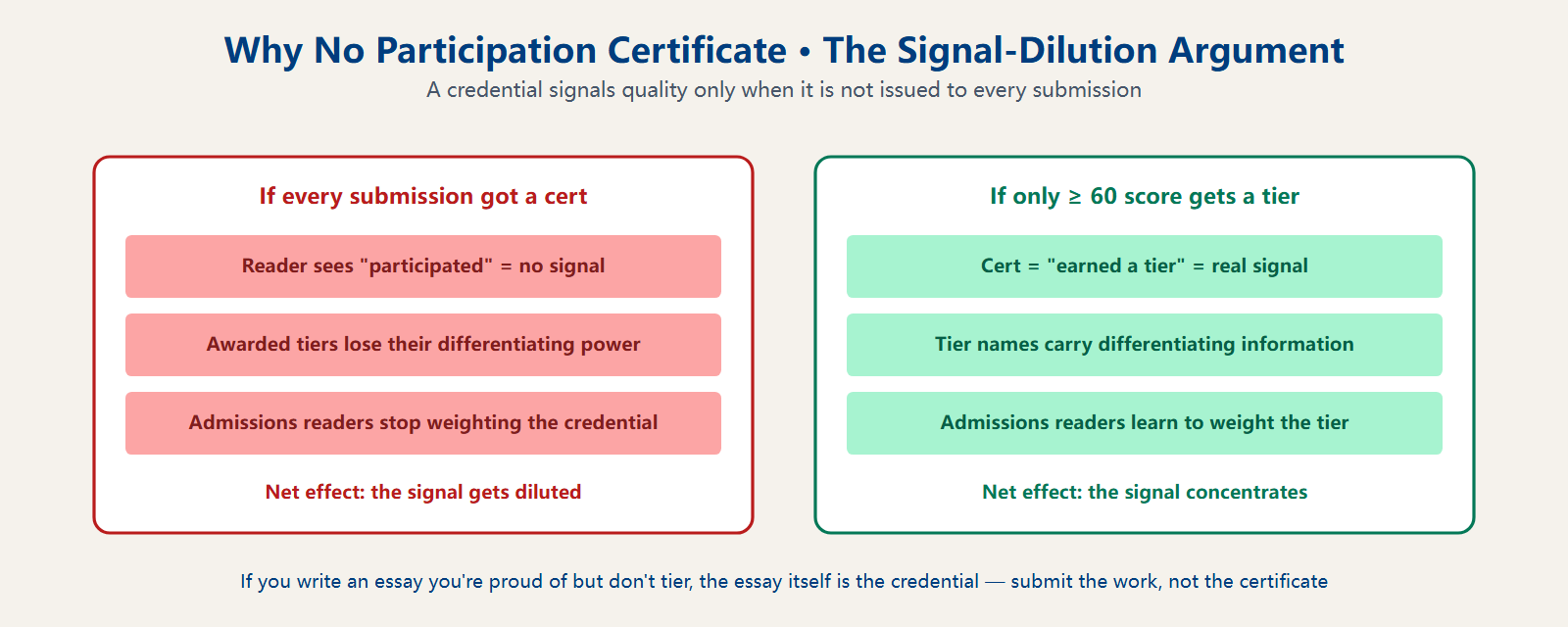
Every season, a small share of entrants ask why the Essay Competition does not issue a certificate to every entrant who submits. The answer, given here in full because it shapes how the rest of the awards structure works, is that the Society believes a certificate carries signal value only when it is issued for a real distinction. Issuing a certificate to every entrant would dilute the four award tiers and weaken the credential of the candidates who earned one.
Distinction-only awarding is a design choice, not a cost cut
A participation certificate is essentially free to produce. The reason the Essay Competition does not issue one is not budgetary; it is editorial. The Society view is that academic awards behave like a market for credentials, and as in any market, supply expansion reduces value. A High Distinction certificate awarded to the top 5% of submissions is worth something on a university application precisely because the other 95% of submitters did not receive a certificate of any kind. Dilute that supply by issuing certificates to everyone, and the High Distinction certificate quietly loses what made it signal-bearing in the first place.
A certificate carries signal value only when it is issued for a real distinction. Issuing one to every entrant dilutes the award tiers that did require distinction.— Editorial committee
What this means for first-time candidates
Two practical implications follow. First, entering and submitting is itself the meaningful step, regardless of whether the candidate places. A submitted essay is on file with the Society; the candidate has gone through the discipline of writing 1500 well-cited words against a Nobel-laureate-set prompt. That is its own form of preparation for university-level economics writing, and it does not require a certificate to be valuable. Second, candidates aiming for a university application credential should aim for High Distinction or above — that is the lowest tier whose certificate is designed for the academic-honour section of a standard application.
Comparison with other essay competitions
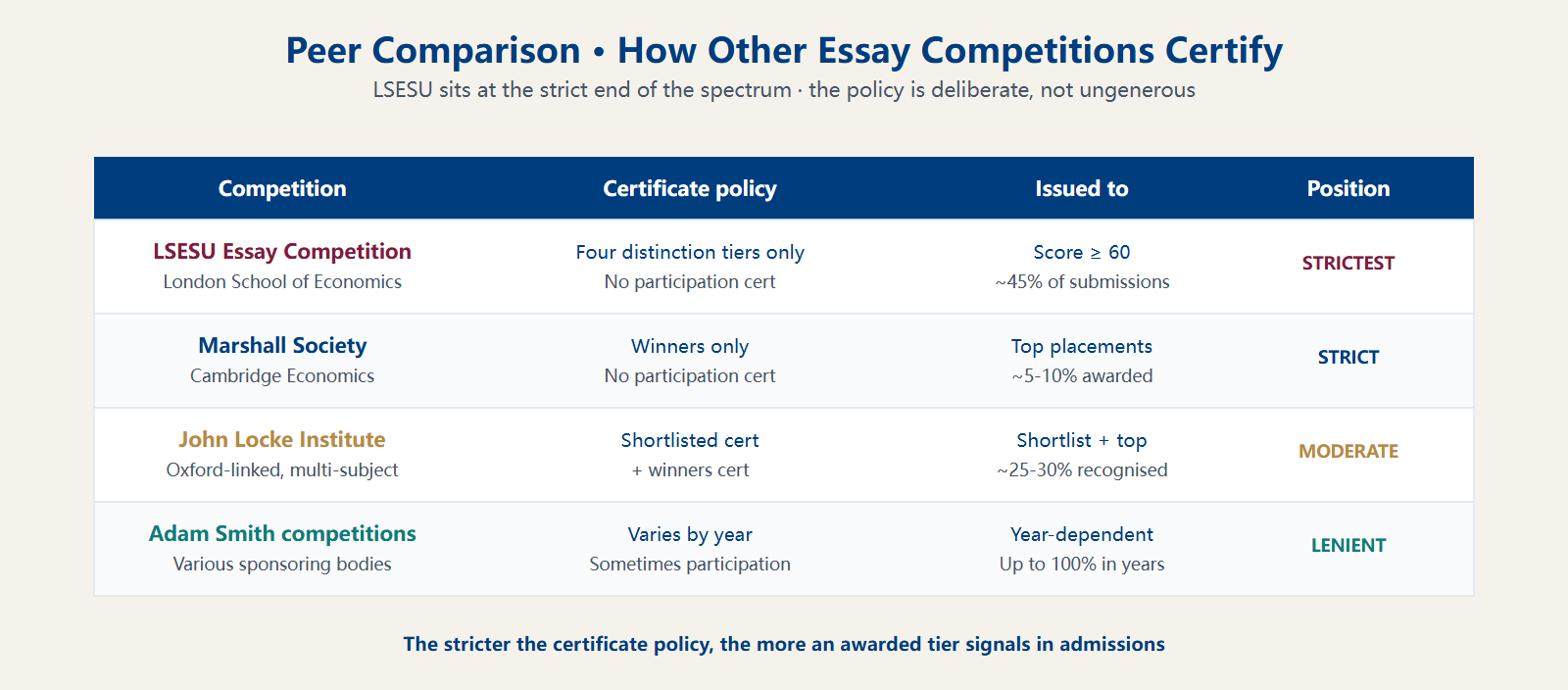
Several pre-university economics writing competitions issue participation certificates. The Essay Competition editorial committee is aware of the choice and continues to depart from it. The reason, restated for candidates who plan to enter multiple competitions in the same cycle: those competitions participation certificates and the Essay Competition tier certificates serve different functions. The participation certificate signals attempt; the tier certificate signals distinction. Both are legitimate; they are not interchangeable when an admissions officer reads them.
What stays the same across tiers
Every tier certificate from High Distinction upward is signed by the LSESU EconSoc President. From Top 3 upward, the certificate adds the signature of the prompt-setting LSE professor. From Overall Champion, the LSE Department of Economics Head signs as well. The named provenance is what makes the certificate portable — admissions officers reading a Top 3 certificate signed by a named LSE professor know it was assessed and signed by the academic who set the question, not by a generic competition administrator.
- Awards page — full four-tier breakdown and certificate design
- Competition rules — including the 100-point rubric
The 2026 LSESU Economics Society Essay Competition is open to high-school students worldwide, is completely free, and requires no registration. The five essay questions are public, and the deadline is 1 September 2026. See how to enter, or open the Contact page and scan the QR to reach our editorial desk. All contact is via QR scan only.

The four distinction tiers, and what each represents
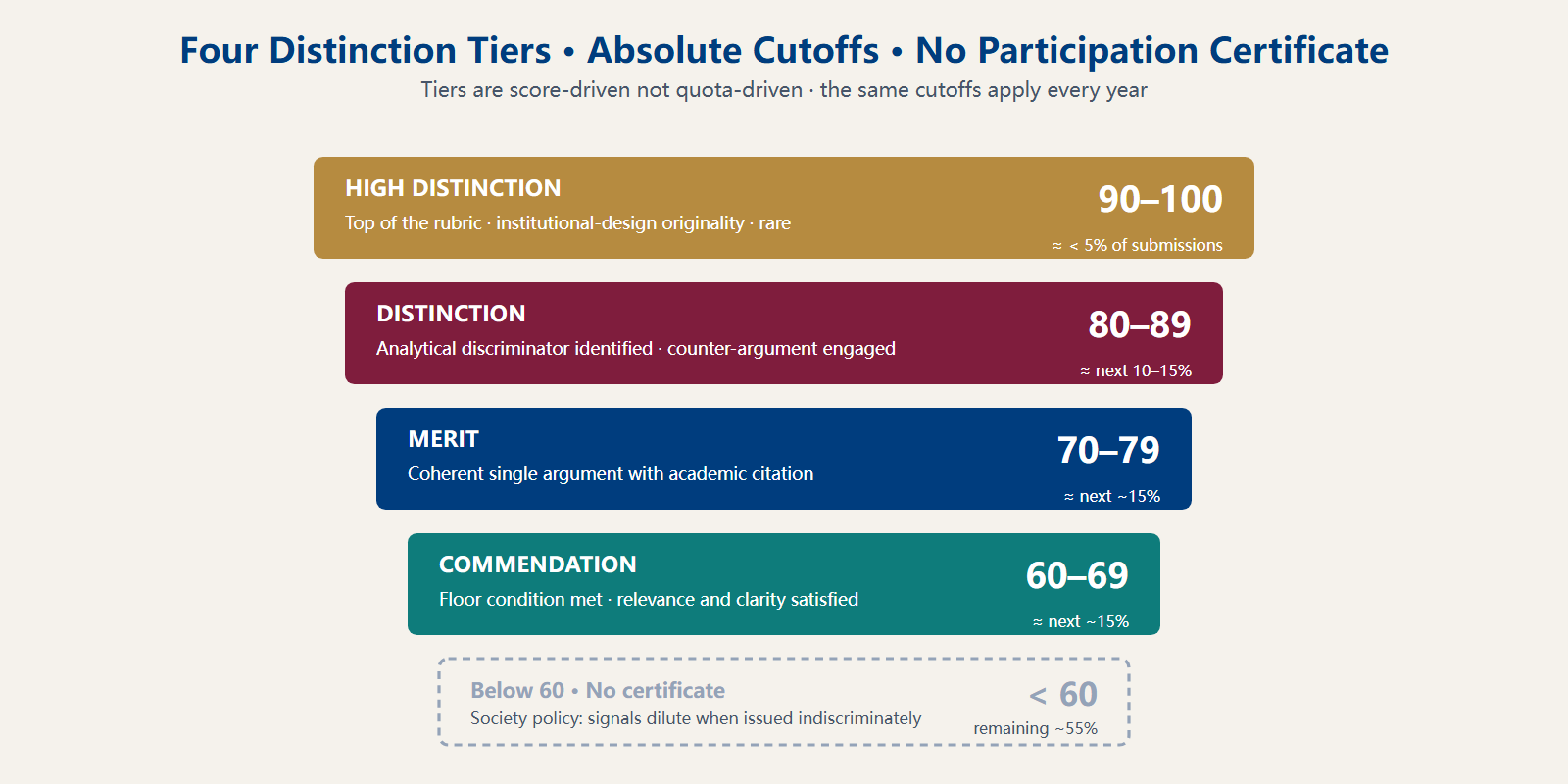
The Essay Competition awards results in four distinction bands: High Distinction, Distinction, Merit, and Commendation. Each tier corresponds to a score band on the 100-point rubric. High Distinction is reserved for essays above the 90-point threshold, typically representing fewer than 5 percent of submissions in a typical cycle. Distinction covers the 80-89 band, accounting for roughly the next 10 to 15 percent. Merit covers the 70-79 band, and Commendation recognises the 60-69 band. The bands are score-driven, not quota-driven — there is no fixed number of essays awarded in any given tier each year. Candidates not awarded one of the four tiers receive no recognition certificate, and the Society publishes only the tiered results, not the underlying scores.
What candidates without a distinction tier receive
Candidates whose essays fall below the 60-point threshold receive a confirmation that their submission was received and judged, with the result. They do not receive a certificate, a participation acknowledgment, or a placement letter. The Society position is that an unsorted recognition document — issued to every submission regardless of quality — undermines the value of the distinction tiers that are issued only to demonstrably strong essays. The position is unusual relative to many pre-university competitions, and is the most common source of candidate feedback received by the editorial desk each year. Candidates who write an essay they are proud of but do not place in a distinction tier are encouraged to use the essay as a writing sample for their college applications, where the work itself is the credential, rather than a certificate.
How the no-participation-certificate policy compares with peer competitions
The Marshall Society Economics Essay Competition at Cambridge, the Adam Smith Society competitions, and the John Locke Institute essay programme each handle participation recognition differently. Marshall Society issues winners certificates only — no participation recognition, similar to LSESU. John Locke Institute issues certificates for shortlisted essays (a broader band than LSESU distinctions), but not for all submissions. Adam Smith Society varies by year. The LSESU position is at the strict end of this spectrum, and is the most explicit about why: the certificate is treated as a signal, and signals dilute when they are sent indiscriminately. The policy contributes to the perceived value of an LSESU distinction tier in college admissions, which the Society treats as an important secondary effect.
What this policy signals about the Society values
The no-participation-certificate decision is not an isolated policy — it reflects the Society broader stance on academic credentialing. The Society also limits the number of essays it publishes from any single cycle, refuses to publish a numerical mark for any individual essay (only the tier), and maintains a closed adjudication process in which individual scores are not disclosed to candidates. The pattern is consistent: the credential that matters is the distinction tier, and the credentialing system is designed to make that tier informative for college admissions and graduate-programme recruiters. Candidates and parents who frame the policy as ungenerous miss its purpose; the policy exists because the Society treats the Essay Competition as a serious academic credential, not a participation programme.
Frequently asked questions
Can I list participation in the Essay Competition on my Common App or UCAS application even if I did not earn a distinction tier?
Yes — participation in the competition can be listed in the Activities section regardless of result. The competition itself is a recognised academic activity. Admissions readers may ask about the essay during interviews if you have not been awarded a distinction tier; the strongest answer is to discuss the substantive argument you made, not the result.
Does the Society notify candidates of their score, or only of their tier?
Only of the tier. Numerical scores are not disclosed to candidates, even by request. The Society position is that score disclosure invites appeals on individual scoring decisions, which is inconsistent with the closed-adjudication standard used by other serious academic competitions and journal review processes.
If I score 59 (one point below Commendation), do I receive any recognition?
No. The four-tier cutoff at 60 is firm. Candidates who narrowly miss a tier are not given an interim recognition document, and the Society does not publish narrow-miss data. Candidates in this situation typically benefit most from revising the essay (perhaps for inclusion in a college application portfolio) rather than from any recognition document.
Are the tier cutoffs (60, 70, 80, 90) the same every year, or do they shift based on the strength of the cohort?
The cutoffs are fixed at 60, 70, 80, and 90 across all cycles. The number of essays awarded in each tier therefore varies year to year, reflecting the actual quality distribution of submissions. The Society does not normalise tier awards to a fixed percentage of the cohort, which is a deliberate choice — the tier is a signal of essay quality against an absolute standard, not a relative ranking.
Filed underAdmissions · Foundation · Methodology · Rubric Decoder
This site is an independent English-language guide to the LSESU Economics Society Essay Competition, operated independently by Hanlin International Education (翰林国际教育) for China-based international-school students. It is not the official competition website and is not affiliated with the LSESU Economics Society, the LSE Students’ Union, or the London School of Economics. Our editors verify every claim against lsesuesec.org and lse.ac.uk source material. Official rules are set by the competition and change yearly, so always confirm current details on that official site before you enter. Confirmed errors are corrected within 7 working days.