LSESU Essay vs John Locke vs Marshall Society: Which Economics Competition (2026)
For ambitious economics students in 2026, the three best-known essay competitions reward different things. The LSESU Economics Society Essay Competition (free, set by LSE faculty, 1,500 words, 1 September deadline) rewards a tight argued answer to one of five set questions. The John Locke Institute prize (2,000 words, 31 May deadline) rewards open-ended originality and offers large programme scholarships. The Marshall Society at Cambridge rewards a shorter, sharply reasoned essay. Pick by format, deadline and what each judges.
In one line: LSESU = short, faculty-set questions, written-argument focus; John Locke = longer, open-ended, high-prestige with cash scholarships; Marshall = short, Cambridge-flavoured, theory-led. This editorial desk covers the LSESU Essay Competition — but a serious applicant should understand all three. Official rules change yearly, so confirm live details on each competition's own pages before you enter.
Why compare these three at all?
If you are a high-school student aiming at Economics, PPE or a related degree, these three are the names admissions readers actually recognise. They are all free or low-cost, open internationally, and judged on writing rather than on a test score — which is exactly why students confuse them and often enter the wrong one for their goals. They differ in three ways that matter: how long the essay is, when it is due, and what the judges are really rewarding. Get those three right and you stop wasting months on a format that does not suit you. For background on the one this site specialises in, see our explainer on what the LSESU Essay Competition is.
A quick honesty note before the comparison: our tutoring track record in this space is in the John Locke Institute competition, where students we have worked with have won. We have not claimed wins in the LSESU competition, and we never relabel a John Locke result as an LSESU one. We flag this so you can read the rest of this guide knowing where our first-hand experience is — and where we are simply reporting published rules.
The three competitions, side by side
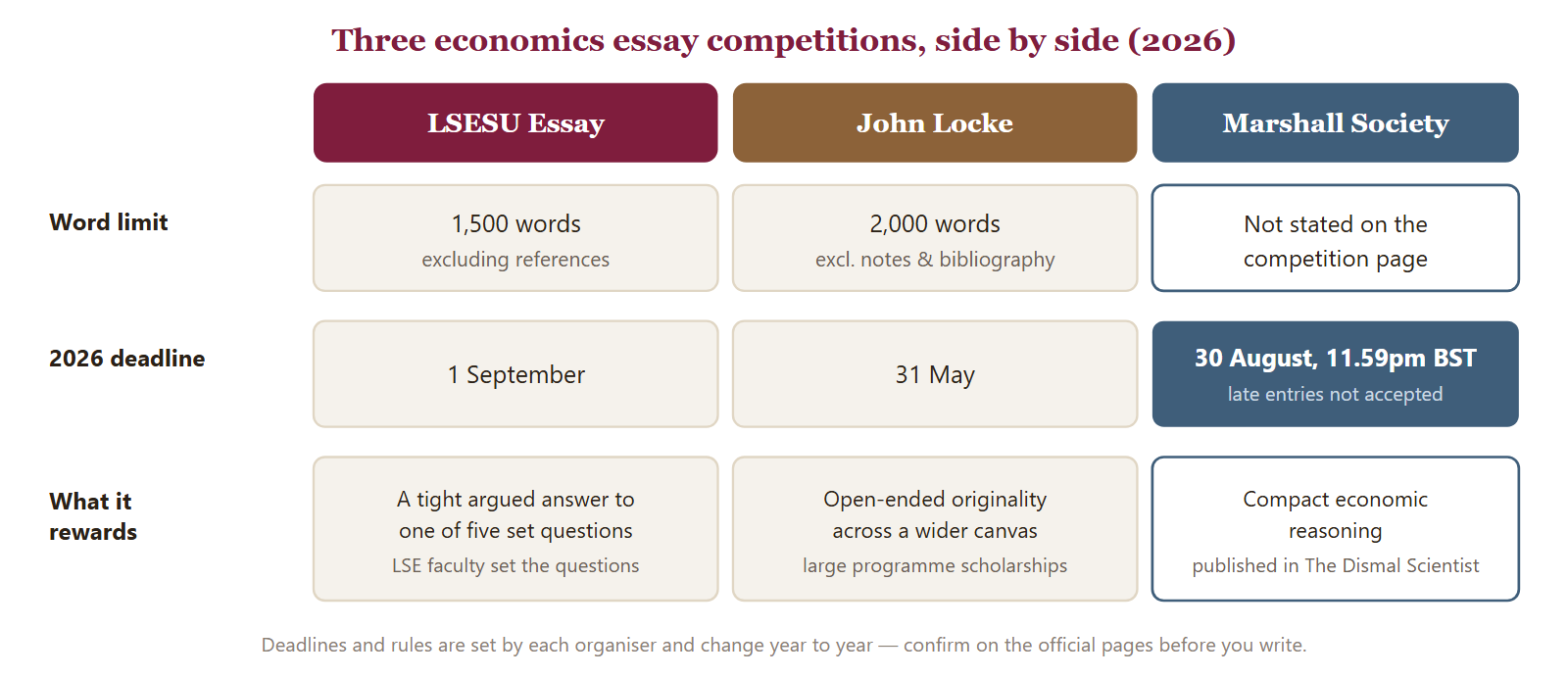
The table below is the fastest way to see the differences. Every figure here is drawn from each competition's most recent published cycle; because organisers update rules each year, treat the table as a starting map and confirm the exact 2026 numbers on the official pages before you commit.
| LSESU Essay | John Locke | Marshall Society | |
|---|---|---|---|
| Run by | LSESU Economics Society (LSE student society); questions set by LSE Economics faculty | John Locke Institute (independent education body) | The Marshall Society, Economics Society of the University of Cambridge (founded 1927) |
| Subject scope | Economics only | Ten subjects incl. an Economics category | Economics only |
| Word limit | 1,500 words (excl. references) | 2,000 words (excl. diagrams, tables, notes, bibliography) | Not stated on the competition page — confirm with the Society before drafting |
| Questions | 5 set questions; answer one | 3 questions in the Economics category; answer one | 6 set titles for 2026; answer one |
| 2026 deadline | 1 September 2026, 23:59 GMT+1 | 31 May 2026 (paid late windows to 7 / 21 June) | 30 August 2026, 11.59pm BST — late entries not accepted |
| Entry fee | Free | Free to enter; fees only for late submission | Free |
| Eligibility | Secondary students worldwide; 2026/2027 graduates recommended | Under 19 on 31 May 2026 (Junior under 15) | Pre-university students worldwide |
| Top prize | Certificates + £100 Amazon voucher (overall winner) | $5,000 programme scholarship per category; $10,000 Junior Fellowship overall | Prizes for winning essays; selected entries published in The Dismal Scientist (amounts not stated on the competition page) |
| AI policy | AI-generated content forbidden; screened | Strict originality rules; declarations required | AI use permitted but must be declared on the entry form (required field) |
| Referencing | Harvard recommended | Standard academic citation | Not stated on the competition page — confirm with the Society |
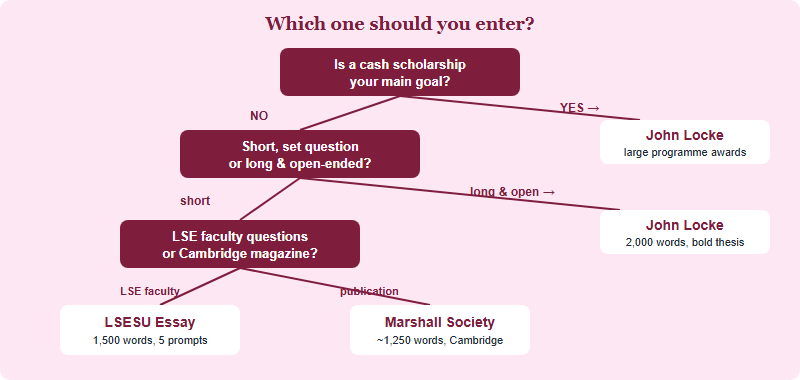
Two contrasts jump out. First, prize structure: John Locke offers large scholarships toward its own programmes, while LSESU and Marshall offer modest cash plus prestige and certificates. If a cash scholarship is the goal, John Locke is in a different league; if a clean, faculty-linked credential is the goal, LSESU and Marshall compete on prestige, not money. Second, AI policy: LSESU forbids AI-generated content outright, whereas Marshall permits declared AI use — a real, practical difference in how you are allowed to work.
What each one actually rewards
Word limits and dates are easy to look up. The harder question is what kind of essay wins — and here the three diverge sharply.
LSESU rewards disciplined argument on a faculty question. Because the five prompts are written by LSE Economics academics and judged against a published 100-point rubric, the winning move is not to be flashy — it is to answer the precise question asked, support every claim with evidence, and reference cleanly. Originality counts, but it is originality in service of the question, not a free-roaming essay. If you want to see how the marks are split, we break it down in our guide to the 100-point rubric, and the live 2026 prompts and criteria are covered in this guide to the 2026 questions and rubric.
John Locke rewards intellectual risk. Its questions are deliberately open and provocative, and the judging language prizes “originality” and “persuasive force.” A John Locke winner often takes a contrarian or unexpected line and defends it with rigour over a longer 2,000-word canvas. This is genuinely different from LSESU's tighter brief — and it is the format where our own students have won, so we can say from experience that the bar is on bold-but-defensible thinking, not safe summary.
Marshall rewards economic reasoning in compact form. As the essay competition of Cambridge's economics society, it leans toward clean theoretical or applied reasoning expressed efficiently — a shorter word limit forces precision. Winning essays are published in the society's magazine, The Dismal Scientist, which tells you the house taste: tight, publishable, idea-forward writing.

Update: the 2026 Marshall Society titles are out — and the deadline is 30 August
Since this comparison was first published, the Marshall Society has opened its 2026 competition and released six essay titles. The Society’s own entry form states the cut-off plainly: “Please submit by 11.59pm BST on 30th August 2026 — any submissions after this will not be accepted.” That places it two days before the LSESU deadline of 1 September, which is the single most useful fact on this page if you are weighing both.
The six titles for 2026, as published by the Society:
- Is it fair to always call tariffs ‘bad’? Explore this in both a historical context and by using an example from recent years.
- To what extent can central banks stabilise their economy in the face of external energy shocks? Use both theory and empirical evidence.
- How far can Britain’s economic recovery in the 1930s be credited to Britain leaving the gold standard in September 1931?
- Evaluate Andy Burnham’s economic and business policies as Mayor of Greater Manchester and discuss whether these should be replicated in the rest of the UK.
- Analyse the statement ‘the stock market is not the economy’. Are stock markets a good indicator of a country’s economic growth?
- Can economics be regarded as its own discipline? To what extent is there a unique economic methodology?
Read against the LSESU set, the contrast is instructive. The Marshall list leans historical and methodological — the 1931 gold standard, whether economics is a discipline at all — alongside live policy questions on tariffs, energy shocks and a named UK mayor. A student who has already done the reading for an LSESU question on monetary policy or inequality will often find one Marshall title sits close enough to reuse the research. Never the essay itself: each entry is judged as original work, and a recycled essay is the fastest way to lose both.
What the official channels confirm — and what they do not
Worth being precise, because secondhand summaries of this competition circulate with numbers the Society does not publish anywhere on its competition page. Confirmed on the official page and entry form:
- Deadline: 11.59pm BST, 30 August 2026. Late submissions are not accepted.
- Submission: through the Society’s official form, linked from its competition page. One PDF, maximum 10 MB.
- Generative AI must be declared. The entry form carries a required “How did you use GenAI?” field, so any use is disclosed at the point of submission rather than left to trust.
- Who it is for: the form asks which academic year you are starting in September 2026 (Year 13, Year 12, or Year 11 and below) — that is how the Society frames its pre-university audience.
- Recognition: winning essays receive prizes, and selected entries are featured in the Society’s magazine, The Dismal Scientist.
What the public competition page does not state is the fine print students most want: an exact word limit, a required referencing style, formatting rules, or the cash value of each prize. Widely circulated figures exist for all four. We are not going to repeat numbers we cannot source to the organiser — if any of them would change how you write, ask the Society directly before you start, and treat every third-party summary, this one included, as a starting map rather than the rulebook.
How the timing actually plays out across a year
A point students miss: these deadlines do not clash, so you can realistically enter more than one in a single year if you plan backwards. John Locke submissions close on 31 May 2026, near the end of the spring exam period. The LSESU and Marshall deadlines fall later, in late August / early September, in the summer break. That sequencing means a disciplined student could draft a John Locke essay through spring, then turn a related body of reading into an LSESU or Marshall entry over the summer — reusing research, not the essay itself. The catch is that each competition wants a different shape of essay, so “recycling” must stop at the research stage; the argument has to be rebuilt to each brief and word limit.
For students based in China and Asia, there is one more scheduling detail worth pinning down early. The LSESU deadline of 1 September 2026, 23:59 GMT+1 falls at 06:59 Beijing time on 2 September — easy to misread if you assume a local cut-off. Whichever competitions you target, convert every deadline to your own timezone the moment you commit, and confirm it against the official page rather than a third-party summary.
A realistic recommendation
There is no single “best” competition — only the best fit for your goal. If you want the highest-prestige, highest-prize route and you thrive on open, contrarian questions, John Locke is the standout, and it is where we have seen students we coached actually win. If you want a faculty-set, rubric-judged challenge that maps cleanly onto an LSE-style economics application and rewards disciplined argument over a 1,500-word brief, the LSESU Essay Competition is the natural choice — and it is the one this desk knows in most depth. If you want a short, theory-forward piece with a shot at being published by Cambridge's economics society, Marshall fits. Many strong applicants enter two of the three across one year. Whatever you choose, the winning behaviour is the same everywhere: answer the exact question, build the argument with evidence, reference honestly, and never outsource the thinking to a tool that the rules forbid.
Frequently asked questions
Which economics essay competition is hardest to win?
By prize prestige and applicant volume, John Locke is generally the most competitive, with large scholarships and an open, demanding brief. LSESU and Marshall are highly competitive too but reward tighter, set-question essays.
Can I enter LSESU, John Locke and Marshall in the same year?
Yes. John Locke closes around 31 May 2026; Marshall closes 11.59pm BST on 30 August 2026, and LSESU on 1 September 2026. The deadlines do not clash, though each wants a differently shaped essay, so confirm every date officially.
Do these competitions allow AI assistance?
Policies differ. LSESU forbids AI-generated content and screens for it; John Locke applies strict originality rules; Marshall permits AI use only if declared. Always check the current rule before you write.
Are you affiliated with John Locke or Marshall?
No. This site is operated independently by Hanlin International Education and is not affiliated with the John Locke Institute, the Marshall Society, or the LSESU Economics Society. We have coached students to wins in the John Locke competition, but we do not run or represent any of these competitions.
Published by the editorial desk of this site, operated independently by Hanlin International Education (翰林国际教育) for China-based international-school students. This site is not the official competition website and is not affiliated with the LSESU Economics Society or the London School of Economics. Official rules are set by the competition and change yearly, so always confirm current details on the official site lsesuesec.org. Confirmed errors are corrected within 7 working days.
Filed underComparisons · John Locke · Marshall Society