The LSE Faculty Behind the 2026 LSESU Essay Questions (2026)
The five 2026 LSESU Economics Society Essay Competition prompts are set by current LSE Department of Economics faculty: Professor Sir Christopher Pissarides (labour, 2010 Nobel laureate), Professor Ricardo Reis (monetary and fiscal policy), Professor Silvana Tenreyro (monetary economics, former Bank of England MPC), Professor John Van Reenen (productivity and inequality) and Professor Michael Gmeiner (economics). Knowing each setter's field tells you which models, evidence and debates a strong answer should engage.
Why the question-setter matters before you write a word
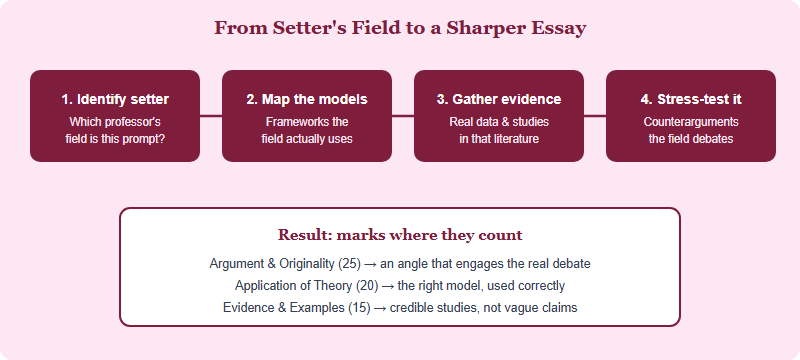
Most entrants read the five prompts, pick whichever sounds easiest, and start writing. That is a mistake. Each year the LSE Economics Department asks current professors to set a question inside their own research area, which means the prompt is not a neutral exam question — it is a doorway into a specific scholarly conversation. The fastest way to write an essay that reads like it belongs in the top 5–10% is to understand whose conversation you are entering.
This matters directly for marks. The official 100-point rubric awards 25 points to Argument & Originality — the single largest band — and a further 20 to Application of Economic Theories and 15 to Evidence and Examples. An essay that reaches for the frameworks and empirical literature the setter actually works in will land those 60 points far more convincingly than one that recycles a generic A-Level model. (For the full criteria, see our walkthrough of the 100-point rubric.)
Two ground rules before we go further. First, this is editorial context, not insider knowledge: professors' names, titles and research fields are public facts published by LSE and the Society. Second, the exact 2026 prompt wording and how the five themes map to each setter can change year to year, so always read the live questions on the official portal and treat the field notes below as background, not a substitute. We do not reproduce or guess the prompt text here.
The five LSE economists who set the 2026 questions
The Society lists five current LSE Department of Economics academics as the 2026 question-setters, each associated with a broad theme. Their names, titles and research areas are matters of public record at LSE; the table below pairs each setter with the field they are known for, so you can recognise the intellectual territory a prompt sits in. We deliberately do not paraphrase the exact prompts — only the setter's area of expertise.
| Question-setter | LSE title | Known research field | Theme area (per Society) |
|---|---|---|---|
| Prof. Sir Christopher Pissarides | Regius Professor of Economics | Labour economics; unemployment; search-and-matching (2010 Nobel) | Technology & worker wellbeing |
| Prof. Ricardo Reis | A.W. Phillips Professor of Economics | Macroeconomics; monetary & fiscal policy; inflation | Energy & economics |
| Prof. Silvana Tenreyro | Professor of Economics | Monetary economics; ex-Bank of England MPC member (2017–2023) | AI & employment |
| Prof. John Van Reenen | Professor of Economics | Productivity; firms; “superstar firms” & inequality | Taxation & fairness |
| Prof. Michael Gmeiner | Assistant Professor of Economics | Economics (teaching incl. applied/environmental topics) | Green technology |
Two things are worth flagging. First, the theme labels above are how the Society has presented the strands publicly; the binding text is whatever appears on the live entry page, which you should read before committing to a question. Second, LSE's economics faculty rotates question duties, so the exact pairing of professor to theme is not guaranteed to be identical each cycle — check the current list. For the official prompts and marking scheme as published this year, see our summary of the 2026 prompts and rubric.

What each field expects from a strong answer
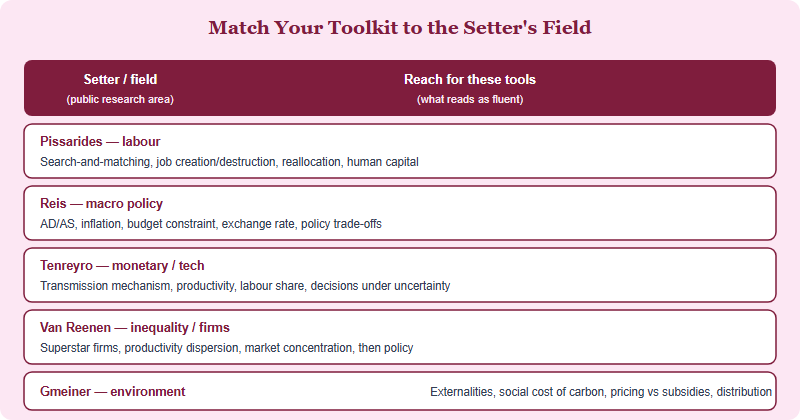
Here is the practical payoff: matching your toolkit to the setter's discipline. None of this tells you what the prompt says — it tells you what kind of economics will read as fluent if you choose that strand.
Labour (Pissarides). Sir Christopher Pissarides shared the 2010 Nobel Memorial Prize for search-and-matching theory — the economics of how unemployed workers and vacancies find each other, and why frictions leave unemployment even in good times. An essay in his orbit should treat the labour market as a matching process, not a simple supply-and-demand cross. Strong answers reason about job creation and destruction, the value of being employed versus searching, automation's effect on which jobs disappear and which appear, and human-capital adjustment. Vague claims that “robots take jobs” score poorly; reasoning about reallocation and frictions scores well.
Macro policy (Reis). As the A.W. Phillips Professor, Ricardo Reis works on monetary and fiscal policy, inflation dynamics and how central banks and treasuries interact. A policy-flavoured essay should think in terms of aggregate demand and supply, inflation and the central bank's reaction, government budget constraints, the exchange rate, and the current account — and, crucially, the trade-offs and unintended consequences of a policy mix. The mark of sophistication here is showing that a single policy lever moves several variables at once.
Monetary economics & technology (Tenreyro). Silvana Tenreyro is a monetary economist who served on the Bank of England's Monetary Policy Committee from 2017 to 2023, with research spanning the monetary transmission mechanism, productivity and wage dynamics. An essay touching technology and employment in her area benefits from connecting micro-level technological change to macro outcomes: productivity growth, the labour share, wage dispersion, and how policymakers should respond under genuine uncertainty. Acknowledging what we do not yet know about AI's effects is a strength, not a hedge.
Inequality & firms (Van Reenen). John Van Reenen is known for work on productivity and inequality, including the rise of “superstar firms” — a small number of highly productive companies pulling away from the rest, with consequences for the labour share, market concentration and the wage gap between firms. An essay on taxation and fairness in his territory should ground distributional questions in firm-level mechanisms and real productivity dispersion, then connect them to policy. Treating inequality as purely about individuals, with no reference to firms or technology, misses the conversation he leads.
Environment & green technology (Gmeiner). Michael Gmeiner is an LSE economics faculty member whose teaching touches applied and environmental questions. An essay on green technology should use the standard environmental-economics apparatus — externalities, the social cost of carbon, carbon pricing versus subsidies and standards, innovation incentives, and the distribution of costs across groups and generations. Strong answers weigh instruments against each other rather than asserting that one obvious solution exists.
How to use this without crossing any line
Field awareness is an advantage; faking expertise is not. Three rules keep you honest and high-scoring:
- Read deeply, cite accurately. If you mention a setter's field or a famous result, anchor it to a real, properly referenced source — the rubric awards 10 points for citations and 15 for evidence. Harvard referencing is the recommended style.
- Engage the debate, do not name-drop. Examiners reward an argument that genuinely wrestles with the relevant economics, not a paragraph that lists the professor's CV. The 15-point Critical Analysis band rewards taking on counterarguments.
- Write it yourself. Plagiarism and AI-generated content are strictly forbidden and all essays are screened; a breach means immediate disqualification. Using a field to plan your own original argument is fine — outsourcing the writing is not.
One more practical point on logistics, because it trips up newcomers: there is no registration step for this competition. You choose one of the five prompts and submit your essay directly to the official portal at lsesueconsoc.org/competitions — there is no candidate ID to obtain and the prompts do not “unlock” after sign-up; they are public. The deadline is 1 September 2026, 23:59 (GMT+1), and late entries are not accepted. Entry is free and open to students finishing their penultimate or final year of secondary school plus those entering university in 2026/27. If you are new to the competition itself, start with our overview of what the LSESU Essay Competition is.
A note on how we know coaching against this kind of rubric works: our editorial team and our mentors have guided students to wins in comparable senior economics essay competitions — for example, multiple awards in the John Locke Institute essay programme (attributed accurately to John Locke, not relabelled as LSESU outcomes). The same discipline — pick the right framework for the question-setter's field, evidence it carefully, stress-test it — is what we apply here. No competition guarantees a place or a prize, and any honest coach will tell you the same.
Frequently asked questions
Who sets the LSESU essay questions?
Current LSE Department of Economics professors set the prompts. For 2026 the Society lists Pissarides, Reis, Tenreyro, Van Reenen and Gmeiner; confirm the live list on the official site.
Do I need to register before I can see the prompts?
No. There is no registration. The five prompts are public — you choose one and submit directly to lsesueconsoc.org/competitions by the deadline.
Should I pick a question based on the professor's field?
Pick the question you can argue most rigorously. Knowing the setter's field helps you choose the right models and evidence, which the rubric rewards heavily.
Can I quote the professor's research in my essay?
Yes, if you reference it accurately in Harvard style. Cite real sources; never fabricate quotes, and write the essay entirely yourself — AI-generated text is disqualified.
Published by the editorial desk of this site, operated independently by Hanlin International Education (翰林国际教育) for China-based international-school students. This site is not the official competition website and is not affiliated with the LSESU Economics Society or the London School of Economics. Official rules are set by the competition and change yearly, so always confirm current details on the official site lsesuesec.org. Confirmed errors are corrected within 7 working days.