The Change Freeze: Which Late Edits to Your LSESU Essay Are Worth the Risk (2026)
With six days left before the 1 September deadline, the question is no longer how to improve your LSESU essay but which improvements are worth the risk. There is no revision or replacement route after submission, so a late edit that breaks a sentence cannot be undone. Below is a register of eleven common late changes, priced by what each can win, what each can break, and the last day it is safe.
Why the last week is risk management, not writing
Three facts about this competition change how the final week should be run, and all three are mechanical rather than a matter of taste.
The file you upload is the entry. There is no registration step and no candidate account, so nothing is held in draft on the competition side: you write, export a PDF and submit it through the official portal at lsesueconsoc.org/competitions/. No revision or replacement route is published, which means the last version you saved before uploading is the version that gets read. That single fact makes late edits asymmetric — an improvement you make is worth its marks, but a mistake you introduce is permanent.
Late edits are made at the worst hours. The typical final-week edit happens after 10pm, after a full school day, on a draft the writer has read fifteen times. That is precisely the state in which a writer deletes a transition, changes a verb tense in one clause of a three-clause sentence, or pastes a new paragraph over an old one and loses the citation attached to it.
Not all improvements are equal. The published criteria weight the essay unevenly — argument and originality carries 25 marks, application of theory 20, evidence and critical analysis 15 each, structure and clarity 10, citations 10, relevance 5. An edit that touches a 25-mark criterion and an edit that touches nothing marked are not the same purchase, even if they take the same hour. The weights are set out in full in our guide to the 2026 prompts and published criteria.
The register: eleven late changes, priced
| Late change | What it can win | What it can break | Last safe day |
|---|---|---|---|
| Rewrite the introduction so it states your answer | Argument and originality (25); relevance (5) | Little, if the body already argues that answer | Sun 30 Aug |
| Add the counterargument you never wrote | Critical analysis and evaluation (15) | Your word budget; needs 150–250 words from somewhere | Sat 29 Aug |
| Correct a wrong number or a mis-cited source | Evidence (15); citations (10) | Nothing. This is correctness, not improvement | Any time, including submission day |
| Add one new source you have genuinely read | Evidence (15) | Reading time you do not have; 40–80 words | Sat 29 Aug |
| Add a table or chart | Evidence (15), if the exhibit carries the argument | PDF export, layout, page breaks, labelling | Fri 28 Aug |
| Reorder two sections | Structure and clarity (10) | Every transition sentence between them, in four places | Fri 28 Aug |
| Add subheadings | Structure and clarity (10) at zero word cost | Almost nothing | Mon 31 Aug |
| Change your title | Reader orientation; titles sit outside the word count | Almost nothing, if the file name convention is unaffected | Mon 31 Aug |
| Convert to a different referencing style | Nothing, if your current style is already consistent | Consistency, which is the marked property (10) | Do not start this now |
| Show the draft to a new reader | Depends entirely on the reader and the turnaround | Your schedule, if comments arrive after your freeze | Thu 27 Aug |
| Switch to a different question | Rarely anything at this point | Your reading, evidence and argument, simultaneously | Passed |
Read the last column before the second. Most students in the final week choose changes by appetite — what feels unfinished — rather than by deadline logic, and that is how a Sunday-night section reorder ends up leaving four broken joins in a submitted PDF.
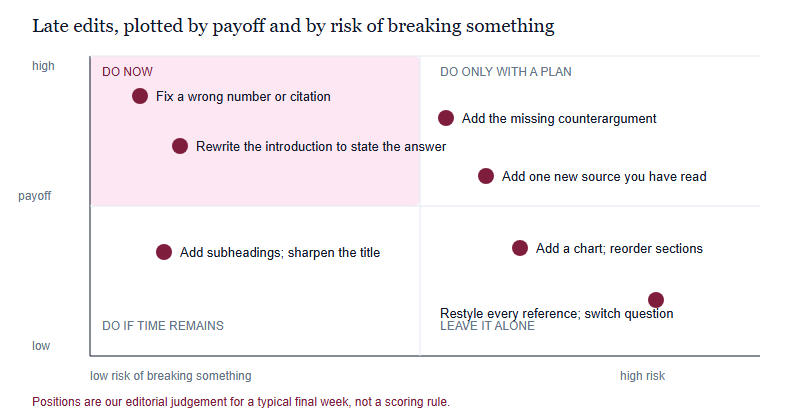

Three worth making, and three that only feel productive
Worth making. First, an introduction that states your answer rather than announcing your topic. Many drafts open by describing the question and only reach a position on page two; moving that position into the opening paragraph costs 30 minutes and acts on the two criteria that together carry 30 of the 100 marks. Second, a counterargument, if your essay does not have one. Critical analysis and evaluation is 15 marks, and an essay with no opposing case cannot access them however elegant the rest is. Third, any factual correction — a figure you cannot source, a study you cited from memory, a year you guessed.
Only feel productive. First, the sixth full read-through from the top. Reads three through six mostly generate churn: synonym swaps, comma migrations, and the slow sanding-down of the sentences that had personality. Second, restyling your references — if your entries are already consistent, converting them from one style to another buys nothing and risks the consistency being marked. Third, hunting for a better example to replace one that already works. Replacement means new reading, new checking and new prose, for a gain that is usually invisible.
There is a fourth, subtler trap: rewriting the essay to sound more like an academic paper. In the final week, students who are nervous about their English tend to add abstraction, longer noun phrases and more hedging — which moves the prose away from the precise language the structure and clarity criterion actually rewards. If a sentence gets longer and less specific, that is not polishing.
The freeze schedule: 26 August to 1 September
Software teams stop accepting changes before a release, not because the product is perfect but because late changes carry more risk than value. The same logic applies to an essay you cannot revise after submission. Two gates are enough.
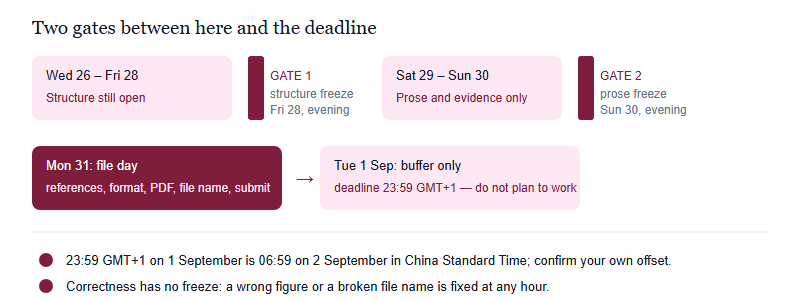
Gate 1 — structure freeze, Friday evening. After this point, no reordering, no new sections, no new exhibits, no new sources. Everything structural has to be settled while you still have two full days to repair the joins it breaks.
Gate 2 — prose freeze, Sunday evening. After this point you touch only factual corrections and formatting. No rewriting for style, no reordering paragraphs, no new sentences. If you find yourself rephrasing a clause on Monday because it sounds slightly better, you have crossed the gate.
Monday is file day. Reference list checked, format checked, exported to PDF, opened and read once in the PDF rather than in the editor, file named to the published convention — forename and surname in capitals plus the question number — and submitted. Tuesday stays empty. The deadline is 23:59 GMT+1 on 1 September, which is 06:59 on 2 September in China Standard Time, and late submissions are not accepted; treating Tuesday as working time is how a time-zone conversion becomes a catastrophe.
The exception: what you fix at any hour
A freeze covers improvements. It does not cover correctness. The following are fixed whenever you find them, including on Monday afternoon with the portal open:
- A factual error — a wrong figure, a misattributed study, an invented year.
- A claim with no source attached, where the source exists and you can add it in one line.
- An essay that names one question in its title and answers a different one. Relevance to topic is a marked criterion, and this is the cheapest failure to fix.
- A file name that does not follow the published convention, or a PDF that does not open cleanly on a second device.
- Anything in the document that is not your own writing. AI-generated content is forbidden and screened, and there is no version of the final week in which leaving it in is the lower-risk choice.
If you are unsure whether a change is an improvement or a correction, use this test: a correction is something you would be embarrassed to have a reader find. An improvement is something you would like a reader to notice. Corrections have no deadline. Improvements have two gates. And if the honest answer is that your draft still needs structural work at this stage, the choice is between narrowing what you defend and entering next year — our guide to writing the 1,500-word essay sets out how narrow a claim can be and still work.
Frequently asked questions
Can I replace my file after submitting if I spot a mistake?
No replacement or revision route is published. Treat the upload as final and run every check before it, not after.
Is it too late to add a counterargument?
Not on 26 August. It acts on a 15-mark criterion. Get it in before the Friday structure freeze, and find the words by cutting a definition.
Should I still send my draft to a teacher this week?
Only if comments come back by Friday. Feedback arriving after your structure freeze creates pressure to break your own gates.
What if I find a wrong number on Monday?
Fix it. Correctness has no freeze. Re-export the PDF, check the file name again, then submit.
Published by the editorial desk of this site, operated independently by Hanlin International Education (翰林国际教育) for China-based international-school students. This site is not the official competition website and is not affiliated with the LSESU Economics Society or the London School of Economics. Official rules are set by the competition and change yearly, so always confirm current details on the official site lsesuesec.org. Confirmed errors are corrected within 7 working days.