Five Days to the LSESU Deadline: A Realistic Plan If You Are Starting Now (2026)
Five days is enough to produce a complete, on-question, properly referenced 1,500-word LSESU essay. It is not enough to produce the wide reading the published Distinction descriptor describes. If you accept that trade honestly, the plan below runs Thursday 27 August to Monday 31 August, costs about sixteen hours, and leaves Tuesday 1 September as buffer rather than working time.
What five days buys, and what it does not
Start with the mechanics, because they are the reason a five-day entry is possible at all. There is no registration step and no candidate ID for this competition: the five questions are public, you choose one, you write, and you submit the finished PDF directly through the official portal at lsesueconsoc.org/competitions/. Nothing administrative has to happen before you begin writing today. If you have never seen the competition before, our overview of what the LSESU Essay Competition is takes ten minutes and covers the whole shape of it.
Now the honest part. The published grade descriptors are explicit about what separates the bands: the top band describes a rigorous, original argument informed by advanced theory and evidence, critically engaging with competing views, with wide reading and proper referencing. Wide reading is not something five days manufactures. The band below describes a coherent, mostly well-structured argument applying relevant concepts with some critical engagement — and that is a target a focused five days can realistically aim at.
No one can promise you an outcome, and nobody should try. What is worth saying plainly is that the essay is only 1,500 words. At that length the binding constraint is not typing speed — a fluent writer produces 1,500 words in an afternoon. The binding constraint is decision speed: choosing the question, committing to one answer, and refusing to reopen either. Students who fail on a five-day timeline almost never fail because they could not write fast enough. They fail because they spent three of the five days deciding.
The scope rule: one mechanism, two pieces of evidence, one counterargument
A 1,500-word essay holds one argument properly, or three arguments badly. On a five-day timeline the scope is fixed in advance and not negotiated later:
- One claim — a single sentence answering the question, specific enough that a reasonable economist could disagree with it.
- One mechanism — the causal chain that makes the claim economics rather than opinion: who responds to what incentive, and through which channel.
- Two pieces of evidence — one empirical study or dataset, one concrete case. Two used well beat six named in passing.
- One counterargument — the strongest opposing case, stated fairly, then answered. This is a 15-mark criterion and it is not optional.
- One stated limit — what your evidence cannot show. Two sentences.
Choosing the question is the one decision worth a firm time-box: ninety minutes on Thursday, no more. Two tests settle it faster than reading will. The mechanism test: can you state, right now and without opening anything, a causal chain that answers this question? The evidence test: can you name a real case, policy episode or dataset you could use? Pick the question that passes both, not the one that sounds most impressive. The five questions in full, with the criteria, are in our guide to the 2026 prompts and published criteria. Once you have chosen, the decision is closed — reopening it on Saturday is the single most common way a late-start entry dies.

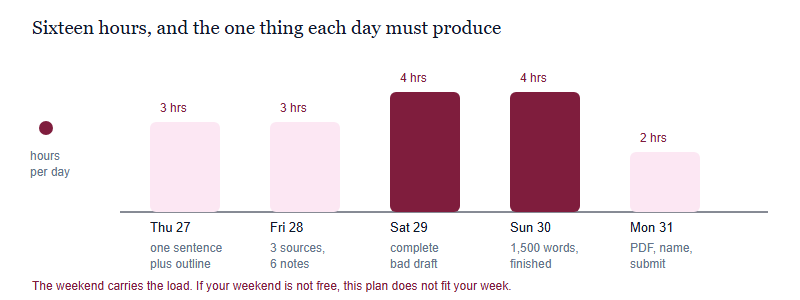
The five-day timetable
| Day | Hours | What you do | Done by end of day |
|---|---|---|---|
| Thu 27 Aug | 3 | Choose the question in 90 minutes using the mechanism and evidence tests. Write your answer as one sentence. Outline six paragraphs, each with a job. | One sentence and a six-line outline |
| Fri 28 Aug | 3 | Read three sources, no more. Take claim-shaped notes: each note is one claim, one number, and where it came from. Stop reading when you have six usable notes. | Three sources, six notes, full reference details captured |
| Sat 29 Aug | 4 | Draft straight through without editing. Aim for roughly 1,800 words. Leave gaps marked rather than stopping to fix them. | A complete bad draft, beginning to end |
| Sun 30 Aug | 4 | Rewrite for argument first: does every paragraph serve the one claim? Then cut to 1,500 words. Then add the counterargument if it is missing. | A finished essay at the limit |
| Mon 31 Aug | 2 | Reference list, formatting, PDF export, file name, submit. Read the PDF once as a PDF, not in the editor. | Submitted |
| Tue 1 Sep | 0 | Buffer only. Deadline 23:59 GMT+1, which is 06:59 on 2 September in China Standard Time. | Nothing planned |
Three notes on running this. Saturday is the day people break the plan, by editing the opening paragraph six times instead of reaching the conclusion. A complete bad draft is worth more on Saturday night than a beautiful first third, because Sunday’s job is rewriting and you cannot rewrite what does not exist. Capture reference details as you read on Friday — author, year, exact title, publication, page or link — because reconstructing them on Monday from memory is how invented citations happen. And protect Monday: two hours for file work sounds generous until a PDF export breaks a table or your name order is ambiguous.
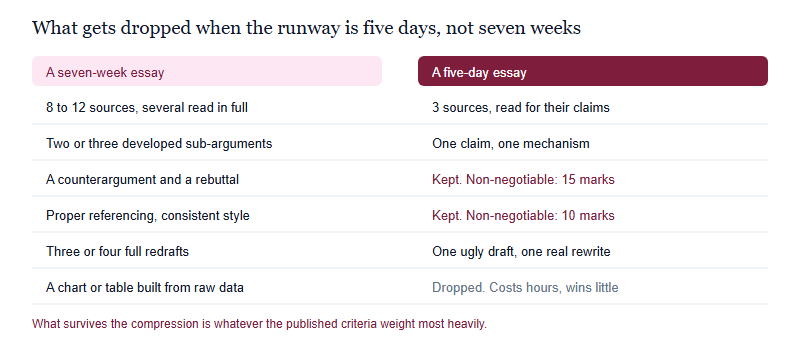
What you skip, and what you cannot
| Skip deliberately | Why it is safe to drop |
|---|---|
| A literature review | Nothing in the published criteria rewards surveying a field. Depth on two sources beats breadth across eight. |
| A third case study | Repeats a point you have already made and costs 200 words you need elsewhere. |
| A formal model you cannot derive confidently | A model you half-understand loses marks under application of theory rather than gaining them. |
| Building a chart from raw data | Hours of work, and formatting risk at PDF export, for a small evidence gain. |
| Elegant prose in the first draft | Sunday is the rewrite. Polishing on Saturday is the most expensive procrastination available. |
What you cannot skip is short and non-negotiable: answering the question actually set; writing every word yourself, since AI-generated content is forbidden and screened; a complete and consistent reference list; the 1,500-word limit, which excludes titles, subtitles and references; the published file-naming convention of forename and surname in capitals plus the question number; a clean PDF; and submitting before the deadline. Each of these is either a marked criterion or a condition of entry, and none of them is where you buy time back.
The honest stop condition
Two checkpoints decide whether you continue. Thursday night: if you cannot write your answer as one sentence, you do not yet have an argument, and five days is not enough to find one and defend it. Saturday night: if you do not have a complete draft, beginning to end, the plan has already failed — Sunday is a rewrite day, not a drafting day, and compressing both into one day produces an essay that reads exactly like what it is.
If either checkpoint fails, stopping is a legitimate decision and not a personal failure. The reading you have done does not evaporate: the questions are set by LSE academics on subjects — labour, monetary policy, AI and employment, taxation, climate technology — that will still be live next year and in your school economics course. What is not legitimate is meeting the deadline with work that is not yours. That is the one shortcut with consequences that outlast a competition cycle, and in a season where AI-generated content is screened, it is also the one most likely to be found.
If both checkpoints pass, stop reading advice on Saturday morning and write. At this point in the season, additional guidance has sharply diminishing returns compared with 1,500 words on a page — and once you have a draft, our guide to structuring and writing the essay is more useful as a Sunday checklist than as Thursday reading.
Frequently asked questions
Do I need to register before writing?
No. There is no registration and no candidate ID. The questions are public and you submit the finished essay directly through the official portal.
Is a five-day essay worth entering?
A complete, on-question, properly referenced essay is a real entry. Nobody can promise an outcome, but an unsubmitted draft scores nothing.
How many sources do I need in five days?
Three read properly is a workable target. Two analysed carefully beat six named in passing under the evidence criterion.
When exactly does the portal close in China?
23:59 GMT+1 on 1 September is 06:59 on 2 September China Standard Time. Aim to submit on 31 August; confirm the deadline on lsesuesec.org.
Published by the LSESU Essay Competition editorial desk, operated by Hanlin Education for China-based international-school students. Official rules are set by the competition and change yearly — confirm current details on lsesuesec.org. Errors reported to the editorial desk are corrected within 7 working days.