The Numbers Audit: Verifying Every Figure and Citation Before You Submit (2026)
Three days out, the highest-return work left on an LSESU essay is not more argument. It is checking that every number you cite is real, correctly labelled, and actually says what your sentence claims. Evidence and example carries 15 marks and citations and sources carries 10, so 25 of the published 100 sit in the one area you can verify completely in an afternoon.
Build the inventory before you check anything
Auditing by re-reading does not work, because the sentences you wrote are the sentences you believe. Instead, extract every claim that rests on a source into a separate list and check each one out of context. A typical 1,500-word essay has between six and twelve such claims — small enough to finish, large enough that two or three are usually wrong in some detail.
Open a blank document and build five columns. Fill the first three from your essay, then go to the source for the fourth. The worked row below is our own illustration, not a real study.
| Sentence in your essay | Figure as written | Source you cite | What the source actually says | Verdict |
|---|---|---|---|---|
| “Remote work raised measured productivity by 13%.” | 13% | A field experiment in one firm | 13% within a single call-centre setting, for volunteers, over nine months | Repair — name the setting in the sentence |
| Your row 2 | Keep / Repair / Delete | |||
| Your row 3 | Keep / Repair / Delete |
The discipline that makes this work is filling column four from the source itself, not from your notes. Notes are where drift begins — a qualifier gets dropped on the way from the paper into your notebook, and again on the way from your notebook into the essay.
Six unit errors that quietly break an economics claim
These are the errors that survive proofreading, because the sentence reads perfectly well. They are specifically economic, and a reader marking the application of theory will notice all six.
| Error | What it looks like written down | What it should say | Why it matters |
|---|---|---|---|
| Percent vs percentage point | “Unemployment rose by 2%” | “Unemployment rose by 2 percentage points, from 4% to 6%” | The first sentence describes a rise from 4% to 4.08%. The two are not close. |
| Nominal vs real | “Energy prices doubled” | “Nominal energy prices doubled; in real terms the rise was smaller” | Any argument about inflation or living standards collapses if the deflator is missing. |
| Level vs growth rate | “Investment fell after the policy” | “Investment grew more slowly after the policy” | A slowdown in growth is not a decline, and the mechanism you need to explain differs. |
| Stock vs flow | “Taxing the wealth of the top 1% would raise income inequality” | Distinguish wealth (a stock) from income (a flow) explicitly | Central to any question on taxing the top 1%; conflating them makes the argument unreadable. |
| Aggregate vs per capita | “Country A invests more in green technology” | “Country A invests more in absolute terms; per capita the ranking reverses” | Cross-country comparisons flip depending on which one you mean. |
| Forecast vs outturn | “AI displaced X million jobs” | “One projection estimates X million jobs at risk of displacement” | Presenting a projection as something that happened is the most common evidence failure in AI questions. |
Two of these deserve special attention this year. If your essay concerns taxation and the top 1%, the stock-versus-flow distinction is not a technicality — a wealth tax and an income tax act on different bases, and an essay that slides between them cannot make a coherent argument about either. If your essay concerns AI and employment, almost every headline number in circulation is a projection under assumptions, and labelling it as such is a mark of rigour rather than weakness. The full wording of each 2026 question is in our guide to the prompts and published criteria.

Source-claim drift, and when old data is a liability
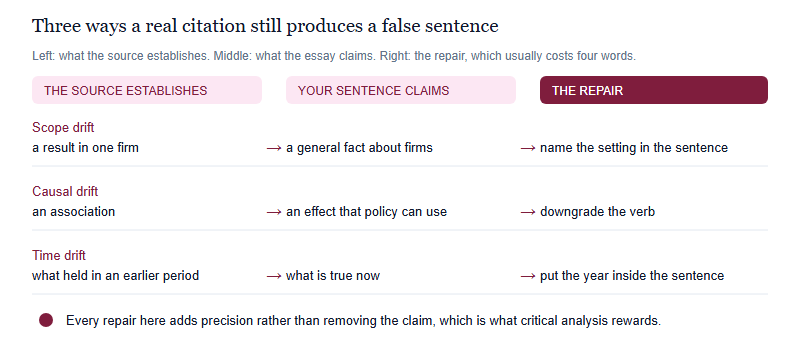
Drift is when your sentence says more than the source does. The number is real, the citation is real, and the sentence is still wrong. It has three forms:
- Scope drift. A single-firm or single-country study cited as a general fact. Repair: name the setting inside the sentence. “In one call-centre experiment…” costs four words and converts a vulnerable claim into a careful one.
- Causal drift. The source reports an association; your sentence reports an effect. Repair: downgrade the verb. “Is associated with” and “causes” are different claims requiring different evidence, and the difference is exactly what critical analysis rewards.
- Time drift. Evidence from one period used to support a claim about now. Repair: put the year in the sentence, or find a current figure.
Time drift needs a nuance, because “old” is not the same as “stale”. Historical evidence ages extremely well when the argument is structural: an energy-price shock from the 1970s is legitimate evidence about how economies absorb import-price shocks, and saying so explicitly strengthens the essay. What ages badly is frontier data used as current fact — adoption rates for a technology, employment effects of a tool released in the last three years, or any figure you have described with the word “currently”. The rule is simple: if your sentence claims something is true now, check that no more recent official release exists. If your sentence uses history as evidence, say the year and keep it.
The citation reality check
Every reference in your list must resolve to something a reader can find. Take the list, and for each entry confirm four things: the author name and year, the exact title, the journal or publisher, and the specific version you are citing. Working papers get revised, and the number in the 2021 working paper is not always the number in the published version — cite the one you actually read.
Three specific hazards are worth naming.
- References that do not exist. A chatbot asked to “tidy up” or “complete” a reference can produce entries that are perfectly formatted and entirely fictional — plausible authors, plausible journals, no such paper. AI-generated content is forbidden in this competition and is screened, and an unverifiable reference is a double liability: it fails the citations criterion and it raises exactly the question you do not want raised. Search every entry once. Ninety seconds each.
- Second-hand citing. You read a summary that quoted a paper, and cited the paper. Either read the paper or cite the summary you actually read. This is also where most numeric errors enter an essay, because the intermediate source dropped a qualifier.
- Inconsistency. Harvard is recommended, and any consistent style is accepted, so the marked property is consistency rather than the choice itself. Do not convert styles at this stage. Do check that every in-text citation has a list entry and every list entry appears in the text.
Remember that references sit outside the 1,500-word count, so completeness is free. There is never a reason to shorten an entry to save space. If you are unsure what the essay is being assessed against overall, our overview of the competition sets out the shape of it.
The ninety-minute audit, in order
- 0:00–0:15 — Build the inventory. Every sourced claim into the five-column table. Do not check anything yet; extraction and verification are different mental modes.
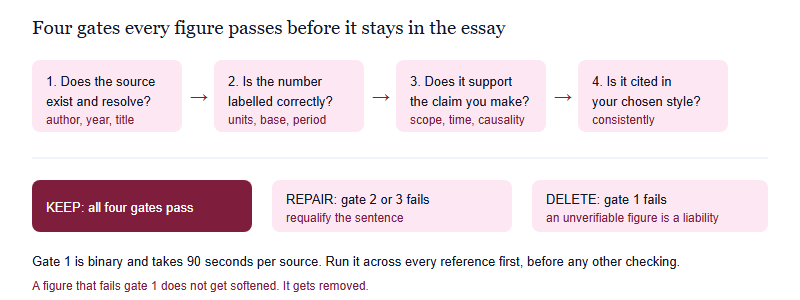
- 0:15–0:35 — Gate 1 on every reference. Does each source exist and resolve? Binary. Anything that fails is deleted from the essay along with the claim resting on it.
- 0:35–1:00 — Gates 2 and 3, one figure at a time. Units, base year, period; then whether the source supports the sentence. Repair by requalifying, not by softening into vagueness.
- 1:00–1:15 — The six unit errors. One pass per error type, using search where possible: “%”, “rose”, “fell”, “doubled”, “currently”.
- 1:15–1:30 — Reconcile the reference list. Every citation has an entry; every entry appears in the text; one consistent style throughout.
Two final points about timing. Repairs almost always add words — “in one call-centre experiment” and “is associated with” both cost length — so budget 30 to 60 words for the audit and take them from a definition rather than from your argument. And run this before you export the PDF, not after. There is no revision or replacement route once you have submitted, so the audited version has to be the version that becomes the file. Submit on 31 August if you can; the deadline is 23:59 GMT+1 on 1 September, which is 06:59 on 2 September in China Standard Time, and late submissions are not accepted.
Frequently asked questions
What if I cannot find the source for a number I remember?
Delete the number and the claim resting on it. An unverifiable figure fails the evidence criterion and invites questions you cannot answer.
Is old data always a weakness?
No. Historical episodes are strong evidence for structural arguments. Put the year in the sentence, and only chase newer data for claims about now.
Do references count toward my 1,500 words?
No — the published limit excludes titles, subtitles and references, so a complete reference list costs you nothing in length.
Can I ask an AI tool to format my references?
Do not. Generated entries can be fictional, and AI-generated content is forbidden and screened. Format them yourself from the sources you read.
Published by the LSESU Essay Competition editorial desk, operated by Hanlin Education for China-based international-school students. Official rules are set by the competition and change yearly — confirm current details on lsesuesec.org. Errors reported to the editorial desk are corrected within 7 working days.