LSESU Essay Competition for Grade 9 and 10 Students: Enter Early or Wait? A Two-Year Plan (2026-27)
Yes, a Grade 9 or 10 student can enter. In 2026 the official page described the competition as open to all secondary students, with 2026 and 2027 graduates recommended, so younger students were welcome but outside the target group. Every essay was read against the same seven criteria, and the 2026 awards had no junior category. The real decision is whether to enter early for the experience or to build first, and how to spend the time either way.
What “2026 and 2027 graduates recommended” means for your grade
The recommendation names graduation years rather than grades, which is why families read it in different ways. In the 2026 cycle, 2026 graduates were leaving or had just left school when they wrote their essays, and 2027 graduates were between their last two years. Both groups were in the final two years of secondary education. A student in Grade 9 or 10 during 2025-26 was one or two years younger than that window.
The wording for 2027 has not been published. If it moves forward by one year per cycle, which is our assumption rather than a published rule, the picture for students in school this year looks like the grid below.
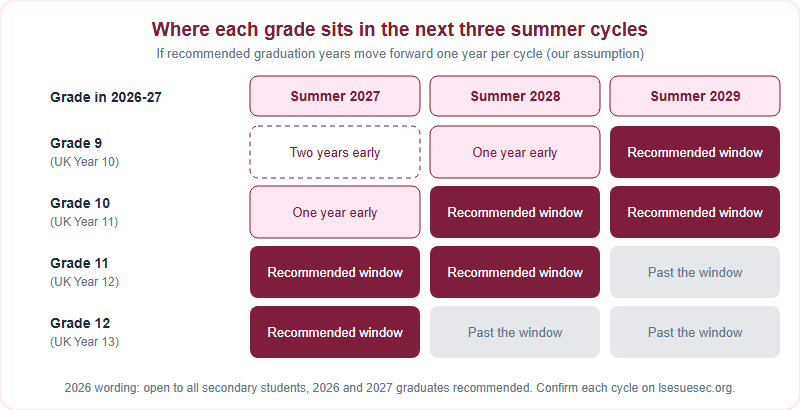
Recommended is not the same as required. The same official line says the competition is open to all secondary students, and nothing in the 2026 rules we have read limits a student to entering in a single year. What the recommendation does tell you is who the essays around yours are likely to come from: students with one or two more years of economics, writing and reading behind them. The official essay page is the place to check the wording each cycle.
Where two extra years of school show up in the marks
Age is not a criterion, but some criteria depend far more than others on what you have already been taught. We have rated each of the seven published criteria by how much we think an extra year or two of school moves it. The ratings are our editorial judgement, not the competition's; the weights are the ones published for 2026.
| Criterion | Marks | Age sensitivity (our rating) | Why |
|---|---|---|---|
| Structure and clarity | 10 | Low | A claim in the introduction and paragraphs that follow from one another can be taught in weeks |
| Citations and sources | 10 | Low | A consistent referencing style is a habit, not a level of knowledge |
| Relevance to topic | 5 | Low | Answering the clause the question actually contains is careful reading |
| Evidence and example | 15 | Medium | Finding, checking and dating data takes practice and a little statistics |
| Critical analysis and evaluation | 15 | Medium | You can only answer the strongest objection if you have read enough to know what it is |
| Argument and originality | 25 | Medium to high | Going beyond the textbook answer assumes you already know the textbook answer |
| Application of theory | 20 | High | Many of the models a specialist reader expects arrive only in Grade 11 and 12 economics courses |
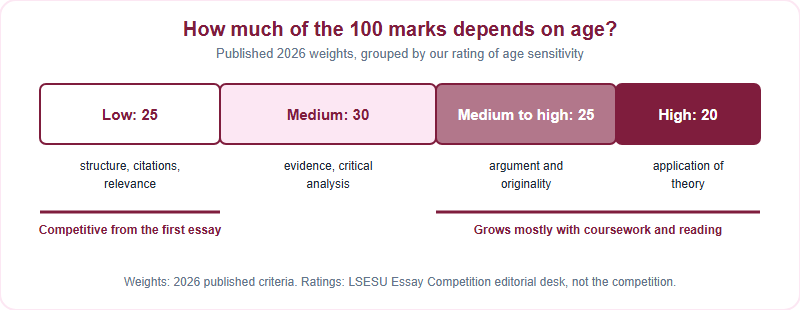
Read the bar as a plan, not a verdict. A Grade 10 student who banks the 25 low-sensitivity marks and competes properly for the 30 in the middle is writing a respectable essay, even if the theory and originality marks come later. A Grade 9 student who tries to compete on theory by memorising models they have not yet been taught tends to put the reachable marks at risk, because an essay built around borrowed ideas can lose its structure first.

Enter early or wait: three paths
There is no single right answer, but there are three sensible paths, and most younger students fit one of them clearly once they are honest about how much economics they have actually studied.
| Path | Who it suits | What it costs | What it gives |
|---|---|---|---|
| A. Enter the 2027 cycle as a first attempt | Grade 10 now, already reading some economics and comfortable writing 1,500 words in English | A summer's work that may end with no certificate, since only winning students receive one | A real deadline, a finished essay, and a second attempt later with the criteria already understood |
| B. Build this year, enter from 2028 | Grade 9 now, or Grade 10 without economics lessons yet | No finished competition essay in 2027 | Time to meet the models and build reading stamina before the first entry counts |
| C. Prepare as for A, decide in June 2027 | Anyone unsure whether A or B fits | Nothing extra, if the preparation happens anyway | An entry only if one of the new questions matches something you can genuinely evidence |
Path C deserves a word, because it is the one families most often overlook. In 2026 the questions appeared at the start of June, and the questions change every cycle. A younger student cannot know in September whether next summer's questions will suit them. Preparing regardless and deciding when the questions appear turns a vague ambition into a decision made with the evidence in front of you.
A two-year plan from Grade 9 or 10
The plan below runs from this autumn to the summer of 2028, and every column feeds a published criterion: reading feeds argument and critical analysis, writing feeds structure and relevance, and numbers feed evidence.
| Term | Read | Write | Numbers | Output |
|---|---|---|---|---|
| Autumn 2026 | One explainer a week written for non-specialists, noting the mechanism each one describes | 150-word paragraphs: one claim, one reason, one piece of evidence | Percentage change, index numbers, real versus nominal values | A reading log of ten mechanisms |
| Spring 2027 | One short research summary or policy brief a fortnight | One 800-word essay on a 2026 question, referenced in one consistent style | Reading a chart and a simple table of results | An essay self-marked against the seven criteria |
| Summer 2027 | Read around the new questions within a week of their release | Path A: the full entry. Path B: a 1,000-word practice on a new question | Check every figure you quote against its source | An entry or a practice essay |
| Autumn 2027 | One economics paper a month: abstract, then results, then method | Rewrite the weakest section of the summer essay | Mean and variance, and what a coefficient and its standard error tell you | Three rules for next time |
| Spring 2028 | A source bank in the fields your courses now cover | Two timed 45-minute essay plans on past questions | Correlation and causation in real studies | A pre-writing checklist |
| Summer 2028 | Targeted reading for the question you choose | The entry that counts, with your own draft deadline set before the holiday | A final numbers check before submitting | Your target entry |
Two kinds of source make the reading column manageable for a student who has never read economics outside a textbook: explainers written for non-specialists, such as the Bank of England's Knowledge Bank and the Economics Observatory, and the plain-language summaries research centres publish alongside their papers. The writing column matters more than it looks. The method in our guide to writing the 1,500-word essay is written for the full-length entry, but its core move, claim first with the evidence attached, is exactly what a Grade 9 student can practise 150 words at a time.
For parents: what an early entry is, and what it is not
It is a real deadline and an independent piece of academic writing in English, which is valuable at any age. It can also become part of a longer story. Admissions readers check a claim of interest against everything else in a file, and an early essay, a stronger essay a year later, the subjects chosen and the reading done in between all corroborate one another in a way that a single late entry cannot. That is a reason to start, not a promise: no competition result guarantees an admission outcome.
It is not a certificate by default. The official page says only winning students receive certificates and that participation certificates are not available, and the 2026 awards had no junior or age-based category. The broadest award, High Distinction, covers the top 5 to 10% of entries according to the official page, so a younger entrant should measure a first attempt by what it teaches rather than by what it wins.
It is not a family project either. The competition runs AI-detection and plagiarism checks on every essay and disqualifies breaches. Parents can help with the calendar, with access to reading and with conversation about ideas; rewriting sentences, supplying sources the student has not read or steering the argument crosses the line. For the basic facts about how the competition runs, our overview of the LSESU Essay Competition is the page to share at home.
Frequently asked questions
Can a Grade 9 student enter the LSESU Essay Competition?
In 2026 it was open to all secondary students, with 2026 and 2027 graduates recommended. Confirm the 2027 wording when it opens.
Is there a junior category for younger entrants?
The 2026 awards had no junior or age-based category. Every essay was judged against the same seven published criteria.
Should a Grade 10 student enter in 2027?
If they already read some economics and can write 1,500 words in English, yes. Otherwise practise on the 2026 questions first.
Does entering early stop a student entering again later?
We have seen no published rule that limits a student to one cycle. Each cycle allows one essay; confirm when the 2027 rules appear.
Published by the LSESU Essay Competition editorial desk, operated by Hanlin Education for China-based international-school students. Official rules are set by the competition and change yearly — confirm current details on lsesuesec.org. Errors are corrected within 7 working days.