Your LSESU Essay in a UCAS Reference: A Referee Brief for Students and Teachers (2026)
A UCAS reference can mention your LSESU essay, but in one place and in one register: short, factual statements in the third section, describing what your referee actually saw you do. It should not retell your argument, which your own statement already covers, and it should not hint at a result nobody has announced. The simplest way to get that sentence right is to hand your referee a one-page brief this month.
Where the essay belongs in the three-section reference
UCAS's guidance for referees at registered schools, which we read on 15 September 2026, divides the reference into three sections. Universities receive them under the headings Establishment details, Extenuating circumstances and Other supportive information. The whole reference has a ceiling of 4,000 characters, and because spaces, section headings and line breaks all count, UCAS tells referees to keep the text they enter under 3,800. There is no separate limit for each section, and there is no formatting at all: no bullet points, bold or italics, although UCAS accepts short statements written in a bullet-point style.
| Section | What UCAS says it is for | Does the LSESU essay belong here? |
|---|---|---|
| 1. A general statement about the school | Context about the school, college or centre the applicant attends, such as its intake, results and the qualifications it offers | No. This section describes the school, not the student |
| 2. Extenuating circumstances | If applicable, circumstances that may have affected the applicant's education and achievement; UCAS notes that many students will not have any | No. A competition entry is not a circumstance, whatever happened to it |
| 3. Other supportive information | Information specific to the applicant and relevant to the courses applied for, given in short, clear, factual statements; UCAS describes it as the place to showcase students with evidence-based detail | Yes. This is the only natural home for the essay |
Two further lines in the same guidance shape the essay sentence directly. Referees are asked to avoid repeating information the student has already given in the application, unless they want to comment on it, and to avoid mentioning any university or college. And under the Data Protection Act 2018, an applicant can ask for a copy of their reference, so a teacher should write nothing about the essay that they would not be comfortable showing the student.
The rule about naming universities has a quirk here, because this competition's name contains the letters LSE. Writing the full name once simply names the activity; turning it into a remark about the student's fit for any university is what the guidance asks referees to avoid, since every university on the application reads the reference. If a teacher has never met the competition, forward our overview of what the LSESU Essay Competition is before they start writing.
What only a referee can corroborate
Admissions readers rarely take a single line on trust. They read an essay or a stated interest against the rest of the file: the predicted grades, the student's own statement and, where a course interviews, what the student says in the room. A file becomes believable when those sources agree. The reference is the one written by an adult who watched the work happen, which makes it the natural place for corroboration and the wrong place for a summary.
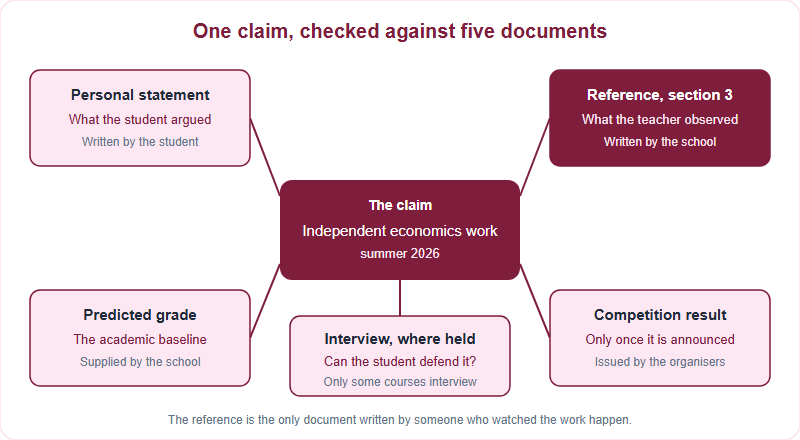
In practice, that leaves a referee four things that nobody else in the file can say:
- Process. When the student started, whether they brought their reading into lessons, and whether a draft existed well before the deadline.
- Independence. That the question, the reading and the argument came from the student, stated only as far as the teacher actually knows it.
- Behaviour under challenge. How the student handled an objection in class, in a society talk or in a conversation about the essay.
- Comparison. How this piece of independent work compares with what the teacher has seen from other students, a judgement only the school can make.
What a referee should leave out is just as specific: the thesis in detail, prize values, and words such as shortlisted or recognised that describe a status the organisers have not given. The competition's official page says only winning students receive certificates and participation certificates are not available, so a sentence about entering should not sound as though a certificate stands behind it.

The referee brief: one page, handed over in September
UCAS tells students who apply through a school to follow the school's own deadline, which exists so that referees have time to read the application, check the qualifications, and write and attach the reference. That internal deadline necessarily comes before UCAS's own dates, so September is when your referee needs the facts. A brief also protects your referee from the generic sentence that could describe any applicant in the country.
| Field | What to give your referee | Illustrative example |
|---|---|---|
| Competition and cycle | The full name and the year, spelled out | LSESU Economics Society Essay Competition, 2026 cycle |
| Question | The topic in your own words, with the question number | Monetary policy after a sharp rise in UK energy prices (Question 2) |
| Your claim | One sentence stating what you argued, not what you hope it scored | The central bank should look through the first rise in prices but respond if wages start to follow |
| Reading | Three sources you actually used, with authors and years | A central bank speech, one academic paper and one official statistics release |
| Dates | When you chose the question, finished a full draft and submitted | Chose in June, full draft by late July, submitted in August |
| What your referee saw | Specific moments they witnessed, with rough dates | Raised the exchange-rate channel in a June lesson; presented the argument to the economics society in September |
| Outside help | Any tutoring or feedback you received, described plainly | Discussed structure once with an outside tutor; nobody edited the text |
| Result status | Pending, with the published timing | Submitted; the official page lists results for October 2026, marked tentative |
| Please do not write | The phrases that would overstate it | LSE prize, shortlisted, award-winning |
The outside-help row matters more than students expect. The competition runs AI-detection and plagiarism checks on every essay and disqualifies breaches, so the work has to be yours, and a reference that is accurate about help is stronger than one that implies there was none. The claim row should match the thesis you actually built; if you used the method in our guide to writing the 1,500-word essay, it is the one sentence from your introduction.
UCAS also reminds agents and counsellors that the reference is an academic one, linked to predicted grades, and needs someone who knows the applicant's academic achievements. So an outside tutor does not write about the essay; the school does, and the tutor's role belongs in your brief as a fact. If a counsellor rather than your economics teacher is compiling the reference, ask the teacher to confirm the rows on what they saw and what help you had, because a counsellor cannot check those.
Sentences that corroborate, and sentences that backfire
The same essay can be described in a way that adds weight to the file or in a way that quietly subtracts from it. The difference is almost always whether the sentence reports something observed or something asserted.
| Backfires | Why | Corroborates instead |
|---|---|---|
| “She won recognition in a prestigious LSE essay prize.” | Implies an award and a university endorsement before any result exists | “Over summer 2026 she researched and submitted an essay to the LSESU Economics Society Essay Competition; results are expected later this autumn.” |
| “He is passionate about economics and reads widely.” | Could describe any applicant; UCAS asks for short, specific, factual statements | “He brought a working paper on hybrid work to our Year 13 seminar and explained why its sample limited what it could show.” |
| Three sentences retelling the essay's argument | Repeats the application, which UCAS asks referees to avoid unless they are commenting on it | “When challenged on second-round wage effects, she revised her position rather than restating it.” |
| “This essay makes him an ideal candidate for LSE.” | Names a university in a reference that every university on the application reads | “The essay is consistent with the analytical strength behind his predicted grade in economics.” |
Space is the other constraint. Every section shares the same 3,800 usable characters, and a sentence like those in the right-hand column runs to roughly 120 to 200 characters. Two of them use about a tenth of the reference, which is a fair weight for one summer's independent project set beside two years of classroom evidence.
Letters for applications to the United States follow each platform's own format, and these UCAS rules do not apply to them. The principle transfers intact: observed rather than asserted, specific rather than general, and silent on outcomes that have not happened.
The October problem, from the referee's side
The dates line up awkwardly this year. UCAS began accepting completed 2027-entry applications on 1 September 2026, the same day the essay window closed at 23:59 GMT+1, and an application cannot be sent without a reference. For the universities of Oxford and Cambridge, and for most courses in medicine, dentistry and veterinary medicine or science, the equal consideration date is 15 October 2026 at 18:00 UK time. For most other undergraduate courses it is 13 January 2027 at 18:00 UK time. The competition's official essay page lists results for October 2026 and marks that date as tentative.
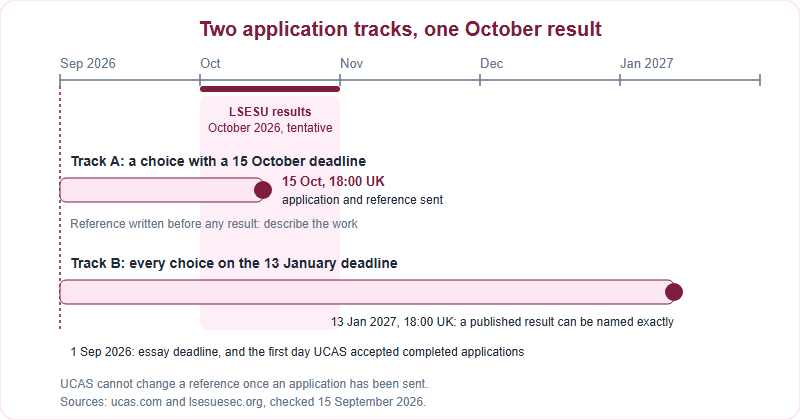
On Track A, the reference is written and sent before the result can exist, so it describes the work and nothing else. UCAS is explicit that once an application has been sent, it cannot return it or change the reference or predicted grades. The same guidance recommends telling universities about changes to an applicant's profile or circumstances that occur after submission. If a result arrives after your application has gone, ask each admissions office whether and how they want to hear about it, rather than assuming a competition result is a change they need.
On Track B, a published result may exist by the time the reference is finalised. If it does, use the award name exactly as published, with the year, and add nothing. If it does not, the process sentence from your brief still stands on its own, which is why it is worth writing that sentence first on either track.
Frequently asked questions
Where in a UCAS reference should an essay competition go?
In section 3, other supportive information, as short factual statements about what the referee observed and how it relates to the course.
Can a reference mention an LSESU result that is not yet announced?
It can describe the work the referee saw. It should not imply an award. The official page lists results for October 2026, tentative.
Can the reference be updated if the result arrives after submission?
UCAS says it cannot change a reference once an application is sent. Ask each university how they want to hear about later results.
How much space should the essay take in the reference?
There is no per-section limit. The reference allows 4,000 characters including headings; one or two specific sentences is usually enough.
Published by the LSESU Essay Competition editorial desk, operated by Hanlin Education for China-based international-school students. Official rules are set by the competition and change yearly — confirm current details on lsesuesec.org. Errors are corrected within 7 working days.