LSESU Essay Policy Trade-Offs: Comparing Two Options Under the Same Assumptions
Defining the Precise Difficulty
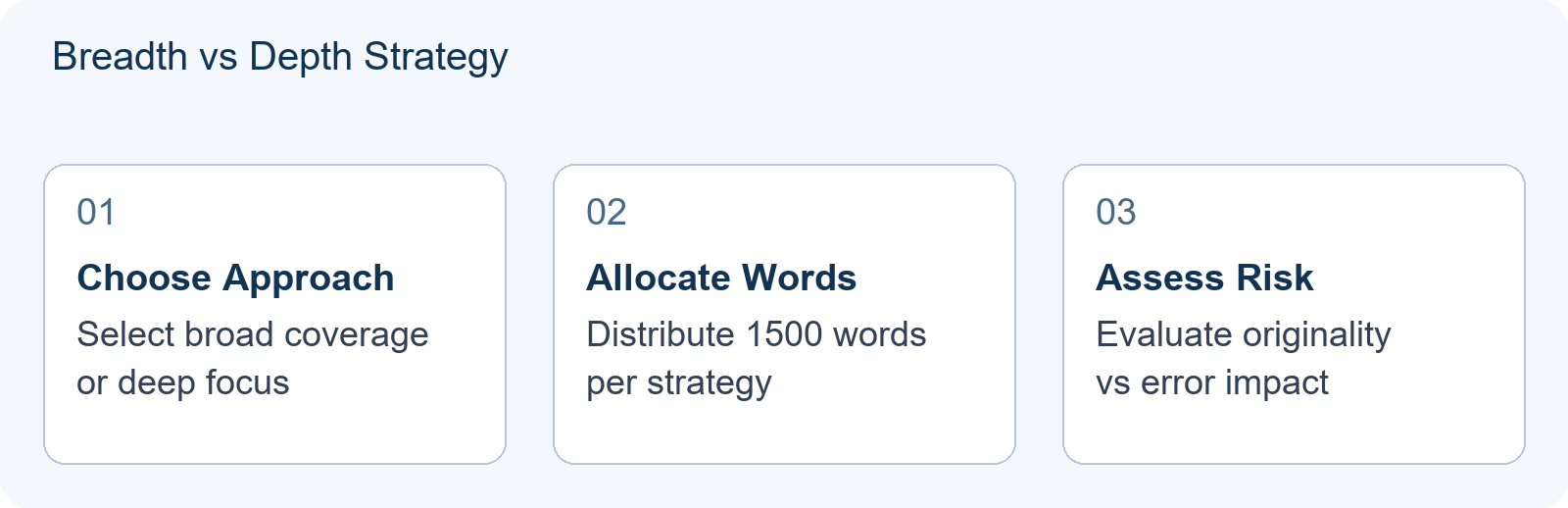
Students preparing for the LSESU Economics Society Essay Competition often face an implicit strategic choice: how to balance depth, breadth, and originality within the 1500-word limit. There is no official “essay policy” that dictates a specific argumentative stance. Instead, the challenge lies in navigating strategic trade-offs between different approaches when responding to one of the five publicly available questions.
The Core Constraint
All essays must adhere to the same fundamental constraints: maximum 1500 words, English language, Harvard referencing, and submission through the official competition website. Within these fixed boundaries, students must choose a strategy. This article presents two teaching illustrations—Breadth-First Analysis and Depth-First Argumentation—to illustrate where each may succeed or fail under identical assumptions. These are hypothetical constructs for learning purposes only, not official past-paper questions or validated scoring predictions.
Important disclaimer: The scenarios below are original teaching illustrations created for educational discussion. They are not based on verified official marking criteria, past winning essays, or confirmed scoring patterns. Any reference to rubric outcomes is speculative and unverified.
Teaching Illustration 1: Breadth-First Analysis
Hypothetical Scenario: A student chooses a question on macroeconomic stability. They decide to cover three distinct theoretical perspectives (Keynesian, Monetarist, New Classical) equally, dedicating roughly 400 words to each, plus an introduction and conclusion.
Step-by-Step Execution
- Introduction (150 words): Defines macroeconomic stability and outlines the three frameworks.
- Section 1 (400 words): Explains Keynesian view with one example.
- Section 2 (400 words): Explains Monetarist view with one example.
- Section 3 (400 words): Explains New Classical view with one example.
- Conclusion (150 words): Summarizes all three without taking a strong stance.
Hypothetical Outcome Assessment
This approach demonstrates wide knowledge but may struggle to demonstrate original critical engagement. By treating all theories equally, the essay risks lacking a central argument. It may read like a textbook summary rather than an analytical piece. While it avoids factual errors, it may fail to engage deeply with any single perspective, potentially missing nuanced critiques that could strengthen the submission.
Note: Whether this actually results in lower scores for any specific rubric category is unverified. The 100-point rubric includes Originality (confirmed at 25 points), but the weighting and interaction of other categories has not been independently verified.
Teaching Illustration 2: Depth-First Argumentation
Hypothetical Scenario: Another student chooses the same question but adopts a focused thesis: “Monetarist policies are more effective than Keynesian interventions in high-inflation environments.” They dedicate 80% of the essay to defending this claim against counterarguments.
Step-by-Step Execution
- Introduction (150 words): States the thesis clearly.
- Core Argument (600 words): Analyzes Monetarist mechanisms with detailed case studies.
- Counterargument & Rebuttal (450 words): Addresses Keynesian critiques and refutes them using evidence.
- Nuance/Limitations (150 words): Acknowledges where the thesis might fail.
- Conclusion (150 words): Restates thesis with strengthened confidence.
Hypothetical Outcome Assessment
This approach may better demonstrate critical thinking and analytical depth. By committing to a position, the student shows they can defend an original claim. However, it carries higher risk: if the core argument is flawed or poorly supported, the entire essay lacks fallback content. Unlike the breadth approach, there is no “safe” middle ground. Success depends heavily on precise evidence selection and logical coherence.
Note: The claim that this approach “directly targets” any specific scoring criteria is speculative. Without verified access to how judges apply the rubric, we cannot confirm which structural choices correlate with higher scores.

Diagnostic Table: Identifying Strategic Risks
The following table compares the two teaching illustrations across dimensions relevant to essay quality. These are editorial observations for discussion, not validated predictors of official scores.
| Criterion | Breadth-First Risk | Depth-First Risk |
|---|---|---|
| Originality | Lower: Summary-like tone | Higher: Clear unique stance |
| Analysis | Shallow: Surface-level comparisons | Deep: Focused critique |
| Coherence | Moderate: Jumps between topics | Strong: Unified narrative |
| Evidence Use | Diluted: Spread thin | Concentrated: High impact |
| Error Impact | Lower: One section fails | Higher: Thesis undermined |
Targeted Practice Sequence
To help learners navigate these trade-offs, we suggest a self-study practice sequence based on editorial observations of common pitfalls. This is not an official curriculum but a recommended preparation path.
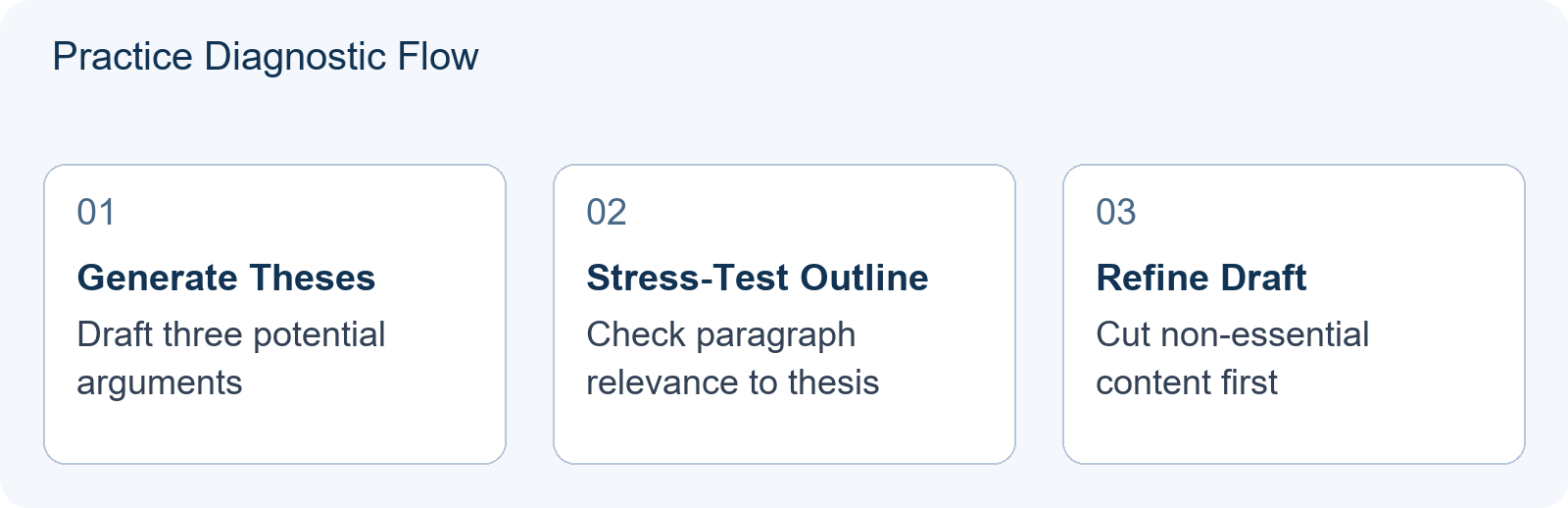
Phase 1: Thesis Generation
Take one publicly available question and write three possible theses. Do not write full essays. Evaluate which thesis allows for the most nuanced rebuttal.
Phase 2: Outline Stress-Test
Create a detailed outline for your strongest thesis. Check if every paragraph serves the central argument. Remove any content that merely “adds information” without advancing the point.
Phase 3: Word Count Discipline
Draft the essay aiming for 1400 words. Then, expand to 1500 only if necessary. This forces conciseness and prevents the dilution seen in the breadth-first illustration.
Linking to Existing Guidance
For preparation planning specific to Grade 11 students, see LSESU Essay Competition Preparation: A Focused Plan for Grade 11 Students. For a decision framework comparing this competition with another popular option, refer to LSESU Essay Competition vs Marshall Society Essay: A Decision Framework for 2026. To understand what happens after submission and how to use the waiting period productively, consult LSESU Essay Competition Results: What Happens After You Submit and How to Use the Wait.
Course-Fit and Resource Preparation
Use this diagnostic to assess your current needs. Are you struggling with generating original arguments (suggesting need for brainstorming guidance)? Or are you unable to structure complex rebuttals (suggesting need for editing feedback)?
Preparation Checklist for Consultation
- Have you identified your preferred question from the five public options?
- Do you have a draft thesis statement ready for critique?
- Can you articulate where your current draft feels weakest (e.g., lack of evidence, poor flow)?
- Are you aware of the 1500-word limit and its implications for scope?
This preparation ensures that any discussion with mentors focuses on high-value strategic decisions rather than basic rule clarification. For official rules, dates and announcements, always refer to the official competition website. The competition requires no registration; submissions are made directly through the official competition website.
This guide is operated by Hanlin International Education as an independent information resource. It is not affiliated with, endorsed by, or authorized by the LSESU Economics Society, the LSE Students’ Union, or the London School of Economics. For official rules and announcements, refer to the official competition website.
Frequently Asked Questions
Is one strategy objectively better for scoring?
No validated scoring data confirms one approach universally outperforms the other. The rubric includes Originality at 25 points in a 100-point scale, but how judges weight structural choices against content quality has not been independently verified. The optimal choice depends on the specific question, your existing knowledge, and your ability to defend a focused claim. The teaching illustrations in this article are hypothetical scenarios for discussion, not validated scoring predictions.
Do I need to register before choosing my strategy?
No. The LSESU Essay Competition requires no registration. You can select your question and begin drafting immediately. Submission is done directly through the official competition website.
Can I change my strategy after starting the draft?
Yes, during the drafting phase. However, once submitted, entries cannot be modified or replaced. Therefore, finalize your strategic choice before submitting to avoid losing the opportunity to revise.