LSESU Essay Time Horizons: Separate an Immediate Effect From a Long-Run Adjustment
Why Time Horizons Decide Whether Your LSESU Essay Is Convincing
Every LSESU Economics Society Essay Competition prompt asks you to analyse a policy, a shock, or a structural change. The difference between a top-scoring essay and one that stalls at mid-range marks often comes down to one analytical move: separating what happens immediately from what unfolds only after markets, firms, and workers have had time to adjust. The 2026 rubric awards 25 marks for Argument and Originality and 20 marks for Application of Economic Theories; both criteria reward essays that build a clear temporal architecture rather than collapsing everything into a single snapshot.
This article works through a concrete decision framework for time-horizon analysis, checks every step, and shows where a superficially similar approach fails. It is intended for students preparing for the LSESU Essay Competition Preparation: A Focused Plan for Grade 11 Students and for teachers structuring classroom support.
The Core Distinction: Stock vs. Flow, Fixed vs. Flexible
In microeconomic and macroeconomic reasoning, “immediate” means before agents can re-optimise. Prices may be sticky, contracts fixed, or expectations unadjusted. “Long-run” means after all adjustment mechanisms have operated: factor mobility, entry and exit, learning, or policy adaptation. The same shock therefore produces two different equilibria.
The LSESU 2026 Topic 2 (Energy & Economics) illustrates this perfectly. A sharp rise in UK energy prices raises firms’ costs immediately. In the short run, with existing contracts and menu costs, some firms absorb the shock through narrower margins; others pass it through to consumers. The Bank of England, facing a 2 percent inflation mandate, must decide whether to tighten monetary policy now or wait. In the long run, however, firms may substitute toward renewables, households may retrofit insulation, and the energy share of GDP may fall—changing the economy’s sensitivity to future energy-price shocks, provided relative prices and policy support make those investments cost-effective.
Compare how a policy response could change as supply adjusts and inflation expectations evolve. Sustained tightening and prolonged accommodation are possible scenarios to examine, not the only choices. Explain what evidence about persistence, pass-through and expectations would justify changing the response over time. This makes the temporal trade-off explicit without predicting a fixed central-bank decision.
Teaching Illustration: A Minimum Wage Hike in a Competitive Labour Market
The following is a deliberately simplified teaching illustration with stated assumptions, not an empirical claim about any actual policy.
Consider a hypothetical policy shock: a government raises the national minimum wage by 20 percent in a competitive labour market with no search frictions. We trace the immediate and long-run effects on employment using standard theory, with explicit assumptions stated at each step.
Step 1: Immediate Effect (The First Few Months)
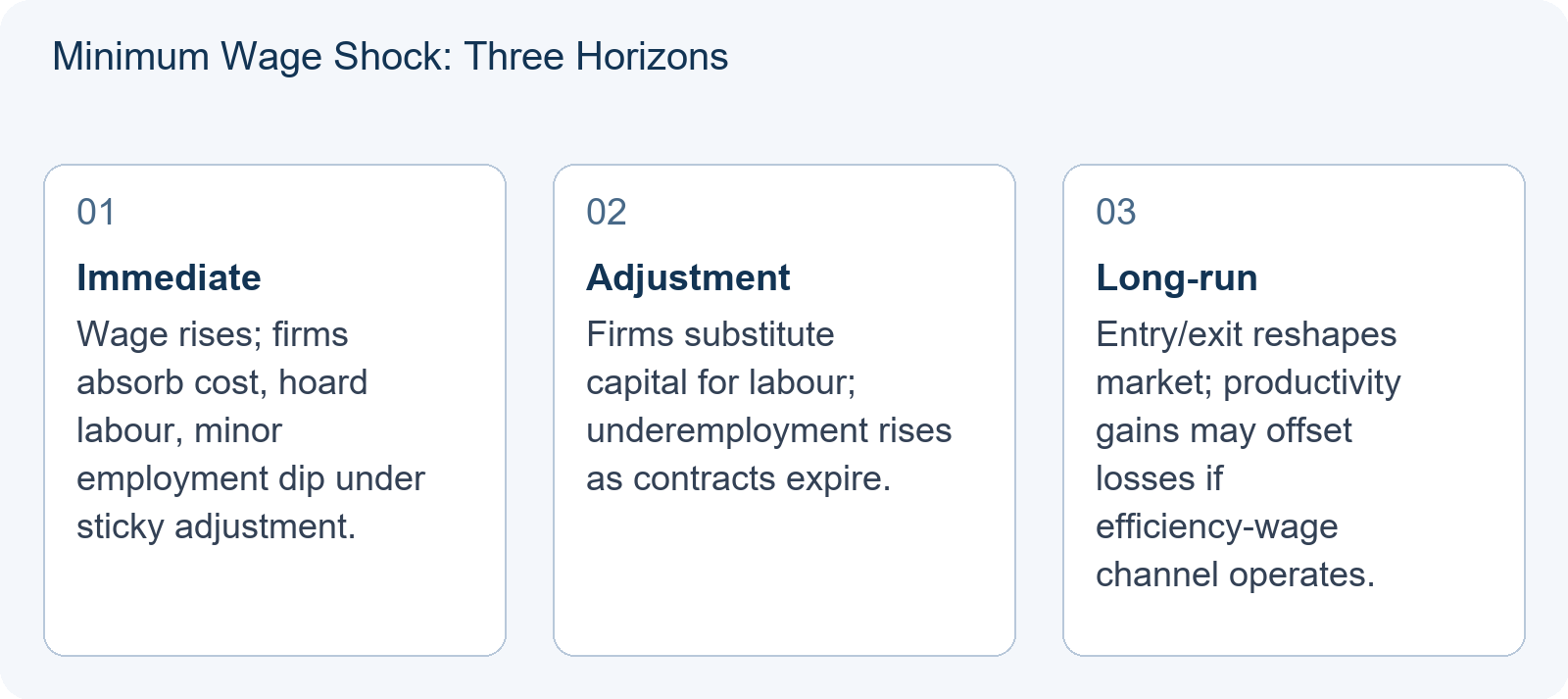
With wages mandated above the market-clearing level, labour supply exceeds demand at the new wage. Firms face higher marginal costs. Because hiring and firing decisions take time—notice periods, contractual obligations, managerial inertia—employment falls by less than the full competitive model predicts. Some firms hoard labour, expecting the shock to be temporary. Measured unemployment rises modestly, but underemployment (fewer hours, reduced effort) may rise more.
Check: This is consistent with standard sticky-adjustment models. The short-run labour demand curve is less elastic than the long-run curve because capital stock and production techniques are fixed.
Step 2: Intermediate Adjustment (6–18 Months)
Firms begin to substitute capital for labour. Self-service kiosks, automation software, and offshore outsourcing become cost-effective at the new wage. The labour demand curve rotates: demand for low-skill workers shifts left more elastically. Workers who retain jobs enjoy higher incomes; those displaced face structural mismatch if their skills do not transfer.
Check: The substitution elasticity is a standard theoretical prediction. The direction of change is unambiguous under competitive assumptions; the magnitude depends on sector and region.
Step 3: Long-Run Equilibrium (2+ Years)
In a competitive model without a productivity response, a binding minimum wage can reduce labour demand. Over longer horizons, firms may change capital use, output or market participation. Whether employment remains lower depends on these adjustments and on the labour-market model. Efficiency-wage mechanisms concern how higher pay can change effort, retention or productivity; capital investment is a separate channel. Do not call every productivity improvement an efficiency-wage effect. State which mechanism your argument assumes and what evidence would distinguish it from alternatives.
Contrast with alternative market structure: In a monopsony model, the same 20 percent wage increase could raise employment, because the employer initially restricted hiring to suppress wages. The competitive and monopsony predictions have opposite signs. Without knowing market structure, the long-run employment effect is ambiguous.
Check: The competitive long-run prediction is standard theory. The monopsony contrast demonstrates the critical engagement the rubric rewards. No empirical magnitude is asserted.
Contrasting Case: Where the Same Framework Fails
Now consider a student who applies the minimum-wage template to LSESU 2026 Topic 4 (Taxation & Fairness): “Is it possible and desirable to raise taxation on the top 1 percent?”
The superficial move is to argue: “Immediately, higher taxes reduce disposable income and discourage work effort. In the long run, the rich emigrate or shelter income, so revenue falls.” This sounds structurally parallel, but it commits two errors:
- Assuming a single predictable elasticity: Empirical estimates of labour-supply and tax-response elasticities among high earners vary widely across countries and time periods. Some studies find small responses; others find larger ones through avoidance channels. Treating any single number as universal oversimplifies the evidence.
- Treating “long run” as automatically negative: For the competitive minimum-wage analysis above, the long-run employment effect is more negative than the short-run effect under the stated assumptions. For top-income taxation, the long-run effect on revenue is genuinely ambiguous: base erosion matters, but so do public-good provision and potential human-capital externalities from spending. The sign is not predetermined by the structure of the argument.
The lesson: time-horizon analysis must be substantive, not decorative. Simply appending “in the long run” to every claim is a recipe for losing the Argument and Originality marks.
A Diagnostic Decision Framework for Your Draft
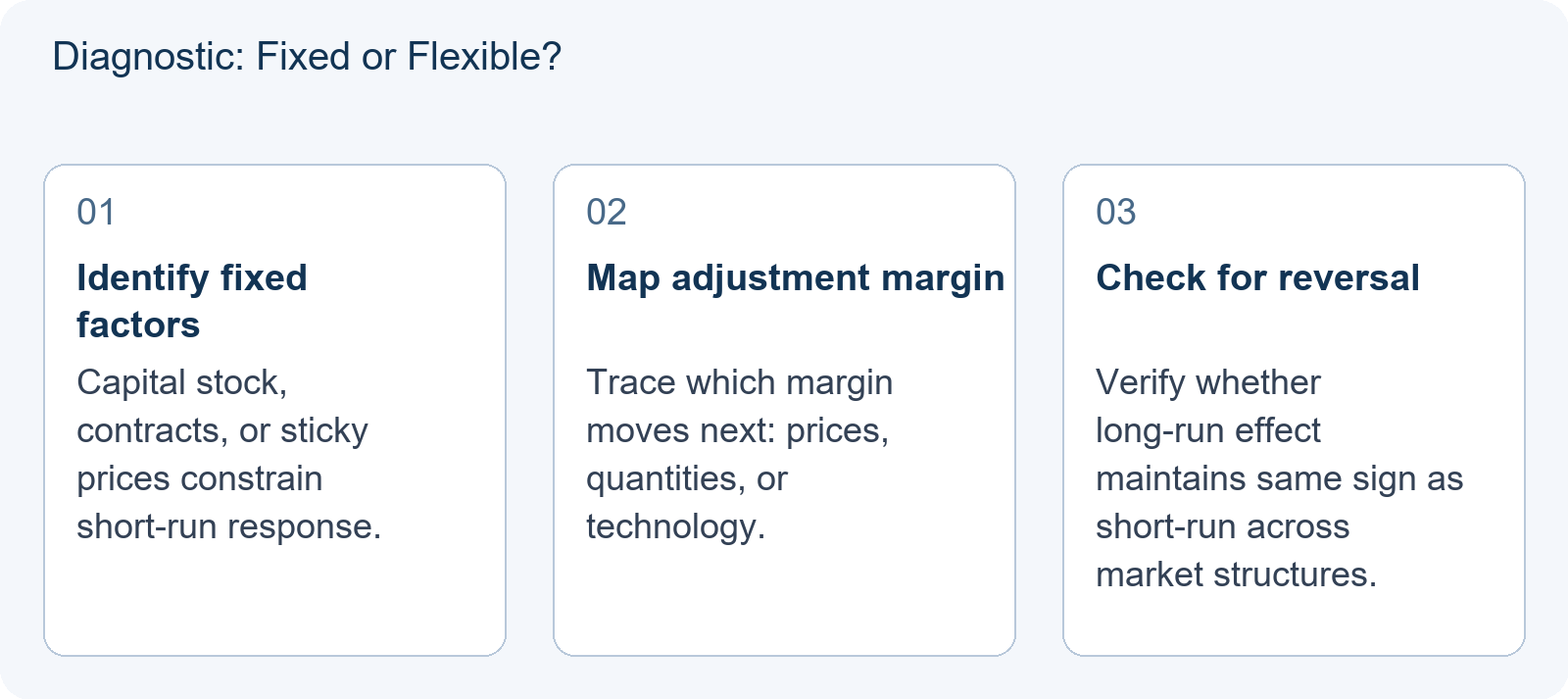
Use this three-question test on every causal claim in your essay:
| Question | Purpose | Fail Signal |
|---|---|---|
| 1. What is fixed in this period? | Defines the short-run constraints | Assuming all prices adjust instantly |
| 2. What margin adjusts next? | Identifies the transmission mechanism | Jumping from “firms lose” to “unemployment rises” with no intermediate step |
| 3. Does the direction of the effect reverse? | Catches oversimplified monotonic stories | Claiming higher taxes always reduce revenue, or higher wages always reduce employment |
If you cannot answer question 1 for a given claim, your time horizon is undefined and your argument is vulnerable.

Applying the Framework to LSESU 2026 Topic 3 (AI & Employment)
Topic 3 asks what measures should limit inequality if AI reduces labour demand. A strong essay needs three temporal layers:
Immediate: Displaced workers lose income before retraining programmes are designed. Universal basic income or short-term transfers address this.
Medium-run: Firms reorganise around AI; new occupational categories emerge. Education policy and portable benefits determine whether workers transition or remain stranded.
Long-run: If productivity gains accrue mainly to capital owners, labour’s income share may fall under the assumed institutions. That does not establish a permanent outcome or require a single policy instrument. Compare possible responses, such as taxation, transfers, competition policy, broader asset ownership and worker bargaining, against the specific mechanism and constraints in the question.
Notice how the type of appropriate policy changes with the horizon. A student who recommends only retraining misses the immediate income gap; a student who recommends only UBI misses the structural transformation.
What This Means for Your Next Revision
If your current draft treats every effect as instantaneous, revise by adding one explicitly dated paragraph per major causal chain: “In the first months…”, “Once firms can adjust…”, “After the market has fully adapted…” This structural move alone typically lifts essays into the upper third of the Structure and Clarity scoring band.
If your draft already uses time-horizon language, audit it with the diagnostic table above. The most common residual weakness is assuming the long-run effect has the same sign as the short-run effect. Flag every instance and check whether the theoretical mechanism actually supports monotonicity, or whether the sign could flip once adjustment completes.
For students seeking structured preparation, our LSESU Essay Competition Preparation: A Focused Plan for Grade 11 Students sequences time-horizon practice across eight weeks, and our LSESU Essay Causal Inference: Why Correlation Is Only the Start of an Argument addresses the deeper methodological question of why correlation alone cannot establish even short-run effects.
Your Immediate Next Step: Run the Diagnostic
Before writing another paragraph, pick one causal claim from your current draft and answer the three diagnostic questions in writing. If you find question 2 or 3 difficult, you have identified the exact paragraph that needs restructuring. That is the practical decision this framework delivers: not whether to add more theory, but which existing claim is underdeveloped and what specific adjustment—fixity, margin, or reversal—will repair it.
Interpreting the Diagnostic: A Worked Example of Horizon Reversal
The diagnostic framework asks whether an effect’s direction reverses between horizons. Many students assume monotonicity—that if a policy hurts employment now, it will hurt more later. This is often false. Consider a teaching illustration based on the LSESU 2026 Topic 1 (Technology & Worker Wellbeing): a firm introduces remote work but installs monitoring software to ensure productivity.
The Immediate Effect: Friction and Resistance
In the short run, workers perceive monitoring as intrusive. Trust erodes. Effort may drop due to psychological reactance, or turnover rises among high-skill employees who value autonomy. The firm sees immediate costs: recruitment fees, lost institutional knowledge, and potentially lower output per hour. If a student stops here, they might conclude that “monitoring reduces wellbeing and efficiency.”
The Long-Run Adjustment: Selection and Adaptation
Over time, two mechanisms alter the equilibrium. First, selection: workers who dislike monitoring leave, while those who prefer flexibility join. The remaining workforce is better matched to the hybrid model. Second, adaptation: firms refine monitoring tools to focus on outcomes rather than keystrokes, reducing friction. If the firm successfully balances autonomy with accountability, long-run productivity may exceed the pre-shock baseline because the labor pool is now optimized for remote collaboration.
Diagnostic Check: Does the Sign Flip?
Here, the short-run effect (negative) and long-run effect (potentially positive) have opposite signs. A superficial essay would recommend abandoning monitoring entirely. A rigorous analysis argues for designing monitoring to facilitate selection and adaptation. The key insight is that the “cost” of monitoring is front-loaded, while the “benefit” of a self-selected, flexible workforce accrues over time.
Practice Task: Map Your Own Causal Chain
Take one causal claim from your current draft. Ask: What fixed constraints exist today? What margins adjust next? Could the net effect reverse after adjustment? Write three sentences answering these questions explicitly. If you cannot identify a mechanism for reversal, check if you are assuming perfect information or instant adjustment—both are unrealistic in LSESU contexts. This exercise transforms vague temporal language into precise economic reasoning, directly addressing the rubric’s demand for critical engagement with trade-offs.
Frequently Asked Questions
Does every LSESU essay need explicit time-horizon analysis?
Not every prompt requires equal depth on all horizons, but every strong essay benefits from at least distinguishing the immediate policy environment from the adjusted equilibrium. The rubric rewards critical engagement with dynamics, not static snapshots.
How do I avoid making my essay feel like two separate essays pasted together?
Use explicit transition sentences that link horizons causally: ‘Because firms cannot adjust immediately, the short-run effect is X; once they can substitute capital, the medium-run effect becomes Y.’ This signals temporal reasoning rather than mechanical sectioning.
Can I use the same time-horizon structure for macro and micro prompts?
The structure transfers, but the specific margins differ. In micro prompts, focus on firm entry/exit and factor substitution. In macro prompts, add monetary policy lags, expectation formation, and international capital flows.