LSESU Essay Command Words: What Each 2026 Prompt Asks You to Produce
Students searching for LSESU essay command words usually already know which of the five 2026 prompts looked interesting. The hard part is the next step. The five official prompts, set by current professors in the LSE Department of Economics, do not ask for the same kind of writing at all. Read as commands, they request five different outputs:
- Q1 — a recommendation to a firm about what it should do.
- Q2 — a brief addressed to a central bank.
- Q3 — a set of measures to limit inequality.
- Q4 — a two-part verdict on whether a tax is possible and desirable.
- Q5 — a causal forecast about how technologies will affect inequality and wealth distribution.
Decode that instruction before you outline and most of the “well written but off-target” problem disappears. The rubric’s Topic Relevance criterion is explicit: it asks whether the essay stays on topic and directly answers the question asked. That is a small share of the total, but it is the criterion that tells you what the rest of the marks are being awarded for.
Season scope. The official site lists the 2026 submission deadline as 1 September 2026, 23:59 GMT+1, with no late submissions accepted, and a tentative October 2026 results announcement. The published 2026 set is therefore now a training corpus and a method, not an open call for entries. The decoding below is written so you can run it on that set and then reuse it on any future prompt set.
Start With the Verb, Not the Topic
Topic choice is about interest. Command words are about obligation. If you pick Q4 because taxation debates interest you, the prompt still obliges you to test feasibility as well as fairness. If you pick Q2 because monetary policy is familiar, the prompt still obliges you to write something shaped like a brief rather than a survey of inflation theory.
A useful working rule: the command word sets the type of claim your essay must end on. A “what should the firm do” prompt ends on a recommendation. A “prepare a brief” prompt ends on advice with options and a preferred option. A “what measures” prompt ends on a designed package. A “is it possible and desirable” prompt ends on two separate verdicts and then one combined judgement. A “how will X affect Y” prompt ends on a mechanism-based forecast.
The Five 2026 Prompts, Decoded
| Prompt | Command frame | What the response must deliver | Common misread |
|---|---|---|---|
| Q1 — Pissarides: workers want a home-working day but dislike monitoring devices; what should the firm do? | Prescriptive advice to a named decision-maker | A recommendation, with the trade-off between motivation and assurance of output made explicit, and the reason a specific instrument beats the alternatives | Explaining that workers like flexibility and dislike surveillance, with no actual recommendation |
| Q2 — Reis: after a sharp rise in UK energy prices, prepare a brief for a central bank | A document request, not a topic request | An advisory brief: the constrained mandate is stated, options are set out, one is preferred, and the assumption that the UK is a net energy importer is used | Writing a general essay on inflation and energy markets that never takes the form of advice to the Bank of England |
| Q3 — Tenreyro: if AI displaces labour, what measures should be put in place to limit inequality in pay and hours? | Instrument design under a stated threat | A concrete set of measures, each tied to a named channel through which pay or hours inequality widens | Establishing that AI could raise unemployment, then stopping before proposing anything |
| Q4 — Van Reenen: is it possible and desirable to raise taxation on the top 1%? | A compound evaluative question | Two tests answered separately — administrative and behavioural feasibility, then normative desirability — followed by a combined position | Arguing fairness at length and never testing whether the tax can actually be levied and collected |
| Q5 — Gmeiner: how will development and adoption of climate-friendly technologies affect inequality and the distribution of wealth? | A predictive, mechanism-building question | A forecast built from transmission channels, covering both inequality and wealth distribution, and honest about which channels are contested | Answering “what should governments do about green technology” when the prompt asks what will happen |
The table is our reading of the prompts, not official guidance. The prompt wording it rests on is verbatim from the competition’s own topic page.
Q2: “Prepare a Brief” Names a Document
This prompt requires a specific genre. A brief is a short, directed piece of advice. It assumes a busy reader who wants a position, the reasoning behind it, and the conditions under which that position would change. That shape is different from an academic essay that surveys the literature before arriving somewhere in the final paragraph.
In practice, a brief-shaped answer does four things early: it states the reader and the constraint, it states the question the reader actually faces, it lays out two or three genuine options, and it says which one it recommends. Because the prompt also supplies two facts — the UK is a net energy importer, and the Bank of England’s mandate is to keep inflation at 2% — a strong answer visibly uses both rather than treating them as decoration. Omitting the importer fact is a specific, checkable mismatch between prompt and response.
Q4: The Only Prompt With Two Separate Tests
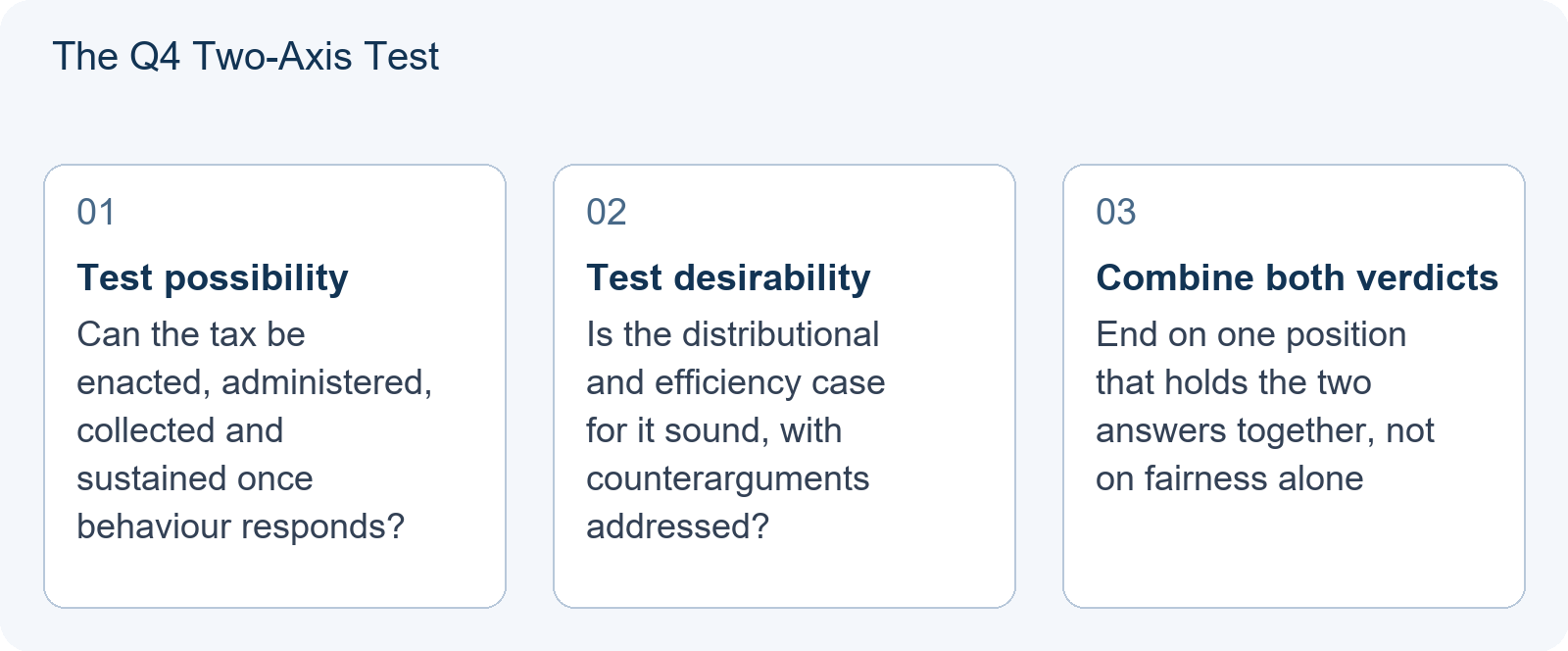
“Possible and desirable” is a compound command, and this is where the five prompts diverge most sharply. Desirability is a normative question about fairness, efficiency and distribution. Possibility is an empirical and administrative question about whether the tax can be enacted, administered, collected and sustained once behaviour responds. A response that answers only one of the two has answered half the question, however elegant the half is.
Teaching illustration (constructed by us, not an official sample answer and not a real entrant’s script). Imagine a draft that opens by arguing that the top 1% benefit disproportionately from publicly funded infrastructure and legal institutions, that their effective tax rates have scope to rise, and that a modest increase is a fair contribution. The paragraphs are well evidenced. Every one of them tests desirability. Now check the possibility test: does the draft say how the tax would be levied — on income, capital gains, wealth, or realised consumption? Does it consider capital mobility, valuation disputes on illiquid assets, or the behavioural response of people who can change residence or timing? If the draft never does this, the reader finishes it without knowing whether the author thinks the policy would actually work. The command word “possible” has been left unanswered.
The repair is structural rather than cosmetic. Two clearly signposted tests, each with its own evidence, then a synthesis: for example, a position that a given version of the tax is administratively possible but only weakly desirable, or desirable in principle but fragile in practice. That combination is precisely what the compound command invites.

Q5: A Forecast Question, Not a Policy Question
Q5 looks similar to Q3 because both concern inequality, but the commands point in opposite directions. Q3 asks for measures — it wants instruments. Q5 asks how technologies will affect inequality and wealth distribution — it wants transmission. A Q5 answer that spends its length recommending subsidies and retraining has substituted a policy question for a forecast question.
The natural structure for a forecast answer is a set of channels, each carried through to a distributional outcome. Who owns the intellectual property behind the technology, and therefore who captures the returns? Does adoption raise the relative demand for the skills that complement it, widening pay dispersion, or does it lower the cost of a broadly consumed good, compressing real consumption gaps? Does the technology change the return on physical capital relative to labour, which moves wealth distribution independently of pay? Presenting two or three channels with different signs, and stating which you think dominates and under what conditions, is a stronger answer than a single unopposed mechanism.
The Two-Minute Diagnostic
Run this before you write a plan, not after you write a draft.
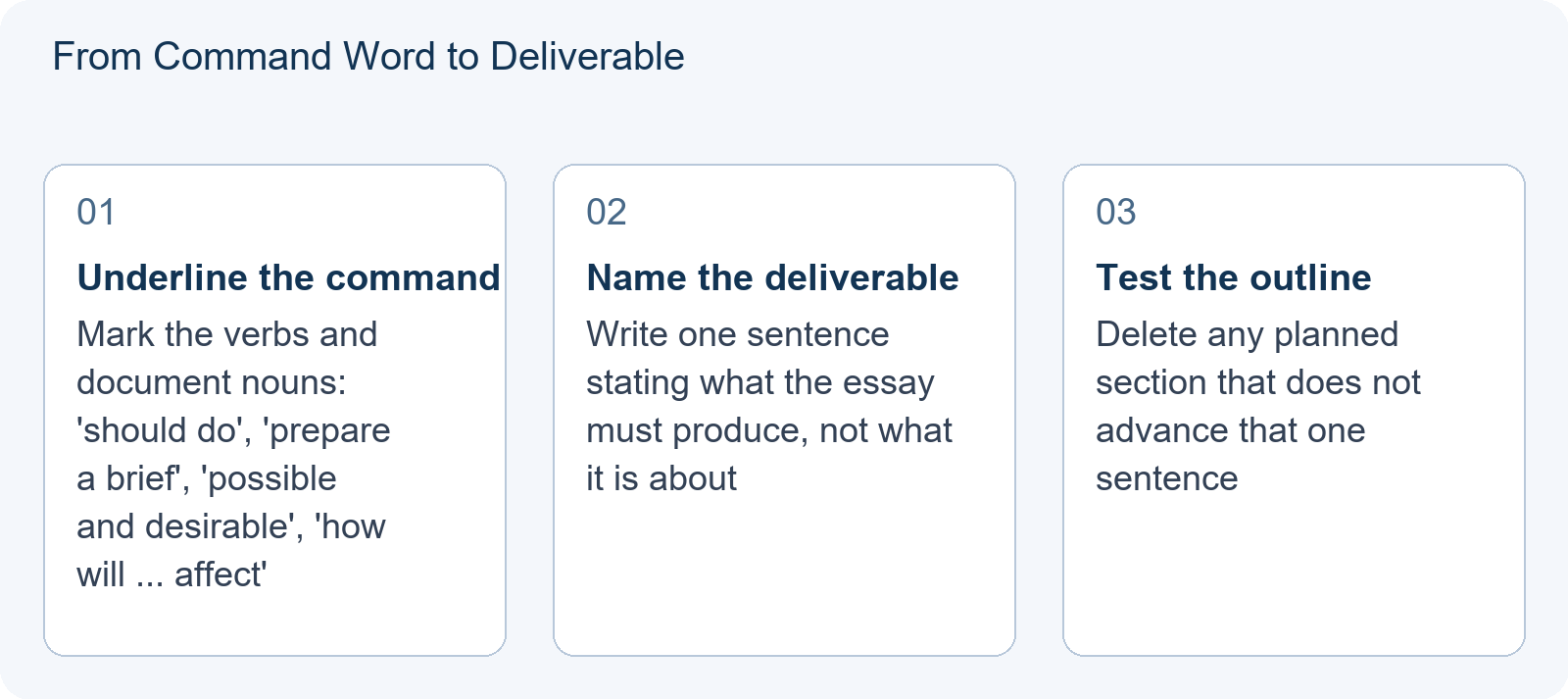
- Underline every verb and every noun that names a document or a decision. “Should do”, “prepare”, “put in place”, “possible”, “desirable”, “how will … affect” and “brief” are the load-bearing words. If a word is doing work in the prompt, it must be doing work in your outline.
- Write one sentence stating the deliverable. Not the topic — the deliverable. For Q2, that might read: “This brief advises the Bank of England on how monetary policy should respond to an energy-price shock, given the UK is a net energy importer and the 2% mandate.” For Q5: “This essay sets out how the development and adoption of climate-friendly technologies is likely to affect income inequality and the distribution of wealth, through ownership, skill-demand and capital-return channels.” If you cannot write the sentence, you have not yet understood the prompt.
- Check every planned section against that sentence. Any section that does not advance the deliverable is a candidate for deletion, however interesting it is. This is the same discipline that a post-draft question-type audit applies retrospectively; here it is applied before the writing exists.
Our editorial desk uses this three-step check as a standing first pass on prompt interpretation, and it is also the fastest way to practise on a closed prompt set — the method used in LSESU Essay Past Prompts as Practice: A Training Method.
Repairing a Draft That Answered the Topic but Not the Question
If you have already written something and only now notice the mismatch, you rarely need to start again. Diagnosis first: find the paragraph where the essay stops doing what the command word asks. In a Q1 draft that describes home-working preferences, the break usually comes after the evidence section, where the writer summarises instead of recommending.
The repair has three moves. Convert the closing paragraphs from description into advice — “workers report disliking monitoring” becomes “the firm should therefore commit to output-based review rather than continuous monitoring”. Add the section the command word requires but the draft lacks: for Q1 a stated recommendation with alternatives considered, for Q4 a feasibility test. Then delete what no longer serves the deliverable, even when it is genuinely good economics, because unused quality costs words you need elsewhere.
One caution: argument quality and prompt fit are different problems and both are marked. Critical Analysis carries 15 of the 100 marks, so a draft that answers the right question weakly is not automatically better than one that answers the wrong question well. Whether you are arguing against your own case effectively is a separate check — see Critical Engagement Is 15 Marks: How to Argue Against Your Own Case in the LSESU Essay (2026). If the mismatch is severe enough that the core argument cannot be redirected, a post-draft review of the whole response is the more reliable route, which is what The Question-Type Audit: Does Your LSESU Essay Actually Answer What Was Asked? (2026) is designed to catch.
What This Method Does Not Do
Decoding command words will not supply your economics, your evidence or your originality, and the largest single rubric block is Argument and Originality at 25 marks. It also will not tell you which question is easier — none of the five is easier in the abstract, because difficulty depends on which literature and data you can actually handle. What the diagnostic does is prevent a specific and common loss: a fluent essay that answers a neighbouring question the examiner did not ask.
Source and identity note. Prompt wording, the five topic setters, the 100-mark rubric breakdown and the deadline details above are taken from the official LSESU Economics Society Essay Competition page at lsesuesec.org (retrieved 26 October 2026). The Q4 walk-through is a teaching illustration constructed by our editorial desk and is not an official sample answer. Hanlin International Education operates this independent information site; it is not the official competition website and has no affiliation with the LSESU Economics Society, the LSE Students’ Union or the London School of Economics. For official rules, dates and announcements, always refer to the official competition website.
General event background is available at Event background.
Frequently Asked Questions
Does choosing the most interesting 2026 prompt ever justify ignoring the command word?
No. The rubric’s Topic Relevance criterion asks whether the essay stays on topic and directly answers the question asked, and the largest block, Argument and Originality, is judged on the argument the prompt actually invited. An essay that answers a neighbouring question puts both at risk. Interest is a reasonable tie-breaker between prompts; it is not a licence to rewrite the task.
Can I use one standard introduction-body-conclusion structure for all five prompts?
Only at the outer level. The internal logic has to move with the command word: Q1 needs a stated recommendation with alternatives, Q2 needs the shape of an advisory brief with options and a preferred option, Q3 needs designed measures tied to named inequality channels, Q4 needs two separately argued verdicts combined into one position, and Q5 needs transmission channels carried through to distributional outcomes. The skeleton can stay; the joints must change.
What if my draft answers the topic but not the specific question?
Diagnose where the essay stops doing what the command word asks, then convert descriptive paragraphs into the required action, add the missing section — a feasibility test for Q4, a recommendation for Q1 — and cut material that no longer serves the deliverable. If the core argument genuinely cannot be redirected, the mismatch is structural rather than stylistic and the draft needs a full re-plan rather than a patch.