Critical Engagement Is 15 Marks: How to Argue Against Your Own Case in the LSESU Essay (2026)
The LSESU rubric's Critical Analysis band is worth 15 of the 100 marks — the same weight as all of your evidence — and it is the band most 1,500-word essays quietly skip. It is not hedging, and it is not a balanced both-sides summary. It is one disciplined paragraph in which you state the strongest case against your own thesis, and then survive it.
With under four weeks left, this is the cheapest band still open
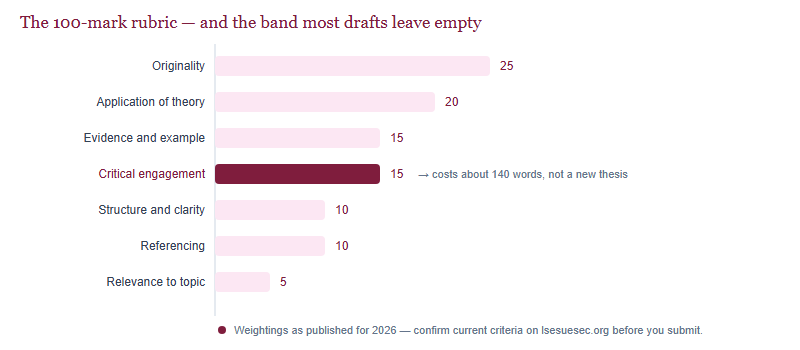
The rubric published with the 2026 competition splits 100 marks across seven criteria: Argument and Originality 25, Application of Economic Theories 20, Evidence and Examples 15, Critical Analysis 15, Structure and Clarity 10, Citations and Sources 10, and Topic Relevance 5. You can see the full breakdown, alongside the five 2026 questions, in our guide to the 2026 prompts and rubric.
Look at that list as a late-stage buyer, not as a writer. Originality (25) rewards a thesis nobody else brought — expensive to change in August, because rewriting your central claim means rewriting everything. Application of theory (20) rewards models you already know or don't. Evidence (15) requires finding, reading and citing new sources. Referencing (10) is mechanical and fast.
Critical engagement is the outlier. It is worth 15 marks, and it is almost entirely structural. You do not need a new argument to earn it. You need roughly 140 words that most drafts currently spend on a second example or a definition the marker did not need. In practice, referencing and critical engagement together put 25 marks within reach of a draft whose thesis is already fixed — which is exactly the position most entrants are in with three or four weeks to the 1 September deadline.
Four things markers see instead of critical engagement
Almost every draft believes it engages critically. Very few do. These are the four substitutes, in descending order of how often they appear in drafts we review:
- The hedge. “This may arguably suggest that policy could potentially be effective.” Piling up modal verbs is not engagement with an objection; it is the absence of a claim. It also costs you under structure and clarity, so you lose twice.
- The token limitation. A single closing sentence: “Of course, further research is needed.” This names no objection, so it answers none. It reads as a ritual, and markers see it in draft after draft.
- The strawman. You raise an opposing view so weak that nobody credible holds it, then defeat it. A marker who works in the field knows the real objection, notices you avoided it, and reads the whole essay as less confident, not more.
- The both-sides shrug. A paragraph of “on the one hand… on the other hand…” that ends without a verdict. This is the most damaging one, because it also drains marks from originality: an essay that refuses to decide has no thesis to be original about.
The distinction that matters: hedging weakens your claim; critical engagement strengthens it by narrowing it. After a good counterargument paragraph, your conclusion should be smaller than it was, and far harder to knock over.
Three legitimate ways to push back on a professor's premise
Each of the 2026 questions was set by an economist who has spent a career on that material. Students freeze here, assuming that disagreement requires beating a specialist at their own game. It does not. Serious critique almost always takes one of three shapes, and all three work at 1,500 words because each concedes something large in order to contest something specific.
| Move | What you concede | What you contest | Sentence stem | Fits well with | How it fails |
|---|---|---|---|---|---|
| Mechanism challenge | The result or correlation is real | The channel that produces it | “The relationship holds, but it is more plausibly driven by X than by Y, because…” | Remote work and monitoring; AI and jobs | You assert an alternative channel with no supporting mechanism or evidence |
| Scope condition | The argument is correct where it was developed | How far it travels — across countries, sectors, firm sizes or time | “This holds for A; it is unlikely to hold for B, where the binding constraint is different…” | Monetary policy after an energy shock; green technology and inequality | You claim “it’s different in China” without naming the specific structural difference |
| Measurement or identification | The framing and the question | What the number actually captures | “The measure records X; the concept the argument needs is Y, and the gap matters because…” | Taxing the top 1%; inequality questions generally | You confuse “the data are imperfect” (true of all data) with a specific mismatch |
Two disciplines make these work. First, the objection must be one a real economist holds — ideally one you met in your reading, and can attribute. Second, the concession must be genuine. If you concede nothing, you have written a strawman with better manners.

The concede–rebut–reassert paragraph, in about 140 words
Here is the architecture that fits the word limit. Treat the word counts as a budget, not a suggestion — at 1,500 words, this paragraph is roughly 9% of your essay, and it has to pay for itself.
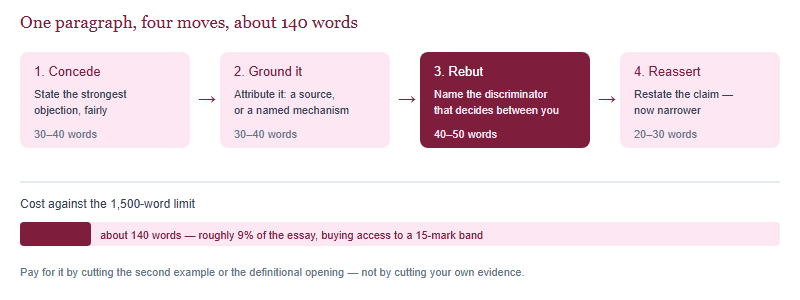
The move that carries the paragraph is number three: the discriminator. A discriminator is the one observable fact that would be true under your reading and false under theirs. “If the objection were right, we would expect to see A; what we observe instead is B.” Without it, you have two opinions side by side and the marker cannot tell why yours wins. With it, you have demonstrated the thing the band is actually testing: that you can evaluate competing explanations rather than list them.
Move four is where students lose their nerve. Reasserting does not mean repeating your original claim word for word — it means restating it with the boundary the objection forced on you. “The effect therefore holds for large listed firms with formal reporting systems, rather than across the economy as a whole” is a stronger sentence than the sweeping version you started with, and it reads as confidence, not retreat.
Where to put it, and what to cut to pay for it
Placement is a structure decision, and it is worth getting right because structure and clarity carry 10 further marks. Our guide to writing the 1,500-word essay sets out the full shape; the counterargument slots in at one specific point.
- Not in the introduction. Raising the objection before you have established your own case reads as though you are arguing against yourself, and the marker reaches paragraph three without knowing what you think.
- Not in the conclusion. Introducing a serious objection in your final 100 words leaves no room to answer it, and the essay ends on your opponent's best sentence rather than yours.
- Immediately after your main argument is established, before the conclusion. By then the marker knows your claim and has seen your evidence. The objection now reads as a stress test you chose to run.
To fund it, cut in this order: the literature-sweep sentences that name three papers without using any of them; the second worked example that makes the same point as the first; the definitional opening that explains what inflation or automation is to an audience of economists. Do not fund it by cutting your own evidence — that trades a 15-mark band for another 15-mark band and gains you nothing.
A 20-minute critical-engagement pass on your draft
Run this once, on a printed copy, before your final line edit:
- Minutes 1–4. Write, in one sentence, what a hostile specialist would say about your thesis. If nothing comes, your claim may be too safe to be attacked — which is itself a warning about the 25-mark originality band.
- Minutes 5–8. Check somebody credible actually holds that view. If you cannot attribute it to a source, a school of thought or a stated mechanism, it is a strawman; find the real objection instead.
- Minutes 9–11. Decide which of the three moves answers it — mechanism, scope or measurement. Pick one. Attempting all three at 1,500 words produces three shallow gestures.
- Minutes 12–17. Draft the 140 words to the four-part shape above, discriminator included.
- Minutes 18–20. Rewrite your conclusion so it matches the narrowed claim, then delete every “arguably”, “may potentially” and “it could be said” that survived elsewhere. You have earned the right to be direct.
One caution to end on. Critical engagement is not self-destruction. If, halfway through the paragraph, you find you agree with the objection more than with your own thesis, stop writing the paragraph and change the thesis — there is still time before 1 September, and an essay that argues the position you actually believe will always outscore one that hedges toward a position it has stopped defending. If you are new to the competition, start with our overview of what the LSESU Essay Competition is and how it is judged.
Frequently asked questions
Is critical engagement the same as writing a “limitations” section?
No. A limitations note lists weaknesses and stops. Critical engagement names an objection, answers it with a discriminator, and narrows your claim.
How many counterarguments should a 1,500-word essay contain?
One, done properly. Two shallow objections score worse than a single paragraph that concedes fairly and rebuts with evidence.
Can I disagree with the professor who set the question?
Yes, if you concede what is established and contest something specific — the mechanism, the scope or the measurement. Disagreement without a concession reads as a strawman.
Does the counterargument paragraph count towards the word limit?
Yes, it is body text. Budget roughly 140 words for it, and confirm current word-limit rules on lsesuesec.org before submitting.
Published by the editorial desk of this site, operated independently by Hanlin International Education (翰林国际教育) for China-based international-school students. This site is not the official competition website and is not affiliated with the LSESU Economics Society or the London School of Economics. Official rules are set by the competition and change yearly, so always confirm current details on the official site lsesuesec.org. Confirmed errors are corrected within 7 working days.