LSESU Essay Revision Order: Fix the Argument Before the Prose
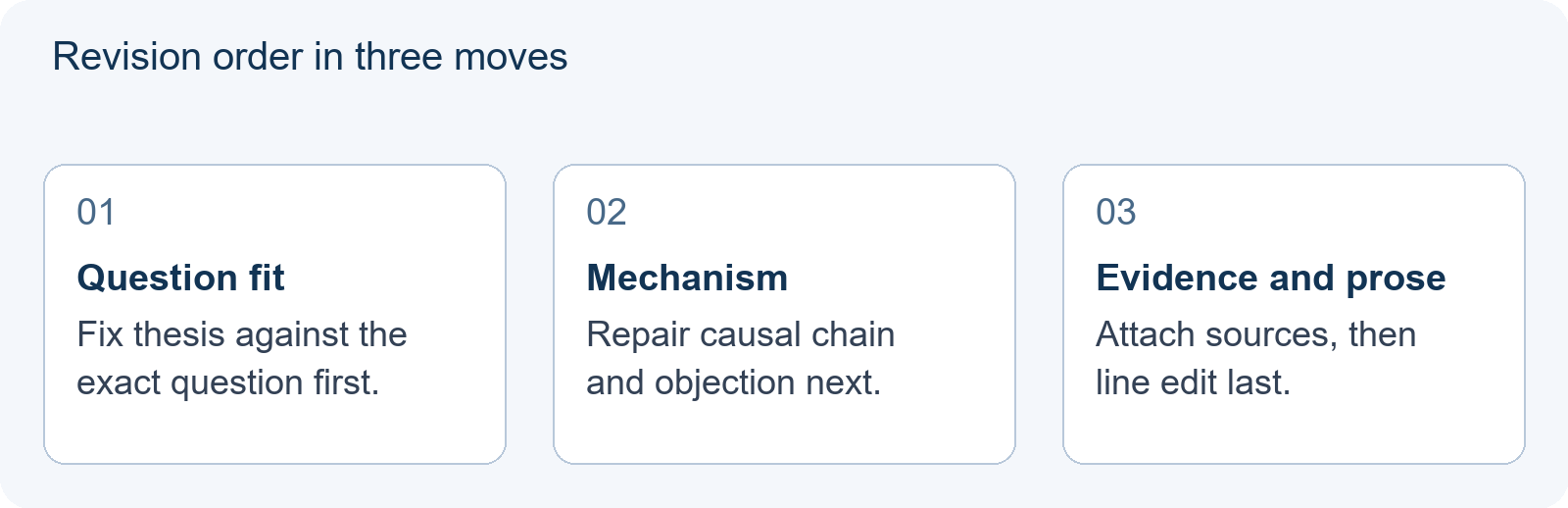
For a complete LSESU Economics Society Essay Competition draft, revise in this order: question fit and thesis, then economic mechanism and critical analysis, then evidence and citations, and only then sentence-level prose. The 2026 submission deadline was 1 September 2026, so this sequence now serves drafts aimed at a later cycle or any economics essay marked against the published seven-criterion rubric. Polishing first hides the defect whose repair would have changed the job of every paragraph.
Why Revision Order Is Not the Same as Scoring
The rubric published on the competition’s official page allocates 25 marks to argument and originality, 20 to application of economic theories, 15 to evidence and examples, 15 to critical analysis, 10 to structure and clarity, 10 to citations and sources, and 5 to topic relevance. Those figures sum to 100. They describe what assessors value; they do not tell a student which defect to repair first when several weaknesses compete for limited time.
Scoring asks, “How strong is this draft on each criterion?” Revision order asks, “Which repair protects the most value and prevents wasted work?” The answers can differ. A draft may score moderately on evidence but still need its thesis rewritten before the evidence means anything. If the essay answers a neighbouring question, adding two better citations may improve a paragraph that should not be in the essay at all. Likewise, polishing sentences can make a weak causal claim sound confident without making it correct.
The practical principle is dependency: fix the defect that changes the job of other paragraphs before fixing defects inside those paragraphs. Topic relevance and thesis come first because they define what every section must do. Mechanism and critical analysis come next because they determine which evidence is relevant. Evidence and citations follow because they attach support to claims that have survived the argument repair. Structure and clarity come last because the introduction, transitions and conclusion must match the revised argument, not the earlier one.
Source for the rubric and submission requirements: “LSESU Economics Society Essay Competition – LSESU Economics Society Economics Challenge”, LSESU Economics Society, accessed 16 November 2026, https://www.lsesuesec.org/essay-en/.
Build a One-Page Revision Triage Before Touching Sentences
Before line editing, make a single page with five columns: observed problem, rubric criterion affected, downstream effects, estimated fix cost, and a concrete test for completion. The page should be blunt. “The second paragraph answers a different question” is more useful than “improve flow.” “The mechanism jumps from tax to lower inequality without explaining incidence” is more useful than “add depth.” The aim is not to produce a second essay plan; it is to stop low-value polishing while high-value defects remain.
Estimate fix cost in time bands, not false precision. A thesis rewrite may take forty minutes because it forces section jobs to change. A citation cleanup may take twenty minutes once the claims are stable. If the thesis is wrong, the citation cleanup is premature. This ordering also guards against cutting words to meet the 1,500-word maximum before removing material that should never have been in the draft. The official page states a maximum of 1,500 words excluding references, so the word budget is real; it is simply not the first problem to solve.
The triage page should also record what not to touch. If a paragraph already states the key assumption and answers the strongest objection, leave it alone while repairing relevance elsewhere. Revision is not a punishment applied evenly to every sentence. It is a sequence of decisions about which defect currently controls the essay’s quality.
Teaching Illustration: A Draft That Answers a Neighbouring Question
Teaching illustration, not an actual contest prompt: suppose the set question asks whether a local government should fund free student bus travel by levying a tax on commercial parking. Draft A’s thesis says, “Free student bus travel is desirable because it improves attendance.” The draft then summarises attendance evidence for three paragraphs. The prose is clear, the citations are present, and the paragraph order is logical. Yet the essay answers a neighbouring question: whether free bus travel has a benefit. It does not evaluate the funding mechanism named in the question.
If the student line-edits first, the sentences become cleaner but the mismatch remains. Pass 1 changes the thesis to something like: “The policy is justified only if the parking levy raises sufficient revenue and its incidence does not fall mainly on low-income households.” That single change alters the job of every section. The attendance paragraph is no longer the centre of the essay; it becomes one benefit to weigh against the levy’s distributional cost. A new section must examine tax incidence: who pays when commercial parking is taxed, and how much of the tax is passed through to consumers.
Pass 2 then repairs the mechanism. The draft needs a causal chain: the levy raises the cost of commercial parking, reduces parking demand or raises revenue, and funds student fares. The chain rests on assumptions about tax pass-through and about how the local government uses revenue. A serious objection is that the levy may be shifted onto local businesses and their customers, including families the policy intends to help. Pass 3 attaches evidence to the surviving claims: attendance evidence can support the benefit of free travel, but it cannot support the revenue yield or incidence of a parking levy. Pass 4 cuts repetition, reorders sections and checks that the introduction promises the revised argument. The same draft, line-edited first, would have looked smoother while still failing the exact question.
Pass 1: Question Fit and Thesis
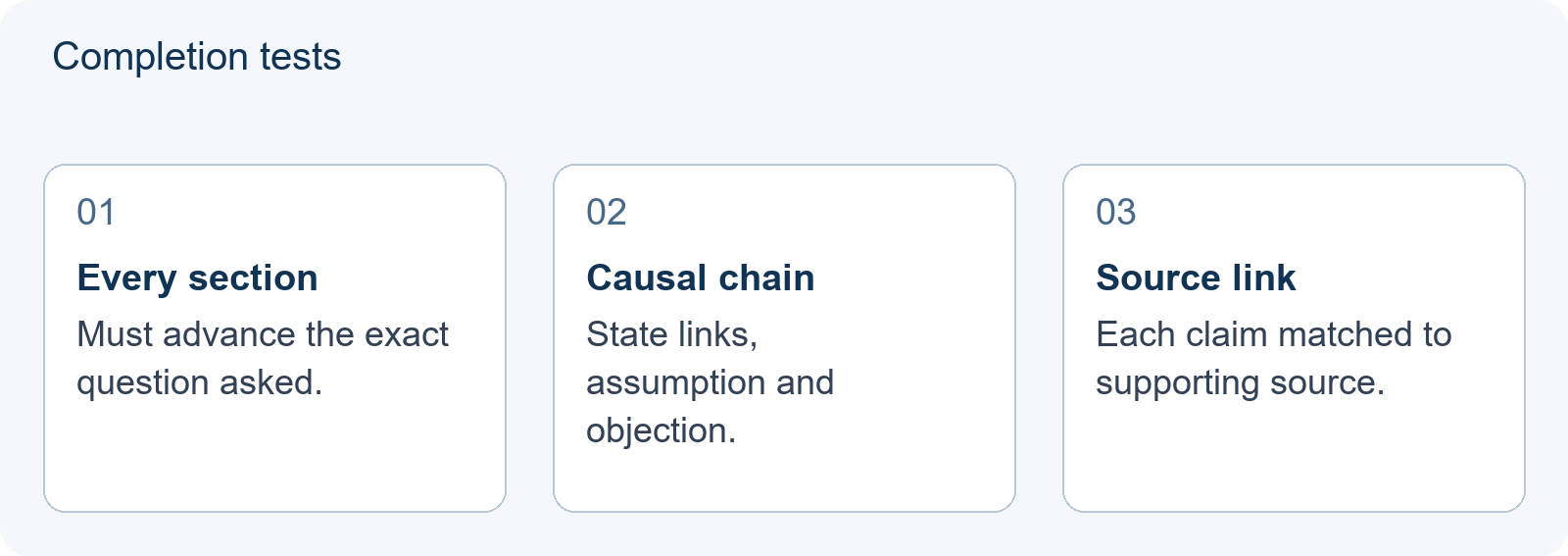
Pass 1 protects topic relevance and argument and originality. The test is simple but strict: every section must advance the exact question asked. That means the thesis should name the decision, the criterion and the main trade-off. “Policy X is good” is usually too thin. “Policy X is justified if condition A holds and cost B does not fall on group C” gives the essay a job.
Use a reverse outline. Write one sentence beside each paragraph stating what it proves. If a paragraph proves something interesting but irrelevant, either reframe it as a step in the exact argument or cut it. The The Question-Type Audit: Does Your LSESU Essay Actually Answer What Was Asked? (2026) is useful here because it forces the writer to classify what the question asks for: a judgement, a policy brief, a causal explanation or a comparison. Classification matters at this pass, because a draft written as an explanation will not survive a prompt that demands a recommendation.
Completion evidence for Pass 1 is not “the thesis sounds better.” It is that the thesis can be restated in one sentence, every section has a stated job, and no paragraph depends on a question the prompt did not ask. Because the 2026 prompts belong to a closed cycle, check the current official page before relying on any prompt-specific assumption for a later entry.

Pass 2: Mechanism, Theory and Critical Analysis
Pass 2 protects application of economic theories and critical analysis. A polished paragraph can still assert a mechanism without showing it. The writer should be able to state the causal chain in three links, name the key assumption, and answer at least one serious objection. For a tax-and-subsidy argument, the chain might run from tax to price, price to behaviour, and revenue to funding. The assumption might concern pass-through. The objection might concern incidence.
Theory should do work, not decorate. Naming a model is not enough; the essay must use the model to explain who responds, what changes and why the conclusion follows. A practical test is to write the chain as three labelled links, then name the assumption that would break the middle one. If the essay cannot say what would break its own chain, it is asserting rather than arguing. If two models give different predictions, the draft should say which assumption drives the difference.
Critical analysis is not a ritual paragraph beginning “However.” It is engagement with the strongest reason the thesis might fail. A useful completion test: can the writer state the best objection in one sentence and explain whether the thesis survives it, is qualified by it, or should be revised? If the objection only attacks a weak version of the argument, Pass 2 is not finished.
Pass 3: Evidence and Citations
Pass 3 protects evidence and examples, plus citations and sources. By this stage the claims should be stable. The writer is no longer asking, “What else could I add?” but “Which claim does this source actually support?” Each empirical claim should have a source that can bear its weight. A study about attendance cannot establish the revenue yield of a parking levy. A citation added to a sentence it does not support is decoration, not evidence.
The official page recommends Harvard referencing style, and the essay should use high-quality academic or institutional sources where possible. Citation cleanup comes after argument repair because moving or deleting paragraphs changes which references are needed. A statistic should test a claim rather than decorate it: state precisely what the source measures, then state what the essay infers from it, then check that the two match. Where they do not match, weaken the claim rather than stretch the source.
Completion evidence for Pass 3 is concrete: every factual claim has a matching source, the reference list is consistent, and no citation is doing rhetorical work that the source cannot support. The writer should also check the word limit: the official page states a maximum of 1,500 words excluding references. Do not count references as space for argument, and do not cut substantive analysis merely to make room for decorative citations.
Pass 4: Structure, Clarity and Word Budget
Pass 4 protects structure and clarity. Only now should the writer line edit. The introduction must match the revised thesis; section order must reflect the new argument; the conclusion must answer the question rather than repeat the introduction. Transitions should show why the next section follows, not simply announce it.
This is also the point to manage the word budget after content repair. If the draft is over the maximum, cut material that no longer serves the exact question. If it is far under, add mechanism or evidence where the argument is thin, not adjectives. The Cutting to 1,500 Words: A Sentence-Level Compression Clinic for the Final Week (2026) is useful once the argument is stable, because local cuts work best when the writer already knows which claims must survive.
Completion evidence for Pass 4 is that a reader can follow the argument from introduction to conclusion without asking why a section is there. The prose should be precise, but precision is not the same as ornament. Short sentences that expose a causal link are better than long sentences that hide one.
A Revision-Order Table
| Revision pass | Rubric marks directly at stake | Typical symptom | Completion evidence |
|---|---|---|---|
| Pass 1: question fit and thesis | Argument and originality 25; topic relevance 5 | Thesis answers a neighbouring question; sections drift | Every section advances the exact question; thesis names decision and criterion |
| Pass 2: mechanism and criticism | Application of theories 20; critical analysis 15 | Mechanism asserted; objection only attacks a weak view | Three-link causal chain; named assumption; strongest objection answered |
| Pass 3: evidence and citations | Evidence and examples 15; citations and sources 10 | Statistics decorate claims; citation does not support sentence | Every factual claim has a source that can bear it; references consistent |
| Pass 4: structure, clarity and word budget | Structure and clarity 10 (word-limit compliance is an eligibility check, not a separate rubric mark) | Introduction promises old thesis; word count is over or thin | Introduction, sections and conclusion match revised argument; within 1,500 words excluding references |
The table is a triage aid, not a scoring formula. It keeps attention on the dependency between criteria. A high argument mark does not guarantee a high overall mark, and a citation cleanup cannot rescue a draft that never answers the question. If a draft already scores well on a criterion, leave it alone while repairing the controlling defect.
What Not to Do, and When to Stop
Do not line-edit first. Do not add citations to disguise a weak claim. Do not cut words before fixing relevance. Do not rewrite the introduction before the thesis is stable. These moves feel productive because they produce visible changes, but they can make the draft harder to repair. A cleaner sentence on a misplaced paragraph is still a misplaced paragraph.
A draft is ready for final proofreading when the following practical checklist passes: the thesis answers the exact question in one sentence; each section has a job that advances that thesis; the mechanism chain names an assumption and answers a serious objection; each factual claim has a source attached to it; the reference list is consistent; the essay is within the maximum of 1,500 words excluding references; and the introduction and conclusion match the revised argument.
If a teacher or reviewer is helping, send the triage page rather than a general request for feedback. Ask for comments on revision order first: which defect currently controls the draft, and what evidence would show that it has been repaired? That produces usable comments without pretending that a checklist is a full rewrite. For students who want a structured self-check, the Mark Your Own LSESU Essay: A Seven-Criterion Self-Scoring Clinic (2026) is the adjacent resource; this article is about what to fix first once a weakness is already visible.
Source note: rubric weights, word limit, referencing recommendation, topic-selection rule and the 1 September 2026 deadline are from “LSESU Economics Society Essay Competition – LSESU Economics Society Economics Challenge”, LSESU Economics Society, accessed 16 November 2026, https://www.lsesuesec.org/essay-en/. Preparation judgments and the teaching illustration are editorial.
General event background is available at Event background.
Frequently Asked Questions
Should I fix citations before rewriting my thesis?
No, not as the first move. A thesis change can delete, move or reframe paragraphs, so citation cleanup done first may be wasted. Repair question fit and the argument first, then attach sources to the claims that survive.
How do I know a relevance repair is complete?
Use a reverse outline. Write one sentence beside each paragraph stating what it proves about the exact question. If a paragraph proves an interesting but neighbouring point, reframe it as part of the answer or cut it.
Does this revision order replace the official rubric?
No. It is a preparation method built from the published criteria and the practical dependency between them. Use the current official competition page for the governing rules and requirements.