The 2026 LSESU Essay Competition Timeline: From Prompts to October Results
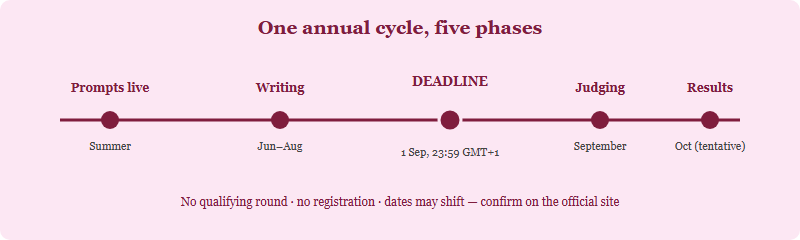
The 2026 LSESU Essay Competition runs on a single annual cycle that ends with a hard deadline of 1 September 2026, 23:59 (GMT+1) and tentative results in October 2026. Because there is no registration step, the clock that matters is your own writing schedule from the moment the public prompts go live to the day you submit. This timeline maps the whole season so China-based students can plan backwards from the deadline with no surprises.
The shape of the cycle at a glance
Unlike competitions with multiple rounds, the LSESU Essay Competition is essentially one long writing window followed by a judging period. The prompts are released openly during the summer cycle, you submit one essay by the September cut-off, and the organisers announce results roughly six weeks later. There is no qualifying round to clear and no candidate registration to complete first — you “may directly select a topic” and begin.
| Phase | Roughly when | What it means for you |
|---|---|---|
| Prompts published | Summer cycle (confirm on official site) | Start reading and choosing immediately — no wait for access |
| Writing window | From prompt release to 1 Sep | Research, draft, redraft, reference, proofread |
| Submission deadline | 1 September 2026, 23:59 GMT+1 | One PDF, one entry, via the official portal |
| Judging period | September | AI/plagiarism checks, then marking against the rubric |
| Results announcement | October 2026 (tentative) | Winners and certificates confirmed |
If you are new to the competition, read our complete guide to what the LSESU Essay Competition is first, then come back to slot the dates into your own calendar.
Planning backwards from 1 September
The smartest way to use this cycle is to fix the deadline and work backwards. A 1,500-word essay is short, but a good 1,500-word economics essay needs several genuine drafts. Here is a realistic eight-week shape you can compress or expand depending on when the prompts land and how busy your summer is.
| Weeks before deadline | Focus | Output by the end |
|---|---|---|
| 8–7 | Read all prompts; choose one; map possible arguments | A chosen question and a one-line thesis |
| 6–5 | Research and gather evidence; find your data and sources | An evidence bank with Harvard-style references |
| 4–3 | Write the first full draft to length | A complete ~1,500-word draft |
| 2 | Redraft for originality, structure and clarity | A sharper second draft |
| 1 | Proofread, check formatting and file name, finalise | A submission-ready PDF |
| Final days | Submit early; convert the timezone | Confirmed submission, well before cut-off |
This is a calendar, not a study method. If you want a deeper preparation plan — including how to decide whether to self-study or get coaching, and a longer 16-week roadmap — that is covered separately in our 2026 prompts, rubric and how-to-enter guide. The point here is timing discipline: students who back-plan from 1 September almost always submit a calmer, better-proofed essay than those who start in late August.
A note on the summer for China-based students specifically: the writing window falls squarely across the long summer holiday, which is both an advantage and a trap. The advantage is uninterrupted time — no school timetable competing for your attention. The trap is that summer also fills up with travel, summer schools, test prep and family commitments, and an essay with a distant-looking deadline is the first thing to slip. The students who finish well tend to treat the essay as a fixed weekly appointment from the moment prompts appear, rather than as something they will “do in August.” If your July is already crowded, that simply means starting the reading and question-choice phase earlier, not compressing the drafting into the final fortnight.
The one decision that shapes the whole timeline: which question
Because only one entry is allowed per student, the choice of question is not a small early step — it sets the direction of everything that follows. Switching questions in week three means throwing away two weeks of research, so the cycle works best when you invest real thought in the first phase and then commit. Treat the opening week as a genuine decision phase rather than a formality.
When weighing the prompts, three practical filters help international-school students choose well. First, evidence access: pick a question where you can actually find data and credible sources to cite in Harvard style, because an argument you cannot evidence will stall. Second, genuine interest: you will live with this topic for weeks, and authentic curiosity shows up in the writing as originality — the most heavily weighted rubric criterion. Third, argument room: favour a prompt that lets you take a clear, defensible position rather than one that pulls you toward summarising both sides without committing.
| Question-choice filter | Ask yourself | Why it matters on this timeline |
|---|---|---|
| Evidence access | Can I find data and sources I can cite? | Prevents a stalled draft in weeks 6–5 |
| Genuine interest | Do I actually want to argue this? | Sustains motivation across the long summer window |
| Argument room | Can I take a clear position? | Drives originality, the top-weighted criterion |
| Commitment | Am I ready to stop comparing options? | Switching late wastes irreplaceable weeks |
Spend the first week reading every prompt and sketching a one-line thesis for the two or three that appeal most. Then choose and do not look back. The students who agonise over the choice into August are usually the ones who run out of drafting time.

The timezone trap for China-based students
The single most common avoidable mistake is misreading the deadline. The cut-off is 23:59 GMT+1, which is London summer time. China Standard Time is GMT+8 — seven hours ahead — so 23:59 on 1 September in London is approximately 06:59 on 2 September in Beijing, Shanghai and across China.
That seven-hour gap sounds helpful — it technically gives you into the morning of 2 September — but treating it as breathing room is risky. Upload errors, file-conversion problems, and last-minute internet issues all cluster at the deadline. The official guidance is blunt: late submissions will not be accepted. Plan to submit a full day early and treat the timezone arithmetic as a safety margin you never actually spend.
After you submit: judging and results
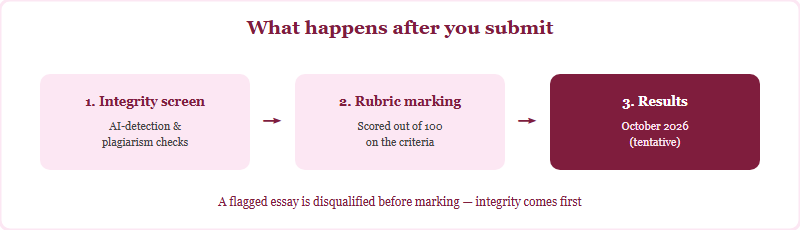
Once your essay is in, two things happen before any prize is decided. First, every entry passes through AI-detection and plagiarism screening; an essay flagged here is disqualified immediately, regardless of quality. Second, the surviving essays are marked against the competition’s rubric out of 100 points — the same rubric that weights originality far more heavily than relevance. We break that weighting down in our piece on the 100-point rubric.
Results are announced in October 2026 on a tentative basis. The award structure runs from High Distinction certificates for the top band, through per-question podiums and winners, up to a single Overall Winner — so even strong essays that do not take the top prize can earn meaningful recognition. The “tentative” label on the October date is a reminder to confirm the exact announcement timing on the official site rather than assume a fixed day.
For Year 13 students applying to UK universities, the October results window has a useful overlap with the application season: the UCAS deadline for Oxford, Cambridge and most medical, dentistry and veterinary courses falls in mid-October, with the main UCAS deadline later in the cycle. A result that lands in time can, in principle, be referenced in a personal statement — but because the date is tentative, never build your application narrative on the assumption that a prize will be confirmed before a given deadline. The safer approach is to write your statement around the essay you produced and the thinking behind it, treating any award as a bonus rather than a dependency. If results do arrive in time, you can add the line; if they slip, your statement still stands on the work itself.
A season-planning checklist
- Anchor the deadline first. Put 1 September 2026, 23:59 GMT+1 in your calendar, converted to China time.
- Start the day prompts go live. No registration means no excuse to delay reading them.
- Budget for at least two real drafts. 1,500 words is short enough to over-polish and long enough to need rewriting.
- Reserve the final week for formatting and proofreading. Font, spacing, page numbers, file name.
- Mark October for results. Tentative — verify the exact date officially.
Treat the timeline as the backbone of your entry. The students who win are rarely the ones who wrote fastest; they are the ones who gave a short essay the long runway it deserves.
Frequently asked questions
When are the 2026 results announced?
Results are announced in October 2026 on a tentative basis. Confirm the exact date on the official site, as timing can shift between cycles.
Is there a qualifying round before the main essay?
No. The competition is a single writing window ending on 1 September 2026, with no preliminary round and no registration to complete first.
What is the deadline in China time?
The deadline is 1 September 2026, 23:59 GMT+1 — roughly 06:59 on 2 September China Standard Time (GMT+8). Submit a day early to be safe.
What happens to my essay right after I submit?
It is screened for AI-generated content and plagiarism, then marked against the 100-point rubric. Flagged essays are disqualified before marking.
Published by the editorial desk of this site, operated independently by Hanlin International Education (翰林国际教育) for China-based international-school students. This site is not the official competition website and is not affiliated with the LSESU Economics Society or the London School of Economics. Official rules are set by the competition and change yearly, so always confirm current details on the official site lsesuesec.org. Confirmed errors are corrected within 7 working days.