Am I Eligible? LSESU Essay Competition Entry Rules and How to Submit (2026)
Almost any secondary-school student can enter the 2026 LSESU Essay Competition. There is no registration and no fee: you pick one of the public questions, write up to 1,500 words, and submit a single PDF directly through the official portal at lsesueconsoc.org/competitions/ before 1 September 2026, 23:59 (GMT+1). This guide walks Chinese international-school students through eligibility, file requirements, and the submission steps so nothing trips you up.
Who is eligible to enter
The competition is run by the LSE Students’ Union Economics Society and is deliberately open. Per the official guidance, it is “open to all secondary students,” with 2026 and 2027 graduates specifically recommended. In practice that means the sweet spot is students currently in Year 12 / Grade 11 or Year 13 / Grade 12 (and their IB / A-Level / AP equivalents), but younger secondary students are not excluded.
International eligibility is the most common question we get from China-based families, and the answer is encouraging: the field draws from over 60 countries, and there is no nationality or residency restriction. A student at an international school in Shanghai, Shenzhen or Beijing enters on exactly the same terms as a student in London. If you are unsure whether your specific year group or graduation year qualifies — for example if you are on a gap year — treat it as a detail to confirm on the official site, because eligibility wording can change each cycle.
| Question | Short answer | What to check |
|---|---|---|
| Which year group? | All secondary students; 2026/2027 graduates recommended | Your graduation year vs the recommended window |
| International students? | Yes — 60+ countries, no nationality limit | Nothing; you enter on equal terms |
| Do I register first? | No registration required | Prompts are public — just write and submit |
| Is there a fee? | Completely free — no entry or submission fee | Anyone asking you to pay is not the official route |
| How many essays? | One entry per student | Choose your strongest question before submitting |
| Gap year / unusual case? | Not explicitly stated | Confirm on the official site |
The no-registration rule (this surprises people)
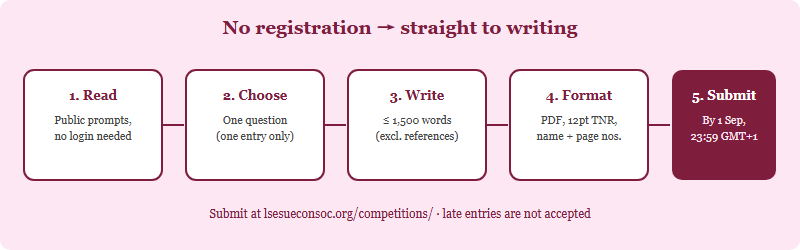
Many essay competitions make you create an account, register, and receive a candidate ID before they release the prompts. The LSESU Essay Competition does not work that way. The questions are published openly, and the official instruction is plain: you “may directly select a topic, complete your essay writing in line with the requirements, and submit your work.” There is no candidate number to wait for, no unlock step, and no portal login required to see the topics.
Why this matters for planning: because there is no registration bottleneck, you can begin reading the prompts and drafting the day they are published, rather than losing days waiting for a confirmation email. If you have read elsewhere that you must “register to get the questions,” that information is wrong for this competition — see our complete guide to what the LSESU Essay Competition is for the full picture, and the 2026 prompts and rubric breakdown for the questions themselves.
File requirements that get entries disqualified
The competition is strict about presentation, and getting the basics wrong is an avoidable way to lose marks or, worse, fall foul of the rules. The official formatting requirements are: 12pt Times New Roman, 1.5 line spacing, and page numbers added throughout. The word limit is a maximum of 1,500 words excluding references, so your reference list does not eat into your argument budget.
The file-naming convention is easy to overlook and easy to get right. Name your file with your FORENAME SURNAME in capitals, followed by the question number — for example, PETER SMITH + Question 1. A Chinese student named Li Wei submitting on the first question would save as LI WEI + Question 1. Using the wrong name format or the wrong question number creates needless admin friction at the judging stage.
| Requirement | Official spec | Common slip-up |
|---|---|---|
| Word count | Max 1,500 words (excl. references) | Counting references into the limit and cutting argument |
| Font | 12pt Times New Roman | Submitting in a default sans-serif |
| Spacing | 1.5 line spacing | Single-spacing to “fit more in” |
| Page numbers | Added throughout | Forgetting them entirely |
| File name | FORENAME SURNAME (CAPS) + Question X | Lowercase names, no question number |
| Referencing | Harvard recommended | Mixing citation styles inconsistently |
One more non-negotiable: plagiarism and AI-generated content are strictly forbidden, and every essay is run through AI-detection and plagiarism checks. A flagged essay is disqualified immediately. The fix is not to avoid AI tools out of fear of detection — it is to make sure the analysis, structure, and wording are genuinely yours. For the rubric weighting behind all of this, see our walk-through of the 100-point rubric.

Spotting the official route (and avoiding fake ones)
The no-registration, no-fee design has a useful side effect: it makes impostors easy to spot. Because the genuine competition never charges an entry or submission fee and never requires you to register through a third party to receive the prompts, anything that contradicts those two facts is a red flag. If a page asks you to pay to enter, pay to “unlock” the questions, or hand over personal details to a site that is not the official portal, it is not the real competition.
Three quick tests keep you safe. Does it ask for money? The real competition is completely free. Does it claim you must register to see the prompts? The real prompts are public. Is the submission destination lsesueconsoc.org/competitions/? That is the single official portal. When in doubt, cross-check against the official society site rather than trusting a forwarded link or a screenshot in a group chat — verify on lsesuesec.org.
| If you see… | Real competition? | Why |
|---|---|---|
| A request for an entry or submission fee | No | The competition is completely free |
| “Register here to unlock the questions” | No | Prompts are public; no registration exists |
| “You will be issued a candidate ID” | No | There is no candidate ID step |
| Submission via lsesueconsoc.org/competitions/ | Yes | This is the official portal |
How to submit, step by step
When your PDF is ready, the submission itself is short. Work through it calmly rather than at 23:58 on deadline day:
- Finalise the PDF. Confirm the word count, font, spacing, page numbers, and file name match the specs above before you do anything else.
- Go to the official portal. Submit through lsesueconsoc.org/competitions/ — this is the single official submission destination. Do not submit via any third-party form claiming to “register” you.
- Submit one entry. Each student may submit only one essay, so upload the question and draft you are most confident in. There is no second attempt.
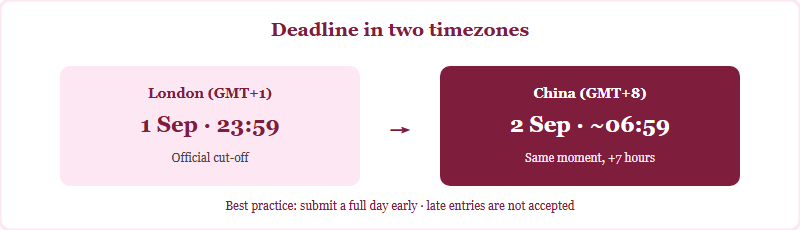
- Mind the timezone. The deadline is 23:59 GMT+1 on 1 September 2026. China Standard Time is GMT+8 — seven hours ahead of GMT+1 — so the deadline falls at roughly 06:59 on 2 September Beijing time. Aim to submit a full day early to absorb any upload hiccups.
A China-cohort checklist before you hit submit
From advising international-school students each cycle, these are the avoidable mistakes that cost the most:
- Do not wait for a “candidate ID.” There isn’t one. Waiting is wasted writing time.
- Convert the timezone early. The most painful misses are students who treat 23:59 as Beijing time and lose a day.
- Pick one question deliberately. With only one entry allowed, the choice of prompt is itself a strategic decision — read all of them, then commit.
- Match the file name exactly. CAPS forename and surname, plus the correct question number.
- Keep your references out of the word count, but keep them clean. Harvard is recommended, applied consistently.
Get these logistics right and you free yourself to focus on what actually wins marks: an original, well-evidenced economic argument. The rules reward students who treat the submission process as seriously as the essay itself.
Frequently asked questions
Do I need to register before I can see the questions?
No. The LSESU Essay Competition prompts are public. You select a topic, write, and submit directly — there is no registration and no candidate ID.
Can students at international schools in China enter?
Yes. The competition is open to secondary students worldwide, with entries from over 60 countries and no nationality or residency restriction.
How should I name my file?
Use your forename and surname in capitals followed by the question number, for example LI WEI + Question 1, saved as a PDF that meets the formatting specs.
What is the deadline in China time?
The deadline is 1 September 2026, 23:59 GMT+1, which is roughly 06:59 on 2 September China Standard Time (GMT+8). Submit early.
Published by the editorial desk of this site, operated independently by Hanlin International Education (翰林国际教育) for China-based international-school students. This site is not the official competition website and is not affiliated with the LSESU Economics Society or the London School of Economics. Official rules are set by the competition and change yearly, so always confirm current details on the official site lsesuesec.org. Confirmed errors are corrected within 7 working days.