Question 2 Deep-Dive: Ricardo Reis on Monetary Policy After an Energy Shock (2026 LSESU Essay)
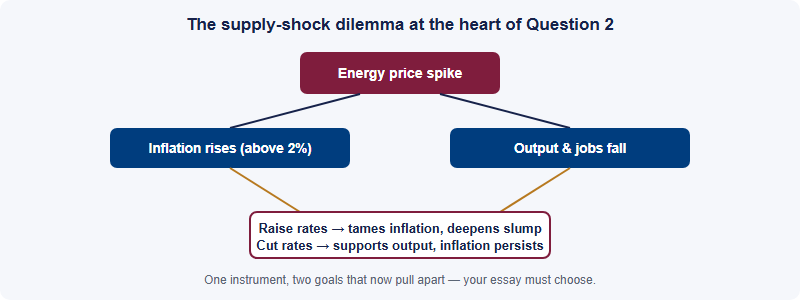
Question 2 of the 2026 LSESU Economics Society Essay Competition asks you to brief a central bank on how monetary policy should respond to a sharp rise in UK energy prices. The winning move is to recognise this as a supply shock — it pushes inflation up and output down at the same time, so no single interest-rate decision can stabilise both. A strong essay picks a defensible stance on that trade-off and defends it.
The question, in plain terms
Here is Question 2 as set by the LSESU Economics Society, written by Prof. Ricardo Reis (LSE) under the Policy theme:
“Following a sharp rise in UK energy prices, prepare a brief for a central bank on how monetary policy should respond. Take into account that the UK is a net importer of energy, and that the Bank of England has a mandate of keeping inflation steady at 2%.”
Two instructions are hidden in the wording, and most weak essays miss them. First, the format is a brief — a decision document for a policymaker, not an academic essay that surveys the literature. Second, you are told two constraints that must anchor your whole answer: the UK is a net importer of energy, and the Bank of England has a 2% inflation mandate. If your essay would read identically without those two facts, you have not answered the question that was asked.
The economics you must show you understand
An energy price spike is a textbook adverse supply shock (more precisely, a cost-push shock with a terms-of-trade component because the UK imports energy). This is the single idea the whole essay turns on, so make sure the examiner sees you grasp it:
- It moves inflation and output in opposite directions. Higher energy costs raise the price level and squeeze real incomes and firms’ margins, so output and employment fall. Economists call the uncomfortable combination stagflation.
- That breaks the usual central-bank comfort. After a demand shock, one move fixes both problems (cut rates to lift a weak, low-inflation economy). After a supply shock, the two goals pull apart: raising rates to fight inflation deepens the downturn; cutting rates to support output lets inflation run.
- Net-importer status matters. Because the UK buys energy from abroad, the price rise is partly a terms-of-trade loss — real national income genuinely falls, and monetary policy cannot undo that. Policy can only decide how the adjustment is shared between inflation and unemployment, not prevent it.
- The 2% mandate is your yardstick. The Bank is legally tasked with keeping CPI inflation at 2%. A first-rate answer engages with what that mandate implies when it collides with a recession — including that the mandate is symmetric and medium-term, not a demand to hit 2% every single month.
The examiners weight argument and originality at 25 of 100 marks — the largest single criterion — so demonstrating this reasoning is worth more than any factual list you could assemble.

How to structure it as a central-bank brief
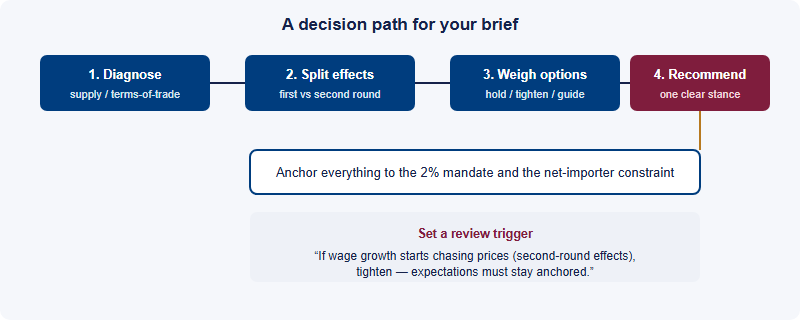
Because the prompt asks for a brief, reward yourself by using the discipline of one. A brief is short, ranked by importance, and ends with a recommendation. A workable skeleton for roughly 1,500 words:
| Section | Job it does | Rough words |
|---|---|---|
| Situation | Name the shock as a supply/terms-of-trade shock; state why it threatens the 2% mandate and output together | 250 |
| The trade-off | Explain why the mandate and the recession now conflict; introduce first-round vs second-round effects | 350 |
| Options | Weigh 2–3 responses (hold and “look through” the first-round rise; tighten to protect credibility; guidance to anchor expectations) | 450 |
| Recommendation | Commit to one stance and justify it against the mandate | 300 |
| Risks & review | Say what would make you change course (e.g. wages chasing prices) | 150 |
The concept that lets you sound like a real central banker is the split between first-round and second-round effects. The first-round effect is the mechanical jump in prices from dearer energy; central banks often argue they should “look through” it, because raising rates cannot lower the world energy price. The second-round effect is the danger: if households and firms expect high inflation to continue, wages and other prices start chasing energy, and inflation becomes self-sustaining. A sophisticated brief says the Bank should tolerate the first-round effect but act decisively to stop the second-round effect and keep inflation expectations anchored at 2%.
What a 25/25 argument does that a weak one doesn’t
Most essays on Question 2 fail in one of a few predictable ways. Knowing them is the fastest way to lift your mark:
- The one-liner. “Raise interest rates to fight inflation.” It ignores the output cost, the net-importer point, and the mandate’s medium-term nature. It answers a demand shock, not this one.
- The textbook dump. Reciting every monetary tool with no decision. A brief that never recommends anything is not a brief.
- Ignoring the two given constraints. If you never use “net importer” or “2% mandate,” you have thrown away the examiner’s own hints.
- No trade-off. The single strongest signal of economic maturity here is admitting policy cannot save both inflation and output, then choosing anyway. Students who state the dilemma explicitly consistently read as more advanced.
Originality does not mean inventing a new macroeconomics. It means a crisp, defensible thesis — for example, “the Bank should hold, publicly commit to the 2% target over the medium term, and use communication rather than aggressive tightening, because the shock is a terms-of-trade loss that rate rises cannot reverse” — argued consistently from first principles.
An illustrative outline (build your own — don’t copy)
To show what “committing to a stance” looks like, here is one illustrative thesis and spine. It is deliberately skeletal so you write your own argument; examiners screen for originality, and a copied structure helps no one:
- Thesis: The Bank should look through the first-round price rise, hold rates, and lean on credible communication — because the shock is a real income loss that tightening cannot reverse, and over-tightening would turn an unavoidable squeeze into an avoidable recession.
- Support 1: Why energy is a supply/terms-of-trade shock, not demand — and why that changes the prescription.
- Support 2: The mandate is medium-term and symmetric; hitting 2% next quarter at the cost of a deep slump is not what it requires.
- Counter-argument you must answer: If expectations de-anchor, “looking through” becomes dangerous — so pair the hold with a hard commitment to act on second-round effects.
Once you have your spine, our companion guides on writing the 1,500-word essay and the 100-point rubric will help you turn it into a scoring entry. For a worked example on a different prompt, see the Question 1 deep-dive, and to understand who set your question, read on the LSE faculty behind the 2026 questions.
Frequently asked questions
Do I need A-level economics to answer Question 2?
No. You need to grasp one core idea — a supply shock raises inflation and lowers output at once — and reason carefully from it. Clear logic beats jargon.
Should I recommend raising or holding rates?
Either can score full marks. What matters is that you acknowledge the trade-off, use the net-importer and 2%-mandate constraints, and defend your stance consistently.
How technical should the brief be?
Aim for a smart policymaker, not a maths exam. Name mechanisms (first- and second-round effects, anchored expectations); you do not need equations.
How long should it be?
Up to 1,500 words in total, answering exactly one of the five set questions. Confirm current word limits and the deadline in the official guide before you submit.
Published by the editorial desk of this site, operated independently by Hanlin International Education (翰林国际教育) for China-based international-school students. This site is not the official competition website and is not affiliated with the LSESU Economics Society or the London School of Economics. The essay questions, marking rubric, prizes, and deadlines are set by the competition and change yearly, so always confirm current details on the official site at lsesuesec.org before you submit. The economic analysis above is educational and reflects standard open-economy macroeconomics, not official model answers. Confirmed errors are corrected within 7 working days.
Filed under2026 Season · How To Write · Macroeconomics · Monetary Policy · Question 2