Question 5 Deep-Dive: Gmeiner on Green Technology and Inequality (2026 LSESU Essay)
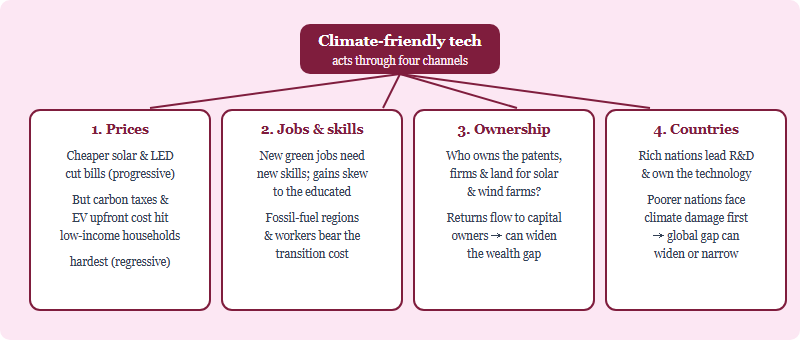
Question 5 of the 2026 LSESU Economics Society Essay Competition, set under Prof. Michael Gmeiner's green-technology theme, asks how climate-friendly technologies affect inequality and the distribution of wealth. The winning move is to reject the yes/no trap: green technology does not simply raise or lower inequality — it does both at once, through several distinct channels, and a strong essay maps those channels before judging the net effect.
The question, in plain terms
As published by the LSESU Economics Society, Question 5 asks, in essence: “How do climate-friendly technologies affect inequality and the distribution of wealth?” (confirm the exact current wording on the official site before you write). It was set by Prof. Michael Gmeiner, Assistant Professor of Economics (Education) and Deputy Undergraduate Programme Director at LSE, an industrial-organization economist who teaches the department's quantitative and econometrics courses.
The trap in this prompt is its openness. A weak essay treats it as “is green tech good or bad for the poor?” and picks a side. But the phrase “distribution of wealth” is a signal: the examiner wants you to think about who gains and who loses across at least three cuts — between rich and poor within a country, between rich and poor countries, and between workers in old versus new industries. If your essay only discusses one of those, you have answered a third of the question.
The examiners weight Argument & Originality at 25 of 100 marks — the largest single criterion — so the analytical move of separating the channels is worth more than any list of green technologies you could name.
The economics you must show you understand
Four ideas will carry this essay. Each maps to one channel above:
- Progressive vs regressive effects on households. Some green technology is progressive: once solar panels, LED lighting, or heat pumps become cheap, they cut energy bills, and energy is a bigger share of a poor household's budget. But the transition is often regressive: carbon taxes raise the price of petrol and heating that lower-income families cannot easily avoid, and the upfront cost of an electric car or a home retrofit is out of reach for many. The same policy can help the poor in the long run and hurt them in the short run.
- Skill-biased technical change. New industries reward new skills. Green-tech jobs — engineers, software, project finance — tend to favour the more educated, so the gains concentrate among skilled workers while coal miners, oil workers, and their regions bear the losses. This is the same mechanism economists use to explain why computerisation widened wage gaps, now applied to the energy transition.
- Capital ownership and returns. “Distribution of wealth” is a hint to think about assets, not just wages. Whoever owns the patents, the firms, and the land for wind and solar farms captures the returns. If green capital is owned mainly by the already-wealthy, the technology can widen the wealth gap even as it lowers emissions — unless ownership is broadened (community energy schemes, public stakes).
- The global dimension — and a key fairness paradox. Rich countries lead the research and own most of the technology, while poorer countries, which emitted least, face the earliest and worst climate damage. Whether green tech narrows or widens the international gap depends on technology transfer, financing, and price — making this the strongest terrain for an original argument.
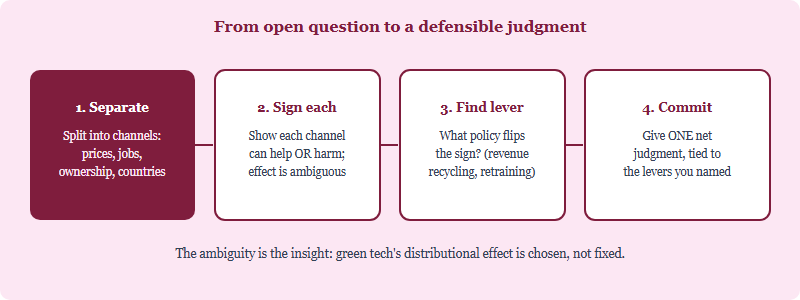
Notice the pattern: on every channel, the sign of the effect is ambiguous and depends on policy design. That is not a weakness in your answer — it is the answer. The examiners reward the candidate who shows that green technology is neither automatically equalising nor automatically regressive, and that the outcome is a policy choice.
How to structure the answer
The cleanest structure walks the channels, then resolves them into a judgment. A workable skeleton for roughly 1,500 words:
| Section | Job it does | Rough words |
|---|---|---|
| Frame | State the thesis; flag that the effect runs through several channels and is ambiguous by design | 200 |
| Within-country | Prices (progressive long run vs regressive transition) and jobs/skills | 400 |
| Wealth & ownership | Who owns green capital; why returns can concentrate | 300 |
| Between countries | Technology transfer, financing, and the climate-damage paradox | 300 |
| Resolve & recommend | Give a net judgment and name the policy levers that decide the sign | 300 |
The concept that lets you sound like a real economist is the phrase “just transition.” It captures the whole tension: decarbonisation is necessary, but its costs and benefits fall unevenly, so the distributional outcome depends on how the transition is managed — carbon-revenue recycling to poorer households, retraining for displaced workers, and broadened ownership of green assets. An essay that ends by identifying the levers that convert green tech from regressive to progressive reads as far more advanced than one that simply declares it good or bad.

What a 25/25 argument does that a weak one doesn't
Essays on Question 5 fail in a few predictable ways. Avoiding them is the fastest way to lift your mark:
- The cheerleader. “Green technology helps everyone by saving the planet.” It ignores the transition costs, the ownership question, and who pays.
- The single channel. Writing only about consumer prices, or only about jobs, and never touching wealth or the global gap. The word “distribution” demands more than one cut.
- Listing technologies. Cataloguing solar, wind, EVs, and hydrogen with no distributional analysis. The prompt is about who gains and loses, not what the technologies are.
- No policy resolution. Concluding “it depends” and stopping. “It depends” is a strong start; the marks come from saying on what, and which lever tips the balance.
Originality here does not mean discovering a new climate economics. It means a crisp, defensible thesis — for instance, “green technology is regressive during the transition but progressive at maturity, and the deciding factor is whether carbon revenue is recycled to poorer households and whether ownership of green capital is broadened” — argued consistently across the channels.
Where the evidence marks come from
Evidence & Examples is worth 15 marks and Critical Analysis another 15, so a channel map with no grounding will stall. For this prompt, credible evidence clusters in four areas — you need to know where to look and to cite responsibly, not to memorise statistics:
- Falling technology costs. The cost of solar panels and batteries has dropped dramatically over the past decade. This is the backbone of the optimistic case: as green technology gets cheaper, it becomes accessible beyond the wealthy. Present the trend as directional and well documented, and let readers verify current figures.
- The design of carbon pricing. Real schemes differ in whether they return revenue to households. A carbon tax with per-capita rebates can be progressive; one without is often regressive. Contrasting how different jurisdictions recycle carbon revenue is exactly the kind of policy-design evidence the markers reward.
- Regional job transitions. The decline of coal regions is a concrete, well-studied example of a green transition's local costs. Using it shows you understand that “jobs” is not an abstraction but specific workers in specific places.
- Global technology transfer and finance. Whether poorer countries can access green technology depends on patents, aid, and climate finance commitments. Framing this as an unresolved policy question — rather than asserting an outcome — is the safest and most sophisticated move.
Because Citations & Sources carries 10 marks and Harvard referencing is expected, attribute these debates and flag their uncertainty. On a topic this politically charged, a hedged, well-sourced claim scores better than a sweeping one — and it guards against the accusation that you have picked only the evidence that suits your thesis.
An illustrative outline (build your own — don't copy)
To show what “committing to a judgment” looks like, here is one illustrative thesis and spine. It is deliberately skeletal so you write your own argument; examiners run AI and plagiarism checks and screen for originality, so a copied structure helps no one:
- Thesis: Climate-friendly technology tends to widen inequality in the short run and across the poorest countries, but can narrow it at scale — so the net effect is set by policy, not by the technology itself.
- Support 1: Within countries, the transition is regressive (carbon costs, upfront prices, skill-biased job gains), though maturity brings progressive bill savings.
- Support 2: Wealth concentrates because green capital and patents are owned by the already-rich, unless ownership is deliberately broadened.
- Counter-argument you must answer: The optimistic case — that falling costs and technology transfer will make green tech a great equaliser — and why it holds only under specific policy conditions.
Once you have your spine, our companion guides on what the LSESU Essay Competition is and the 2026 prompts and rubric will help you turn it into a scoring entry. To see how marks are allocated across argument, evidence, and analysis, read our breakdown of the 100-point rubric.
Frequently asked questions
Do I need to be a climate expert to answer Question 5?
No. You need economics, not engineering. Grasp how prices, jobs, ownership, and cross-country gaps shift — the technologies are just examples.
Should I argue green tech increases or decreases inequality?
Either can score 25/25. The strongest answers show it does both through different channels, then commit to a net judgment tied to policy.
What is the single best point to include?
That the distributional effect is ambiguous and depends on policy design — carbon-revenue recycling, retraining, and broadened ownership — not on the technology alone.
How long should the essay be?
Up to 1,500 words, answering exactly one of the five set questions. Confirm the current word limit and the 1 September deadline on the official site before you submit.
Published by the editorial desk of this site, operated independently by Hanlin International Education (翰林国际教育) for China-based international-school students. This site is not the official competition website and is not affiliated with the LSESU Economics Society or the London School of Economics. Official rules are set by the competition and change yearly, so always confirm current details on the official site lsesuesec.org. Confirmed errors are corrected within 7 working days.