Question 3 Deep-Dive: Silvana Tenreyro on AI, Jobs and Inequality (2026 LSESU Essay)
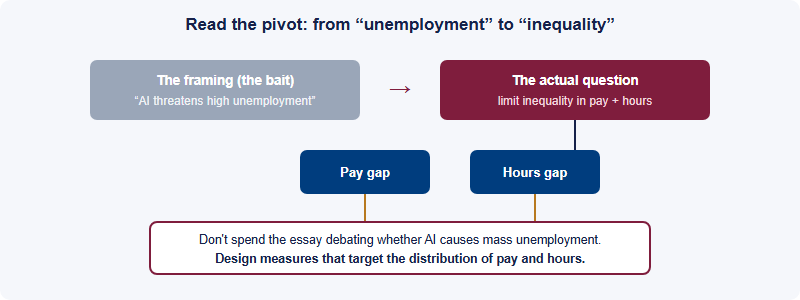
Question 3 of the 2026 LSESU Economics Society Essay Competition asks what measures could limit inequality if AI replaces a large share of jobs. The move that separates strong essays from weak ones is reading the question precisely: it is framed around unemployment, but what it actually asks about is inequality — in pay, and ideally in hours worked. Answer the distribution question, not the job-loss headline.
The question, in plain terms
Here is Question 3 as set by the LSESU Economics Society, written by Prof. Silvana Tenreyro (LSE) under the Technology theme:
“Suppose AI reduces the number of people needed to perform a large fraction of jobs, threatening to cause high unemployment. What measures should be put in place to limit inequality in pay (and, ideally, also in hours worked)?”
Read the second sentence twice. The prompt hands you an alarming scenario — AI “threatening to cause high unemployment” — but the task is narrower and more precise: design measures that limit inequality in pay, and if you can, inequality in hours worked. A common failure is to spend 1,500 words debating whether AI will cause mass unemployment. That is answering a question you were not asked. The examiner wants a policy design that targets the distribution of income and work, taking the disruption as given.
The economics you must show you understand
Before proposing measures, show that you understand why AI changes distribution even if it does not cause permanent mass unemployment:
- Technology historically reallocates jobs more than it destroys them. Automation has repeatedly displaced specific tasks while creating new roles elsewhere. A mature essay notes the word “threatening” and treats permanent mass unemployment as a risk to manage, not a certainty — which lets you pivot to the real question.
- The sharper problem is who wins and who loses. If AI is labour-replacing for routine tasks but labour-augmenting for high-skill workers, it widens the pay gap — this is skill-biased technical change. Gains flow to those whose skills complement AI and to owners of the technology.
- Watch the capital share. If AI lets firms produce with less labour, the share of income going to capital (the owners of the AI) can rise relative to labour. That is a distributional shift a pay-focused policy alone will miss — and it opens the door to your most original ideas.
- Hours are a distribution problem too. The prompt’s bracketed clause about “hours worked” is a gift: it invites you to discuss work-sharing and the length of the working week, which most candidates ignore.
Because argument and originality is the largest rubric criterion at 25 of 100 marks, the essay that frames the problem correctly has already earned more than one that lists ten policies.

The menu of measures — and how to choose
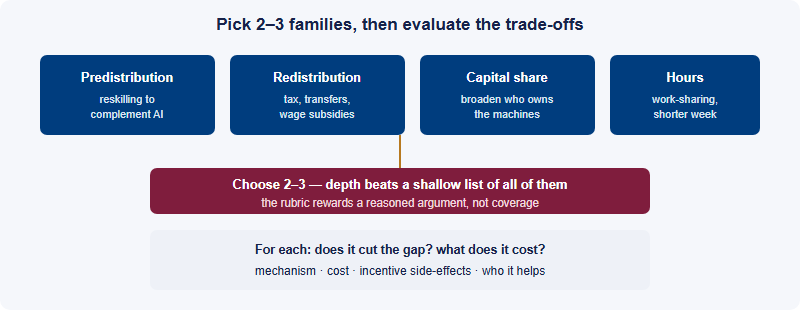
There are more possible policies than you can evaluate well in 1,500 words. Group them, then pick two or three and interrogate them rather than listing all of them shallowly. A useful grouping:
| Family | Examples | What it targets |
|---|---|---|
| Predistribution | Education & reskilling so workers complement AI; broadening access to complementary skills | The pay gap at its source |
| Redistribution | Progressive tax and transfers; wage subsidies; universal basic income | Post-tax pay inequality |
| Capital ownership | Employee ownership; sovereign wealth funds; taxing AI/automation returns | The rising capital share |
| Hours | Work-sharing; a shorter standard working week | Inequality in hours worked |
| Institutions | Collective bargaining; minimum wage | Bargaining power of labour |
An essay that picks, say, reskilling + broadening capital ownership + work-sharing and evaluates each — its mechanism, its cost, its incentive side-effects, who it helps — will out-score one that name-checks all fifteen ideas. For each measure, ask the two questions an examiner is silently asking: does it actually reduce the pay or hours gap, and what does it cost in efficiency or incentives?
What a 25/25 argument does that a weak one doesn’t
The predictable ways to lose marks on Question 3:
- The listicle. Ten measures, one sentence each, no evaluation. It shows breadth of recall, not economic judgement — and judgement is what earns the 25.
- Answering the framing. Debating whether AI causes mass unemployment while never designing the inequality measures the question asks for.
- Ignoring the “hours” clause. The bracket is an opening most candidates skip; a paragraph on work-sharing is easy originality.
- No trade-offs. Proposing UBI or a robot tax with no mention of cost, incentives, or feasibility reads as a wish-list, not economics.
Originality on this question rarely comes from a novel policy — most measures are known. It comes from a sharp diagnosis (this is a distribution problem, driven partly by a rising capital share) and a coherent, costed package that follows from it.
An illustrative spine (build your own — don’t copy)
- Thesis: Because AI’s threat is distributional rather than a permanent shortage of jobs, the priority is a costed package — reskilling, broader capital ownership, and work-sharing — that shares the gains rather than merely compensating the losers.
- Support 1: Why the gap widens (skill-biased change + rising capital share), so pay policy alone is insufficient.
- Support 2: Two or three measures, each evaluated on effect and cost.
- Counter-argument you must answer: Redistribution and taxes on automation can blunt the incentive to innovate — so design them to preserve efficiency while sharing the returns.
With your spine set, use our companion guides on writing the 1,500-word essay and the 100-point rubric to turn it into a scoring entry. See the Question 1 deep-dive for a worked example on a different prompt, and read about the LSE faculty behind the 2026 questions to understand what your examiner values.
Frequently asked questions
Is Question 3 asking me to predict whether AI causes mass unemployment?
No. It takes the disruption as given and asks what measures limit inequality in pay and hours. Note the risk, then design the policy.
How many measures should I propose?
Two or three, evaluated properly, beat a long shallow list. The rubric rewards reasoned argument, not coverage.
Do I have to discuss “hours worked”?
It is optional (“ideally”), but a paragraph on work-sharing or a shorter week is an easy way to stand out, because most candidates skip it.
How long should the essay be?
Up to 1,500 words, answering exactly one of the five set questions. Confirm the current word limit and deadline in the official guide before you submit.
Published by the editorial desk of this site, operated independently by Hanlin International Education (翰林国际教育) for China-based international-school students. This site is not the official competition website and is not affiliated with the LSESU Economics Society or the London School of Economics. Official rules are set by the competition and change yearly, so always confirm current details on the official site lsesuesec.org. Confirmed errors are corrected within 7 working days.
Filed under2026 Season · Artificial Intelligence · How To Write · Inequality · Labour Economics · Question 3