Starting the LSESU Essay in Mid-July: A 7-Week Late-Starter Plan (2026)
Yes — seven weeks is enough to write a competitive LSESU Economics Society essay, provided you start this week and follow a disciplined schedule. The deadline is 1 September 2026, 23:59 GMT+1 (06:59 on 2 September, Beijing time), and late entries are not accepted. Because the essay is capped at roughly 1,500 words, the binding constraint is thinking time, not typing time. This plan divides the remaining weeks into three research weeks, two drafting weeks, and two revision weeks.
Why a mid-July start is later than ideal — but genuinely workable
The 2026 questions have been public since the spring, so students who began in May have a head start in reading. What they do not have is an unbeatable advantage: a 1,500-word essay rewards one sharply developed argument, not months of accumulated notes. In our experience coaching China-based international-school students through essay competitions, the essays that stall are usually the ones that over-research and under-argue — a failure mode that a compressed timeline actually protects you against.
Three structural features of this competition favour the late starter:
- No registration step. There is no sign-up, no candidate ID, and nothing to unlock. The five questions are public, and you submit the finished essay directly through the official portal at lsesueconsoc.org/competitions/. You lose zero days to administration.
- A short word limit. At about 1,500 words, a full draft is achievable in a single focused weekend once your outline is solid. Compare that with 3,000–4,000-word competitions, where a July start would be far more painful.
- Public marking expectations. The competition publishes a 100-point rubric, so you can aim your effort at what is actually rewarded rather than guessing. We break the criteria down in our guide to the 2026 prompts and rubric.
If you are entirely new to the competition, skim What Is the LSESU Essay Competition? first — it covers who runs it, who can enter, and why the questions are written by LSE faculty.
The 7-week schedule at a glance
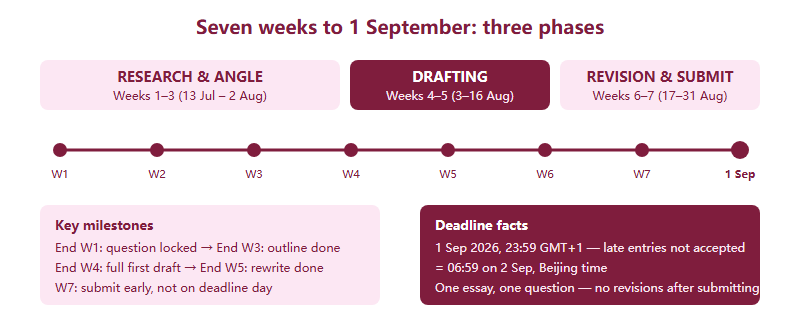
Weeks 1–3: choose fast, read narrow, outline early
Week 1 (13–19 July): lock your question. Read all five 2026 prompts — they span labour and remote work, monetary policy after an energy shock, AI and jobs, taxing top earners, and green technology and inequality (full wording in the prompts and rubric guide). You do not have time to trial two questions. Apply a simple filter: which question can you already sketch a two-sided argument for, using economics you have actually studied? Curiosity matters more than perceived “easiness” — you will spend fifty days with this question.
Week 2 (20–26 July): targeted reading, not a literature review. Cap yourself at 6–10 sources. A workable mix for a school student: one or two survey-style pieces to map the debate, two or three empirical papers or reports with concrete numbers, and one or two credible commentary pieces that stake out opposing positions. Take notes in your own words from day one — this protects both your originality and your integrity when the competition screens for plagiarism and AI-generated text.
Week 3 (27 July – 2 August): thesis and skeleton. Write your one-sentence answer to the question, then a paragraph-by-paragraph outline with the point of each paragraph stated in a full sentence. If you cannot state a paragraph’s point in one sentence, it is not ready to draft. Our structure and method guide walks through what a 1,500-word skeleton should look like.

Weeks 4–5: draft ugly, then rewrite properly
Week 4 (3–9 August): the full first draft. Draft the entire essay in two or three sittings, ignoring elegance. Overshooting to 1,700–1,800 words at this stage is fine; cutting is easier than padding. Insert placeholder citations as you go — for example “(source: IMF report on energy prices)” — so referencing week is assembly rather than archaeology.
Week 5 (10–16 August): the structural rewrite. This is the highest-value week of the plan. Rewrite for argument, not wording: does the introduction answer the question directly? Does every paragraph advance the thesis? Is the strongest counterargument addressed rather than ignored? Most essays improve more from deleting one weak section than from polishing five sentences.
Weeks 6–7: evidence check, formatting, early submission
Week 6 (17–23 August): verify every number and claim against its source, complete your reference list in a consistent style (the official guidance recommends Harvard referencing — confirm current formatting requirements on lsesuesec.org), and trim to the word limit. Read the essay aloud once; anything you stumble over, a marker will too.
Week 7 (24–31 August): final proofread, correct file naming — the official guidance asks for your name in capitals plus your question number (FORENAME SURNAME, Question X) — and submit through lsesueconsoc.org/competitions/. Aim for 28–29 August, not deadline night. Remember that you may submit only one essay on one question, and you cannot revise or resubmit after sending it, so submit only when you are finished — but do not confuse “finished” with “perfect”.
What to cut when time is short
| Tempting time-sink | Why late starters should skip it | Do this instead |
|---|---|---|
| Reading 25+ sources | Breadth does not fit in 1,500 words and delays outlining | Cap at 6–10 sources, chosen for opposing views and hard numbers |
| Trialling two questions in parallel | Splits your thinking; neither draft matures | Commit in week 1 using the “can I argue both sides?” test |
| Learning advanced university models | Misapplied advanced theory scores worse than well-applied school-level theory | Deploy IB/A-Level tools precisely, with stated assumptions |
| Waiting for inspiration on the intro | Intros are easiest to write last | Draft body paragraphs first; write the intro in week 5 |
| Polishing sentence-by-sentence in week 4 | Line edits before structural edits get thrown away | Draft ugly, rewrite structurally, polish last |
The late-starter’s weekly hour budget
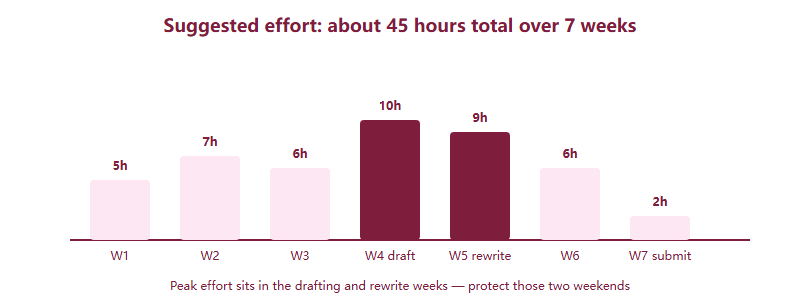
Roughly 45 focused hours produces a serious entry. That is around six hours a week — compatible with a summer school, an internship, or IB summer work, as long as weeks 4 and 5 each protect one full writing weekend. Students in mainland China should also plan around the timezone: the deadline of 23:59 GMT+1 on 1 September falls at 06:59 on the morning of 2 September, Beijing time, but building your schedule around 1 September your local time removes any risk of confusion.
Frequently asked questions
Is it too late to enter the LSESU Essay Competition in mid-July 2026?
No. Seven weeks remain before the 1 September deadline, there is no registration step, and the 1,500-word format suits a focused summer schedule. Start with question choice this week.
Do I need to register before writing?
No. The five questions are public and there is no sign-up or candidate ID. You simply submit your finished essay through the official portal at lsesueconsoc.org/competitions/ before the deadline.
Can I submit a draft now and replace it with a better version later?
No. Each entrant may submit one essay on one question, and submissions cannot be revised or replaced afterwards. Submit once, when the essay is genuinely finished.
What time is the deadline in Beijing?
The deadline is 23:59 GMT+1 on 1 September 2026, which is 06:59 on 2 September in Beijing. Treat 1 September evening, China time, as your personal cut-off and submit days earlier if possible.
Published by the editorial desk of this site, operated independently by Hanlin International Education (翰林国际教育) for China-based international-school students. This site is not the official competition website and is not affiliated with the LSESU Economics Society or the London School of Economics. Official rules are set by the competition and change yearly, so always confirm current details on the official site lsesuesec.org. Confirmed errors are corrected within 7 working days.