Submitting Your LSESU Essay from China: Portal Access, PDF Export and the 06:59 Problem (2026)
Three things go wrong for China-based entrants that have nothing to do with economics: the deadline lands at 06:59 the next morning in Beijing and feels like a free extra night, the entry portal is hosted outside the mainland and may not open on your network, and a document exported from a Chinese-locale machine can arrive with substituted fonts. All three are fixable in August. None are fixable at 23:00 on 1 September.
The deadline in your own time zone, written down
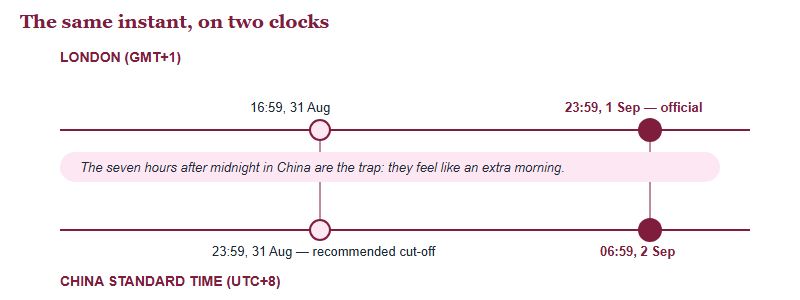
The official deadline is 1 September 2026 at 23:59 (GMT+1), and late submissions are not accepted. Converted, that instant is 22:59 UTC on 1 September — which in China Standard Time is 06:59 on the morning of 2 September.
That extra seven hours is the single most dangerous fact in this article. It creates the feeling of a bonus night: you can go to bed on 1 September with the essay unsent and still, technically, be inside the window. Every part of that plan is fragile. You would be uploading at dawn, on a network you have not tested at that hour, with no ability to revise if the file is wrong, and with no published grace period if anything stalls. In our editorial desk's experience across cohorts, the entrants who use that window are disproportionately the ones who end up sending a file they have not properly checked (per Hanlin International Education; individual experiences vary).
Set your personal cut-off at the end of 31 August in your own local time instead. For a student in China that is 23:59 on 31 August local, which is 16:59 GMT+1 on 31 August — comfortably inside the official window, in daylight, with a full working day of margin if something breaks.
| Where you are | Offset | Official deadline, local | Recommended personal cut-off |
|---|---|---|---|
| United Kingdom | GMT+1 | 23:59, 1 September | End of 30 August |
| Mainland China, Hong Kong, Singapore, Malaysia | UTC+8 | 06:59, 2 September | End of 31 August |
| Japan, South Korea | UTC+9 | 07:59, 2 September | End of 31 August |
| Thailand, Vietnam | UTC+7 | 05:59, 2 September | End of 31 August |
| India | UTC+5:30 | 04:29, 2 September | End of 31 August |
| United Arab Emirates | UTC+4 | 02:59, 2 September | End of 31 August |
| Eastern Australia | UTC+10 | 08:59, 2 September | End of 31 August |
| US Eastern (summer time) | UTC−4 | 18:59, 1 September | End of 31 August |
Reaching the portal from a mainland network
Entries go directly to the official portal at lsesueconsoc.org/competitions/ — there is no registration step and no candidate ID to obtain first, so this page is your only technical dependency. It is hosted outside mainland China, and the entry route is whatever the official competitions page currently shows. Confirm the current route on the official site, because the organiser can change it between seasons.
What matters for you is the operational consequence: you have one external dependency and you should test it in August, not in September. Do it today, from the network you actually intend to use, on the device you actually intend to use.
- If it loads normally: good. Note which network and browser worked, and use that combination on the day. Do not assume a different building will behave the same.
- If the page loads but an embedded form does not appear: this can happen when part of a page is served from a different host than the page itself. Try a different browser first, then a different network.
- If nothing loads: try mobile data, then a second network such as your school's. School networks are often filtered by an IT policy rather than anything else, and a filter is something the IT office can look at — if you ask them in mid-August rather than on the night.
- If you still cannot reach it: ask the organiser through the official contact channels well before the deadline, and ask them what they want you to do. Do not invent a workaround.
Two things you should not do. Do not ask a friend, relative or agent to upload on your behalf: the entry is your own work under your own name, and a submission made by someone else creates a question about authorship that you do not want attached to a screened essay. And do not email your file to the organiser as a substitute route unless the official page tells you to — an unrequested email is not a submission.

What breaks when a Chinese-locale machine exports an English PDF
The stated format is 12pt Times New Roman, 1.5 line spacing and page numbers. On a system configured for Chinese, those instructions can be followed in the editor and still fail in the export, because font substitution happens silently at render time.
The usual symptom is punctuation. Curly quotation marks, dashes, ellipses and brackets are the characters most likely to fall back to a Chinese-language system font, and when they do they render full-width: visibly wider, oddly spaced, sitting in the middle of an English sentence. Nobody who wrote the essay notices, because on the machine that made it everything looked fine. A marker opening it elsewhere sees an essay with strange typography, and the criterion being read at that moment is structure and clarity.
The checks that catch this, in order:
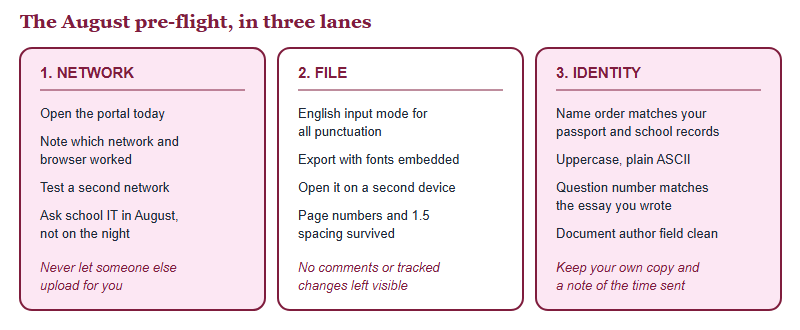
- Type your punctuation in an English input mode. Full-width quotes, commas and brackets entered in a Chinese input mode are different characters, not styling, and they will survive into the PDF.
- Export to PDF with fonts embedded rather than sending the editable document, so what you see is what the marker sees.
- Open the exported PDF on a second device — ideally one with a different language setting. This single step catches most substitution problems.
- Confirm page numbers and 1.5 spacing survived the export. Header and footer content is the first thing to disappear when a document is converted through an unusual route.
- Check for tracked changes, comment bubbles and hidden markup. A visible comment from a teacher in the margin of a submitted file is an unforced error on a competition that screens entries.
- Clean the document properties. On a school-issued laptop the author field often carries a shared account or a previous owner's name. It is not a published rule, but it costs nothing to fix.
Your name, in capitals, in the right order
The stated file-naming convention is your forename and surname in uppercase plus the question number, with the official example given in the form “PETER SMITH + Question 1”. For students with Chinese names, the live question is which part is the forename and which is the surname, since the everyday order is the reverse of the English one.
The safe anchor is your passport. Use the same given-name and family-name split that appears on your travel document and in your school records, because that is the version that will appear on university applications later, and a certificate that matches your other documents is more useful than one that does not. If you routinely use an English given name at school, use whichever version your school records and future applications will carry — and then use it consistently in the file name, on the essay itself and anywhere else you refer to the entry.
Keep the file name in plain ASCII characters. A name containing full-width characters, an accented letter typed in the wrong mode, or a stray emoji is exactly the kind of thing that behaves unpredictably on upload. Then read the saved name back against the convention one character at a time before you send it. Our guide to the 2026 prompts and published criteria confirms which question numbers exist; make sure the number in your file name is the question your essay actually answers.
The last 48 hours, on China time
Because there is no revision route after submitting, the final sequence is not “send it and keep working” — it is a series of one-way steps you complete in daylight.
- Morning of 30 August: final read of the argument. After this point you are correcting errors, not changing your thesis.
- Afternoon of 30 August: word count with the reference list excluded, recorded on paper. Export to PDF. Open the export on a second device.
- Morning of 31 August: file name check, character by character. Portal loads on your chosen network. Have a second network ready.
- Afternoon of 31 August: submit. Save your own copy of the exact file you sent, note the date and time, and capture any confirmation the portal gives you.
- 1 September: nothing. This day exists as slack, not as workspace. If everything went to plan you are simply not using it.
If your draft is not in a fit state to run that sequence, the honest move is to work on the essay itself rather than on the logistics — our guide to writing the 1,500-word essay covers what a finished draft needs to contain before it is worth exporting at all.
Frequently asked questions
What is the deadline in Beijing time?
23:59 GMT+1 on 1 September 2026 is 06:59 on 2 September in China Standard Time. Treat the end of 31 August local as your real cut-off.
Do I have to register on the portal first?
No. There is no registration and no candidate ID. You select a question, write the essay, and submit it directly through the official portal.
Which name goes first in the file name?
Use the forename and surname split shown on your passport and school records, in uppercase, so your entry matches your other documents.
Can someone submit the essay for me if the site will not load?
No. Solve the access problem in advance and ask the organiser through official channels rather than sending it through another person.
Published by the editorial desk of this site, operated independently by Hanlin International Education (翰林国际教育) for China-based international-school students. This site is not the official competition website and is not affiliated with the LSESU Economics Society or the London School of Economics. Official rules are set by the competition and change yearly, so always confirm current details on the official site lsesuesec.org. Confirmed errors are corrected within 7 working days.