What Actually Voids an LSESU Essay: Hard Rules, Soft Rules and the Ones Nobody Publishes (2026)
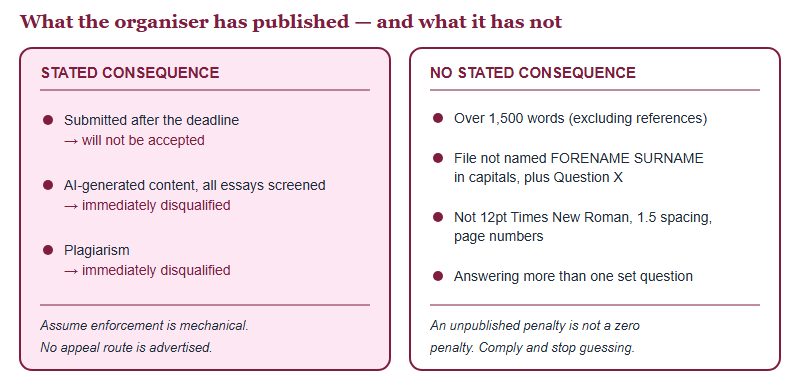
Three rules have a consequence the organiser has actually published: a late entry is not accepted, AI-generated content is disqualified, and so is plagiarism. Every other rule — the word limit, the file name, the format, answering one question — is binding without a published penalty. That asymmetry is the whole point of this audit, and it should change what you check first.
Why sort the rules by consequence rather than by topic
Most pre-submission checklists list rules in the order they appear on the entry page. That is a fine way to read a page and a bad way to manage risk two weeks out, because it gives equal weight to a formatting preference and to a rule that ends your entry outright.
Sorting by consequence does something more useful. It tells you where the organiser has committed itself in writing, and where it has said nothing. Where it has committed itself, you should assume enforcement is mechanical and unsympathetic. Where it has said nothing, you are looking at unpriced risk — which is not the same as no risk, and is arguably worse, because you cannot calculate it and therefore cannot trade against it.
The practical rule that falls out of this: never spend a marginal hour on a soft rule while a hard rule is still unverified. Students routinely get this backwards in the final fortnight, polishing a bibliography while their file has never once been opened on a second device.
The three rules with a published consequence
1. Lateness. The stated deadline is 1 September 2026 at 23:59 (GMT+1), and the official page states that late submissions will not be accepted. Note what that sentence does not contain: no grace period, no technical-failure clause, no appeal route. Treat the stated time as the moment the door closes, and treat your own cut-off as materially earlier. If you live outside the United Kingdom, the deadline is also not the time your own clock shows — work out the local equivalent now rather than on the night, and set your personal cut-off at least a day inside it.
2. AI-generated content. The official position is blunt: AI-generated content is strictly forbidden, all essays are screened, and essays in violation are immediately disqualified. Two things follow that students often miss. First, screening applies to all essays, so this is not a spot check you might be lucky enough to escape. Second, the risk is not confined to the obvious case of asking a model to write your essay. Rewriting your own paragraph through a tool to make it “sound more academic” produces generated text sitting in your file, and you would be relying on a screen not to notice. If you want your English tightened, the safe route is the ordinary human one and the safe artefact is your own sentence.
3. Plagiarism. Same stated consequence, and it includes the case students find hardest to see: a source whose idea you have absorbed so thoroughly that you have stopped attributing it. Citations and sources carry 10 marks in the published criteria, so attribution is being scored anyway. The disqualification risk sits above the mark scheme, not inside it.
All three of these are verifiable in an afternoon, and none of them are writing problems. That is exactly why they should be cleared first.
The rules with no published consequence — and why you comply anyway
The maximum is 1,500 words excluding references. The recommended format is 12pt Times New Roman, 1.5 line spacing and page numbers. The file name convention is your forename and surname in capitals plus the question number. Your essay answers one of the five set questions. What the published guidance does not do is tell you what happens if you break any of these.
Some students read that silence as slack. The better reading is an argument about asymmetric payoffs. Complying costs you almost nothing: renaming a file takes ten seconds, and cutting to the limit is work you should be doing anyway, because compression is part of what the exercise tests. Not complying buys you nothing you value — an extra 200 words is not what separates a strong essay from an average one — while exposing you to a penalty whose size you cannot see. When the cost of compliance is near zero and the cost of breach is unknown, you comply. You do not need a probability estimate to make that decision.
The one-question rule deserves a line of its own because it fails quietly. Students who have read widely often drift into writing an essay that half-answers one prompt and half-answers another, then pick a question number at the naming stage. That essay will be marked against the question in its file name, and topic relevance is a scored criterion. Decide which question you are answering, then make every section serve it. Our guide to the 2026 prompts and published criteria sets out what each one is asking.
| Rule | What the official page states | Published consequence | How to verify it in one minute |
|---|---|---|---|
| Deadline | 1 September 2026, 23:59 (GMT+1); late submissions not accepted | Yes — not accepted | Convert to your own local time in writing; set a cut-off a day earlier |
| AI-generated content | Strictly forbidden; all essays screened | Yes — immediate disqualification | Confirm no passage in your file was generated or machine-rewritten |
| Plagiarism | Screened; violations disqualified | Yes — immediate disqualification | Every borrowed idea, number and phrase carries an attribution |
| Word limit | Maximum 1,500 words, excluding references | Not published | Count the body text only, with references excluded, and record the number |
| File name | FORENAME SURNAME in uppercase plus Question X | Not published | Read the saved file name aloud against the stated convention |
| Format | 12pt Times New Roman, 1.5 spacing, page numbers | Not published | Open the exported file on a second device and look at page one |
| One question | The essay answers one of the five set questions | Not published | Check every section answers the question in your file name |
| Revision after submitting | No revision or replacement route | Effectively final | Do all checks before you upload, not after |

The exclusivity clash you have to resolve before the end of August
One risk this season sits outside the LSESU rules entirely. The Marshall Society essay competition closes on 30 August and bars entries that have been submitted to another competition at the same time. If you are holding a single economics essay in late August, that condition forces a choice rather than a sequence: you cannot enter both with the same piece of work and hope the timing sorts itself out.
Resolve it deliberately and early, on the merits of your own essay and your own calendar. And never state a word limit or a formatting requirement for the other competition from memory — briefings on that point disagree, and the requirements are theirs to publish. Read each competition's current rules on its own official site before you commit a file to either.
Irreversibility changes the order of your last operations
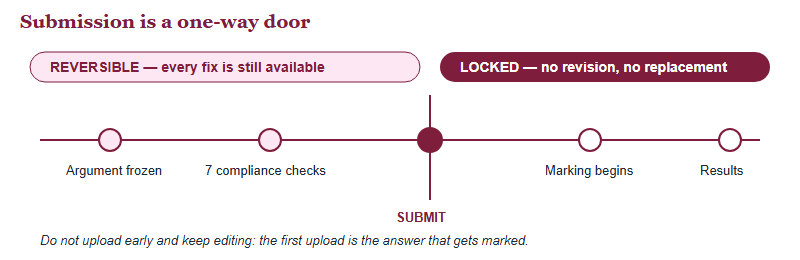
You cannot revise or replace an LSESU entry after submitting it. That single fact reorganises the final week. In a workflow you can revise, the sensible order is to submit early, then keep improving and re-upload. Here that order is actively harmful: an early upload converts a draft into your final answer.
The order that works is the opposite. Freeze the argument. Run the three published-consequence checks. Run the four compliance checks. Export, then open the export on a device that did not create it. Only then submit — and once you do, close the file. The essay you uploaded is the essay that gets marked, and re-reading it will only cost you sleep. If you want the shape of those final passes in more detail, our guide to writing the 1,500-word essay covers the drafting side; this audit is the compliance layer that sits on top of it.
The 20-minute audit
Run this once, in this order, on the exported file you actually intend to send. Do not run it on the working document, because the export is where things break.
- Minutes 1–4 — lateness. Write your local equivalent of 23:59 GMT+1 on 1 September on paper. Set your personal cut-off at least 24 hours earlier and put it in a calendar with an alarm.
- Minutes 5–9 — integrity. Scroll the whole file and confirm no sentence was generated or machine-rewritten, and that every borrowed idea, figure and phrase carries an attribution. If you cannot remember where a number came from, you have found the paragraph to fix.
- Minutes 10–13 — length and question. Count the body text with references excluded and write the number down. Then read each section heading and ask whether it answers the question in your file name.
- Minutes 14–17 — file and format. Read the saved file name against the stated convention, character by character, and confirm the exported document shows the specified font, spacing and page numbers.
- Minutes 18–20 — second device. Open the exported file on a phone or a different computer. Fonts, spacing and page numbers survive export more often than they should be trusted to.
In our editorial desk's experience across cohorts, the late-stage failures that hurt most are almost never failures of economics (per Hanlin International Education; individual outcomes vary). They are a file that was never opened after export, a word count taken with the reference list still included, and a naming convention read once in July and never re-read. None of those require talent to fix — only twenty minutes, spent before rather than after the one-way door. If you are new to the competition's structure, start with our overview of what the LSESU Essay Competition is and then come back to this audit.
Frequently asked questions
Do I need to register before submitting?
No. There is no registration and no candidate ID. The questions are public, and you submit your finished essay directly through the official portal.
What happens if my essay is over 1,500 words?
The organiser has not published a penalty. Because the cost of complying is near zero, write to the limit rather than testing it.
Can I replace my file if I spot a mistake after submitting?
No revision or replacement route is published, so treat your upload as final and run every check before it.
Does using a grammar tool count as AI-generated content?
Generated or machine-rewritten text sits in your file either way. Keep the sentences your own and take language help from a person.
Published by the editorial desk of this site, operated independently by Hanlin International Education (翰林国际教育) for China-based international-school students. This site is not the official competition website and is not affiliated with the LSESU Economics Society or the London School of Economics. Official rules are set by the competition and change yearly, so always confirm current details on the official site lsesuesec.org. Confirmed errors are corrected within 7 working days.