LSESU Essay Definitions: Income, Wealth and the Top 1%
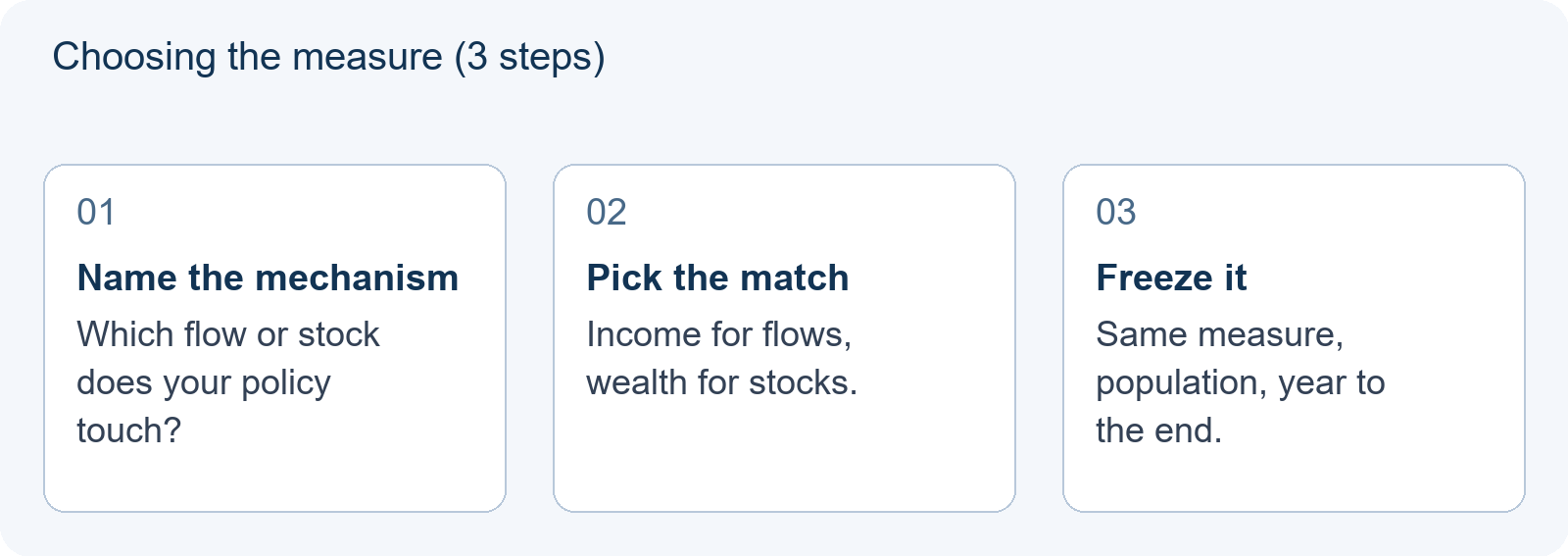
Choose the measure your causal mechanism actually runs through, define it in one sentence at first use, name the measure you are deliberately not using, and hold that choice until the conclusion. That is the whole answer. If your policy instrument is an annual tax on income, your “top 1%” has to be an income construct; if your claim is about accumulated advantage, it has to be a wealth construct. A definition that floats free of the mechanism is the most common way a strong draft loses its argument halfway through.
This guide therefore treats LSESU essay definitions as a working decision rather than a glossary exercise: you pick a measurable construct, you state it in the draft, you hold it under pressure, and you can point to the sentence where you did so.
Three scope notes before the detail. The 2026 submission window closed at 23:59 GMT+1 on 1 September 2026, so this is a method guide to the published 2026 prompt set and to the same definitional problem in any inequality or taxation question; the prompts will change in a later cycle, the measurement problem will not. The competition sets a maximum of 1,500 words excluding references, allows one response to one of five questions, and recommends Harvard referencing (official competition page, LSESU Economics Society Essay Competition). And everything below about the rubric is our reading of the published criteria, not a statement about how any individual reader weights a definitional slip.
Why a definition choice is a scoring decision
The published rubric awards 100 marks across seven dimensions: Argument and Originality 25; Application of Economic Theories 20; Evidence and Examples 15; Critical Analysis 15; Structure and Clarity 10; Citations and Sources 10; Topic Relevance 5 (official competition page). Four of those are directly exposed to a definition that drifts.
Argument and Originality asks whether the argument is “well-articulated, logically consistent, and innovative”. A claim that changes its own subject halfway through cannot be logically consistent, however elegant each paragraph looks in isolation. Application of Economic Theories asks whether models and concepts are “used correctly and effectively to support the argument”: a model applied to an income base in one section and a wealth base in the next is not applied, it is borrowed twice. Evidence and Examples asks whether claims are “supported by empirical studies, historical examples, case studies, or credible data” — and evidence only supports a claim when it measures the same thing the claim is about. Topic Relevance asks whether the essay “stay[s] on topic and directly answer[s] the question asked”, and the question’s own wording usually constrains the construct you may use.
Notice what this does not say. It does not say a particular definition earns marks, or that markers reward length in a definition. It says the criteria are written in terms of consistency and fit, and definitions are where consistency is created or destroyed. If you want the prompt’s verb mapped before you start writing, the command-word breakdown in LSESU Essay Command Words: What Each 2026 Prompt Asks You to Produce covers that layer; this article covers the layer underneath it.
The four definitional forks
Almost every definitional problem reduces to four decisions. They interact, so make them in order.
| Fork | What actually changes | Where it bites |
|---|---|---|
| Income vs wealth vs consumption | An annual flow, an accumulated stock, or spending actually observed | Revenue arithmetic, elasticity claims, and any statement about advantage compounding over time |
| Individual vs household | Whether a two-earner household appears once or twice, and whether household size is adjusted for | Comparisons across countries and across household types |
| Pre-tax-and-transfer vs post-tax-and-transfer | Whether the tax system’s own taxes and transfers sit inside the number | Any claim that a policy “reduces inequality” must say which side of the system it is measuring |
| Which population the top 1% is drawn from | Adults in one country, taxpayers, households, or the world | Policy exposure: a national top 1% and a global top 1% are largely different people |
Question 4, published under the heading TAXATION & FAIRNESS, asks: “Is it possible and desirable to raise taxation on the top 1%?” It names no country, no instrument and no population. That is not an omission to complain about; it is a decision you must make and defend in your opening. Question 5, published under the heading GREEN TECHNOLOGY, is more prescriptive — “How will development and adoption of climate-friendly technologies affect inequality and the distribution of wealth?” — and forces two constructs rather than one. Question 3, published under the heading AI & EMPLOYMENT, reads “Suppose AI reduces the number of people needed to perform a large fraction of jobs, threatening to cause high unemployment. What measures should be put in place to limit inequality in pay (and, ideally, also in hours worked)?”, which fixes the outcome variables to pay and hours and leaves the population open. Read the prompt for which forks it has already closed and which are handed to you.
A worked illustration where the measure drifts
Teaching illustration. The two draft paragraphs below are constructed for this article. They are not an official answer, a model essay, or scoring guidance, and the figures in them are invented so the arithmetic is checkable in your head.
Draft paragraph A: “The top 1% should pay more. Their share of national income has risen, so a higher marginal rate on that group is both possible and desirable.”
Draft paragraph B: “Because the top 1% also hold a large share of total wealth, the revenue from taxing them is clearly there.”
Paragraph A is internally consistent: an income instrument supported by income evidence. Paragraph B imports a wealth stock to support a revenue claim about an income tax. Suppose the writer invents a base: total annual income of £100 in the economy being discussed, with the top 1% receiving 10% of it, or £10. A 5 percentage point increase in the rate applied to that slice raises at most £0.50 a year before any behavioural response. The wealth figure tells you nothing about that £0.50: it is a stock measured on a date, not a flow per year, and the households holding the largest wealth share need not be the same households as those with the largest annual income.
The repair is short. Either keep income and write that wealth is outside the scope of the claim, or run both measures deliberately and say so. What you cannot do is let paragraph B’s evidence stand in for paragraph A’s claim. Note also that the prompt’s two tests, “possible” and “desirable”, lean on different parts of the definition: broad bases make revenue look easy, while incidence and behavioural response decide desirability. A definition chosen to make one test easy often makes the other harder to argue.
The three-sentence definition paragraph
You do not need a section on definitions. The whole of LSESU essay definitions work fits into three sentences, placed where a reader first meets the term — usually the end of your introduction.
- Sentence 1, construct and scope: name the measure, the unit, the period, and which side of the tax system it sits on.
- Sentence 2, justification: state the mechanism, then state why this measure carries it.
- Sentence 3, exclusion: name the measure you are not using and the limit that places on your conclusion.
Filled for Question 4, income route
“I define ‘the top 1%’ as the 1% of adults in the economy under discussion with the highest household income before taxes and transfers, equivalised for household size, in a single tax year. I use income rather than wealth because the instrument I analyse — a higher marginal rate on that group’s income — operates on an annual flow. I do not use wealth, so my revenue estimates and my desirability argument apply only to income taxation.”
Filled for Question 5, two constructs
“I define inequality as dispersion in equivalised household disposable income, and the distribution of wealth as the distribution of net household assets across the same adults in the same year. I use two measures because climate-technology adoption can move wage income and asset prices through different channels and at different speeds. I do not use consumption, so my claims concern income and wealth rather than living standards directly.”
That is roughly 70 to 75 words, about 5% of a 1,500-word budget. If you must define two constructs, as Question 5 requires, allow up to about 90 words — 6% of the budget. It is the cheapest insurance in the essay: once those sentences exist, every later sentence has a standard to be checked against.

Run a consistency audit before you edit for style
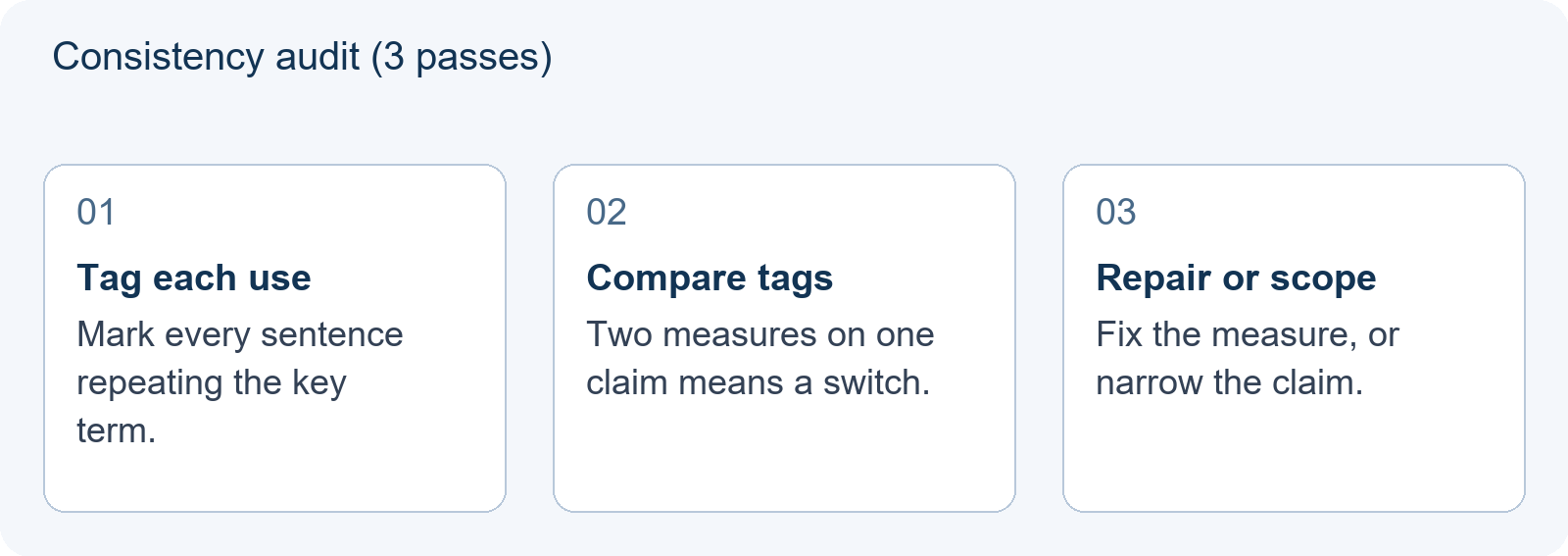
Extract every sentence that repeats your key term, tag each one with measure, unit, population and year, then hunt for five patterns.
| Pattern | What it looks like | Repair |
|---|---|---|
| Silent switch | “their income share” in one section, “their wealth share” in another, one shared conclusion | Fix the measure, or split the claim into two separately labelled claims |
| Stock/flow mismatch | A wealth stock used to justify an annual revenue estimate | Rebuild the estimate on the matching base |
| Pre/post drift | Before-tax evidence supporting an after-tax outcome claim | Say which side of the tax and transfer system the number is on |
| Population drift | National adults in one paragraph, global adults in the next | Hold the population fixed, or flag the change explicitly |
| Denominator drift | “share of income” in one place, “share of tax paid” in another | Name the denominator inside the sentence |
The audit takes about twenty minutes and catches the errors that survive a style edit, because a switch usually reads smoothly. Two companion checks sit next to it: LSESU Essay Distributional Effects: Explaining Who Gains, Who Loses and Why tests whether your definition identifies the right losers, and The Question-Type Audit: Does Your LSESU Essay Actually Answer What Was Asked? (2026) tests whether the construct matches the verb the prompt used.
When two measures are the right answer
Sometimes carrying two measures is not drift but compliance. Question 5 asks about inequality and the distribution of wealth in one sentence, so one construct cannot answer it. Question 3 asks for inequality in pay and in hours worked, which is two outcome variables on one population. In both cases the rule changes from “hold one measure” to “declare both and label every claim”.
Practically: write one definitional paragraph covering both constructs, keep the population and period identical across them, and add a single bridge sentence explaining how the two connect — for example, “Flows become stocks slowly: saving out of income, and returns on assets already held, determine how a change in the income distribution appears, years later, in the wealth distribution.” Then tag each body paragraph with the construct it uses. What you must not do is maintain two literatures at full depth; pick one as primary, treat the second as a supporting channel, and say which is which. Two measures also double the consistency risk, so run the audit once per construct rather than once for the whole draft.
Five checks before you submit
- Does the first use of the key term state construct, unit, period and pre- or post-tax position?
- Does any sentence use a second measure without announcing it?
- Does every revenue or incidence claim rest on evidence of the matching type?
- Does the conclusion use the same measure the definition paragraph committed to?
- If two measures are carried, is there a bridge sentence, and is each claim labelled?
A draft that passes all five can still be wrong on economics. It cannot be wrong about what it is measuring, which is the failure this article exists to prevent.
What to bring to a draft-review conversation
A review that begins with “is this good?” can only produce opinions. Bring four things instead: the three-sentence definition paragraph; a copy of the draft with the key term highlighted at every appearance; your audit table with the tags filled in; and a short note naming the fork you are least sure about — usually household versus individual, or national versus global population. Add the two sentences where you deliberately carried a second measure, so a reader can see the choice rather than infer it.
That set lets a reader test the measure paragraph by paragraph and tell you where the argument stops matching its own definition. It also keeps the conversation inside the 1,500-word constraint, because every question you ask will be about a specific sentence rather than about the essay as a whole.
Sources and scope. Prompt wordings and their published topic headings, the seven scoring dimensions and their marks, the 1,500-word limit excluding references, the one-question entry rule, the Harvard referencing recommendation and the 1 September 2026 23:59 GMT+1 deadline are taken from the official competition page of the LSESU Economics Society Essay Competition (lsesuesec.org/essay-en). This site is an independent guide operated by Hanlin International Education and is not the official competition website; official rules, dates and announcements are published by the organiser.
General event background is available at Event background.
Frequently Asked Questions
Do I have to use the same definition of the top 1% throughout my essay?
For a single claim chain, yes. If the prompt itself asks about two constructs, as Question 5 does with inequality and the distribution of wealth, carry both, but declare each in the definition paragraph and label which sentences use which. What fails is an undeclared switch, where the evidence in one paragraph measures something different from the claim it is supporting.
Is income or wealth the better measure for a taxation question?
Whichever base the instrument you analyse actually acts on. An annual income tax acts on a flow, so the top 1% has to be an income group; a wealth tax acts on a stock held on a date. State the base, the unit and the year, and do not let evidence from one base support a claim about the other — a wealth stock cannot tell you how much an income-tax rise raises.
How long should the definition paragraph be in a 1,500-word essay?
About 50 to 75 words, which is 3% to 5% of the limit; allow up to roughly 90 words (6%) if you must define two constructs, as Question 5 does. Place it where a reader first meets the term — usually at the end of your introduction — and use three sentences: construct and scope, justification from the mechanism, and the measure you are excluding.