LSESU Essay Policy Brief: Answering a Prompt Addressed to a Decision-Maker
Short answer. A prompt that says “prepare a brief for a central bank” is not asking for an essay about inflation. It is asking for a document addressed to a decision-maker with a fixed objective: open with the mandate and the shock, show how the instrument you recommend actually reaches the target, compare at least two options under the same assumptions, and close with a call plus the conditions under which you would withdraw it. Energy-market background is support for that argument, never the argument itself.
This article works through the genre using Topic 2 of the 2026 LSESU Economics Society Essay Competition, published on the organiser’s site at lsesuesec.org. The prompt text and scoring dimensions quoted below are reproduced from that page. The architecture, word budget and worked examples are Hanlin’s teaching analysis and hypothetical illustrations — not official guidance, not a model answer, and not a prediction of any mark. The 2026 submission deadline of 1 September 2026, 23:59 GMT+1, has passed; there is no late submission route. Treat what follows as training for the next prompt that names an addressee.
What the Question 2 prompt fixes for you
The official page lists this question as Topic 2, ENERGY & ECONOMICS, set by Professor Ricardo Reis. The full prompt reads:
“Following a sharp rise in UK energy prices, prepare a brief for a central bank on how monetary policy should respond. Take into account that the UK is a net importer of energy, and that the Bank of England has a mandate of keeping inflation steady at 2%.”
Read it as a contract with three clauses already written.
- Addressee. You are writing to a central bank, and the second sentence names the Bank of England. Every recommendation must be something that institution can do with the instruments it actually holds.
- Objective. “Keeping inflation steady at 2%” is not decoration. The word “steady” makes the time path part of the question: how quickly to return, and whether to look through a one-off shift in the price level.
- Structural condition. “Net importer of energy” constrains the transmission mechanism. It determines which part of the price rise domestic policy can reach and which part it cannot.
What the prompt leaves open is the policy path: hold, tighten, or tighten while committing to a faster return — and with what communication. That open space is where the 25 marks for Argument and Originality sit. If you are still unsure whether a prompt is asking you to explain or to recommend, the LSESU Essay Command Words: What Each 2026 Prompt Asks You to Produce is the place to start.
Brief architecture versus essay architecture
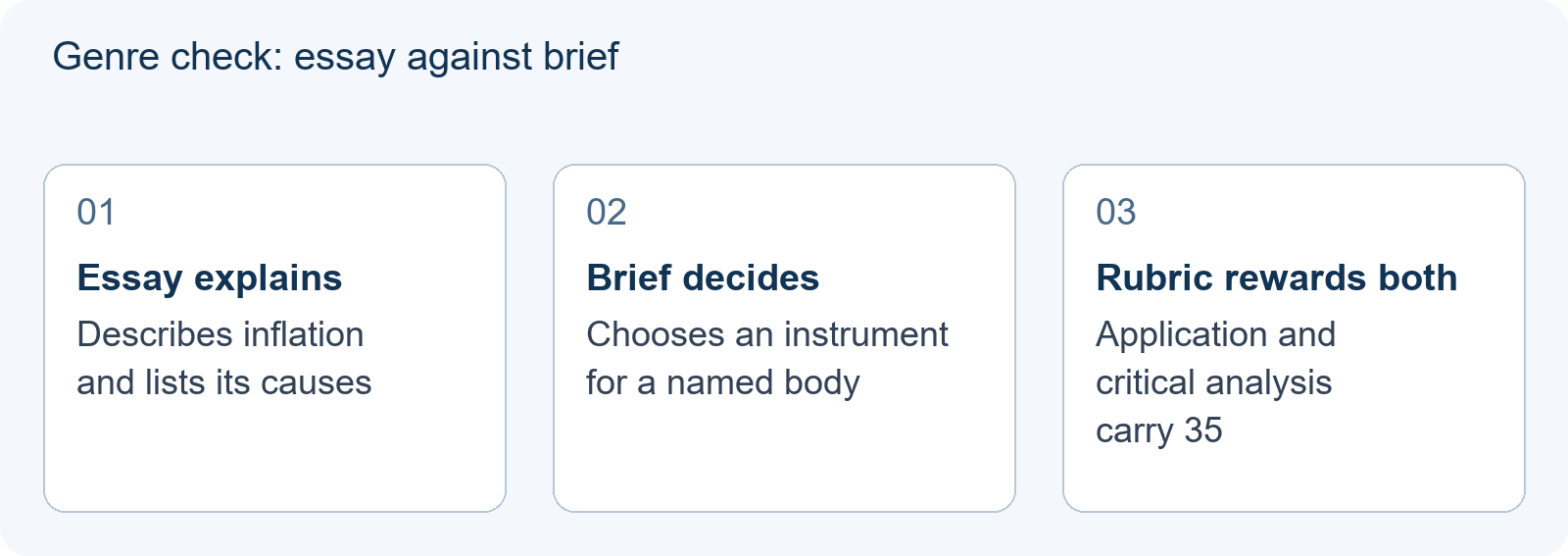
A five-paragraph essay organises itself around causes, effects and a conclusion. A brief organises itself around a decision. The seven-block structure below maps onto the published rubric; the word figures are a planning device, illustrative rather than official.
| Block | Planned words | Rubric dimension served |
|---|---|---|
| 1. Mandate anchor | 120 | Topic Relevance (5); Application of Economic Theories (20) |
| 2. Shock and transmission to the target | 350 | Application (20); Argument and Originality (25) |
| 3. Options and instrument logic | 380 | Argument and Originality (25) |
| 4. Evidence and calibration | 250 | Evidence and Examples (15) |
| 5. Recommendation, horizon and exit condition | 200 | Argument and Originality (25) |
| 6. Risks, counterargument, revision trigger | 150 | Critical Analysis (15) |
| 7. References (excluded from the count) | 0 | Citations and Sources (10) |
That is roughly 1,450 planned words plus 50 of signposting, inside the 1,500-word maximum that excludes references. The table is not a template you must obey to the word. Its purpose is to stop the commonest failure of this genre: 1,200 words on the energy market followed by two lines beginning “therefore the Bank should”.
Note also what the table does not buy you. Structure and Clarity is worth 10 of 100. A memo layout is not a substitute for mechanism; a document that flows beautifully but never explains how a policy rate reaches the price level loses far more than elegance can recover.
What goes in each block
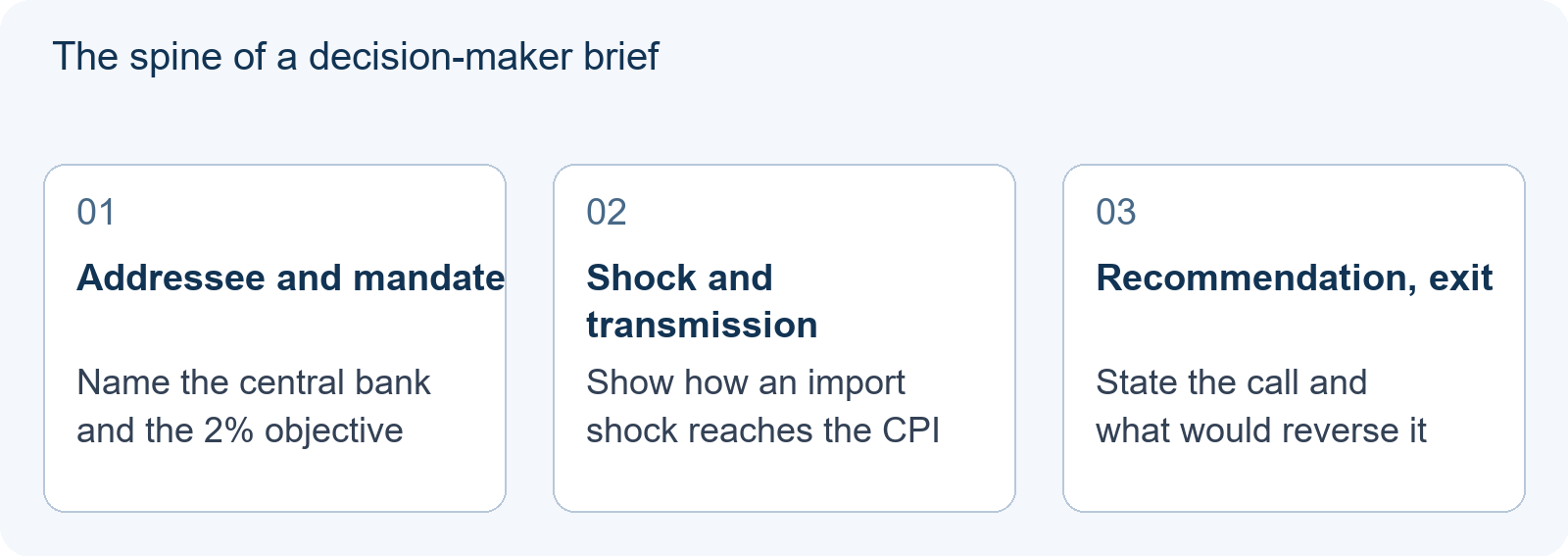
Teaching illustration, not an official answer. The mandate block is one paragraph: restate the 2% objective, state the horizon over which you will judge success, and say what you take “steady” to require. Do not open with a definition of inflation or a potted history of the Bank.
The shock block separates the first-round rise in the price level from the second-round response of wages and price setting. This is exactly what the net-importer clause is for. It should also say where the constraint binds: a central bank can influence domestic demand and the exchange rate, but it cannot set the price of imported energy.
The options block is where a brief differs most from an essay. Two or three named paths, each with its own instrument logic, each costed against the same assumptions. The recommendation block then picks one, states a horizon, and adds the sentence most drafts omit: what would make you withdraw it.
One paragraph, written twice
Both versions below are hypothetical teaching illustrations. Here is the paragraph most first drafts contain:
“Inflation in the UK has been high recently. Energy prices have risen sharply, which has caused inflation. The Bank of England should raise interest rates to bring inflation back to 2%.”
Three failures in three sentences. It describes a phenomenon rather than a decision. It offers no transmission channel between the instrument and the target. And it ignores the net-importer clause entirely, treating the UK as a closed economy in which the central bank can reverse an imported price rise.
Now the same material as brief prose:
“Because the UK is a net importer of energy, a rise in imported energy prices raises the energy component of the CPI before any domestic wage or price response occurs. A higher Bank Rate does not lower that import bill. Its first channel is domestic: higher real borrowing costs soften demand, hiring and wage growth, which limits second-round pass-through into core prices. Its second channel is external: a rate rise may support sterling and reduce the sterling cost of imported energy, so part of the first-round increase is offset. Both channels operate with a lag, so the relevant question is whether wage bargains and price setting are beginning to track the higher price level, and the brief should say which observable would show that they are.”
The second version earns its marks where the rubric puts them. Application of Economic Theories (20) rewards a correctly specified channel rather than a direction of travel. Critical Analysis (15) rewards naming the lag and the uncertainty instead of asserting a clean result. Any figure you attach to that argument — an import share, a wage settlement, an inflation print — must come from a dated, citable source.

The four genre errors, with a fix for each
1. Writing about the phenomenon instead of the decision. Symptom: the words “the Bank should” appear once, in the final paragraph. Fix: require every substantial paragraph to end in a sentence about what the institution should do, or how it would know whether to change course.
2. Ignoring a stated constraint. Symptom: a draft that claims monetary policy can “reverse the energy price shock”. The net-importer clause makes that claim untenable as stated, because the imported component is priced abroad and only partly reachable through the exchange rate. Fix: state explicitly what share of the shock lies outside the instrument’s reach, and what is left inside it.
3. Recommending an instrument with no transmission channel. Symptom: “tighten policy to restore 2%” with no chain in between. Fix: write the chain out — policy rate to real borrowing costs to domestic demand to wage and price setting to CPI — and mark where the lag bites. The LSESU Essay Mechanism Chain: Link Policy to Outcome method covers this.
4. Asserting a trade-off instead of pricing it. Symptom: “there is a trade-off between inflation and output” as a stand-alone sentence. Fix: say on which margin, over what horizon, and what evidence would tell you the trade-off is steep rather than shallow. A sentence that could not be wrong cannot earn Argument and Originality.
Recommendation, exit condition, and pricing the trade-off
A brief has to commit. A committed sentence looks like this hypothetical: “Recommendation: hold Bank Rate and pre-announce a faster path if the next bargaining round produces settlements above the rate consistent with 2%; I would withdraw the hold if core inflation responds to the energy shock by less than its import content implies.”
Two things are happening there. The recommendation names a path rather than a number, which is honest about lags. The exit condition converts the recommendation into a claim someone could contest, which is what originality means in practice.
The trade-off then has to be priced rather than recited. If tightening faster reduces second-round inflation at the cost of a deeper output gap, say how you weigh the two, and say whose losses appear where. Comparing the options under one shared set of assumptions — rather than letting each option be judged on its own preferred grounds — is the discipline described in LSESU Essay Policy Trade-Offs: Comparing Two Options Under the Same Assumptions.
Transfer test: Question 3 and other decision-maker prompts
The same architecture travels. The official page lists Topic 3, AI & EMPLOYMENT, set by Professor Silvana Tenreyro. The full prompt reads:
“Suppose AI reduces the number of people needed to perform a large fraction of jobs, threatening to cause high unemployment. What measures should be put in place to limit inequality in pay (and, ideally, also in hours worked)?”
The addressee is no longer a named central bank, and the instrument is no longer a policy rate. But the contract has the same three clauses. For a brief, you must still choose an addressee — here, plausibly a government with tax and transfer instruments. You must state what the objective actually is: inequality in pay, and ideally in hours worked, which is two targets and therefore a design problem. And you must show what constraint shapes transmission: the stated mechanism is a fall in labour demand, which is not the same shock as a rise in import prices.
“What measures should be put in place” is a request for an inventory followed by a selection. A draft that lists eight policies and recommends none has answered the descriptive part and defaulted on the decision. The published format rules allow only one response to one of the five questions, so this transfer is rehearsal, not an extra submission.
Seven checks before you call it a brief
- Does the first 120 words name the institution and the objective it is being judged against?
- Is the stated constraint from the prompt visible in the mechanism, not just quoted once?
- Can you point to the sentence that explains how the instrument reaches the target?
- Are at least two options costed under the same assumptions?
- Does the recommendation include a horizon and a condition for withdrawal?
- Is every number dated and sourced, and does the reference list match the published format rules?
- Would a reader who disagreed know exactly which claim to attack?
If any answer is no, the draft is still an essay with a memo heading. The rubric already tells you where that costs you: Topic Relevance is 5 marks and Application is 20, and both are decided by whether the document answers the question that was asked. A criterion-by-criterion pass over your own draft is a useful next exercise.
When you ask a teacher, mentor or coach for structural feedback, bring four things and the conversation becomes specific rather than encouraging: the prompt text, your one-sentence recommendation, the paragraph you believe carries the transmission channel, and the sentence stating what would change your mind. A reviewer can argue with those in ten minutes. A reviewer handed 1,500 unmarked words can only tell you how it felt to read them.
General event background is available at Event background.
Frequently Asked Questions
Does “prepare a brief” mean I must use a memo layout with headings and a subject line?
The published requirements set a 1,500-word maximum excluding references, English, and one response to one of the five questions. The organiser’s format guidance also recommends Harvard referencing, 12pt Times New Roman at 1.5 line spacing with page numbers, and a file named FORENAME SURNAME (UPPERCASE) + QUESTION X. They do not prescribe a memo template. Headings are a choice you make to help a reader follow a decision; what the genre requires is an addressee, a transmission channel, options compared under shared assumptions, and a recommendation with an exit condition. Structure and Clarity carries 10 of the 100 marks, so presentation helps, but it cannot substitute for mechanism.
Can I answer Question 2 as a normal essay about inflation and still score well?
You can write it that way, but the rubric makes the cost visible. Topic Relevance (5) asks whether the essay directly answers the question asked, and Application of Economic Theories (20) asks whether models and frameworks are used to support the argument. A text that explains inflation but never addresses a central bank as a decision-maker answers a different question from the one set. The practical test is whether a reader who disagreed with you would know which recommendation to attack.
Do I need to quote the Bank of England’s current policy rate or the latest inflation figure?
Nothing in the published rules requires a specific statistic, and no figure is better than an unsourced one. If you do use a number — an import share, a wage settlement, an inflation print — give the publication and the date so a reader can check it, and make sure the reference list matches the citing rules. A dated, modest figure that does work in your mechanism argument is worth more than a precise-sounding number with no traceable source.