Does the LSESU Essay Competition Help University Admissions? An Honest 2026 Read
An LSESU Essay Competition result is a credible academic-interest signal for economics, PPE and related degrees — but it is not a guaranteed-admission lever, and no honest adviser will tell you otherwise. Its real value is evidence: a 1,500-word essay judged by an LSE-linked society shows admissions tutors you can build an economic argument independently. This guide explains, candidly, what that signal is worth and how to use it well.
What admissions tutors actually read into it
University admissions — especially for selective UK economics and PPE courses — reward demonstrated, self-directed engagement with the subject beyond the syllabus. A competition entry speaks to exactly that. When a student writes a focused economics essay, references it properly, and submits it to an external competition run by the LSE Students’ Union Economics Society, they produce concrete evidence of three things tutors care about: genuine subject curiosity, the ability to construct an argument, and the discipline to finish independent work to a deadline.
It is important to be precise about the framing. The competition is run by the LSESU Economics Society — a student society at LSE — not by the LSE admissions office, and entering it confers no admissions advantage at LSE or anywhere else by itself. What it gives you is material: a piece of work and, potentially, a result you can reference truthfully in a personal statement or supplemental essay. For the full background on who runs it and how it works, see our complete guide to the LSESU Essay Competition.
| What the result signals | What it does not do |
|---|---|
| Self-directed interest in economics beyond class | Guarantee or materially boost an admission decision |
| Ability to build and reference an argument independently | Replace strong grades or admissions tests |
| Discipline to finish work to an external deadline | Confer any official LSE endorsement of you |
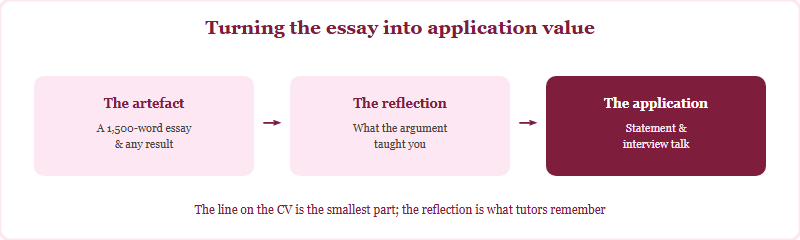
| A concrete artefact to discuss in a statement or interview | Speak for itself without your reflection on it |
How the award tiers translate into signal strength
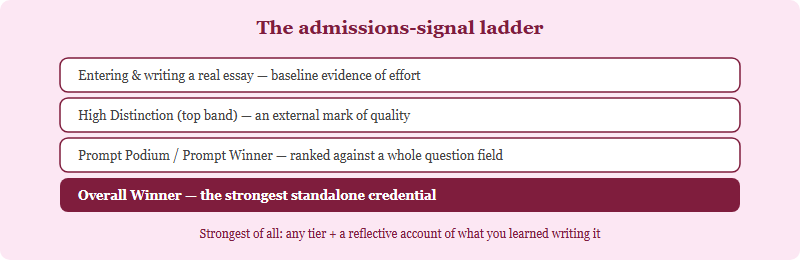
The competition’s awards run on a ladder, and each rung carries a slightly different weight on an application. Understanding the structure helps you set realistic expectations rather than treating “winning” as binary.
| Award tier | Roughly who earns it | Reward |
|---|---|---|
| High Distinction | Top 5–10% of entries | Certificate |
| Prompt Podium | Three per question | Certificate |
| Prompt Winner | One per question | Certificate + £50 |
| Overall Winner | One overall | Certificate + £100 |
| LSE Offer Holder Winner | Best entrant holding an LSE offer | Certificate + £100 |
Two honest observations. First, even a High Distinction — a certificate with no cash — is a meaningful line, because it places you in the top tenth of a large international field. Second, the monetary prizes are modest (£50–£100); nobody should enter for the money. The currency that matters here is the credibility of the result and the essay itself, not the cash. We cover the tiers in more depth in the 2026 prompts, rubric and awards guide.
Why the rubric is the real admissions lesson
Here is the under-appreciated point: the skills the competition rewards are the same skills selective economics admissions reward. The 100-point rubric weights originality of argument most heavily and pure topic-relevance least — which is a near-perfect rehearsal for the kind of independent thinking a university wants to see. A student who internalises “originality scores 25 and relevance scores 5” is learning to prize fresh analysis over restating textbook content, and that habit shows up later in interviews and supplemental essays.
In other words, the deepest admissions benefit is not the certificate — it is what writing the essay teaches you about constructing an economic argument. A student who can sit in an Oxbridge or LSE-style interview and discuss the trade-offs in their own essay is demonstrably more prepared than one who only revised past papers. To see how the marks break down, read our analysis of the 100-point rubric.

UK and US applications read it differently
Many China-based international-school students apply on both sides of the Atlantic, and the two systems weigh a competition essay in different ways. Understanding the difference helps you position it correctly rather than copy-pasting the same line into every application.
UK applications for economics and PPE are narrowly academic. A UCAS personal statement is supposed to be overwhelmingly about your subject, and admissions tutors at courses like LSE, Oxford PPE or Cambridge economics actively look for super-curricular work — independent reading, essays and competitions that show subject commitment beyond required coursework. In that context, a focused economics essay sits naturally in the statement and can be probed at interview. US applications are more holistic: an economics essay competition is one of many extracurricular and intellectual signals, and it competes for space with leadership, service and personal narrative. It still helps — it demonstrates intellectual initiative — but it carries proportionally less weight than in a UK-style academic statement.
| Dimension | UK (economics / PPE) | US (holistic) |
|---|---|---|
| Where it fits | Core of an academic personal statement | One of several intellectual signals |
| How it is tested | Often discussed at interview | Usually read, rarely interviewed on directly |
| Relative weight | High — super-curricular focus is expected | Moderate — balanced against the whole profile |
| Best framing | The economic argument you built | The initiative and curiosity it reflects |
The practical takeaway: for UK applications, lead with the substance of your argument; for US applications, frame it as evidence of intellectual drive and connect it to a broader story about how you think.
How to use the result honestly on an application
If you do earn a result, present it accurately. Overstating a credential is one of the fastest ways to lose a tutor’s trust. From our experience advising China-based students, these principles keep it honest and effective:
- Name it precisely. Call it the LSESU Economics Society Essay Competition and state your actual tier (for example, “High Distinction”). Do not imply it is an LSE university award or an offer of any kind.
- Lead with the thinking, not the trophy. A sentence on what your essay argued and what you learned is worth more than the award name on its own.
- Connect it to the course. Show how the topic links to why you want to study economics or PPE, not just that you entered a competition.
- Be ready to defend it. If you mention the essay, expect to discuss it. Know your argument’s weaknesses as well as its strengths.
- Don’t let it carry the application. It is one supporting signal among grades, tests and references — strong, but not load-bearing on its own.
There are a few specific over-claims that experienced tutors notice immediately, and each undermines trust in everything else you have written. Describing the competition as an “LSE award” or “LSE prize” implies a university endorsement that does not exist — it is a student-society competition. Listing “LSESU Essay Competition” with no tier invites the assumption that you merely entered, so if you earned High Distinction or a podium, say so plainly. And inflating the field size or your placement is risky, because a tutor who knows the competition can tell. Accurate, specific, modest language is not just more honest; it reads as more credible than vague superlatives.
And if you do not place? The essay still earned its keep. The research, the argument-building, and the discipline of finishing are exactly the capabilities a strong application demonstrates — with or without a certificate to show for it. In a personal statement you can legitimately write about an essay you entered even if it did not win, because the value to a tutor is the thinking you can demonstrate, not the rosette. A student who can explain a nuanced economic argument they developed independently is showing the precise quality selective courses screen for, regardless of the outcome.
A realistic verdict for China-based students
The LSESU Essay Competition is worth entering for a student genuinely interested in economics — not because it “gets you in,” but because it forces you to produce the kind of independent, well-argued work that good admissions outcomes are built on. Treat the result as supporting evidence and the writing process as the real prize, and you will use it far better than a student chasing a line for the CV. The honest framing is also the most persuasive one: tutors can tell the difference between a student who entered to learn and one who entered to decorate an application.
Frequently asked questions
Does winning the LSESU Essay Competition guarantee university admission?
No. It is a credible academic-interest signal and a useful artefact for your application, but it does not guarantee or materially decide any admission.
Is this an official LSE university award?
No. It is run by the LSESU Economics Society, a student society, not by LSE admissions. Describe it accurately and avoid implying an LSE endorsement.
Is a High Distinction worth mentioning if there is no prize money?
Yes. A High Distinction places you in roughly the top 5–10% of a large international field, which is a meaningful credential regardless of cash.
How do I write about it in a personal statement?
Name the competition precisely, state your tier, and focus on what your essay argued and what you learned — then link it to why you want to study the subject.
Published by the editorial desk of this site, operated independently by Hanlin International Education (翰林国际教育) for China-based international-school students. This site is not the official competition website and is not affiliated with the LSESU Economics Society or the London School of Economics. Official rules are set by the competition and change yearly, so always confirm current details on the official site lsesuesec.org. Confirmed errors are corrected within 7 working days.