Question 4 Deep-Dive: Van Reenen on Taxing the Top 1% (2026 LSESU Essay)
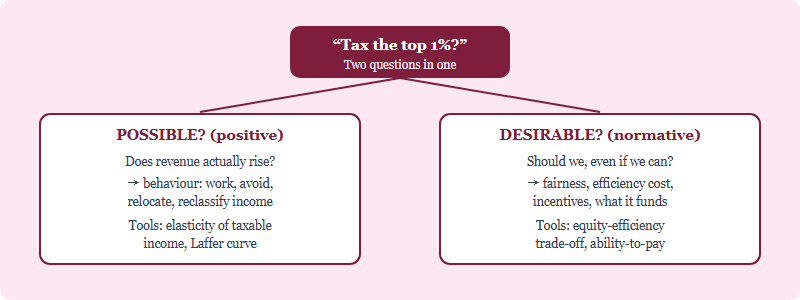
Question 4 of the 2026 LSESU Economics Society Essay Competition, set under Prof. John Van Reenen's taxation-and-fairness theme, asks whether it is possible and desirable to raise taxation on the top 1%. The winning move is to notice the question contains two separate questions — a positive one about how much extra revenue is actually collectable, and a normative one about whether we should — and to answer both without letting one collapse into the other.
The question, in plain terms
As published by the LSESU Economics Society, Question 4 reads, in essence: “Is it possible and desirable to raise taxation on the top 1%?” (confirm the exact current wording on the official site before you write). The prompt was set by Prof. John Van Reenen, the Ronald Coase Chair in Economics and a School Professor at LSE, who directs the Programme on Innovation and Diffusion and whose research centres on the causes and consequences of technological and managerial innovation in the labour market.
Two words do the heavy lifting, and most weak essays only see one of them:
- “Possible” is a positive, empirical question. If you raise the top rate, does revenue actually go up — or do the very rich work less, avoid, relocate, or reclassify income so that the tax base shrinks? This is about behaviour and arithmetic.
- “Desirable” is a normative, ethical question. Even if extra revenue is collectable, should we take it? That turns on fairness, efficiency, incentives to innovate, and what the money would fund.
If your essay would read identically whether the question said “possible” or “desirable,” you have answered half of it. The examiners weight Argument & Originality at 25 of 100 marks — the single largest criterion — and separating these two strands cleanly is one of the fastest ways to signal economic maturity.
The economics you must show you understand
You do not need a public-finance degree, but three ideas will carry the “possible” half of the essay. Show the examiner you can use them:
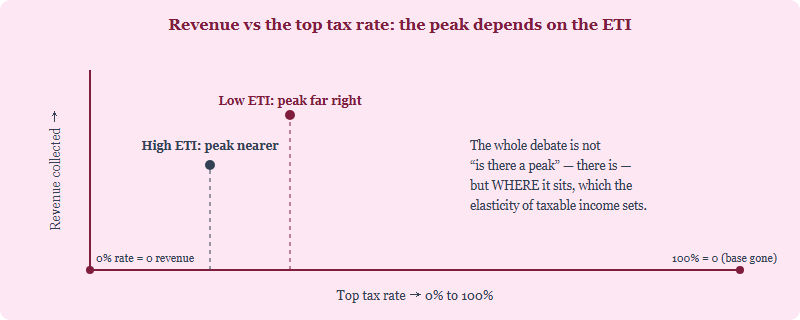
- The elasticity of taxable income (ETI). This is the single most important concept for this question. It measures how much reported taxable income falls when the after-tax share of an extra pound falls — capturing not just working less, but avoidance, timing, and reclassifying salary as capital gains. A high ETI means a rate rise raises little revenue because the base erodes; a low ETI means the rich absorb the tax and revenue climbs. The honest answer to “is it possible” is: it depends on the ETI, which depends on how easy avoidance is.
- The Laffer logic (used carefully). There is a top rate beyond which higher rates collect less because the base shrinks faster than the rate rises. This is not a claim that we are on the wrong side of the peak — treating the Laffer curve as proof that taxes are already too high is a classic weak move. Use it as a framing device: the revenue-maximising rate exists and depends on the ETI, so the real debate is where that peak sits.
- Real vs avoidance responses. A first-rate essay separates two very different reactions. If the rich genuinely produce less (fewer hours, less entrepreneurship), that is a real efficiency cost society bears. If they merely shuffle income into lower-taxed forms or offshore it, that is an avoidance response — and it can be attacked by broadening the base and closing loopholes rather than by abandoning the rate rise. This distinction is where strong candidates pull ahead.
- The equity–efficiency trade-off. The normative core. Higher top taxes can reduce inequality and fund public goods (equity), but may blunt incentives to invest, innovate, and take risk (efficiency). Naming this trade-off explicitly, then taking a side, reads as far more advanced than asserting that taxing the rich is simply fair or simply harmful.
For a refresher on how these criteria are scored, our breakdown of the 100-point rubric shows exactly why demonstrating a mechanism beats listing facts.
How to structure the answer
Because the prompt is a genuine two-part question, the cleanest structure answers each part in turn, then resolves them. A workable skeleton for roughly 1,500 words:
| Section | Job it does | Rough words |
|---|---|---|
| Frame | State the thesis; flag that “possible” and “desirable” are distinct questions you will answer separately | 200 |
| Is it possible? | Use the ETI and Laffer logic; separate real responses from avoidance; conclude how much revenue is realistically collectable | 450 |
| Is it desirable? | Weigh the equity–efficiency trade-off; consider innovation incentives, fairness, and the value of what the revenue funds | 450 |
| Resolve & recommend | Bring the two strands together into one defensible stance (e.g. base-broadening over a headline-rate spike) | 250 |
| Counter & risks | Answer the strongest objection; note what evidence would change your mind | 150 |
The idea that lets you sound like a real economist here is that “how you raise it” matters as much as “whether you raise it.” A crude rise in the headline top rate faces a high ETI because the wealthy have the most avoidance options. But raising effective taxes on the top 1% by broadening the base — taxing capital gains closer to income, closing loopholes, tightening trusts — faces a much lower ETI, because there is less room to escape. A sophisticated essay can argue that raising taxation on the top 1% is more “possible” through the base than through the rate.

What a 25/25 argument does that a weak one doesn't
Essays on Question 4 fail in a handful of predictable ways. Knowing them is the quickest route to a higher mark:
- The slogan. “The rich should pay their fair share” — or its mirror, “taxing success punishes hard work.” Both answer “desirable” with an assertion and ignore “possible” entirely.
- Treating the Laffer curve as a verdict. Claiming higher taxes “always” cut revenue misreads the theory. The curve says a peak exists; it does not tell you which side we are on.
- Merging the two questions. Answering only whether it is fair (and forgetting the arithmetic of collectability), or only whether revenue rises (and forgetting the ethics), throws away half the marks.
- Ignoring avoidance. The most sophisticated single point available is that the top 1% respond partly by avoidance, which policy can attack directly — so “the rich will just leave” is an argument for base-broadening, not for surrender.
Originality here does not mean a new theory of taxation. It means a crisp, defensible thesis — for instance, “raising taxation on the top 1% is possible and desirable, but chiefly through a broader base rather than a higher headline rate, because avoidance makes the rate response elastic while the base response is not” — argued consistently from the ETI upward.
Where the evidence marks come from
Evidence & Examples is worth 15 marks, and Critical Analysis another 15 — nearly a third of the paper — so an argument without evidence caps out fast. For a top-1% tax essay, the credible evidence sits in four buckets. You do not need to memorise figures; you need to know where the debate lives and to cite responsibly:
- Historical rate changes. The twentieth century ran a natural experiment: top marginal rates in the UK and US were far higher mid-century than today, then fell sharply. Discussing what happened to reported top incomes and revenue around those changes is strong material — provided you present it as contested, not settled.
- Estimates of the elasticity of taxable income. Economists have tried to measure the ETI directly, and the honest headline is that estimates vary widely and depend on the setting and on how much avoidance is possible. Citing that the ETI is uncertain and context-dependent is more sophisticated than quoting one number as if it were a law of nature.
- Mobility and the “millionaire migration” question. A common objection is that the rich simply leave. The empirical literature on whether top earners actually relocate in response to tax is a live debate — use it to test, rather than assume, the mobility claim.
- Composition of top incomes. Whether the top 1% earn mostly salary or mostly capital income matters enormously, because capital is taxed differently and is easier to shift. Pointing out that “the top 1%” is not one homogeneous group is an easy way to add analytical depth.
The examiners also value Citations & Sources (10 marks) and Harvard-style referencing. When you draw on the debates above, attribute them and note their uncertainty — a hedged, well-sourced claim scores better than a bold, unsupported one, and it protects you against the charge of cherry-picking.
An illustrative outline (build your own — don't copy)
To show what “taking a side” looks like, here is one illustrative thesis and spine. It is deliberately skeletal so you write your own argument; examiners run AI and plagiarism checks and screen for originality, so a copied structure helps no one:
- Thesis: It is both possible and desirable to raise taxation on the top 1% — but the effective route is base-broadening (capital gains, loopholes, trusts) rather than a dramatic rise in the headline income-tax rate.
- Support 1 (possible): The ETI is high for the headline rate but far lower for the base; therefore revenue is genuinely collectable if you close escape routes.
- Support 2 (desirable): The equity gain and the public goods funded outweigh the efficiency cost, provided real (not avoidance) responses stay modest.
- Counter-argument you must answer: Mobility and innovation incentives — if top talent and firms relocate, both revenue and long-run growth suffer; respond with why base measures are harder to escape than rates.
Once you have your spine, our companion guides on what the LSESU Essay Competition is and the 2026 prompts and rubric will help you turn it into a scoring entry.
Frequently asked questions
Do I need A-level economics to answer Question 4?
No. Grasp one idea — that a rate rise changes behaviour, so revenue is not automatic — and reason from it. Clear logic beats jargon every time.
Should I argue for or against taxing the top 1%?
Either can score 25/25. What matters is answering both “possible” and “desirable,” using the elasticity idea, and defending your stance consistently.
Is the Laffer curve enough on its own?
No. It shows a revenue peak exists but not where it lies. Pair it with the elasticity of taxable income and the real-versus-avoidance distinction.
How long should the essay be?
Up to 1,500 words, answering exactly one of the five set questions. Confirm the current word limit and the 1 September deadline on the official site before you submit.
Published by the editorial desk of this site, operated independently by Hanlin International Education (翰林国际教育) for China-based international-school students. This site is not the official competition website and is not affiliated with the LSESU Economics Society or the London School of Economics. Official rules are set by the competition and change yearly, so always confirm current details on the official site lsesuesec.org. Confirmed errors are corrected within 7 working days.