Which of the 5 LSESU Essay Questions Should You Choose? A 2026 Decision Guide
The 2026 LSESU Economics Society Essay Competition sets five questions, and you answer exactly one. That first decision quietly shapes your whole result: pick a prompt that matches your evidence, your background, and your tolerance for competition, and the essay writes itself more smoothly. This guide gives you a four-test framework to choose well — and a candid look at each of the five 2026 prompts.
Why the choice matters more than students think
Because each entrant submits a single essay against a single question, your prompt is not just a topic — it is the terrain you compete on. Two facts make the decision strategic:
- Prizes are awarded per question and overall. The published structure includes a “Prompt Winner” and a “Prompt Podium” for each question, alongside a single Overall Winner across all prompts. That means your realistic first target — placing on your question's podium — depends on how strong the field is on that specific prompt, not just how strong you are. Always confirm the current award tiers on the official site, since they change yearly.
- The rubric is identical across all five questions. Every prompt is marked out of 100 on the same criteria — Argument & Originality (25), Application of Economic Theories (20), Evidence & Examples (15), Critical Analysis (15), Structure & Clarity (10), Citations & Sources (10), Topic Relevance (5). So the “easiest” question is simply the one where you can most easily hit those criteria. Our breakdown of the 100-point rubric explains each in detail.
In short: choose the question where you can produce the most original, best-evidenced argument — not the one that sounds most impressive, and not the one everyone else will crowd onto.
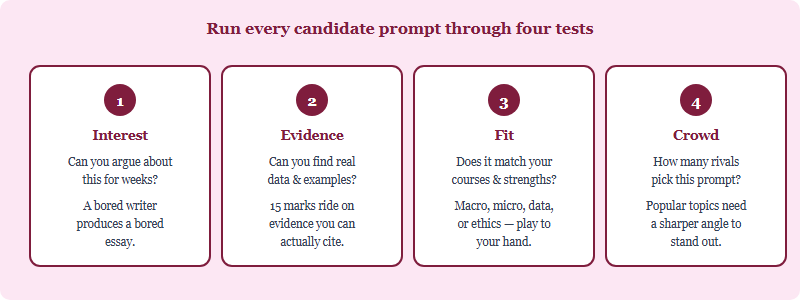
The four tests, applied
Score each prompt you are considering from 1 to 5 on each test, then add them up. The highest total wins — but treat Test 2 (evidence) as a veto: if you cannot find data and examples to cite, the 15 evidence marks and much of the 15 analysis marks are out of reach, no matter how interesting the topic.
- Genuine interest. You will live with this question through drafting and revision. A prompt you find dull produces flat prose that examiners notice. Pick the argument you actually want to make.
- Evidence availability. Can you name three concrete pieces of evidence — a dataset, a policy episode, a real-world example — today? If not, the question is high-risk. See our guide on the 2026 prompts and rubric for what “evidence” the markers reward.
- Background fit. A macro-heavy prompt suits a student comfortable with inflation and central banks; a data-and-fairness prompt suits one who likes distributional analysis. Play to the economics you already know.
- Competition density. Some questions attract far more entries (topical, headline-friendly ones), so the podium bar is higher. A less obvious prompt, answered sharply, can be an easier route to a per-question prize — provided you still pass Tests 1–3.

The five 2026 questions, sized up
Here is a candid profile of each 2026 prompt to speed up your four-test scoring. Question wording below is summarised; confirm the exact phrasing on the official site before you commit.
| Q | Set by | Theme (summary) | Best suited to a student who… | Watch out for |
|---|---|---|---|---|
| Q1 | Pissarides | Motivating & monitoring remote workers | likes labour economics, management, incentives; enjoys applied micro | staying analytical, not writing an HR opinion piece |
| Q2 | Reis | Monetary policy after a UK energy price shock | is comfortable with inflation, interest rates, central banks (macro) | the highest technical bar; needs a clear supply-shock grasp |
| Q3 | Tenreyro | Limiting inequality if AI cuts jobs | likes technology, labour markets, and policy design | very popular — expect a crowded, AI-hyped field |
| Q4 | Van Reenen | Taxing the top 1% — possible and desirable? | enjoys public finance, data, and the ethics of fairness | must answer both “possible” and “desirable” |
| Q5 | Gmeiner | Green technology and the distribution of wealth | likes environmental economics and distributional thinking | resist listing technologies; keep it about who gains/loses |
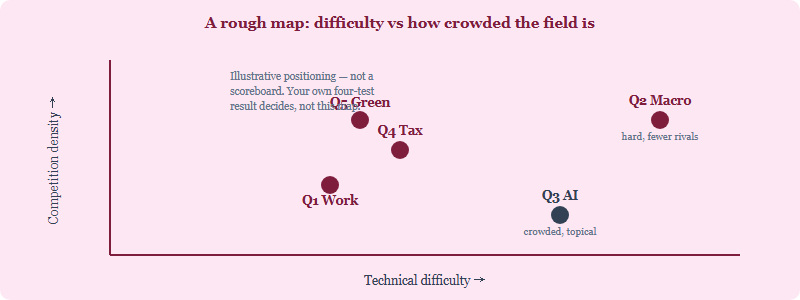
A useful pattern emerges. Q2 has the highest technical ceiling — rewarding for confident macro students, punishing for the unprepared. Q3 is likely the most crowded, because AI is the topic of the moment, so it needs the sharpest original angle to stand out. Q1, Q4, and Q5 sit in a productive middle: rich enough for a strong argument, but less mobbed, which can make the per-question podium more reachable if your evidence is solid. None of this overrides your own four-test scores — a crowded question you can answer brilliantly still beats a quiet one you find dull.
For worked, question-specific method, see our deep-dives on the individual prompts — they show exactly what a 25/25 argument looks like on each theme.
How to lock in your choice (and when to switch)
Turn the framework into a decision in three sittings:
- Shortlist two, not one. After four-test scoring, keep your top two prompts. Committing to a single question too early is how students discover, three weeks in, that the evidence isn't there.
- Run a one-hour evidence probe on each. For both shortlisted prompts, spend an hour trying to gather three citable pieces of evidence and one defensible thesis sentence. Whichever prompt yields a sharper thesis and stronger evidence is your answer.
- Then commit — and stop second-guessing. Switching questions after you have a working draft usually costs more than it gains. A good essay on your second-choice prompt beats an abandoned draft on your first.
One rule overrides all of the above: because examiners run AI and plagiarism checks and weight originality at 25 marks, never choose a question because a model answer or template exists for it. The prompt where your own argument is strongest is always the right one. For the full picture of what the competition is and how entries are judged, start with our guide on what the LSESU Essay Competition is.
Three choosing mistakes we see every year
Working with China-based students on economics essays, the same three selection errors surface again and again — and all three are avoidable before you write a single paragraph:
- Choosing the “most prestigious” question. Students gravitate to the macro or AI prompt because it sounds serious, then stall when the technical demands outrun their coursework. There are no bonus marks for a harder question — the rubric is identical — so difficulty you cannot handle is pure downside. Prestige is not a test on the framework for a reason.
- Choosing the question a friend or template already “solved.” If a model structure is circulating for one prompt, that prompt becomes both crowded and dangerous: originality is 25 marks, and AI and plagiarism checks flag recycled arguments. A question where you have to think from scratch is safer than one where a ready answer tempts you.
- Choosing by topic, not by thesis. “I like AI” is not a reason to pick Question 3; “I have a specific, defensible argument about AI and inequality” is. Liking a subject and having something to argue about it are different things, and only the second wins marks.
The through-line is that a good choice is made argument-first. Before you commit, you should be able to finish this sentence for your chosen prompt: “My essay will argue that…” If you cannot — if all you have is a topic you find interesting — keep probing your shortlist until a real thesis appears. A student who enters with a sentence like that already has the spine of a 25/25 argument; a student who enters with only a topic is still searching for one on deadline day.
One more practical note for international applicants: none of the five questions is UK-specific in a way you cannot handle from abroad. Question 2 mentions the Bank of England and Question 4 touches UK-style tax debates, but the underlying economics — supply shocks, the elasticity of taxable income, distributional channels — is universal. Do not rule a prompt out simply because it names a British institution; rule it out only if you cannot build an argument and find evidence for it.
Frequently asked questions
Can I answer more than one question?
No. You submit one essay answering exactly one of the five set questions. Choosing well is therefore a real strategic decision — confirm entry rules on the official site.
Is the “easiest” question the same for everyone?
No. The rubric is identical across prompts, so the easiest question is simply the one where you have the strongest argument and the best evidence to cite.
Should I avoid popular questions like the AI one?
Not automatically. A crowded prompt you can answer brilliantly beats a quiet one you find dull — but on popular topics you need a sharper, more original angle to stand out.
When is the deadline I'm choosing against?
Entries are due 1 September 2026 at 23:59 (GMT+1), with no late submissions. Always confirm the current deadline and rules on the official site before you commit.
Published by the editorial desk of this site, operated independently by Hanlin International Education (翰林国际教育) for China-based international-school students. This site is not the official competition website and is not affiliated with the LSESU Economics Society or the London School of Economics. Official rules are set by the competition and change yearly, so always confirm current details on the official site lsesuesec.org. Confirmed errors are corrected within 7 working days.